Frederick B. Hodges, former commanding general of U.S. Army-Europe, claimed last month that Ukraine’s forces would soon slow Russia’s advance and, the New York Timesreported, begin “to roll back its gains by late summer.” Hodges said his confidence was based on his belief that “the Ukrainian logistical situation getting better each week while the Russian logistical situation will slowly degrade.”
Such claims, however, are in contradiction to observable reality on the battlefield – and continue a disturbing, decades-long trend of poor and misleading advice given by America’s top military officers.
Listening over the past four months to what America’s retired generals and admirals have said on TV, one would be forgiven for believing that Ukraine is winning its war with Russia, that Putin’s troops and leaders are incompetent, and that soon Ukrainian troops will begin rolling the Russians back.
Such belief, however, would be badly misplaced, as substantial evidence indicates virtually the opposite.
A Rosy Look at the Brutal Battle in Ukraine
Rosy, optimistic – and inaccurate – assessments from U.S. flag officers have unfortunately become the norm over the past few decades. While some current and former generals give excellent and accurate assessments, there are far too many that don’t. The consequence to American policy has often been severe. It is time to reassess how much credibility we should place with American generals and admirals.
As I have chronicled on these pages, the conditions and military fundamentals clearly evident for years have strongly suggested that Ukraine could not win a war with Russia, and that both Kyiv and Washington should have made different policy choices based on that reality, both before and since Russia’s illegal invasion. But as graphically detailed below, active and retired flag officers have continually claimed that – ignoring clear evidence to the contrary – Ukraine has a chance to win the war.
Encouraging Ukraine to Keep Up the Fight
Such unwarranted assertions have led policymakers and the American public to believe, improperly, that we should continue encouraging Ukraine to maintain its fight against Russia. American official policy has been to provide Kyiv with substantial armaments to defend itself and overwhelming emotional support.
If the generals were right, if Ukraine were indeed close to winning the war, and if the aid we have offered could tip the scales in Kyiv’s favor, then our policy might make sense. But it doesn’t. Ukraine isn’t winning the war and isn’t even close to parity, much less superiority, to Russian forces.
In my most recent piece at 19FortyFive, I detail many of the practical, military reasons Ukraine is losing the war and is likely to continue losing. In my assessment, if Kyiv continues refusing to seek a negotiated settlement with Russia – something that is understandably repugnant to many Ukrainian citizens and government – they are in danger not merely of sliding into a long-term stalemate, but of outright losing the war.
I do not hesitate to admit that I can’t guarantee an outcome in this war. There are too many variables and information I don’t have, and do not have access to the secret council of either the Russian or Ukrainian general staff, or that of the western NATO leaders. A number of things could change the dynamics and trajectory of the war, which are not publicly known. Of course events that have yet to happen could result in major course changes.
But as I have laid out in detail, the current trends and military fundamentals reveal Ukraine is unquestionably losing this war. For the conditions to change dramatically enough to make an eventual Ukrainian military victory possible, as many generals continue to claim, would require a radical shift from today’s realities. Beyond mere rhetoric, there is no evidence such a radical shift is forthcoming. It is therefore irresponsible, I argue, to tell the American people that the desired outcome is possible when all evidence screams that it’s not – and downright cruel to the Ukrainian Armed Forces and civilian population, to foster a belief that they have a chance.
Should Washington Change Course?
To have the best chance to protect America’s vital national interests and save as many Ukrainian people as possible from being killed, Washington must change course and begin to form policy based on a frank and honest assessment of the combat, economic, and diplomatic realities of this war. It will be hard to get to that rational place, however, unless we first recognize the consistently rosy pictures painted by America’s flag officers over the past few decades have been atrocious.
My 21 years of active service in the U.S. Army, including four combat deployments, has put me in a position to personally observe many of the mistakes and bad judgments of both active and retired generals. The cumulative result of their frequently flawed advice has been uniformly bad for our country, resulting in some of the worst military and foreign policy decisions our country has made.
Whether it was routine claims, made over a 20-year period, of success in the Afghan War when events conclusively proved it was always a disastrous failure, or perpetual claims of success during and after the 2003 Iraq war – before the Iraqi Security Forces the U.S. trained melted away at the first contact with the Islamic State – senior American military leaders have consistently misled the American public on the true state of affairs.
Since virtually the beginning of the Ukraine-Russian war, American active and retired generals have consistently claimed that Russian troops were incompetent, that their troops were ill-disciplined, arrogant, unmotivated, and sometimes rebelled against their leaders and refused to fight. The Russians, many generals claimed, could not win, with Gen. Hodges claiming that Ukraine would begin rolling back Putin’s troops before the end of this summer.
It is appropriate, in light of the awful record active and retired general officers have amassed over the past few decades, that both the media and public should give more scrutiny to future claims made by generals. It is understandable why many would give blanket trust to the word of a senior commander: they typically have 30-plus years of experience and have served at the highest levels. But evidence confirms that this trust has been misplaced and it is up to the generals to earn that trust back. Telling the truth and giving honest assessments would be a good place to start.
Now a 1945 Contributing Editor, Daniel L. Davis is a Senior Fellow for Defense Priorities and a former Lt. Col. in the U.S. Army who deployed into combat zones four times. He is the author of “The Eleventh Hour in 2020 America.” Follow him @DanielLDavis.
Obvious examples of Central Intelligence Agency covert action abroad are difficult to identify today, save for occasional acknowledged calamities, such as the long-running $1 billion effort to overthrow the government of Syria, via funding, training and arming barbarous jihadist groups.
In part, this stems from many of the CIA’s traditional responsibilities and activities being farmed out to “overt” organizations, most significantly the National Endowment for Democracy (NED).
Founded in November 1983, then-CIA director William Casey was at the heart of NED’s creation. He sought to construct a public mechanism to support opposition groups, activist movements and media outlets overseas that would engage in propaganda and political activism to disrupt, destabilize, and ultimately displace ‘enemy’ regimes. Subterfuge with a human face, to coin a phrase.
Underlining the Endowment’s insidious true nature, in a 1991 Washington Post article boasting of its prowess in overthrowing Communism in Eastern Europe, senior NED official Allen Weinstein acknowledged, “a lot of what we do today was done covertly 25 years ago by the CIA.”
It Begins
Fast forward to September 2013, and Carl Gershman, NED chief from its launch until summer 2021, authored an op-ed for The Washington Post, outlining how his organization was hard at work wresting countries in Russia’s near abroad – the constellation of former Soviet republics and Warsaw Pact states – away from Moscow’s orbit.
Along the way, he described Ukraine as “the biggest prize” in the region, suggesting Kiev joining Europe would “accelerate the demise” of Russian President Vladimir Putin. Six months later, Ukraine’s elected president Viktor Yanukovych was ousted in a violent coup.
Writing in Consortium News earlier that month, investigative legend Robert Parry recorded how, over the previous year, NED had funded 65 projects in Ukraine totaling over $20 million. This amounted to what the late journalist dubbed “a shadow political structure of media and activist groups that could be deployed to stir up unrest when the Ukrainian government didn’t act as desired.”
NED’s pivotal role in unseating Yanukovych can be considered beyond dispute, an unambiguous matter of record – yet not only is this never acknowledged in the mainstream press, but Western journalists aggressively rubbish the idea, viciously attacking those few who dare challenge the established orthodoxy of US innocence.
As if to assist in this deceit, NED has removed many entries from its website in the years since the coup, which amply underline its role in Yanukovych’s overthrow.
For example, on February 3rd 2014, less than three weeks before police withdrew from Kiev, effectively handing the city to armed protesters and prompting Yanukovych to flee the country, NED convened an event, Ukraine’s lessons learned: from the Orange Revolution to the Euromaidan.
Alongside him was Nadia Diuk, NED’s then-senior adviser for Europe and Eurasia, and graduate of St. Antony’s College Oxford, a renowned recruiting pool for British intelligence founded by former spies. Just before her death in January 2019, she was bestowed the Order of Princess Olga, one of Kiev’s highest honors, a particularly palpable example of the intimate, enduring ties between NED and the Ukrainian government.
While the event’s online listing remains extant today, linked supporting documents – including Powerpoint slides that accompanied Leshchenko’s talk, and a summary of “event highlights” – have been deleted.
What prompted the purge isn’t clear, although it could well be significant that Leshchenko’s talk offered a clear blueprint for guaranteeing the failure of 2004’s Orange Revolution – another NED-orchestrated putsch – wasn’t repeated, and the country remained captured by Western financial, political and ideological interests post-Maidan. It was a roadmap NED subsequently followed to the letter.
Along the way, Leshchenko specifically highlighted the importance of funding NGOs, exploiting the internet and social media as “alternative [sources] of information,” and the danger of “unreformed state television.”
So it was that on March 19th, representatives of the far-right Svoboda party – which has been linked to a false flag massacre of protesters on February 20th, an event that made the downfall of Yanukovych’s government a fait accompli – broke into the office of Oleksandr Panteleymonov, chief of Ukraine’s state broadcaster, and beat him over the head until he signed a resignation letter.
That shocking incident, motivated by the station broadcasting a Kremlin ceremony at which Vladimir Putin signed a bill formalizing Crimea as part of Russia, was one of many livestreamed by protesters that traveled far and wide online.
The brutal defenestration of Ukraine’s state TV chief notwithstanding, much of this livestreamed output served to present foreign audiences with a highly romantic narrative on the demonstrations, and their participants, which bore little or no relation to reality.
The Revolution Will Be Televised
Writing in NED’s quarterly academic publication Journal of Democracyin July that year, Leshchenko discussed in detail the media’s role in the Maidan coup’s success, drawing particular attention to the fundamental role of “online journalist” Mustafa Nayyem.
He kickstarted the protests the previous November, rallying hundreds of his Facebook followers to protest in Kiev’s Independence – now Maidan – Square, after Yanukovych scrapped the Ukrainian-European Association Agreement in favor of a more agreeable deal with Moscow.
Nayyem was no ordinary “online journalist”. In October 2012, he was one of six Ukrainians whisked to Washington DC by Meridian International, a State Department-connected organization that identifies and grooms future overseas leaders, to “observe and experience” that year’s Presidential election.
Funded by the US embassy in Kiev, over 10 days they “[gained] a deeper understanding of the American electoral process,” meeting candidates and election officials, and touring voting facilities. They were also invited to discuss “Ukraine’s progress towards a more fair and transparent election process” with “equally curious” representatives of US government agencies.
With whom the sextet met is unstated, although promotional pictures show Nayyem filming a personal summit with John McCain on his smartphone. The video was posted to his personal YouTube channel – in it, Nayyem asks the noted warhawk for his thoughts on Ukraine, to which he responds, “I’m concerned with the influence of Russia.”
This is striking, for McCain flew to Kiev in December 2013 to give an address to Maidan protesters, flanked by known Neo-Nazi Oleh Tyahnybok. Then-State Department official Victoria Nuland, notoriously handing out motivational cookies to attendees.
On February 4th 2014, one day after Leshchenko’s NED presentation, an intercepted recording of a telephone call between Nuland – now Under Secretary of State for Political Affairs – and US Ambassador to Ukraine Geoffrey Pyatt was leaked, in which the pair discussed how Washington was “midwifing” Yanukovych’s ouster, and named several handpicked individuals to head the post-coup government.
Whether Nayyem’s influential US contacts in any way motivated his decision to ignite the Maidan demonstrations in November 2013 isn’t certain. The pivotal part he played in promoting the protests globally is far clearer, for he was a key founder of digital broadcaster Hromadske TV.
In his Journal of Democracy article, Leshchenko records how Hromadske hadn’t even officially launched when it began streaming Maidan demonstrations live, the literal second they erupted at Nayyem’s direction.
While Leshchenko coyly states that Hromadske “drew most of its modest funding from international organizations and the donations of Ukrainian citizens,” it actually received hundreds of thousands of dollars in financing from a variety of questionable sources, including the US Embassy in Ukraine, intelligence front USAID, George Soros’ International Renaissance Foundation, American oligarch Pierre Omidyar, and – of course – NED.
Hromadske’s audience expanded rapidly both within and without Ukraine thereafter, its embedded output eagerly recycled by countless mainstream news outlets, meaning Western viewers were presented with a single, partisan perspective on the unrest – and a highly misleading one at that.
Based on Hromadske’s coverage, overseas onlookers would’ve been entirely forgiven for concluding the protests were wholly energized by concerns over human rights and democracy, and overwhelmingly – if not universally – popular.
In a representative February 2014 essay dismissing as Russian propaganda the demonstrable fact that both the Maidan demonstrators and their leadership were riddled with neo-Nazis, academic and Journal of Democracy contributor Andreas Umland boldly declared that “the movement as a whole…reflects the entire Ukrainian population, young and old.”
Nothing could’ve been further from the truth. An extraordinarily revealing Washington Post op-ed by North American academics Keith Darden and Lucan Way published that same month detonated that narrative, which has nonetheless only endured – and intensified – ever since.
The pair forensically exposed how less than 20 percent of protesters professed to be driven by “violations of democracy or the threat of dictatorship,” only 40 – 45 percent of Ukrainains were in favor of European integration, Yanukovych remained “the most popular political figure in the country,” and no poll conducted to date had ever indicated majority support for the uprising.
In fact, “quite large majorities oppose the takeover of regional governments by the opposition,” and the population remained bitterly divided on the future of Ukraine, Darden and Way wrote. Such hostility stemmed from “anti-Russian rhetoric and the iconography of western Ukrainian nationalism,” rife among the demonstrators, “not [playing] well among the Ukrainian majority.”
Of the 50 percent of Ukraine’s population residing in regions that had “strongly identified with Russia” for over two centuries, “nearly all [were] alienated by anti-Russian rhetoric and symbols.”
“Anti-Russian forms of Ukrainian nationalism expressed on the Maidan are certainly not representative of the general view of Ukrainians. Electoral support for these views and for the political parties who espouse them has always been limited,” Darden and Way concluded. “Their presence and influence in the protest movement far outstrip their role in Ukrainian politics and their support barely extends geographically beyond a few Western provinces.”
‘Pro-Ukrainian Agenda’
Despite – or perhaps because of – such slanted coverage, Hromadske only grew from strength to strength subsequently. Such was its surging popularity, Leshchenko records, even Ukraine’s state broadcaster “struck a deal” to amplify its output, “thus handing this small ‘garage’ webcasting enterprise an audience of millions.” In the process, Ukrainians – and the world – were well-educated in the false narrative of Yanukovych being overthrown via popular will.
Hromadske’s potential to influence perceptions was evidently not lost on other Western governments either. In 2015, the British Foreign Office provided significant funds to develop “radio broadcasting” initiatives in the Russian-majority regions of Donetsk and Luhansk, for a project dubbed “Donbas calling”. The next year, London proferred more sums to the outlet, so it could serve as a local “information provider” to an “audience of up to one million people.”
In 2017, Hromadske again received hundreds of thousands of pounds to expand even further into the breakaway regions. Among other things, Britain supported the installation “of 16 FM transmitters in Ukraine-controlled areas along the contact line and ‘grey zone’ in the east,” meaning the station could reach up to two million citizens potentially possessed of separatist perspectives.
The public profiles of Leshchenko and Nayyem concurrently rose exponentially too. In Ukraine’s October 2014 elections, both were elected to parliament as part of Petro Poroshenko’s bloc, the former becoming a member of its anti-corruption committee, the latter its cross-party group on European integration, leading to glowing profiles in the Western media. All along, NED closely monitored their progress, hailing the pair as emblems of the new, liberated Ukraine that flowered in the wake of Maidan.
Nonetheless, Leshchenko’s personal commitment to democracy was rather undermined in August 2016, when he and Artem Sytnyk, head of Kiev’s National Anti-Corruption Bureau, leaked documents – dubbed the “the black ledger” – identifying payments to Donald Trump’s then-campaign manager Paul Manafort from Yanukovych’s Party of Regions, to the US media.
Leshchenko expressed his “hope” that the disclosure would damage Trump’s electoral chances and would be “the last nail in Manafort’s coffin lid,” as “a Trump presidency would change the pro-Ukrainian agenda in American foreign policy.” He was one of several prominent politicians in Kiev “involved to an unprecedented degree in trying to weaken the Trump bandwagon,” as the Atlantic Council, NATO’s propaganda arm, conceded at the time.
Manafort duly resigned, and the RussiaGate racket erupted – a connivance that went some way to ensuring the “pro-Ukrainian agenda in American foreign policy” wasn’t compromised one iota.
Indeed, Trump’s term in office was typified by ever-escalating hostility between Washington and Moscow, the Oval Office resident going to dangerous lengths his predecessor had consistently refrained from to arm and galvanize the most reactionary and violent elements of the Ukrainian armed forces, including the notorious Neo-Nazi Azov Battalion, and tear up Cold War arms control treaties, much to Moscow’s chagrin.
In December 2018, a Ukrainian court ruled that Leshchenko and Sytnyk’s release of the “black ledger” was illegal, amounting to “interference in the electoral processes of the US” that “harmed the interests of Ukraine as a state.”
In May the next year, a corruption probe was launched after Leshchenko purchased a $300,000 apartment in central Kiev, a sum far in excess of his apparent means. Two months later, he was voted out of parliamentc, Zelensky’s Servant of the People party candidate taking his seat in a landslide. His friend and collaborator Nayyem simply opted not to stand, in order to seek a government post “connected to the Donbas.”
Despite no longer being part of the legislature, Leshchenko has continued to wield significant sway over the Ukrainian government, directly advising Zelensky on “Russian disinformation” to this day.
What direct influence NED still exerts over him – and Ukraine’s President by extension – isn’t certain. Although, mere days before the Russian invasion began, in an interview with The Guardian, Leshchenko referred to the Minsk Accords – which Zelensky stood on a specific platform of implementing – as “toxic”, suggesting the leader would “betray” his country by adhering to their obligations, which included granting autonomy to Donetsk and Luhansk.
This reflects NED’s position – on February 14th this year, its Journal of Democracy published an article declaring the Accords to be “a bad idea for the West and a serious threat to Ukrainian democracy and stability,” not least because they would mean “tacitly accepting Russia’s false narratives about the Donbas conflict” – namely, that the conflict “was caused by the West-orchestrated ‘coup’ in 2014.”
In other words, an objective analysis of what actually happened and why, in which NED is completely central. Still, the organization didn’t need to rely purely on Leshchenko to keep the Minsk Accords moribund. Its extensive network of assets in the country, and Washington’s dark alliance with Ukraine’s far-right, was more than sufficient to ensure that Zelensky’s overwhelmingly popular mission of restoring relations with Russia would and could never be fulfilled.
‘In Solidarity’
In the hours following Russia’s invasion of Ukraine, NED hurried to remove any and all trace of its funding for organizations in Ukraine from its website.
A search of the NED grants database today for Ukraine returns “no results,” but a snapshot of the page captured February 25th reveals that since 2014, a total of 334 projects in the country have been awarded a staggering $22.4 million. By NED President Duane Wilson’s reckoning, Kiev is the organization’s fourth-largest funding recipient worldwide.
An archive of NED funding in Ukraine over 2021 – which has now been replaced with a statement “in solidarity” with Kiev – offers extensive detail on the precise projects backed by the CIA front over that pivotal 12-month period.
It points to a preponderant focus on purported Russian misdeeds in eastern Ukraine. One grant, of $58,000, was provided to the NGO Truth Hounds to “monitor, document, and spotlight human rights violations” and “war crimes” in the Donetsk and Luhansk regions.
Another, of $48,000, was provided to Ukraine’s War Childhood Museum to “educate the Ukrainian public about the consequences of the war through a series of public events.” Yet another received by charity East-SOS aimed to “raise public awareness” of “Russia’s policies of persecution and colonization in the region, and document illustrative cases,” its findings circulated to the UN Human Rights Council, European Courts of Human Rights, and International Court of Justice.
There was no suggestion this wellspring would be used to document any abuses by Ukrainian government forces. UN research indicates 2018 – 2021, over 80 percent of civilian casualties were recorded on the Donbas side. Meanwhile, Organization for Security and Cooperation in Europe reports show that shelling of civilian areas in the breakaway regions intensified dramatically in the weeks leading up to February 24th, potentially the precursor of a full-blown military offensive.
As such, NED’s expurgation of records exposing its role in fomenting and precipitating the horror now unfolding in southeast Ukraine not only protects de facto CIA agents on the ground. It also reinforces and legitimizes the Biden administration’s sprawling, fraudulent narrative, endlessly and uncritically reiterated in Western media, that Russia’s invasion was entirely unprovoked and groundless.
Ukrainians now live with the mephitic legacy of that reckless, unadmitted meddling in the most brutal manner imaginable. They may well do so for many years to come. Meanwhile, the men and women who orchestrated it rest comfortably in Washington DC, insulated from any scrutiny or consequence whatsoever, every day cooking up fresh schemes to undermine and topple troublesome foreign leaders, hailed as champions of liberty by the mainstream press every step of the way.
In May, when the Biden administration announced that it would send medium-range missile guided missile launchers to Ukraine, the White House insisted that the weapons would not be used to attack Russian territory.
“We’re not going to send to Ukraine rocket systems that strike into Russia,” Biden told reporters. “We are not encouraging or enabling Ukraine to strike beyond its borders,” he later added in a New York Times op-ed announcing the deployment of HIMARs missile systems to Ukraine.
On Friday, however, a Pentagon spokesperson indicated that the United States would not discourage Ukraine from using US weapons to attack territory claimed by Russia.
Asked by a reporter whether there were any “preclusions” on what could be targeted by US-supplied weapons, and whether the Kerch bridge in the Black Sea would be “precluded as a potential target,” the defense department official stated, “there aren’t any preclusions that I’m aware of about the Ukrainians fighting on their sovereign territory against Russia.”
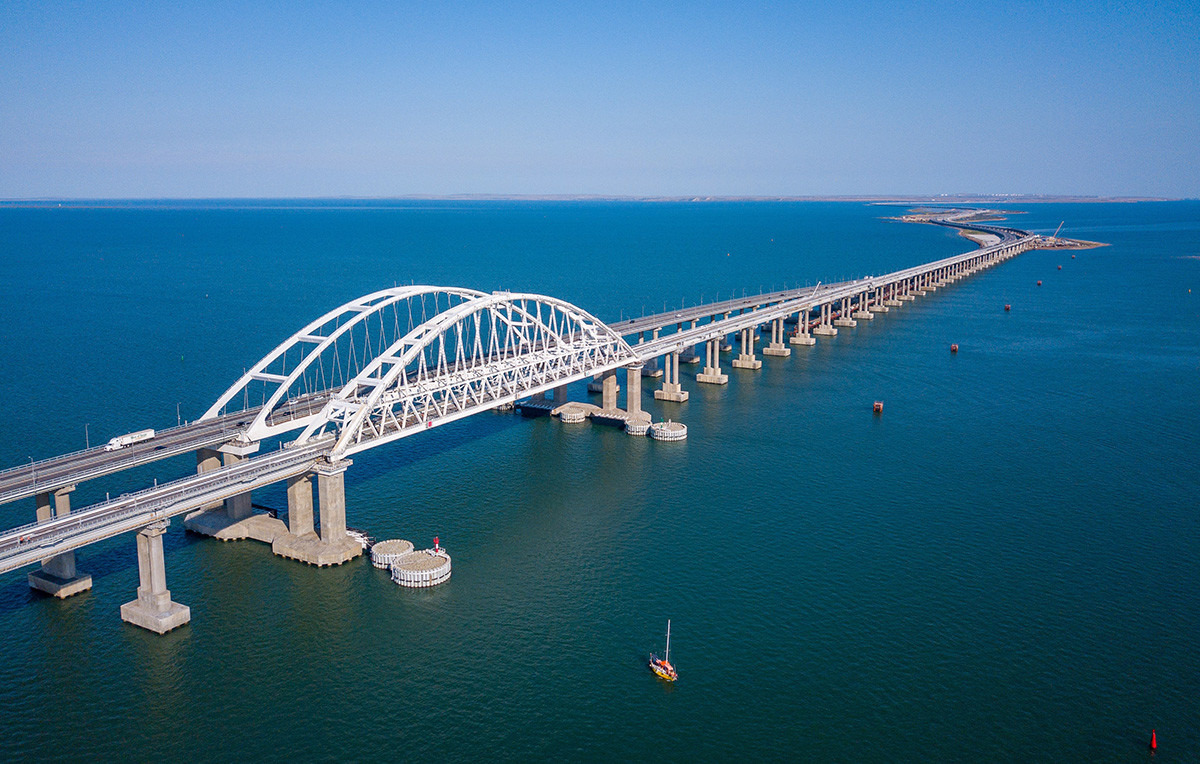
The Kerch bridge was built by Russia in 2015-2018 and forms the main connection between Russia and the Crimean peninsula, which Russia annexed in the wake of the US- and EU-backed coup in Kiev in 2014. The statement by the US defense official suggesting that the bridge constitutes Ukraine’s “sovereign territory” is yet another expression of the US endorsement of Ukraine’s aim, openly adopted as military strategy in 2021, to retake Crimea by military means.
The statements by the US official can only be interpreted as a green light for Kiev to attack the Kerch bridge and constitute a significant provocation. They came just one day after Philip Breedlove, the former NATO supreme allied commander in Europe, declared, “the Kerch bridge is a legitimate target.”
Speaking to the British Independent, Breedlove said that “Several people I have spoken to say ‘dropping’ [destroying] Kerch bridge would be a huge blow to Russia. Kerch bridge is a legitimate target.”
Breedlove continued, “But if they wanted to drop the bridge, that would require a more dedicated bombing operation.”
He added, “I hear a lot of people asking whether it is right for Ukraine to take such aggressive action and whether the West would support it, but I cannot understand that argument.”
Breedlove indicated that such an attack on Russian territory could involve the use of US harpoon missiles, which are capable of attacking land targets despite being primarily known as a naval weapon.
Friday’s briefing by the Pentagon, which went largely unreported in the press, was also shockingly blunt about the extent to which the United States systematically worked to prepare its Ukrainian proxy for war with Russia over the course of years.
The United States first initiated a training program for Ukraine in 2015 — yes, 2015 — on helping Ukraine with its capacity to man, train, equip, deploy and sustain combat arms units. It is this background that’s important for understanding how early in the war, Ukraine was able to face a larger, more capable Russian force, able to stay nimble, empower subordinates, achieve commendable successes, already be trained on certain capabilities that the United States as well as other countries had provided — notably Javelins but not only Javelins — and therefore, Russia was walking into a battle back in February with a far more capable military than it expected and that it — it had frankly faced back in 2014.
The defense official added,
And what we saw in Ukraine’s successful fighting off of the initial attack was that the years of training, equipping and advising, coupled with the surge of key capabilities such as 11,000 anti-armor and almost 1,500 anti-air weapons just in those first weeks, along with critical intelligence sharing, enabled the Ukrainian Armed Forces to successfully defend Kyiv and force the Russians to pull back and reassess their battlefield objectives and their approach.
While the US arming of Ukraine occurred over the span of years, the defense officials made clear that US involvement in the war would continue for years into the future. The US is “thinking about Ukraine’s needs over months and years,” the defense official said.
These statements were accompanied by the announcement of yet another $400 million in weapons sales to Ukraine, including the deployment of four more HIMARS medium-range missile systems to the country, bringing the total to twelve.
These statements were made against the backdrop of the G20 Summit, in which the United States categorically ruled out any bilateral discussions for bringing the war to an end.
Asked whether Secretary of State Anthony Blinken would meet with Russian foreign minister Sergei Lavrov, State Department spokesman Ned Price gave a categorical no, saying, “We would like to have the Russians give us a reason to meet on a bilateral basis with them… But the only thing we have seen emanate from Moscow is more brutality and aggression against the people and country of Ukraine.”
As in every war, the goals of the combatants are becoming increasingly clear as time passes. Despite what the US calls “tactical” setbacks, the United States plans to surge weapons and troops into the country in order to bleed Russia dry and to enable Ukraine to eventually mount a counteroffensive, with Crimea constituting a central target. As far as the ruling class is concerned, this war, which has already claimed the lives of tens of thousands, will last, in the words of Joe Biden, “as long as it takes” to achieve these goals.
Major attacks on Russian territory, such as the destruction of the Kerch bridge, would constitute a qualitative escalation of the war. The enormous risks of such an action were spelled out in an op-ed published earlier this year in the Financial Times by Malcolm Chambers entitled, “Crimea could be Putin’s tipping point in a game of nuclear chicken.”
In the absence of a ceasefire… Ukrainian forces will be keen to prevent Crimea becoming a sanctuary from which the Kremlin can resupply its forces in the rest of Ukraine… The Kerch bridge could be a tempting prize.
If attacks on these targets were perceived as precursors to a full-scale Crimean invasion, they could increase the risk of nuclear escalation. This is one of the most concerning scenarios. Putin was at pains to emphasise this risk in the months before the invasion.
Putin’s spurious nuclear threats of recent months have begun to lose their potency. In order to be credible, Russia would have to make explicit that an invasion of Crimea constituted a red line. Faced with losing Crimea, Putin might consider this a worthwhile gamble, believing Ukraine (with western encouragement) would blink first. This would be a moment of extreme peril.
As Chambers makes clear, an attack on the Kerch bridge would massively expand the possibility for the war to spiral into a nuclear showdown with unfathomable consequences. The fact that the Pentagon has publicly refused to preclude such an action makes clear the utter recklessness and desperation guiding US policymakers.
Chinese president Xi and Russian president Putin. Photo courtesy of The Asia Today.
The Global Times is considered to be an official mouthpiece of the Chinese government. What’s reported here seems to contradict western reporting about the extent to which China has supposedly held back on some of its trade with Russia post-2/24 for fear of provoking the imposition of secondary sanctions from the west. – Natylie
Many Chinese products, particularly value-added consumer goods, such as mobile phones, cars and printers have seen rapid growth in the Russian market, as local consumers switch to what they consider reliable and affordable products amid escalating tension between Russia and the West.
While some foreign media outlets have been hyping gains of Chinese companies in the Russian market as direct result of Western sanctions, Russian consumers and Chinese industry insiders argue that the growing popularity of Chinese products are the result of years of localization efforts, improving quality and affordability, though the sanctions also played a role.
Russia’s top electronics retailer M.Video-Eldorado said that “the total share of Chinese brands in the Russian market in terms of smartphone sales is steadily increasing – from 50 percent in the first quarter, to 60 percent in April to more than 70 percent in June,” Reuters reported last week.
Though foreign media reports have been focused on the West’s sanctions, Russian consumers said that the growing popularity of Chinese products in the country came long before the sanctions.
27-year-old Pasha, based in Moscow, the owner of an Honor 10 smartphone, told the Global Times that the bigger battery capacity and high quality camera are the main reasons he uses the Chinese brand. He also uses some other Chinese-related products, which he praised for their good quality and reasonable price.
Two other Russian consumers also said that they are using Xiaomi, because it’s practical and affordable and is one of the leading brands in the market.
In addition to mobile phones, Chinese car brands also witnessed a jump in popularity in Russia, with most US, European and Japanese car companies announcing the suspension of Russian production or halting exports to Russia.
According to a recent survey, 46 percent of respondents said they would buy a Chinese brand car, and 25 percent said they would be willing to consider a Chinese car without a European brand.
“One important reason for the higher consumer acceptance of Chinese brands is because of the advanced model configuration and control technology over the years,” Sun Xiaohong, secretary-general of the automobile branch of China Chamber of Commerce for Import and Export of Machinery and Electronic Products (CCCME), told the Global Times on Tuesday.
According to data from Autostat, a Russian auto industry analysis agency, sales of Chinese-branded sedans in Russia increased by about 30 percent from April to May.
Moreover, Western sanctions against Russia have also exposed the shortcomings of the Russian auto supply chain. Russia only produces about 35-37 percent of its auto parts by itself, with imported auto parts making up as much as 62.5-65 percent, data from CCCME shows.
Experts said this also highlights the needs for a complete and reliable supply chain, in which China has advantages. In recent years, Chinese automobiles have performed well in the Russian market, with the popularity of Great Wall, Chery, Geely and other brands continuing to expand, CCCME said.
“Russian car dealers are eager to establish and expand business cooperation these days… there will be more Chinese car brands entering the Russian market to gain market share, including new energy vehicles,” Sun said.
Wang Yu, a manager with the Russian Asian Union of Industrialists and Entrepreneurs, told the Global Times that he has received masses of inquiries about orders and cooperation from Russian companies seeking printers, whose supply has tightened due to Western sanctions on spare parts.
“One Russian company wants hundreds of thousands of printers all at once, and we have responded by coordinating with corresponding factories in China,” Wang said.
While there is the risk of being targeted by the West, industry insiders are confident that these risks can be minimized via highly self-dependent technology and complete supply chains, advantages that plants in China possess. “Unlike those Western brands, the after-sales service of Chinese brands can also be counted on,” Wang said.
While it is a normal market trend for Russian companies and consumers to rely on Chinese products in dealing with the supply chain disruption and lack of stock due to Western sanctions, Chinese companies should further actively adapt to the new market with better product and service quality in a bid to gain public recognition of their brands in the long-run, said Cui Hongjian, director of the Department of European Studies at the China Institute of International Studies, told the Global Times on Tuesday.
Meanwhile, as the late effects of Western sanctions on Russia emerges, including on its exports of technology and products, it cannot be ruled out that with the increasing demand from Russia and more Chinese companies entering the market, the US may further impose long-arm jurisdiction and sanctions on Chinese companies, experts said.
Chinese officials have repeatedly expressed opposition to the US’ unilateral sanctions and stated that China will continue to normal trade and economic cooperation with Russia.
Commenting on the recent US move to blacklist five Chinese companies for allegedly supporting Russia’s military, Zhao Lijian, a spokesperson for the Chinese Foreign Ministry, said that the US move has no basis in international law, nor is there a mandate of the UN Security Council allowing such moves.
Calling the move as another example of US unilateral sanctions and long-arm jurisdiction, Zhao vowed that “China will take all necessary measures to resolutely protect lawful rights and interests of Chinese companies.”
On July 1 at the White House, US President Joe Biden made a startling disclosure that “the idea we’re going to be able to click a switch, bring down the cost of gasoline, is not likely in the near term.”
American gas exporters have positioned themselves accordingly to fill the gap as Europe turns away from Russian imports. FT reported recently that “US liquefied natural gas producers have announced a string of deals to boost exports as the industry capitalises on shortages that have left Europe with a mounting energy crisis.”
The deals are so lucrative that Cheniere, America’s leading gas exporter, has taken an investment decision to push ahead with a project that will boost its capacity more than 20 per cent by late 2025, anticipating long-term supply deals and locked in purchases of US gas over the coming decades. The US producers of gas are reportedly running plants flat-out to increase supplies to the EU.
The US has overtaken Russia for the first time as Europe’s top gas supplier. Although LNG from the US is sold to Europe at much higher costs than pipeline gas from Russia, EU countries have no choice.
With Russian supply via Nord Stream at just 40% of capacity, and deliveries to be halted completely for annual maintenance on July 11-21, the outlook for near-term Russian gas supply to Europe appears bleak.
Germany has warned of the risk that Nord Stream gas may not return at all following the maintenance. At any rate, Russian supply to Europe is at record lows and is “set to remain constrained through the third quarter,” per S&P Global.
Germany is heading for a major economic crisis. The head of the German Federation of Trade Unions has been quoted as saying in the weekend, “Entire industries are in danger of collapsing forever because of the gas bottlenecks — especially, chemicals, glass-making, and aluminium industries, which are major suppliers to key automotive sector.” Massive unemployment is likely. When Germany sneezes, of course, Europe catches cold — not only the Eurozone but even post-Brexit Britain.
Welcome to the European Union’s “sanctions from hell.” The US literally hustled the Europeans into the Ukraine crisis. How many times did Secretary of State Antony Blinken travel to Europe in those critical months in the run-up to the Russian invasion of Ukraine to ensure that the door to any meaningful talks with the Kremlin remained shut! And American energy companies are today making windfall profits selling gas to Europeans. Won’t Europeans have the common intelligence to realise they have been had?
Now, Biden has washed his hands off the gas crisis. He brusquely stated at a press conference in Madrid on June 30 that such premium on oil prices will continue “as long as it takes, so Russia cannot, in fact, defeat Ukraine and move beyond Ukraine. This is a critical, critical position for the world. Here we are. Why do we have NATO?”
Biden’s counterfactual narrative is that the sanctions against Russia are going to work eventually and a long war in Ukraine would be Russia’s undoing. The US narrative is that if you look under the hood of the Russian economy, it may not be flexible and resourceful enough to develop an entrepreneurial bunker spirit and adopt new business models to neutralise the sanctions. Biden is convinced that Russian economy is in the grip of industrial mafias that are not very innovative and, therefore, there aren’t many options for Russia under the western sanctions.
Biden said in Madrid: “Look at the impact that the war on Ukraine has had on Russia… They’ve (Russians) lost 15 years of the gains they made in terms of their economy… They can’t even — you know, they’re having — they’re going to have trouble maintaining oil production because they don’t have the technology to do it. They need American technology. And they’re also in a simi- — similar situation in terms of their weapons systems and some of their military systems. So they’re paying a very, very heavy price for this.”
But even if that’s the case, how does all that help the Europeans? On the other hand, President Putin’s strategic calculations with respect to the war remain very much on track. Russian forces made indisputable progress in establishing full control over Luhansk. On Monday, Putin gave the green signal to a proposal from the army commanders to launch “offensive operations.” Five months into the war, Ukrainians are staring at defeat and Russian army generals know it.
Russia didn’t wander into Ukraine unprepared, either. Evidently, it took precautionary steps both before and since the war to shield its economy. And this enables the Russian economy to settle down to a “new normal”. Washington’s options are quite limited under the circumstances. Fundamentally, western sanctions do not address the causes of the Russian behaviour, and therefore, they are doomed to fail to solve the problem at hand.
To be sure, Putin has some nasty surprises in store for Biden closer to the November mid-term elections. Biden blithely assumes that he controls all the variables in the situation. Schadenfreude is never a rational basis for statecraft.
Yesterday, the strategically important Kherson region bordering Crimea formed a new government with the First Deputy Prime Minister of Russia’s Kaliningrad region heading the cabinet and Russian nationals among his deputies. Now that HIMARS multiple launch rocket system, contrary to Biden’s promise, is blasting Russian cities, expect some major Russian retaliation.
The pathway of Russia’s offensive operations is being relaid to include Kharkov and Odessa as well, apart from Donbass. The influential Kremlin politician and chairman of Duma Vyacheslav Volodin said on Tuesday,
“Some people are asking what our goal is and when all this will end. It will end when our peaceful cities and towns no longer come under shelling attacks. What they are doing is forcing our troops not to stop on the borders of the Lugansk and Donetsk republics (Donbass) because strikes (on Russian regions) are coming from the Kharkov regions and other regions of Ukraine.”
How long does Biden think the Europeans will want to be involved in a protracted proxy war with Russia? Bild reported on Sunday that 75% of German respondents see recent price hikes as a heavy burden, while 50% said they feel their economic conditions are worsening; every second German fears a lack of heating this coming winter due to reduced Russian gas supplies and rising inflation in the European Union.
Yet, Biden says war will go on “for as long as it takes” and fuel shortage will continue “for as long as it takes.” The European economy is expected to start contracting over the course of the second half of 2022 and the recession may continue until the summer of 2023 at least.
Analysts at JP Morgan Chase, the US investment bank, said last week that Russia could also cause “stratospheric” oil price increases if it used output cuts to retaliate. It said, “The tightness of the global oil market is on Russia’s side.” Analysts wrote that prices could more than triple to $380 a barrel if Russia cut production by 5m barrels a day.
Putin’s decree last week is ominous — the Kremlin taking full control of the Sakhalin-2 oil and gas project in Russia’s Far East. State-owned Gazprom held a 50% plus one share stake in the project and its foreign partners included Shell (27.5%), Mitsui (12.5%), and Mitsubishi (10%). The decree stipulates that Gazprom will keep its majority stake, but foreign investors must ask the Russian government for a stake in the newly created firm within one month or be dispossessed. The government will decide whether to approve any request.
An aerial view of the liquefaction plant, part of the Sakhalin-2 liquefied natural gas project in Sakhalin, Russia, described as one of the world’s largest integrated oil & gas project.
This will unsettle energy markets further and put more strain on the LNG market, and can be seen as a move to put more pressure on the West by concurrently restricting gas supplies to Europe and creating more demand for LNG in Asia that will draw off supplies currently going to Europe. Sakhalin-2 supplies circa 4% of the global LNG market!
The only part of the US agenda that is going well seems to be the unspoken part of it: the very same Anglo-American objectives that Lord Ismay once predicted as the rationale behind the NATO’s existence —”to keep the Russians out, the Americans in, and the Germans down.”