All posts by natyliesb

Transcript of Putin’s 7/7/22 Speech to Russian Parliament (breakdown of US-led world order, “let them try” to defeat us on the battlefield, etc.)

Meeting with State Duma leaders and party faction heads. Photo: RIA Novosti

Here is a full transcript of Putin’s speech before the Russian parliament on 7/7, which has received much attention. – Natylie

From Kremlin website, 7/7/22

At the Kremlin, in the St Catherine Hall, the President met with the leaders of the State Duma and the heads of party factions in the State Duma of the Federal Assembly of the Russian Federation.

The meeting was attended by State Duma deputy speakers Alexander Zhukov, Ivan Melnikov, Alexander Babakov, Alexei Gordeyev, Vladislav Davankov, Sholban Kara-ool, Anna Kuznetsova, Sergei Neverov, Pyotr Tolstoy, Boris Chernyshov and Irina Yarovaya; heads of political parties represented in the State Duma Vladimir Vasilyev (United Russia), Gennady Zyuganov (Communist Party of the Russian Federation), Sergei Mironov (A Just Russia – For Truth), Alexei Nechayev (New People), Leonid Slutsky (Liberal Democratic Party of Russia), as well as State Duma Speaker Vyacheslav Volodin, Chief of Staff of the Presidential Executive Office Anton Vaino and First Deputy Chief of Staff of the Presidential Executive Office Sergei Kiriyenko.

President of Russia Vladimir Putin: Good afternoon, colleagues, Mr Volodin.

The State Duma’s spring session ended yesterday, July 6, and all deputies – I want to emphasise this – all parties made a significant contribution to the overall results.

I believe the results of your work were dignified, important and significant for the people, the entire Russian state and for protecting our national interests and ensuring the sovereign, sustainable and effective development of the country.

This Duma session was rich in events and intense work and was very important given the scale and complexity of the tasks at hand. After February 24, when the special military operation began, all the country’s branches and levels of government needed to act decisively, as a team and quickly.

Today, I want to thank you for working like that: in a collected and competent manner and at a fast pace. I believe all parties have confirmed their political viability and maturity and acted in a consolidated and cohesive manner like true statesmen and patriots of Russia, for whom inter-party disagreements fade into the background in difficult conditions. We have many parties, but one Motherland, and there is nothing more important and loftier than the fate of the Fatherland.

You have passed many resolutions and laws that significantly strengthen our system of social support and provide additional protection for our people. This was not just about the advanced indexation of pensions, which is important, an increase in the subsistence level and the minimum wage – all this was done without bureaucratic red tape and delays, in a clear and professional manner; but it was also about new measures on support for families with children, the extension and expansion of the mechanism for subsidised mortgage loans and additional guarantees for our heroic military personnel. There were also many other important decisions – I will not list all of them now since you know them as well and probably better than I do, because you created them yourselves.

I would like to acknowledge and thank every parliamentary party for the organised humanitarian support of the people of Donbass. I am talking about all parliamentary parties because the media has covered this work in different ways, but I know from my reports that all of you have been taking an active part in this.

I know that many deputies have taken an official holiday and gone to the zone of hostilities in order to provide help personally, often at the real risk of their lives. They went to help organise the distribution of food, medications, and basic necessities and quickly set up humanitarian aid centres. Some of your colleagues are still there, working as volunteers. This proactive, selfless effort is truly vital and greatly needed.

I would like to mention separately that given the rapidly changing situation, the State Duma, in cooperation with the Government, continuously upgraded a series of measures to support the backbone sectors of the Russian economy and working teams of companies, including small and medium-sized businesses, the IT-industry and other vital areas.

As a result, we have managed to preserve macroeconomic stability, which is crucial for the economy, to support employment, the normal rhythm of retail trade and economic life in the regions in general, the main transport and logistics chains, to expand the freedom of entrepreneurship, and enhance protection of businesses from excessive administrative pressure and unjustified criminal prosecution. I know that much still needs to be done in this respect but overall, we have done a good job.

In a short time, as soon as in early March, several packages of anti-sanction measures were introduced in close contact with the Government. Thanks to these packages, the consequences of the Western countries’ unfriendly and clearly hostile actions were minimised. Indeed, we understand and know this, we see that these illegal measures against Russia are clearly creating difficulties for us, but not as great as the initiators of this economic blitzkrieg against Russia were counting on.

Clearly, they tried to do more than just hit the Russian economy hard. Their goal was to sow discord and confusion in our society and to demoralise people. But here too, they failed since nothing came of it, and I am sure nothing ever will.

In this regard, the example of the Russian parliament as the highest representative body is quite telling. The policy of the parliament is based on the will of the people of Russia, our firm position and conviction that we are on the right side of history, on the unwavering resolve of the vast majority of the country’s citizens to uphold Russia’s sovereignty and to help our people in Donbass. This is what underlies the policy of our state in general.

The so-called collective West led by the United States has been extremely aggressive towards Russia for decades. Our proposals to create a system of equal security in Europe have been rejected. Initiatives for cooperation on the issue of missile defence were rejected. Warnings about the unacceptability of NATO expansion, especially at the expense of the former republics of the Soviet Union, were ignored. Even the idea of Russia’s possible integration into this North Atlantic alliance at the stage of our, as it seemed then, cloudless relations with NATO, apparently, seemed absurd to its members.

Why? Just because they do not need a country like Russia, that is why. That is why they supported terrorism and separatism in Russia, and internal destructive forces and a ‘fifth column’ in our country. All of them are still receiving unconditional support from the collective West.

We are being told, we hear some people say that we started the war in Donbass, in Ukraine. No, the war was unleashed by the collective West, which organised and supported the unconstitutional armed coup in Ukraine in 2014, and then encouraged and justified genocide against the people of Donbass. The collective West is the direct instigator and the culprit of what is happening today.

If the West wanted to provoke a conflict in order to move on to a new stage in the fight against Russia and a new stage in containing our country, we can say that it has succeeded to a certain extent. A war was unleashed, and the sanctions were imposed. Under normal circumstances, it would probably be difficult to accomplish this.

But here is what I would you like to make clear. They should have realised that they would lose from the very beginning of our special military operation, because this operation also means the beginning of a radical breakdown of the US-style world order. This is the beginning of the transition from liberal-globalist American egocentrism to a truly multipolar world based not on self-serving rules made up by someone for their own needs, behind which there is nothing but striving for hegemony, not on hypocritical double standards, but on international law and the genuine sovereignty of nations and civilisations, on their will to live their historical destiny, with their own values and traditions, and to align cooperation on the basis of democracy, justice and equality.

Everyone should understand that this process cannot be stopped. The course of history is inexorable, and the collective West’s attempts to impose its new world order on the rest of the world are doomed.

At the same time, I want to say and emphasise that we have many supporters, including in the United States and Europe, and even more so on other continents and in other countries. And there will be more, no doubt about that.

To reiterate, even in the countries that are still satellites of the United States, there is a growing understanding that their ruling elites’ blind obedience to their overlord, as a rule, does not necessarily coincide with their national interests, and most often simply and even radically contradicts them. Eventually, everyone will have to face this growing sentiment in society.

Today, these ruling elites are raising the degree to which they manipulate the public consciousness right before our eyes. The ruling classes of the Western countries, which are supranational and globalist in nature, realised that their policies are increasingly detached from reality, common sense and the truth, and they have started resorting to openly despotic methods.

The West, which once declared such principles of democracy as freedom of speech, pluralism and respect for dissenting opinions, has now degenerated into the opposite: totalitarianism. This includes censorship, media bans, and the arbitrary treatment of journalists and public figures.

These kinds of prohibitions have been extended not only to the information space, but also to politics, culture, education, and art – to all spheres of public life in the Western countries. And, they are imposing this on the world; they are trying to impose this model, a model of totalitarian liberalism, including the notorious cancel culture of widespread bans.

However, the truth and reality is that the people in most of these countries do not want this life or this future, and really do not want the formal semblance of sovereignty, they want substantive, real sovereignty and are simply tired of kneeling, of humiliating themselves before those who consider themselves exceptional, and of serving their interests even to their own detriment.

Today we hear that they want to defeat us on the battlefield. Well, what can I say? Let them try. We have already heard a lot about the West wanting to fight us ”to the last Ukrainian.“ This is a tragedy for the Ukrainian people, but that seems to be where it is going. But everyone should know that, by and large, we have not started anything in earnest yet.

At the same time, we are not rejecting peace talks, but those who are rejecting them should know that the longer it goes on, the harder it will be for them to negotiate with us.

Colleagues,

Our patriotic state approach is fully reflected in the work of the State Duma; in fact, it determines the entire legislative and political agenda. This is the way it should be in a democratic and truly independent state.

I am convinced that for Russia’s leading parties, a concern for the good of our country and our people, for the people who voted for you, who entrusted you with the high status of lawmaker, and who expect honest, diligent service and the adoption of effective, fair and deeply thought-out legislative acts from a parliamentary body, has been and will remain paramount. It is the people who will give their unbiased assessment of each party, including during the next regional and municipal elections in September.

I hope that the election campaigns will not harm the approach of partnership that we see here in the eighth convocation of the State Duma.

Thank you very much for your attention.

Please, the floor is yours.

State Duma Speaker Vyacheslav Volodin: Mr President, colleagues.

Mr President, I would like to say thank you. Despite your busy schedule, you always give attention to the State Duma’s agenda and we can always discuss it with you, as we are doing today at this round table.

But I want to start – and I think my colleagues will support me – by saying thank you on behalf of all the deputies for your decision to recognise the independence of the Donetsk People’s Republic and the Lugansk People’s Republic, as well as your decision to launch the special military operation. We all believe that, if it had not been for those decisions, there would have been a humanitarian catastrophe and a huge number of people would have died.

And today, when we are talking about the work of the State Duma, we see it as our duty and priority to do all we can for our soldiers and officers, to provide their families with care, attention and, of course, create, within our capacities, a legislative framework to overcome the challenges that our country is facing.

As many as 11,160 sanctions have been imposed on Russia. No other state has ever faced so many challenges. Therefore, for us it is a moment of truth. We must see our work differently and, as you rightly said, today we have only one party, which is our country. The interests of the Motherland must be superior to any party programmes, and we aspire to achieve that.

Since January, we have adopted 361 new laws, 35 percent of which are of social significance. This is more than in previous years, despite the fact that, to act promptly, we had to hand over authority to the Government. We could not do otherwise in the current situation. The number of directly applicable laws is growing, as per your instruction to the State Duma. Today 63.4 percent of the laws that have been adopted are immediately applicable laws. Obviously, they deal with people’s problems more effectively.

Before they are adopted, the laws are open for discussion, as a measure to improve the quality of our decisions. Therefore, it is extremely important for us to ensure that the State Duma takes effective decisions that respond to the current developments.

The summer holidays will begin soon, and deputies will work in the regions. We plan to approach this in a different way than we did before. On the one hand, we will try to pay more attention to our voters by working in the regions and solving problems that people face. On the other hand, we will use this summer time to prepare for the autumn session and to work on draft laws on import substitution and the creation of new Russian technologies together with the Government.

And, of course, given the problems and the situation in our fraternal republics – Lugansk and Donetsk – and with regard to the requests made by our colleague deputies, we have agreed to help them with creating a legal framework to deal with the issues of healthcare, education and social protection.

They visited us several weeks ago and we discussed joint work within relevant committees so that such lawmaking assistance will be provided by creating model laws and harmonising legislation, so that they will have a legal framework to address these issues. So, this summer will be quite an important time for us.

We believe that it is necessary, in view of the current challenges, to restructure the way in which we work and we plan to start doing this, together with all parliamentary parties and relevant committees, when the deputies start working in the regions on Monday.

I want to thank you, Mr President, once again for all these decisions. We feel that there is dialogue and feedback. Your support is crucial for us.

Thank you.

Vladimir Putin: Thank you, Mr Volodin.

Please, Mr Zyuganov, the Communist Party of the Russian Federation.

Head of the CPRF faction Gennady Zyuganov: Mr President,

This Duma started its work by taking its cues from the address you gave here in the Kremlin Palace. I am focusing on your address because it contains five main goals that this country should achieve: first of all, to become one of the five most advanced countries – and we have the necessary wherewithal for that – then to stop depopulation and impoverishment and do whatever we can to acquire cutting-edge technologies.

But during four out of the past ten months, we have had to live with a military-political operation, which is crucial from every point of view. We fully support your decision to this effect, because what is at stake is the survival of the Russian world. We must stop US globalism, which is attempting to dictate its terms to the rest of the world. Moreover, we must do whatever we can to prevent Nazism and Banderaism from spreading across Europe.

Last time, when fascism and Nazism engulfed the whole of Europe, mankind paid the cost of 71 million lives, 27 million of which were the lives of the best sons and daughters of the great Soviet homeland.

I made it a point to visit the economic forum in St Petersburg, where I followed closely your remarks and jotted down 26 statements. I felt, perhaps for the first time, that we are on the same page for every issue you identified.

I noticed even earlier, when you were addressing the Valdai Club, that you said: Yes, capitalism is at a dead-end. Macron used even tougher language, saying that it [capitalism] has gone mad. We see it run mad in the citadel of capitalism, England, and we must do our utmost to prevent the people, who have not only gone mad but have also decided to continue dictating their terms, from igniting a great war.

In this connection, our team has drawn up a “victory programme”: 12 laws and a development budget. We did our best to formulate the key measures and show in practice that these problems can be successfully solved.

As for the military-political operation, we have always called for recognising the Donetsk and Lugansk people’s republics, Crimea and Sevastopol. I must inform you that the executive committee [of the movement] of left-wing patriotic forces held a meeting earlier today, and that each and every one of its 132 organisations across the planet, which celebrated, along with us, the anniversary of the Great October Revolution and are now preparing to celebrate the 100th anniversary of the USSR, all of them have supported our political line. We believe this is our common victory.

In fact, I have talked with you many times, and I am very glad that you have strengthened our eastern wing: your trip to Beijing and India, as well as constant consultations within BRICS and efforts to expand this organisation. This very powerful counterweight to the Anglo-Saxon idea of ​​crushing us and then dealing away with China is gaining more and more support. I am sure that if you prepare an executive order – I believe my colleagues in the State Duma will support us – we should celebrate the 100th anniversary of the formation of the USSR as a great national holiday, because then we fought the first battle against those aggressors who tried to enslave and destroy us.

It seems to me that today the tougher mobilisation of resources for implementing the programme you have outlined is an acute issue. We have all tools for this.

We have a well-developed programme for new industrialisation and innovations. I presented to you the programme of a new university created by Zhores Alferov, which today shows examples of how to train students of the future.

Now we were all watching your meeting with the future leaders. Look, what faces, what interesting young people, what glorious ideas they suggest! After all, they are born everywhere, and in this regard, we are ready to actively promote this idea in Novosibirsk, developing the second phase of Akademgorodok. You were there and authorised this. Our mayor, Anatoly Lokot, took up this idea. In our team, in our parliamentary party, every third person has a scientific degree, like Ivan Melnikov, and every second person in the party leadership does too.

The idea of creating our own cutting-edge technology has been supported greatly by Prime Minister Mikhail Mishustin. He has allocated an additional 100 billion for the development of electronics and robotics. And now the goal of developing domestic aviation is of special importance for us.

We also developed the New Virgin Lands programme, which you submitted to the State Council, and Vladimir Kashin together with Nikolai Kharitonov and Nikolai Kolomeitsev worked on this programme. Over the last two years, we have added 28 percent in agricultural machine-building. In fact, this happened after you gave a direct instruction to the Government at the State Council meeting. I believe that we can cope with this challenge very effectively.

I went to our famous Kirov Plant; Germans came to visit, too; they were gushing over how quickly we had localised production and started manufacturing modern high-class machines.

Tomorrow and the day after tomorrow, Tatarstan will hold a big festival celebrating friendship among nations. We took a public enterprise there, Kazankovskoye, similar to Pavel Grudinin’s Lenin State Farm. We will show 100 types of Russian-produced equipment and demonstrate how we can operate in modern conditions without driving up prices and still producing food products of a very high quality.

I believe that, if we could promote this idea nationwide and build at least one public enterprise in every district, we would be able to fill up our markets with affordable high-quality products, and food will be our priority and litmus test.

By the way, you set a goal of harvesting 130 million tonnes of grain this year. I believe this task is absolutely realistic, especially if my colleagues actively support the New Virgin Lands programme in the three-year budget that we are already working on.

And the new style and your idea: deadlocked? Capitalists are not only deadlocked. They are going mad. There is only one antidote because capitalism only creates Nazism, fascism and Bandera movements. Nothing but socialism can defeat it.

That is why I expect that in your next speech you will set socialist goals. I think even United Russia will support it. Vyacheslav Volodin is smiling, I can see he likes the idea. He chairs major hearings on the main issues at the State Duma. One of the recent ones was a brilliant session on education. We are ready to put our law on education into practice for everybody.

And look, you supported Andrei Klychkov to govern my home region, the Orel Region. Thank you, it is a matter of principle to me. My entire home region is scarred up. There are 800 mass graves; more than 400,000 of the best people are buried there who were breaking the back of the Nazi beast during the defence of Orel-Kursk.

This year, the Orel Region, which is not a black-earth area, will produce 6 tonnes of grain per capita. Six tonnes is the best harvest in our country. We have doubled the budget in Khakassia over the three years, the only Siberian region to do so. And even those who are called oligarchs are happy to pay taxes. They say they do not steal and instead do business, support people and lend a hand to children of war.

By the way, 44 regions have already adopted a law on children of war. I hope that you will support other regions as well. This issue has been around for a long time.

We will organise a Red Route in Ulyanovsk with our Chinese friends. They are holding their 20th congress this year and preparing a programme for the next 30 years. It will bring significant profit, 10–12 million. We are renovating the Lenin Memorial Museum there. There is also an excellent programme on advanced technology and aircraft engineering.

Our parliamentary party will therefore actively support all the main tasks in this context.

But above all else, we need to provide maximum support for the special military operation. We have sent 97 convoys, 15,000 tonnes of humanitarian aid to Donbass. We are helping the children to the greatest possible extent. We have accommodated 10,500 children at your business administration’s holiday hotel in Snegiri. We are now actively preparing another batch of aid. I should say that your Executive Office is hard at work there.

We have many interesting people there who have achieved a lot at production facilities, who are quite tough, and who are absolutely pro-Russian because the fight against Russophobia is becoming particularly topical nowadays. However, persons with anti-Soviet views are more Russophobic than the rest. I would like to ask you, and we have already stated this viewpoint: unfortunately, Russian culture and media outlets provide too much anti-Soviet information, and we need to stop this. It is a complete disgrace because humankind has no other experience except that of Russian-Soviet patriotism and victory over Nazism. We consider this to be highly important.

In this connection, I would like to ask you once again to revisit this note, including a pardon for some of our comrades who have been punished. I believe that this is illegal. Please tell us to reexamine this issue together with Mr Vaino and Mr Kiriyenko. We will find the relevant solutions that are now virtually available.

The consolidation of society and support is the main issue today. We will support your address and your policy to strengthen national security and unity in a joint fight against Nazism, the supporters of Bandera and American globalism. This is a matter of principle and our historical survival.

Thank you.

Vladimir Putin: Thank you very much.

I have no doubts that members of the Communist Party of the Russian Federation are sticking precisely to this position. Regarding the socialist idea, there is nothing bad about it. We should flesh out this idea, especially in the economic sphere. Some countries have given it substance, and this is linked with market regulation forms, etc. This idea is working quite effectively. We need to look into this.

Regarding the involvement of the state, the relevant debate focuses on the extent of such involvement and its forms. We should see how the state should regulate its economic activities. We will certainly address this during our discussions and debates. I assume that we will find these solutions, while realising that the interests of the people and the country are at stake.

Thank you very much.

Mr Slutsky, go ahead please.

Head of the Liberal-Democratic Party of Russia faction Leonid Slutsky: Mr President,

On April 6, our party the LDPR, the country and the entire Russian world sustained an irretrievable loss – the death of the founder and only leader the Liberal Democratic Party of Russia has had, Vladimir Zhirinovsky. Thank you very much for your condolences.

I am meeting you in a new position today for the first time. Thank you very much for your consent to a brief separate meeting. I will report to you on a consolidated request of the State Duma Speaker and all parliamentary parties’ leaders to honour the memory of Vladimir Zhirinovsky. We believe this is very important today for our society, for all those who remember Vladimir Zhirinovsky. He was a great figure and, as we are seeing, his forecasts and estimates are coming true and will continue coming true in the near future.

Thank you, Mr President, for your personal trust in appointing me one of the four negotiators on Ukraine. You repeated today what I have said more than once and mentioned recently to our counterparts in Kiev. It would seem we had come to terms on the entire humanitarian package, with the exception of a law on heroes – they wouldn’t give up on Bandera and Shukhevich. But unfortunately, they reverted back to their initial positions. I said more than once that it would be more difficult, much more difficult further on.

As for the LDPR, I am grateful for the support from 300,000 – in fact a bit more of our party members at the congress. The delegates in all branches voted unanimously for me as the Chairman of the party. This is an enormous responsibility.

For us, this session is very difficult but effective nonetheless. We submitted at it several dozen draft laws (some of them have already been passed): on the payment of the 13th pension to pensioners; the return of inflation-adjusted pensions for working pensioners; the increase of the minimum wage to 20,000 rubles; zero tax for individuals making under double the minimum wage; progressive taxation; reimbursement of half of all housing and utility fees for combat veterans, to name a few.

I must say that today is not the time for party differences. Today we must consolidate society and remove rather than draw dividing lines between political forces with a view to supporting the national economy and social obligations.

There is no doubt that sanctions and restrictions against us will stall. In fact, they have already stalled.

Two years ago, as Chair of the State Duma International Committee, I addressed the sensible politicians of the world urging them to abandon sanctions and restrictions as a crude practice, as something atavistic and archaic in modern politics. More than 60 national leaders responded, as well as UN Secretary-General António Guterres (he recently visited Moscow), with whom we are now actively discussing Ukraine, and they supported my statement. Now we see the opposite happening.

At the same time, you are absolutely right when you say that a reverse process is under way: European politicians, including the European parliament members, in almost every country with almost no exceptions (no exaggeration here), in Asia, Africa and Latin America, more and more politicians, public figures, representatives of academia and science are saying that the approaches used against Russia today are warped and threaten the stability of the global architecture that should have become stable and secure by now.

We proceed from our understanding that the world order must remain multipolar, as it was determined after World War II when the United Nations with its dominant role was established. At the same time, Washington keeps trying to break into the Security Council. Unfortunately, it has prevailed on a number of dossiers. I am certain that we will be able to achieve our goal with the colleagues who support us. That includes BRICS, the countries accounting for one-third of the world’s GDP. They are against a unipolar world where Washington can be the only pole of power. No matter how desperately our “strategic friends” in the West keep scrabbling, it will be in vain. In this context, I would like to support your statements.

LDPR, which includes people of different ages, faiths and walks of life, unanimously supported the special military operation in Ukraine. We send out big teams of volunteers. We also provide humanitarian assistance. I will report in more detail at a separate meeting. I should say that right now, there is nothing more important than helping these courageous people who, for eight years, have been the targets of bombs with “For the children of Donbass” written on them, solely because they wanted to remain part of the Russian world and continue to speak and teach their children in a language that had been a mother tongue to many generations before them.

Mr President, the ideas you put forward 10 years ago, in 2012, are more relevant today than ever. Vladimir Zhirinovsky repeatedly quoted them in his speeches. Back then, you came out with a major policy article “Russia and the Changing World” in which you said that we must increase our cultural and humanitarian presence around the world by orders of magnitude and increase it by an order of magnitude in places where they speak Russian or understand Russian. This has not been done in full yet.

Today, we are asking the Government to support, at a breakthrough level, relevant federal programmes to promote the Russian world and the Russian language as its cementing foundation. I am confident that we can make it work, even though we are moving towards this goal rather slowly. Given the circumstances, it makes sense, perhaps, to step up our efforts in this area.

In 2012, you came out with another major policy essay titled “Social Policy: Building Justice for Russia,” which we also supported back then and in subsequent years. There is an excellent section in it, “Preservation of Russia.” Mr President, you wrote that if our ethnic, migration and demographic policies remain sluggish, we – one-sixth of the planet’s land, but only 2 percent of the world’s population – we run the risk of becoming, I quote, “an empty space, the fate of which will be decided by someone else.” Of course, it will not be that way.

We need to take back thousands of people – this was mentioned during recent world congresses of our compatriots – who are registered with our foreign missions and are willing to come back. It is imperative to create clusters with excellent health care and education – we can afford it – with jobs and take our people back. This is the right time for doing so.

Now the spirit of St George’s Ribbon is simply flying in the air above the entire Russian world, no matter how far away people live from Moscow. It is necessary to support their desire to return home. To achieve this, we must take certain measures that were drafted long ago. It is simply necessary to strengthen relevant federal departments with state support mechanisms.

No war and no cutting-edge weapons can knock us down. I will say without excessive pathos that we are the most combat-ready power in the world. But we may be knocked down if the education of our youth is eroded.

We conducted a questionable experiment on ourselves with the Bologna education system in 1999. We adopted it quickly but now we have to quit very gradually.

Owing to Mr Volodin, our Speaker, we held fundamental parliamentary hearings. Rector of Moscow University Viktor Sadovnichy, our living legend, also took the floor. I have the honour to head as President the Faculty of Global Politics in his university as a public service.

I must say that we should consistently move in this direction and restore the world’s best educational system where representatives of political and business elites from over a hundred countries received their education.

This won’t take too much time. We started working towards this end and I would like to report to you on this and to ask for your support. Nothing is more important than the comprehensive education of our successors.

Thank you very much for your initiative and all-round support for the Sirius Centre. Now it is not just a centre but also Sirius Territory. But this is just a part of what should be done in this area.

We will work as the LDPR and its parliamentary party in close cooperation, as we are doing now, with other parties to resolve the issues on our current agenda. We will work intensively – this is all-important today – to enhance our national economy and the social sphere and implement our national projects.

To be continued.
Andrew Milburn: TIME IS NOT ON KYIV’S SIDE: TRAINING, WEAPONS, AND ATTRITION IN UKRAINE

ukrainian flag waving in wind with clear sky in background
Photo by Nati on Pexels.com

By Andrew Milburn, Modern War Institute at West Point, 6/27/22

Andrew Milburn retired from the Marine Corps as a colonel in 2019 after a thirty-one-year career. His last position in uniform was as deputy commander of Special Operations Command Central, and prior to that, commanding officer of the Marine Raider Regiment and Combined Special Operations Task Force–Iraq. He is the chief executive officer of the Mozart Group, an LLC training and equipping Ukrainian frontline units.

The battalion commander shrugged helplessly when we advised him that five days was a completely inadequate amount of time in which to train his soldiers. “This is all we have—they are needed on the front,” he replied with grim finality. A few days later, on a separate course that we were running for his medics, half of our class disappeared on the second day. “We have had casualties,” was the only explanation we received. Even in units that fall within the Ukrainian special operations command, most soldiers are sent to the front line with very little training. In one such unit, we estimated that just 20 percent had even fired a weapon before heading to combat.

On May 3, the Ukrainian parliament passed a law that allows territorial defense units—the country’s home guard—to be deployed to combat outside their home regions. These units are manned by local volunteers who typically have received very little preparation. We were soon swamped by requests for training courses. In the western Ukrainian city of Lviv, a town hall meeting to explain the new policy to local territorial defense volunteers was disrupted by wives alarmed at the prospect of their part-time soldier husbands deploying to the front.

Each anecdote by itself a data point, but together they tell a story that belies the relentless optimism that has pervaded Ukrainian representation of the war from the outset. After four months of grinding attrition, the Ukrainian army is facing a manpower shortage.

Every day in the current fighting, President Volodymyr Zelenskyy said earlier this month, around sixty to one hundred Ukrainian soldiers are killed and another five hundred wounded in combat. A more recent New York Times article puts that figure much higher—at one hundred to two hundred deaths a day. To put that in context, during the 1968 Tet offensive in Vietnam, one of the bloodiest periods of the war, US deaths were roughly two hundred a week—and among a force almost twice the size of the Ukrainian army.

Aside from Zelenskyy’s admission, the Ukrainian government has been largely reticent about releasing casualty figures and Western governments have offered few of their own assessments, but grim reports from the front line indicate that Ukrainian casualties are high—and perhaps in the long term unsustainable. “My friend’s son is in a company with just thirty soldiers left,” down from the 120 personnel typically in a company, one senior Ukrainian officer told me.

Every day last week, while evacuating civilians from areas in the east under bombardment by the Russians, as we drove to the front we passed a succession of ambulances going the other way. As they passed, my interpreter read aloud the signs displayed on their front bumpers: “three times 300s” or “four times 200s,” using the Ukrainian military terms for wounded and dead. By the end of the week, the figures in their aggregate, for just one section of the front we observed, seemed staggeringly high.

Of course, the Russians continue to take even higher casualties, but with their vastly greater pool of manpower, it is unlikely that these losses will have a significant impact—at least not in the short term.

And as news of the war slides from prominence in the news cycle, the way it is being fought has changed significantly. Ukraine’s troops now face a Russian force that has shifted strategy from the hasty, single-axis attacks that characterized the early weeks of the war. Now there are no more attempts at pincer movements but instead slow but inexorable advances, preceded by massive artillery bombardments—a few kilometers every day all along the front from Izyum in the north to Zaporizhzhia in the south, tightening the noose on a fragile Ukrainian salient protecting the road network that links Kyiv to the east.

In between artillery barrages, the Russians probe Ukrainian lines with small packets of armored vehicles accompanied by infantry and supported by vehicle-mounted heavy machine guns. All the while, artillery shells are launched at regular intervals in the general direction of Ukrainian forces and along their supply routes, a technique known in the US military as harassment and interdiction fire. The Russians are also practicing movement to contact—a form of reconnaissance in which the idea is to identify Ukrainian positions by drawing fire, thus enabling Russian artillery to pound new targets with precision.

Optimism in the Kremlin?

The Russian army now occupies an area comprising one-fifth of Ukraine’s total land mass—far more than it did at the outset of the war. President Vladimir Putin’s overall objective remains opaque. The low threshold for declaring victory is likely to be annexation of the entire Donbas region, a goal that Putin has almost accomplished, but with a recent resurgence in Russian confidence, that may not be enough to satisfy him.

Credible reports from Meduza, a Russian-language news site based in Latvia, indicate that Kyiv is back in the crosshairs and that there is now renewed support within the Kremlin for another onslaught on the capital. And there are reports of renewed military activity on the Russian side of the border to the north, the most likely origin of an assault on the capital. Our contacts with the Ukrainian military intelligence directorate tell us that Russian reconnaissance troops and private military contractors have been spotted on the Ukrainian side of the border. These may be indications of another attack on the capital, but a ground attack still appears unlikely. Taking Kyiv would involve a massive effort—probably more resources than Russia has at hand without resorting to general mobilization. But Putin has other options.

An advance to within artillery range would be sufficient to inflict severe punishment on the city, especially if combined with a determined effort to undermine Kyiv’s air defense system. “I have advised my wife that it is not safe to return to Kyiv,” one senior officer told me the other day. While those in the know are worried about this prospect, it’s hard to see any reflection of concern in the city itself. Every day, packed trains and buses return more of the population to their homes, and the capital is again a bustling city, with no resemblance to the ghost town it became in the early days of the war. Sirens still wail throughout the day but are universally ignored. Ironically, the impressive performance to date by Ukraine’s air defense system may have lulled the population into a false sense of security. But every air defense system, no matter how modern, is susceptible to a determined and well-planned effort to penetrate it, and Ukraine’s outdated S-300 is no exception.

A War of Endurance

Some might say that this commentary paints an overly gloomy picture for Ukraine—that game-changing weapons are on their way, and these will be enough to turn the tide. It is true that the US-made High Mobility Artillery Rocket System (HIMARS), already operating in Ukraine, is a formidable weapon and a welcome improvement on the Ukrainians’ over-used Soviet howitzers and even the recently supplied M777 lightweight 155-millimeter howitzer, whose deficiencies I have written about recently. Even lacking the long-range Army Tactical Missile System, HIMARS can bring accurate fires to bear at ranges exceeding forty miles within minutes of receiving data.

It will be weeks, however, before HIMARS is fielded in sufficient quantity to have a significant effect—maybe too late to reverse the Russian advance. The logistical exigencies of getting more into theater and then bringing Ukrainian artillery personnel to Germany or Poland for training stand in the way. Meanwhile the hemorrhage of casualties continues. And even when fielded, the HIMARS will not have the same effect for the Ukrainians as when employed by the US military, because of a shortfall in Ukrainian task organization. The tactical units we trained lacked forward observers, personnel trained to locate and report targets in a manner that can be rapidly transferred into firing data. The extremely centralized execution of artillery fire in the Ukrainian army makes for some effective fires for effect, such as the recent one that struck several Russian generals, but is not very responsive to the needs of frontline units.

The lack of forward observers may put the Ukrainians at a significant disadvantage, but the Ukrainians have on their side a strong affinity for drones and an intuitive understanding of their value in modern war. I have written previously of the requirement for long-range strike drones, loitering munitions with longer range and heavier payload than the Switchblade, and drones that can be used to deliver logistics. If Washington does provide strike drones, such as the MQ-1 Predator or even its longer-range successor, the MQ-9 Reaper, these platforms will doubtless come with the proviso that they must not be used to strike targets in Russia itself. Since launching such strikes is undoubtedly part of their plan, the Ukrainian military will have to look elsewhere for platforms that can be used for cross-border strikes on Russian reinforcements, supply chains, and infrastructure.

How Does This End?

If senior Ukrainian officers are to be believed, the war will not end with a ceasefire while Russian boots are on Ukrainian soil. They are determined not only to remove Putin’s gains since the beginning of the war in February, but also to recover areas of the Donbas that have been under de facto Russian control since 2014. Crimea, some Ukrainians admit, may prove to be a bridge too far, but many are determined that the threshold for Ukrainian victory must also include this region, the annexation of which eight years ago sparked the current period of enmity between the two countries.

The problem lies in squaring the wellspring of Ukrainian resolve with the military’s limited resources. Ukraine needs weapon systems that will give it a real edge over its adversary and help staunch the flow of casualties. Without this edge, no amount of determination and courage will be enough to avoid a prolonged war of attrition, and such a contest will favor the side with the greatest numbers. For Ukraine, the darkest days may be yet to come.

Der Spiegel: “Moscow Is Doing Far Better than Expected” How Well Are Sanctions Against Russia Working?

dirty vintage luck table
Photo by Rūdolfs Klintsons on Pexels.com

By Michael Sauga, Der Spiegel, 7/1/22

The chief strategist for Europe’s economic war against Russia isn’t much interested in military posturing. His uniform: gray sneakers and a blue business suit. His command center: a nondescript office on the 13th floor of the European Commission’s headquarters in Brussels with a conference table, houseplant and a cluttered display cabinet.

And if you ask him if he feels he’s the commander-in-chief in the EU conflict with Moscow, you’re likely to get a dismissive wave of the hand in response. “That’s not how the EU works,” he says. “My job is to probe and then work out compromises.”

From Economic Community to Security Alliance

Björn Seibert is one of those people in Brussels whose name is known by few but whose influence is enormous. The head of European Commission President Ursula von der Leyen’s cabinet has been coordinating European sanctions packages against Moscow for seven months. He benefits from being a trained security and military expert. As a young political scientist, he conducted research at the Army War College in Pennsylvania. He later headed the executive staff of the German Defense Ministry.

Will the West’s punitive actions go far enough to deprive Moscow’s war machine of its economic base? At what point will they start hurting Putin? “You can see some things right away,” the longtime Von der Leyen confidant says, matter-of-factly. “A lot of it doesn’t show up for weeks, months or even years.”

What is certain is that the policy of boycotts and embargoes has profoundly changed the union itself. The EU has adopted six sanctions packages since the Kremlin began rolling its tanks.

It has frozen the assets of more than 1,100 aids of Russian President Vladimir Putin and 30 oligarchs. Most Russian banks have been cut off from Europe’s financial markets. Coal from Siberia may no longer be imported, and jet engines or truffle butter can no longer be exported to Moscow or St. Petersburg. Nearly a hundred billion euros worth of trade goods are blocked in what officials at the European Commission now openly call the “militarization of export controls.”

What had once been envisioned as an economic community is transforming itself into a security alliance and is vigorously expanding its influence over the member states. In the course of its sanctions, the EU has enacted dozens of new laws, increased its staff and created a task force to track and confiscate Russian financial assets. “The Commission has cleverly used the situation to secure further powers for itself,” says one EU diplomat in Brussels.

Former U.S. Secretary of State Henry Kissinger once famously complained that Europe has no telephone number. But that’s a lament the White House would be unlikely to repeat today. When it comes to sanctions, the Americans first call the EU authorities in Brussels and only after that the individual nation-state governments in Berlin or Paris.

That’s also how things are supposed to work for future conflicts, including the confrontation with China. If the economic warriors in Washington and Brussels have their way, the Ukraine war will create the blueprint for the economic equivalent of NATO to deter aggressive autocrats.

The idea was born last November, when CIA Director Bill Burns made a surprise visit to Brussels. The intelligence chief had just come from Moscow, where he had solidified his belief that Putin was planning a large-scale invasion of Ukraine and that Kyiv would be a focus. A NATO military response was out of the question, so Western capitals agreed they would have to respond to the invasion with a hefty package of joint economic sanctions.

Because the United States had already scaled back its economic interactions with Russia following the 2014 Crimea occupation, Europe had to join in on the sanctions if Putin was going to be fazed in any way. Brussels, in turn, feared that the United States could unilaterally impose sanctions and, as in other cases, extend them to EU companies, without giving the Europeans any say in the matter.

The Kremlin Was Prepared

That had to be prevented. Seibert sat down with senior officials from his directorate generals for trade, finance and energy. The most important basis for their discussion were long lists of trade flows of thousands of goods, where and how they are produced and how they could be replaced if needed. The panel used those lists to make decisions on how to “impose high costs on Russia” and “minimize undesirable consequences for its own citizens and businesses.”

Experts with the same goal met in Washington, led by Deputy Secretary of State Wendy Sherman and Deputy National Security Adviser Daleep Singh, a former Goldman Sachs banker who had already worked on international financial policy in the Obama administration. U.S. officials had thick files on their desks tracing how sanctions had worked against Iran, against Russia in 2014 and against the Chinese telecom company Huawei.

But another thing also emerged from the intelligence analyses that Washington shared more freely than ever before with its allies: The Kremlin had apparently been preparing for the confrontation for a long time. Months earlier, Moscow’s energy companies had begun reducing the flow of natural gas to Europe, leaving storage facilities only fractionally full. Forecasts showed that the reserves wouldn’t suffice in the event of a cold winter.

Putin’s war chest was in good shape. His central bank head, Elvira Nabiullina, had begun stashing profits from Russia’s lucrative oil and gas operations in Western banks and central banks early on. The accounts held more than $300 billion, and the Russians assumed it was secure. After all, reserves held by monetary authorities have only been interfered with in extremely rare circumstances.

But the architects of Western sanctions weren’t terribly interested in precedent. Various analyses made clear where the West was strong and the Russians weak: in finance, dominated as it is by the U.S. dollar, and in the technology sector, which is largely controlled by American computer and software corporations. These are the areas that sanctions were to target.

As 2021 gave way to 2022, Singh and Seibert often spoke on the phone several times a day; and twice a week, the teams of experts in Washington and Brussels connected using a surveillance-proof video line. By the end of January, weeks before Putin’s invasion, they had laid out the broad outlines of their sanctions regime, which could be adapted to five different war scenarios. The greater Putin’s escalation, the principle went, the harsher the response should be.

At the same time, the planners needed the OK from EU member states, so Seibert brought their Brussels ambassadors into the loop in a series of secret group meetings in January and February. He always assembled the rounds in such a way that there were enough representatives from Eastern Europe to promote a decisive course against Putin.

The sanctions themselves were much less controversial than the question of the conditions under which they should be applied. Most diplomats considered the scenario of a major invasion as described by intelligence reports to be a bluff. If the invasion was limited to the Donbas region, officials considered an even milder response to be a possibility.

The West Had To Move Quickly

Once Putin directed huge numbers of his troops to march on Kyiv, sanctions planners in Brussels and Washington “only had to press the play button,” as they put it. Under the shock of Russia’s all-out assault, all remaining concerns were brushed aside and the sanctions packages were pushed through in record time. As one EU diplomat recalls: “First day: announcement. Second day: discussion. Third day: adoption.”

According to von der Leyen, the most extensive and severe sanctions in the history of the EU followed. At the same time, they served as a prelude to an economic war to which an old military adage applied: “No plan survives first contact with the enemy.” Working out the sanctions packages would prove to be the easier part of the exercise. Maintaining them would be much more difficult.

For example, Brussels and Washington had agreed to exclude Russia’s oil, gas and coal exports from sanctions for the time being. Parts of the EU were too dependent on fuel supplies from Moscow.

But the understanding didn’t last long. Almost as soon as the first package had passed, Canadian Prime Minister Justin Trudeau announced a national oil embargo – to the delight of the strong Ukrainian immigrant community in his country and to the chagrin of those allies who don’t have energy reserves as extensive as those held by Canada.

U.S. President Joe Biden became the first to join the boycott, and Commission President von der Leyen also spoke out in favor. But it was an overly hasty commitment, as it soon turned out, because her officials had only developed rudimentary alternatives for EU countries such as Slovakia, the Czech Republic and Hungary, which obtain their fuel from Russia via pipelines. The consequence was a bitter dispute among member states that delayed the launch of the sixth sanctions package by several weeks.

The West also had to launch its attack against the Russian central bank faster than planned. In late February, government headquarters in Europe and the U.S. began receiving indications that the Kremlin had begun withdrawing assets from Western banks and monetary authorities.

They had to move quick to shut down the Russian reserves. No one grasped that more quickly than Italian Prime Minister Mario Draghi, who vehemently promoted the plan, especially in conversations with the reluctant U.S. Treasury Secretary Janet Yellen.

Planners Also Made Mistakes

In the early morning of Feb. 28, two hours before banks opened, the West moved to freeze Russian assets worth hundreds of billions of dollars. Although the reserves in Japan initially remained untouched because the sanctions decisions had not arrived there expeditiously due to the time difference, the seizure of Moscow’s central bank was probably the West’s most effective blow to date. “Nobody saw that coming,” Russian Foreign Minister Sergei Lavrov later lamented to Moscow students. “It was just theft.”

Normally, it takes several months for the EU to pass economic sanctions, but this time, the punitive measures sometimes had to be implemented within a matter of hours. So, it was hardly surprising that the planners also made mistakes. On one occasion, they inadvertently blocked the export of ambulances, even though health goods were exempt from sanctions. Then they made it difficult to transport Russian titanium, which Airbus Group urgently needed for production. Brussels later had to clarify that Russia could continue to supply the raw material to Europe.

The Kremlin seemed to be at a clear disadvantage in this economic war: Some 30 percent of its exports go to the EU, but only 6 percent of European exports were destined for Russia.

Still, the Kremlin managed to cleverly counter some of the attacks. For example, Putin undermined the ban on the supply of European and American technology goods, for example, by legalizing the so-called parallel import of computers, smartphones and car parts from third countries. To curb financial sanctions, its central bank jacked up interest rates and required citizens and corporations to exchange most of their foreign exchange earnings for rubles. This has even pushed the currency’s exchange rate “above its level at the beginning of the year,” the European Commission recently noted.

Above all, the Kremlin has benefited from rising world market prices for oil, gas and coal, which the West fueled with its boycott threats. Even before the invasion, Russia’s oil revenues had been increasing by around 1.4 billion euros a week, according to the agency’s analysis. And that despite the fact that Moscow has already had to “significantly curtail” the production of fuel, by 9 percent a month, according to the expert report.

Still, sanctions planners in Brussels deny any failure. On the contrary, in their report, they state that imposing immediate and high costs on the Kremlin has been extremely effective. They note that Russia’s economic output is expected to slump by more than 10 percent this year, and private investment by possibly more than 20 percent.

Because of a lack of important spare parts, Russian weapons factories had to be closed, automobile production has been severely affected and there has been a shortage of tractors, engines and data storage devices from the West throughout the country. The report notes that the measures implemented have diminished Russia’s political and economic flexibility, reduced its industrial and technological capabilities and triggered severe financial strains. In short, the paper states, sanctions are working.

Four months after the start of the Russian invasion, the economic conflict has become a war of attrition, with an added element of psychological warfare. Even as the G-7, at the recent summit in Germany, praised the West’s “unprecedented coordinated sanctions measures in response to Russia’s war of aggression,” Putin’s propagandists on Moscow state television were predicting that rising energy prices would drive large parts of Europe into poverty.

Gabriel Felbermayr, head of the Austrian Institute for Economic Research in Vienna, says there is no clear winner in the struggle so far. “Russia cannot sustain being disconnected from the West technologically in the long run,” he says. “At the same time, Moscow is doing far better than expected because sanctions from Europe and the U.S. haven’t been consistent enough.”

The measures against Russian banks, which were described as an “atomic bomb” by the West, have hardly had any effect because of the numerous loopholes, the economist says, critically. Moscow has been able to compensate for the freezing of foreign exchange revenues by increasing energy revenues. Meanwhile, Europe’s oil embargo isn’t slated to go into effect for several months. Already, Moscow has begun selling a considerable share of its oil to India, some of which then finds its way to the West despite the sanctions.

In the Felbermayr’s view, the fact that the EU and America have rejected the advice of many experts to reduce Moscow’s oil revenues by imposing joint import tariffs is the greatest failure of the sanctions policy. If the EU had made that move, it could have eliminated a significant part of Russia’s extra profits, he argues. However, that also could have driven up gasoline and heating oil prices even further, a development the West didn’t want to subject its inflation-stressed citizens to.

Instead, the idea is to enforce a maximum price for Russian oil that is below the level of the global market price. The idea calls for Western insurance companies, which dominate the market, to only continue providing coverage to those tankers that transport oil under the desired conditions. But many experts doubt whether enough countries will sign on to make the idea a success.

That’s why Seibert, the Brussels sanctions planner, argues that there shouldn’t be sole reliance on the economics. “The Kremlin needs to pay a heavy economic price for its brutal attack,” he says. “But other measures are also needed, like arms deliveries. Only then will the pressure to end the war increase.”

Daniel Bessner: Empire Burlesque – What Comes After the American Century?

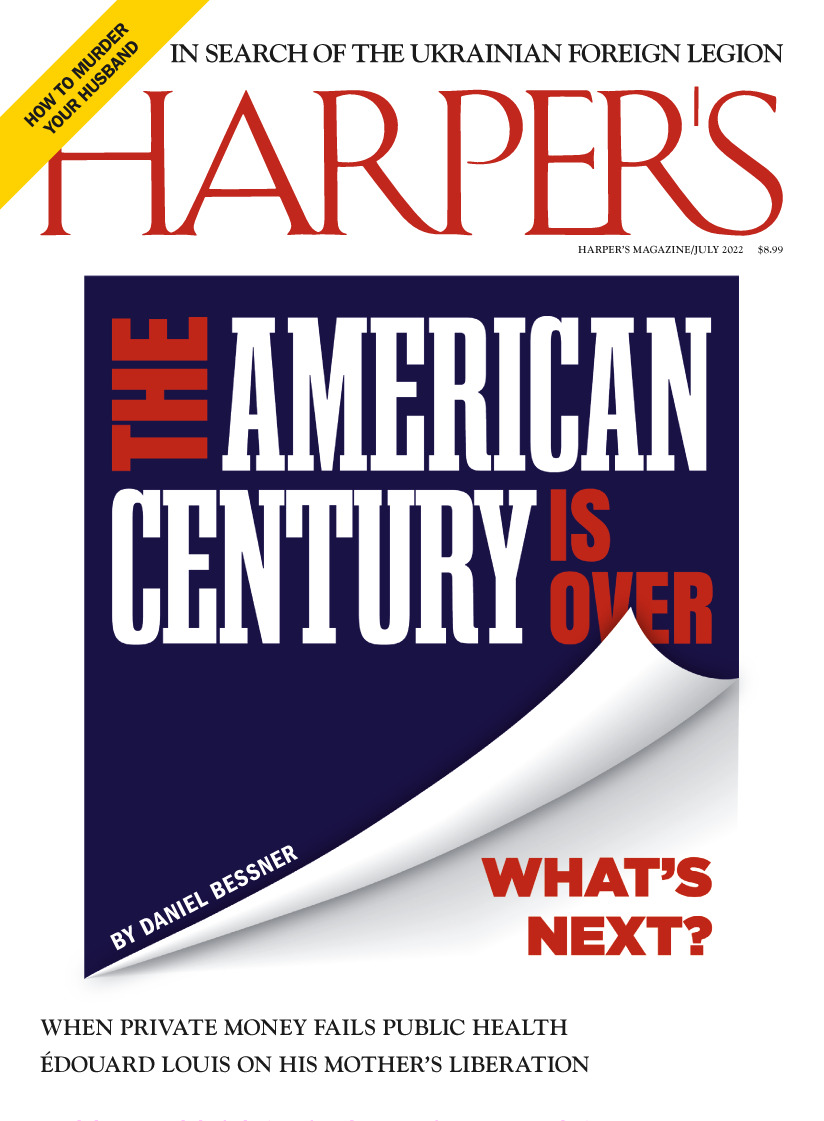
Cover of July 2022 Issue of Harper’s Magazine in which the below article appears.

By Daniel Bessner, Harper’s, July 2022 Issue

In February 1941, as Adolf Hitler’s armies prepared to invade the Soviet Union, the Republican oligarch and publisher Henry Luce laid out a vision for global domination in an article titled the american century. World War II, he argued, was the result of the United States’ immature refusal to accept the mantle of world leadership after the British Empire had begun to deteriorate in the wake of World War I. American foolishness, the millionaire claimed, had provided space for Nazi Germany’s rise. The only way to rectify this mistake and prevent future conflict was for the United States to join the Allied effort and

accept wholeheartedly our duty and our opportunity as the most powerful and vital nation in the world and . . . exert upon the world the full impact of our influence, for such purposes as we see fit and by such means as we see fit.

Just as the United States had conquered the American West, the nation would subdue, civilize, and remake international relations.

Ten months after Luce published his essay, the Japanese attacked Pearl Harbor, and the United States, which had already been aiding the Allies, officially entered the war. Over the next four years, a broad swath of the foreign policy elite arrived at Luce’s conclusion: the only way to guarantee the world’s safety was for the United States to dominate it. By war’s end, Americans had accepted this righteous duty, of becoming, in Luce’s words, “the powerhouse . . . lifting the life of mankind from the level of the beasts to what the Psalmist called a little lower than the angels.” The American Century had arrived.

In the decades that followed, the United States implemented a grand strategy that the historian Stephen Wertheim has fittingly termed “armed primacy.” According to the strategy’s noble advocates, human flourishing, international order, and the future of liberal democratic capitalism depended on the nation spreading its tentacles across the world. Whereas the United States had been wary of embroiling itself in extra-hemispheric affairs prior to the twentieth century, Old Glory could now increasingly be seen flying across the globe. To facilitate their crusade, Americans constructed what the historian Daniel Immerwahr has dubbed a “pointillist empire.” While most empires traditionally relied on the seizure and occupation of vast territories, the United States built military bases around the world to project its power. From these outposts, it launched wars that killed millions, protected a capitalist system that benefited the wealthy, and threatened any power—democratic or otherwise—that had the temerity to disagree with it.

As Luce desired, by the end of the twentieth century, the United States, a nation founded after one of the first modern anticolonial revolutions, had become a world-spanning empire. The “city on a hill” had evolved into a fortified metropolis.

But in the past six years, two transformational events have begun to reshape the United States’ place in the world. First, the election of Donald Trump suggested to domestic and foreign audiences alike that the country might not be forever beholden to the idea that global “leadership” was a vital American interest. Instead of proclaiming the inviolability of the vaunted “liberal international order,” Trump approached international relations as any corrupt businessman would: he tried to get the most while giving the least. He thus withdrew from several international organizations and agreements—including the World Health Organization, the Paris climate agreement, the Iran nuclear deal, the Intermediate-Range Nuclear Forces Treaty, and the Open Skies Treaty—and initiated trade wars intended to boost American business. Taken with his bellicose rhetoric, these actions demonstrated that the world could no longer assume that the United States was committed to defending the geopolitical status quo.

Second, the emergence of China as an economic and military powerhouse has decisively ended the “unipolar moment” of the Nineties and Aughts. The country only recently referred to as a “rising tiger” (Orientalism never dies) now boasts, according to some measures, the largest military and economy on earth. The Asian Infrastructure Investment Bank and New Development Bank offer alternatives to the World Bank, International Monetary Fund, and other Western-dominated institutions, which, to put it mildly, aren’t exactly beloved in the Global South.

For the first time since the collapse of the Soviet Union, the United States confronts a nation whose model—a blend of state capitalism and Communist Party discipline—presents a genuine challenge to liberal democratic capitalism, which seems increasingly incapable of addressing the many crises that beset it. China’s rise, and the glimmers of the alternative world that might accompany it, make clear that Luce’s American Century is in its final days. It’s not obvious, however, what comes next. Are we doomed to witness the return of great power rivalry, in which the United States and China vie for influence? Or will the decline of U.S. power produce novel forms of international collaboration?

In these waning days of the American Century, Washington’s foreign policy establishment—the think tanks that define the limits of the possible—has splintered into two warring camps. Defending the status quo are the liberal internationalists, who insist that the United States should retain its position of global armed primacy. Against them stand the restrainers, who urge a fundamental rethinking of the U.S. approach to foreign policy, away from militarism and toward peaceful forms of international engagement. The outcome of this debate will determine whether the United States remains committed to an atavistic foreign policy ill-suited to the twenty-first century, or whether the nation will take seriously the disasters of the past decades, abandon the hubris that has caused so much suffering worldwide, and, finally, embrace a grand strategy of restraint.

The principles of liberal internationalism were first articulated by Woodrow Wilson as World War I limped along in April 1917. The American military, the president told a joint session of Congress, was a force that could be used to make the world “safe for democracy.” (The United States would decide, of course, which countries counted as democracies.) Wilson’s doctrine was informed by two main ideas: first, the Progressive Era fantasy that modern technologies and techniques—especially those borrowed from the social sciences—could enable the rational management of foreign affairs, and second, the notion that “a partnership of democratic nations” was the surest way to establish “a steadfast concert for peace.” Wilson’s two Democratic successors, Franklin Delano Roosevelt and Harry S. Truman, institutionalized their forebear’s approach, and since the Forties, every president save Trump has embraced some form of liberal internationalism. Even George W. Bush put together a “coalition of the willing” to invade Iraq and insisted that his wars were being waged to spread democracy.

Given liberal internationalism’s unquestioned dominance in the halls of power, it’s not surprising that the dogma still has the support of Washington’s most influential think tanks, which have never been known to bite the hand that feeds them. Members of the Council on Foreign Relations, the Brookings Institution, and the Center for a New American Security consider U.S. hegemony to be an essential condition for global peace and American prosperity. According to these stalwart backers of U.S. supremacy, the fact that a major war between great powers has not broken out since World War II indicates that U.S. hegemony has been, on balance, a force for good.

This is not to say that liberal internationalists are living in the past. They appreciate that, unlike during World War II or the Cold War, most countries agree on the rules of the game. Neither China, nor even Iran and Venezuela, reject the Western international order in the way that Nazi Germany and the Soviet Union did. While states may break rules to advance their interests, few countries are genuine pariahs; in fact, Russia and North Korea might be the only ones. In the modern era, even adversaries interact extensively. During the Cold War, the United States and Soviet Union barely traded with each other. Now, China is one of the United States’ largest trading partners.

This raises a question for liberal internationalists: How should the United States compete in this new world and contain “threats” to the established order? Unfortunately, most have converged on an answer from the past: whether they call it “democratic multilateralism,” “the strategy of reinvigorating the free world,” or “a fully developed democracy strategy,” liberal internationalists hope to establish a coalition of democracies akin to the one that existed during the Cold War, although this time centered on democracies (or, at least, non-autocracies) in the Global South. While claiming to reject the framing of a “new Cold War” with China that has permeated U.S. media, liberal internationalists promote what is effectively a Cold War-era strategy with a few more non-white countries added to the mix.

Like their Cold War predecessors, liberal internationalists believe that their struggle for democracy—and against China, which they regard as the major threat to U.S. power—will last indefinitely. As Michael Brown, Eric Chewning, and Pavneet Singh asserted in a recent Brookings Institution report, the United States must prepare for a “superpower marathon”—“an economic and technology race” with China that is unlikely to reach a “definitive conclusion.” American society, the liberal internationalists avow, will have to remain on a war footing for the foreseeable future. Peace is unthinkable.

The Chinese military, which employs more active personnel than that of any other nation, is of particular concern to liberal internationalists. To combat the threat of Chinese coercion in East Asia, they endorse a strategy in which the United States retains tens of thousands of troops in Japan and South Korea. This aggressive posture, they argue, will convince Chinese leaders that any anti-American actions they take will fail. And, ironically for those who have spent the past few years lambasting Russia for interfering in the 2016 presidential election, liberal internationalists also want to wage an information war against China, smuggling unflattering or damaging information into the country in an attempt to foment anticommunist dissent.

When it comes to the economy, liberal internationalists are bedeviled by the question of whether and how much to confront China—a country that has repeatedly stolen U.S. intellectual property and rejects liberal capitalist ideals of the free market. On one hand, they worry that China could wield its economic power to force other countries to abide by its wishes. On the other, they believe free exchange is vital to the United States’ economic health. Liberal internationalists thus recommend that the nation adopt an approach whereby it pressures China economically, but within the bounds of international rules, norms, and laws. In this way, they hope to combat China without discrediting liberalism writ large. As this suggests, liberal internationalists are well aware of the beating that American prestige has taken in recent years, especially after the wars in Afghanistan and Iraq and the 2008 financial crisis. If the United States is to dominate, it has to abide by rules that in the past it was all too happy to break.

In effect, liberal internationalists want to have it both ways, to challenge China without risking a shooting war or economic decoupling. The problem, however, is that international relations are not nearly as manageable as liberal internationalists assume. The Russian invasion of Ukraine—which was at least partially impelled by NATO expansion into Eastern Europe—is a clear example of the way in which behavior meant to deter war might very well incite it. Yet these basic facts are difficult for liberal internationalists to admit. For them, the American Century can only be restored by facing China head-on.

Restrainers, by contrast, understand that the American Century is over. They maintain that the expansive use of the U.S. military has benefited neither the United States nor the world, and that charting a positive course in the twenty-first century requires taking a root and branch approach to the principles that have guided U.S. foreign policy since World War II. Restrainers want to reduce the U.S. presence abroad, shrink the defense budget, restore Congress’s constitutional authority to declare war, and ensure that ordinary Americans actually have a say in what their country does abroad.

The origins of restraint can be traced to George Washington’s farewell address of September 1796, in which the president warned against “entang[ling] our peace and prosperity in the toils of European ambition, rivalship, interest, humor, or caprice.” Twenty-five years later, on July 4, 1821, the secretary of state, John Quincy Adams, likewise insisted that a defining characteristic of the United States was that it had “abstained from interference in the concerns of others. . . . She goes not abroad, in search of monsters to destroy.” Restraint remained popular for much of the nineteenth and early twentieth centuries; during World War I, for instance, Wilson received substantial criticisms from those who argued that the United States should avoid undertaking messianic projects to remake the world. Of course, the history of U.S. foreign policy is far from one of restraint. From its beginnings, the United States expanded westward, displacing and killing indigenous peoples and eventually seizing a number of populated colonies in the Pacific and Caribbean.

Nevertheless, if restraint did not always apply in practice, the strategy attracted many adherents. Things changed during World War II, when restraint became associated with anti-Semitic “America Firsters,” politically marginal libertarians and pacifists, and discredited “isolationists.” In the Democratic Party, the former vice president Henry Wallace and other progressive restrainers were sidelined, as were Senator Robert A. Taft and other Republican anti-interventionists. Although restraint continued to percolate in social movements like the Vietnam War resistance of the Sixties and think tanks such as the Cato Institute and Institute for Policy Studies, it remained a negligible position until the foreign policy failures in Afghanistan, Iraq, and Libya.

In the wake of these blunders, interest in restraint has been reignited, as evidenced by the fact that two think tanks—Defense Priorities and the Quincy Institute, where I serve as an unpaid non-resident fellow—were recently founded with the goal of advocating for its fundamental principles. Gil Barndollar of Defense Priorities has usefully summarized the restrainers’ limited set of foreign policy goals: helping to realize “the security of the U.S. itself, free passage in the global commons, the security of U.S. treaty allies, and preventing the emergence of a Eurasian hegemon.” Because the major problems of the twenty-first century cannot be solved by U.S. military force, but instead require multilateral cooperation with nations that have adopted different political systems, there is no reason for the United States to promote democracy abroad or act as the global police force.

Accordingly, restrainers do not consider China an existential threat. When it comes to East Asia, their goal is to prevent war in the region so as to facilitate collaboration on global issues such as climate change and pandemics. This objective, they maintain, can be achieved without American hegemony.

Restrainers thus promote a “defensive, denial-oriented approach,” focused on using the U.S. military to prevent China from controlling East Asia’s air and seas. They also want to help regional partners develop the ability to resist China’s influence and power, and argue that the United States should place its forces far from the Chinese coast, in clearly defensive positions. A similarly hands-off approach applies to Taiwan and human rights. If China wants to seize Taiwan, restrainers assert, then the United States should not fight World War III to prevent it from doing so. If China wants to oppress its population, there’s not much that the United States can or should do about it.

The fundamental disagreement between the two schools of thought is this: liberal internationalists believe that the United States can manage and predict foreign affairs. Restrainers do not. For those of us in the latter camp, the withering away of the American Century cannot be reversed; it can only be accommodated.

The question of which strategy the United States should pursue is fundamentally a matter of historical interpretation. Was U.S. domination during the American Century good for the United States? Was it good for the world?

When one takes a long, hard look at U.S. foreign policy after 1945, it’s clear that the United States caused an enormous amount of suffering that a more restrained approach would have avoided. Some of these American-led fiascoes are infamous: the wars in Korea, Vietnam, Afghanistan, and Iraq resulted in the death, displacement, and deracination of millions of people. Then there are the many lesser-known instances of the United States helping to install its preferred leaders abroad. During the Cold War alone, the nation imposed regime changes in Iran, Guatemala, the Democratic Republic of the Congo, British Guiana, South Vietnam, Bolivia, Brazil, Panama, Indonesia, Syria, and Chile.

As this record suggests, the Cold War was hardly “the long peace” that many liberal internationalists valorize. It was, rather, incredibly violent. The historian Paul Thomas Chamberlin estimates that at least twenty million people died in Cold War conflicts, the equivalent of 1,200 deaths a day for forty-five years. And U.S. intervention didn’t end with the Cold War. Including the conflicts in Afghanistan, Iraq, and Libya, the United States intervened abroad one hundred and twenty-two times between 1990 and 2017, according to the Military Intervention Project at Tufts University. And as Brown University’s Costs of War Project has determined, the war on terror has been used to justify operations in almost half the world’s countries.

Such interventions obviously violated the principle of sovereignty—the very basis of international relations. But more importantly, they produced awful outcomes. As the political scientist Lindsey O’Rourke has underlined, countries targeted for regime change by the United States were more likely to experience civil wars, mass killings, human rights abuses, and democratic backsliding than those that were ignored.

When it comes to the benefits that ordinary Americans received from their empire, it’s similarly difficult to defend the historical record. It’s true that in the three decades after World War II, armed primacy ensured favorable trade conditions that allowed Americans to consume more than any other group in world history (causing incredible environmental damage in the process). But as the New Deal gave way to neoliberalism, the benefits of supremacy attenuated. Since the late Seventies, Americans have been suffering the negative consequences of empire—a militarized political culture, racism and xenophobia, police forces armed to the teeth with military-grade weaponry, a bloated defense budget, and endless wars—without receiving much in return, save for the psychic wages of living in the imperial metropole.

The more one considers the American Century, in fact, the more our tenure as global hegemon resembles a historical aberration. Geopolitical circumstances are unlikely to allow another country to become as powerful as the United States has been for much of the past seven decades. In 1945, when the nation first emerged triumphant on the world stage, its might was staggering. The United States produced half the world’s manufactured goods, was the source of one third of the world’s exports, served as the global creditor, enjoyed a nuclear monopoly, and controlled an unprecedented military colossus. Its closest competitor was a crippled Soviet Union struggling to recover from the loss of more than twenty million citizens and the devastation of significant amounts of its territory.

The United States’ power was similarly astounding after the Soviet Union’s collapse in the early Nineties, especially when one aggregates its strength with that of its Western allies. In 1992, the G7 countries—Canada, France, Germany, Italy, Japan, the United Kingdom, and the United States—controlled 68 percent of global GDP, and maintained sophisticated militaries, which, the Gulf War seemed to demonstrate, could achieve their objectives quickly, cheaply, and with minimal loss of Western life.

But this is no longer the case. By 2020, the G7’s GDP had dwindled to 31 percent of the global total, and is expected to fall to 29 percent by 2024. This trend will likely continue. And if the past thirty years of American war have demonstrated anything, it’s that sophisticated militaries do not always achieve their intended political objectives. The United States and its allies aren’t what they once were. Hegemony was an anomaly, an accident of history unlikely to be repeated, at least in the foreseeable future.

There are also more fundamental, even ontological, problems with the liberal internationalist approach. Liberal internationalism is a product of the fin de siècle, when Progressive thinkers, activists, and policymakers across the political spectrum believed that rationality could achieve mastery over human affairs. But the dream proved to be just that. No nation, no matter how powerful, has the capacity to control international relations—an arena defined by radical uncertainty—in the ways that Woodrow Wilson and other Progressives hoped. The world is not a chessboard.

Furthermore, liberal internationalists’ democracy-first strategy assumes a Manichaean model of geopolitics that is both inconsistent and counterproductive. For all their crowing about democracy, liberal internationalists have been just fine collaborating with dictatorships, from Saudi Arabia to Egypt, when it has served perceived U.S. interests. This will probably remain true, making any kind of democracy-first strategy a primarily discursive one. Nonetheless, discursively centering democracy could have drastic repercussions. Dividing the world into “good” democracies and “bad” authoritarian regimes narrows the space for engagement with many countries not currently aligned with the United States. Decision-makers who view autocracies as inevitable opponents are less likely to take their interests seriously and may even misread their intentions. This happened repeatedly in the Fifties and Sixties, when U.S. officials insisted that the very nature of the Soviet system made it impossible to reach détente. In fact, détente was only achieved in the Seventies, after decision-makers concluded that the Soviet Union was best treated as a normal nation with normal interests, regardless of its political structure. Once Americans adopted this approach, it became clear that the Soviets, like them, preferred superpower stability to nuclear war.

Because it’s difficult to know precisely what a government like China’s is up to, liberal internationalists tend to flatten the complexities that shape its behavior, and assume that China will expand to the limits of its power. This idea owes much to the classical realist school of foreign policy, which, following the émigré political scientist Hans Morgenthau, maintains that nations have an animus dominandi, a will to dominate. (The United States, unsurprisingly, is assumed to act according to more noble motivations.) For this reason, some liberal internationalists claim, China will fill any power vacuum it can.

But is this an accurate description of China—or indeed, of any modern nation? Classical realism was born of the traumas of the Thirties, when two great powers, Nazi Germany and imperial Japan, considered the conquest of foreign territory vital to their futures. The experience of German and Japanese expansion profoundly shaped the work of midcentury thinkers like Morgenthau, who insisted that the search for lebensraum reflected more general laws of international relations.

Unfortunately for those liberal internationalists indebted to classical realism, states make the decisions they do for many reasons, from regime type (is a nation a democracy or an autocracy?) to individual psychology (is a particular leader mentally well?) to culture (what behavior does a given nation valorize?). When it comes to trying to explain why China—or Russia, or Iran, or North Korea—acts as it does, it’s not particularly useful to ignore everything that makes the country unique in favor of emphasizing immutable factors.

The historicist approach of restrainers is a far better way to analyze international relations. Restrainers focus on what China has done, and not what it might do; for them, China is a state that exists in the world, with its own interests and concerns, not an abstraction embodying transhistorical laws (which themselves reflect American anxieties).

And when examining what China has done, the evidence is clear: while the nation obviously wants to be a major power in East Asia, and while it hopes to one day conquer Taiwan, there’s little to suggest that, in the short term at least, it aims to replace the United States as the regional, let alone global, hegemon. Neither China’s increased military budget (which pales in comparison to the United States’ $800 billion) nor its foreign development aid (which is not linked to a recipient country’s politics) indicates that it desires domination. In fact, Chinese leaders, who tolerate the presence of tens of thousands of troops stationed near their borders, appear willing to allow the United States to remain a major player in Asia, something Americans would never countenance in the Western Hemisphere.

Ironically, liberal internationalists are imposing their own goals for hegemony onto China. Their commitment to armed primacy—a commitment that has led to war after war—threatens to increase tensions with a country that Americans must cooperate with to solve the real problems of the twenty-first century: climate change, pandemics, and inequality. When compared with these existential threats, the liberal internationalist obsession with primacy is a relic of a bygone era. For the sake of the world, we must move beyond it.

At the present moment, however, a majority of Americans side with the liberal internationalists: in a Pew poll taken in early 2020, 91 percent of American adults thought that “the U.S. as the world’s leading power would be better for the world,” up from 88 percent in 2018.

Nonetheless, there’s a growing generational divide over the future of U.S. foreign policy. A 2017 survey by the Chicago Council on Global Affairs, for instance, discovered that only 44 percent of millennials believe that it’s “very important” for the United States to maintain “superior military power worldwide,” compared with 64 percent of boomers. In a poll from 2019, zoomers and millennials were more likely than boomers to agree that “it would be acceptable if another country became as militarily powerful as the U.S.”

The fact that younger Americans are waking up to the manifold and manifest failures of liberal internationalism presents the United States with an enormous opportunity: it can abandon an irresponsible and hubristic liberal internationalism for restraint. This will, admittedly, be a difficult task. Americans have ruled the world for so long that they see it as their right and duty to do so (especially since most don’t have to fight their nation’s wars). Members of Congress, meanwhile, get quite a bit of money, and their districts even get a few jobs, from defense contractors. Both retired generals and pointy-headed intellectuals rely on the defense industry for employment. And restraint is still a minority position in the major political parties.

It’s an open question whether U.S. foreign policy can transform in a way that fully reflects an understanding of the drawbacks of empire and the benefits of a less violent approach to the world. But policymakers must plan for a future beyond the American Century, and reckon with the fact that attempts to relive the glories of an inglorious past will not only be met with frustration, but could even lead to war.

The American Century did not achieve the lofty goals that oligarchs such as Henry Luce set out for it. But it did demonstrate that attempts to rule the world through force will fail. The task for the next hundred years will be to create not an American Century, but a Global Century, in which U.S. power is not only restrained but reduced, and in which every nation is dedicated to solving the problems that threaten us all. As the title of a best-selling book from 1946 declared, before the Cold War precluded any attempts at genuine international cooperation, we will either have “one world or none.”

Daniel Bessner  is an associate professor at the University of Washington’s Henry M. Jackson School of International Studies.