All posts by natyliesb

AP: ‘Hell on earth’: Ukrainian soldiers describe eastern front

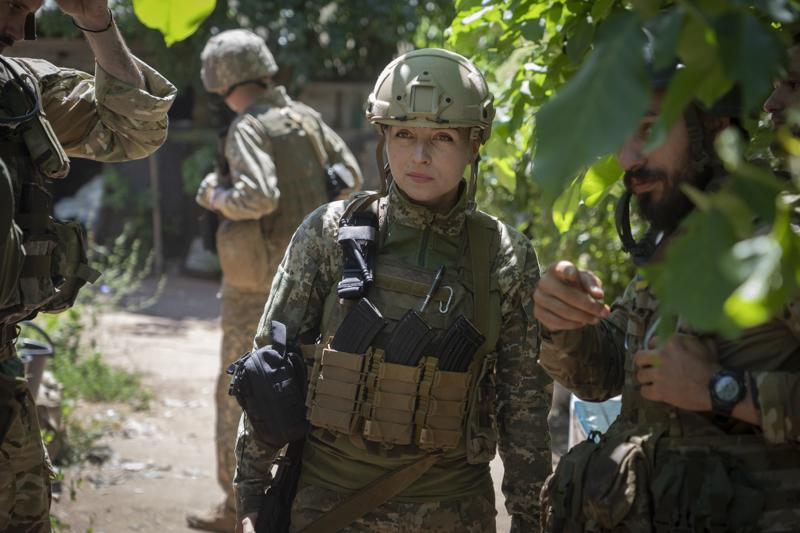
Ukrainian platoon commander Mariia talks to her soldiers in their position in the Donetsk region, Ukraine, Saturday, July 2, 2022. Ukrainian soldiers returning from the frontlines in eastern Ukraine’s Donbas region describe life during what has turned into a grueling war of attrition as apocalyptic. Mariia, 41, said that front-line conditions may vary depending on where a unit is positioned and how well supplied they are. (AP Photo/Efrem Lukatsky)

By Francesca Ebel, Associated Press, 7/4/22

BAKHMUT, Ukraine (AP) — Torched forests and cities burned to the ground. Colleagues with severed limbs. Bombardments so relentless the only option is to lie in a trench, wait and pray.

Ukrainian soldiers returning from the front lines in eastern Ukraine’s Donbas region — where Russia is waging a fierce offensive — describe life during what has turned into a grueling war of attrition as apocalyptic.

In interviews with The Associated Press, some complained of chaotic organization, desertions and mental health problems caused by relentless shelling. Others spoke of high morale, their colleagues’ heroism, and a commitment to keep fighting, even as the better-equipped Russians control more of the combat zone.

Lt. Volodymyr Nazarenko, 30, second-in-command of the Ukrainian National Guard’s Svoboda Battalion, was with troops who retreated from Sievierodonetsk under orders from military leaders. During a month-long battle, Russian tanks obliterated any potential defensive positions and turned a city with a prewar population of 101,000 into “a burnt-down desert,” he said.

“They shelled us every day. I do not want to lie about it. But these were barrages of ammunition at every building,” Nazarenko said. “The city was methodically leveled out.”

At the time, Sievierodonetsk was one of two major cities under Ukrainian control in Luhansk province, where pro-Russia separatists declared an unrecognized republic eight years ago. By the time the order to withdraw came on June 24, the Ukrainians were surrounded on three sides and mounting a defense from a chemical plant also sheltering civilians.

“If there was a hell on Earth somewhere, it was in Sievierodonetsk,” Artem Ruban, a soldier in Nazarenko’s battalion, said from the comparative safety of Bakhmut, 64 kilometers (40 miles) to the southwest of the since-captured city. “The inner strength of our boys allowed them to hold the city until the last moment.”

“Those were not human conditions they had to fight in. It is difficult to explain this to you here, what they feel like now or what it was like there,” Ruban said, blinking in the sunlight. “They were fighting until the end there. The task was to destroy the enemy, no matter what.”

Nazarenko, who also fought in Kyiv and elsewhere in the east after Russia invaded Ukraine, considers the Ukrainian operation in Sievierodonetsk “a victory” despite the outcome. He said the defenders managed to limit casualties while stalling the Russian advance for much longer than expected, depleting Russia’s resources.

“Their army incurred huge losses, and their attack potential was obliterated,” he said.

Both the lieutenant and the soldier under his command expressed confidence that Ukraine would take back all occupied territories and defeat Russia. They insisted morale remained high. Other soldiers, most with no combat experience before the invasion, shared more pessimistic accounts while insisting on anonymity or using only their first names to discuss their experiences.

Oleksiy, a member of the Ukrainian army who started fighting against the Moscow-backed separatists in 2016, had just returned from the front with a heavy limp. He said he was wounded on the battlefield in Zolote, a town the Russians also have since occupied.

“On the TV, they are showing beautiful pictures of the front lines, the solidarity, the army, but the reality is very different” he said, adding he does not think the delivery of more Western weapons would change the course of the war.

His battalion started running out of ammunition within a few weeks, Oleksiy said. At one point, the relentless shelling kept the soldiers from standing up in the trenches, he said, exhaustion visible on his lined face.

A senior presidential aide reported last month that 100 to 200 Ukrainian troops were dying every day, but the country has not provided the total number killed in action. Oleksiy claimed his unit lost 150 men during its first three days of fighting, many from a loss of blood.

Due to the relentless bombardments, wounded soldiers were only evacuated at night, and sometimes they had to wait up to two days, he said.

“The commanders don’t care if you are psychologically broken. If you have a working heart, if you have arms and legs, you have to go back in,” he added.

Mariia, a 41-year-old platoon commander who joined the Ukrainian army in 2018 after working as a lawyer and giving birth to a daughter, explained that the level of danger and discomfort can vary greatly depending on a unit’s location and access to supply lines.

Front lines that have existed since the conflict with pro-Russia separatists began in 2014 are more static and predictable, whereas places that became battlegrounds since Russia sent its troops in to invade are “a different world,” she said.

Mariia, who refused to share her surname for security reasons, said her husband is currently fighting in such a “hot spot.” Everyone misses and worries about their loved ones, and though this causes distress, her subordinates have kept their spirits high, she said.

“We are the descendants of Cossacks, we are free and brave. It is in our blood,” she said. “We are going to fight to the end.”

Two other soldiers the AP interviewed — former office-workers in Kyiv with no prior battle experience — said they were sent to the front lines in the east as soon as they completed their initial training. They said they observed “terrible organization” and “illogical decision-making,” and many people in their battalion refused to fight.

One of the soldiers said he smokes marijuana daily. “Otherwise, I would lose my mind, I would desert. It’s the only way I can cope” he said.

A 28-year-old former teacher in Sloviansk who “never imagined” he would fight for his country described Ukraine’s battlefields as a completely different life, with a different value system and emotional highs as well as lows.

“There is joy, there is sorrow. Everything is intertwined,” he said.

Friendship with his colleagues provide the bright spots. But he also saw fellow soldiers succumbing to extreme fatigue, both physical and mental, and displaying symptoms of PTSD.

“It’s hard to live under constant stress, sleep-deprived and malnourished. To see all those horrors with your own eyes — the dead, the torn-off limbs. It is unlikely that someone’s psyche can withstand that,” he said.

Yet he, too, insisted that the motivation to defend their country remains.

“We are ready to endure and fight with clenched teeth. No matter how hard and difficult it is,” the teacher said, speaking from a fishing store that was converted into a military distribution hub. “Who will defend my home and my family, if it is not me?”

The center in the city of Sloviansk provides local military units with equipment and provisions, and gives soldiers a place to go during brief respites from the physical grind and horrors of battle.

Tetiana Khimion, a 43-year-old dance choreographer, set up the center when the war started. All kinds of soldiers pass through, she says, from skilled special forces and war-hardened veterans to civilians-turned-fighters who signed up only recently.

“It can be like this: For the first time he comes, smiles widely, he can even be shy. The next time he comes, and there is emptiness in his eyes,” Khimion said. “He has been through something, and he is different.”

Behind her, a group of young Ukrainian soldiers on rotation from the front lines sit sharing jokes and a pizza. The thud of artillery can be heard a few miles away.

“Mostly they hope for the better. Yes, sometimes they come in a little sad, but we hope to raise their spirits here, too,” Khimion said. “We hug, we smile at each other and then they go back into the fields.”

On Sunday, Russian forces occupied the last Ukrainian stronghold in Luhansk province and stepped up rocket strikes on Donetsk, the Donbas province where the center is located.
Dmitry Trenin: Russia has made a decisive break with the West and is ready to help shape a new world order

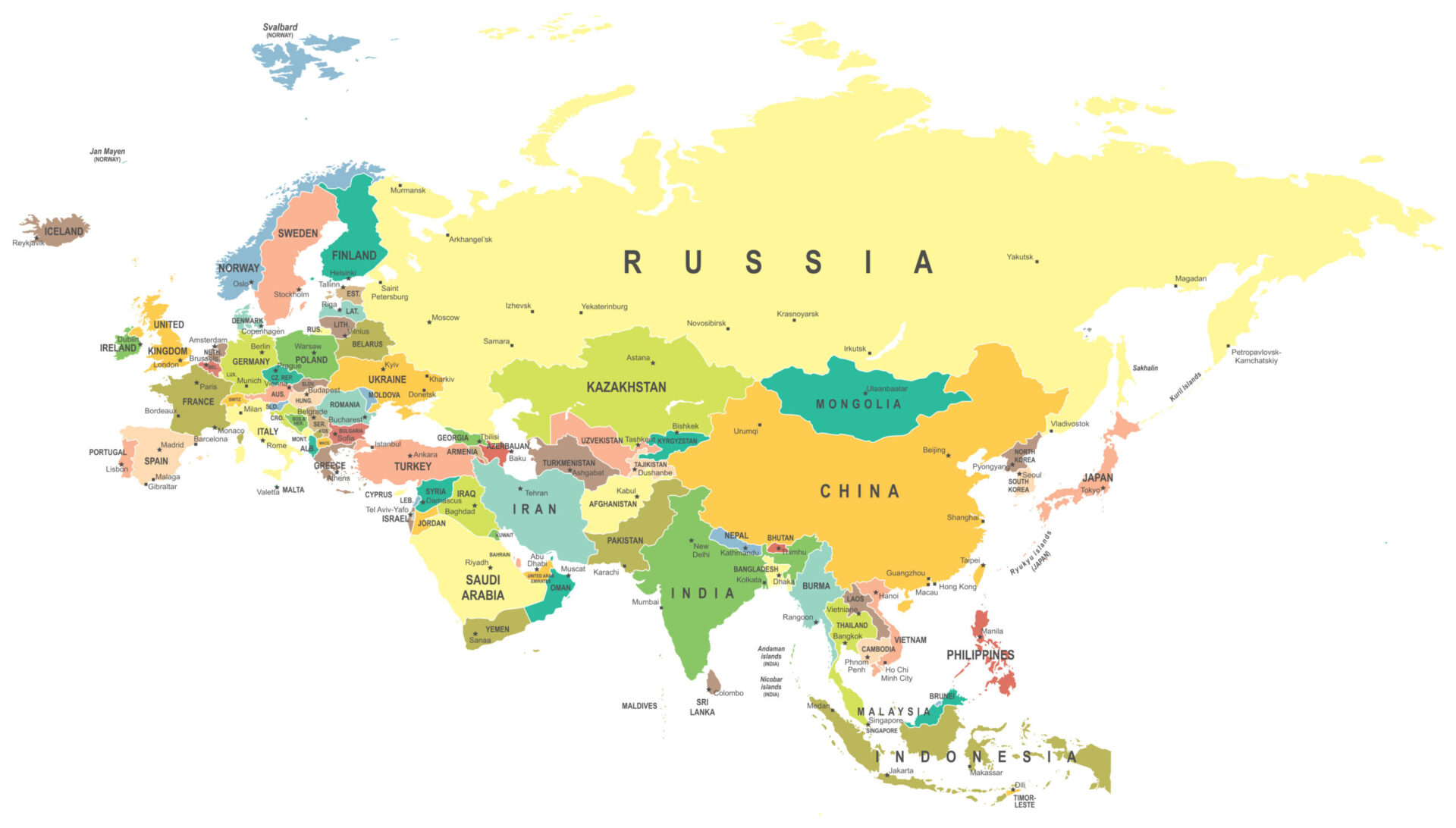
Map of Eurasia

By Dmitry Trenin, RT, 7/4/22

Dmitri Trenin is a member of the Russian International Affairs Council.   

Just before the G7 leaders met at Elmau Castle in Bavaria, last week, their counterparts from the five BRICS countries held an online summit under the Chinese Presidency. Russia had been discussed as a threat at the G7 gathering but was a key participant in the latter.

Long gone are the days when Moscow could straddle the divide between the West and the non-West. Following the 2014 Ukraine crisis, the G8 reverted to its previous G7 format; in the wake of the Russian military action in Ukraine last February, Russian-Western confrontation degenerated into a full-blown “Hybrid War,” complete with an actual confrontation – if so far a proxy one.

Having tried, after the end of the Cold War, to become part of the new West, and having failed at that endeavor, Russia is now focusing on developing its ties with Asia, the Middle East, Africa, and Latin America.

This is both a difficult and a necessary task, for a number of reasons. First, there is a powerful inertia from the past. At least since the days of Peter the Great, Russian elites have looked westward, adopting western ways of appearance and behavior (while remaining distinctly Russian beneath the garb and manners); adapting western institutions (even if often only superficially); borrowing western patterns of thinking (while creatively developing them, as with Marxism); seeking to become a great European power; then, in Soviet days, a global superpower; and, more recently, a key component of a greater Europe from Lisbon to Vladivostok.

This is a pathway hard to wean off from. Yet, now, for the first time ever, Russia is facing a united West, from North America, the European Union, and Britain, to Japan and Australia. What’s more, there are no allies in the West that Moscow can turn to – even notionally neutral states such as Finland, Sweden, Austria, and Switzerland, have all ditched their neutrality. Russia’s political rupture with the West is thus complete, and any new norm of relations between them can only emerge as a result of the “Hybrid War,“ which will take years, if not decades, to fight out. 

Second, Moscow’s economic relations have been largely built with the West. Historically, Russia has been a resource for Western European industry; a breadbasket of the continent; and a major importer of industrial products and technology. Until recently, Russia’s trade with the European Union alone accounted for more than half of Russia’s foreign commerce, and Germany was the lead exporter of machinery and technology to Russia. Since the early 1970s, oil and gas pipelines from Russia to Western Europe have formed the backbone of economic ties and provided for general stability on the continent, even in the dangerous decades of the Cold War and in the turbulent times of the disintegration of the Soviet Union itself. This, too, is on the way out, however.

The severe sanctions imposed on Russia by the US, EU and the UK will not be lifted even when the actual fighting in Ukraine stops, and the painful experience of foreign exchange and asset seizures will leave a huge imprint on any future Russian approach to economic ties with the West.

Third, in cultural terms, Russians have traditionally identified themselves with the rest of Europe. Christianity; the legacies of Ancient Greece and Rome; the ideas of French Enlightenment and German philosophy; European literature and the arts, music, and dance – all of this helped shape and form Russia’s own culture, giving it a powerful stimulus for self-development. Despite the recent political rupture and the geo-economic shift, the foundations of Russian culture remain definitely European.

However, a number of elements of today’s cultural scene in the West, particularly the dominant cult of individual self-expression, runaway liberalism that is turning increasingly oppressive, the erosion of family values and the proliferation of genders, jars with the more traditional cultural code of the majority of the Russian population. 

That said, the obvious necessity for Russia to now look beyond the West means it can probably overcome the historical inertia, the legacy of previous geo-economic priorities, and cultural affinities. With the West shunning Russia, trying to isolate and sometimes “cancel” it, Moscow has no choice but to kick its old habits and reach out to the wider world beyond Western Europe and North America. In fact, this is something that successive Russian leaders vowed to do repeatedly, even when relations with the West were much less adversarial, but the Europe-oriented mindset, the apparent ease of trading resources for Western goods and technologies, and the ambition to be accepted into Western elite circles prevented that intention from turning into reality.

It has been noted, however, that people start doing the right thing only when there are no other options. And certainly, capitulating to the West is no option for Russia, at this point. Things have gone too far.

Beyond the necessity of an overhaul of Russia’s foreign relations there are real opportunities to pursue. Since the end of the Cold War, the leading countries of Asia, the Middle East, Africa, and Latin America have risen spectacularly in all respects, from economically and politically to technologically and militarily.

Even before the outbreak of the “Hybrid War,” China had overtaken Germany not only as Russia’s principal trading partner, but also as the leading exporter of machinery and equipment to Russia. India, a traditional importer of Soviet and Russian weapons, is now emerging as a major technology partner for Moscow. Saudi Arabia and the United Arab Emirates are Russia’s principal partners in regulating oil output in the OPEC+ format. Turkey and Iran are major independent players in a key strategic region. The fact that the vast majority of non-Western countries refused to condemn Russia for what it is doing in Ukraine – many of them despite strong US pressure – is most encouraging for Moscow. In the sense that those who are not against us could be considered to be with us.

From Indonesia to Brazil, and from Argentina to South Africa, there are many dynamic and ambitious countries that Moscow is seeking to engage.

To be able to do that, Russia’s foreign policy needs to come up with an appropriate strategy. Above all, it needs to give relations with non-Western countries priority over the de facto firmly frozen ties with the West. Being an ambassador to Indonesia should be more prestigious than an ambassadorship in Rome, and a post in Tashkent should be viewed as more important than one in Vienna.

There needs to be an audit of potential economic and other opportunities for Russia in the BRICS countries, and a plan to work on them. Apart from economics, student exchange programs should be expanded, and Russian tourism encouraged to move east, and south. The Russian media would be right to increase coverage of developments in the key non-Western nations, educating the Russian elite and the broader public about the economic realities, politics, and culture of those nations.

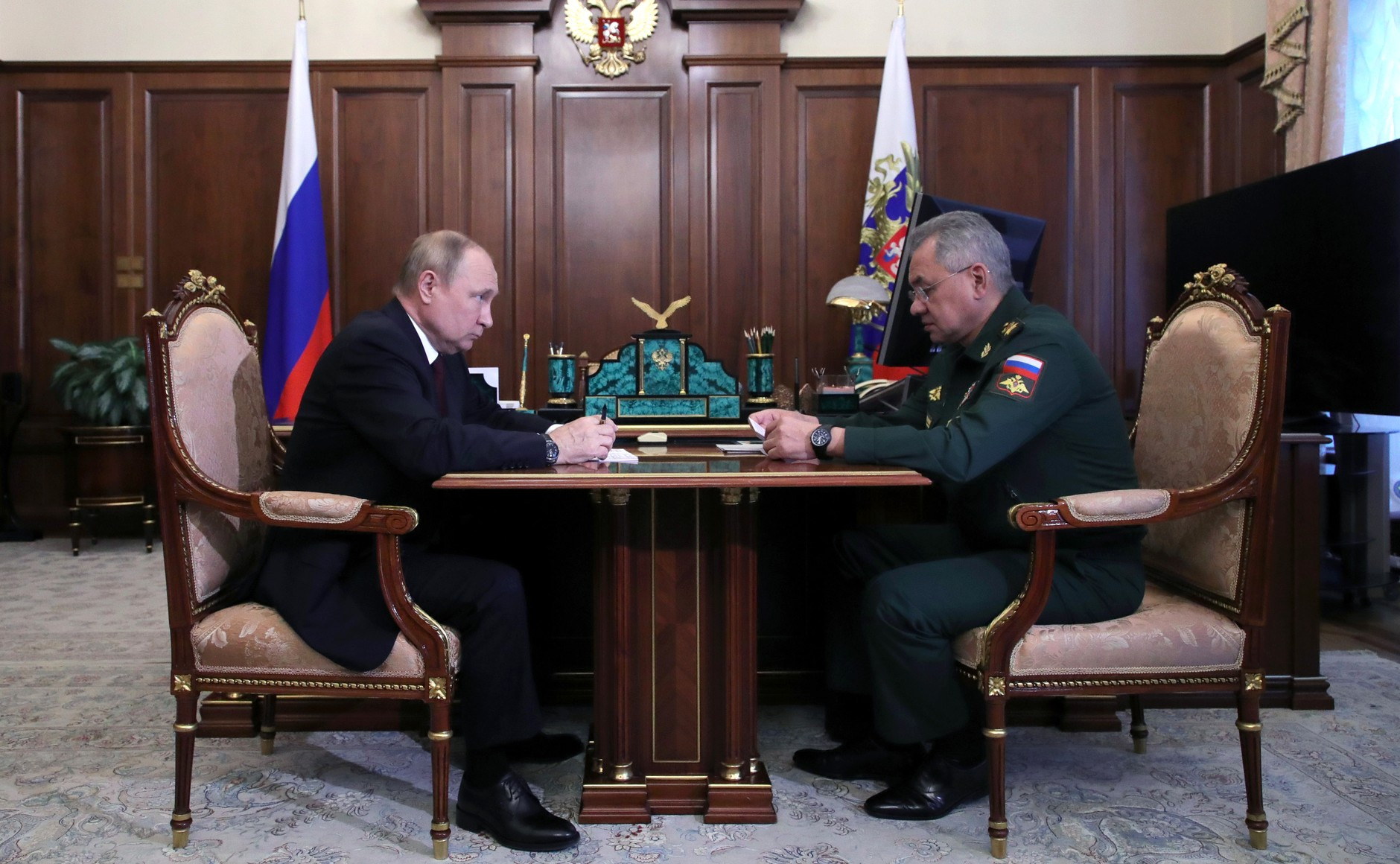
Transcript of Russian Defense Minister Sergei Shoigu’s Meeting with Putin on Taking of Lugansk Region

Meeting with Defence Minister Sergei Shoigu

Kremlin website, 7/4/22

Defence Minister Sergei Shoigu: Comrade Supreme Commander-in-Chief,

Since June 19, formations and units of the Centre Group under the command of Colonel General Alexander Lapin, in co-operation with units of the Second People’s Militia Corps of the Lugansk People’s Republic and supported by the southern group of forces led by Army General Sergei Surovikin, have successfully carried out an offensive operation to liberate the Lugansk People’s Republic.

Within two weeks, they encircled and destroyed the groups in the Gorskoye cauldron, around Lisichansk and Severodonetsk. Twenty-five localities have been taken under control, the largest of which are Severodonetsk, Zolotoye, Gorskoye and Volcheyarovka. The operation ended yesterday with the liberation of Lisichansk, one of the largest towns in the Lugansk People’s Republic. A total of 670 square kilometres of territory were taken under control during the active offensive.

The total losses of the Ukrainian armed forces amounted to 5,469 personnel, including 2,218 killed and 3,251 wounded; 196 tanks and other armoured vehicles, 12 aircraft, one helicopter, 69 drones, six long-range surface-to-air missile systems, 97 multiple rocket launchers, 166 field and mortar artillery pieces and 216 vehicles of various purposes.

When retreating from Lisichansk, the enemy abandoned 39 tanks and other armoured vehicles, 11 guns and mortars, 48 Javelins and NLAW anti-tank missile systems, 18 Stinger systems, and three unmanned aerial vehicles.

Today the demining of the city of Lisichansk and its environs is underway, as is the delivery of humanitarian cargo, as well as the provision of medical assistance to civilians.

The Russian Armed Forces are continuing the special military operation.

President of Russia Vladimir Putin: Good. Thank you.

As you know, Colonel General Alexander Lapin and Army General Sergei Surovikin also reported to me today on the progress in fulfilling their tasks and presented their proposals for the development of offensive operations. Both the Defence Ministry and the General Staff are considering the proposals of the field commanders.

The units that took part in active combat operations and achieved success and victories in the Lugansk direction, of course, should rest and build up their combat capabilities. Other military formations, including the East Group and the West Group, must carry out their tasks according to the previously approved plans, according to the single scheme, and I hope that everything will happen in their directions in the same way as it has happened in Lugansk.

I agree with your proposal to award Commander of the Centre Group Colonel General Lapin and Deputy Commander of the 8th Army of the Southern Military District Major General Abachev the title of Hero of Russia. The corresponding Presidential Executive Order will be signed today.

I would also ask you to recommend for state decorations all military personnel who distinguished themselves in the course of these combat operations. Based on your daily reports, I know that the Russian army has many such brave, professional soldiers, daring – in a good way – warriors, and they should all be honoured with corresponding state decorations of their Motherland.

My congratulations and words of gratitude also go to the soldiers of the 2nd Army Corps of the LPR People’s Militia. I know that they worked actively and competently, too, and showed courage and heroism in the truest sense of the word, when liberating their native land.

I congratulate all of you and wish you further success.

Thank you.

Jeffrey Sachs: Ukraine Is the Latest Neocon Disaster

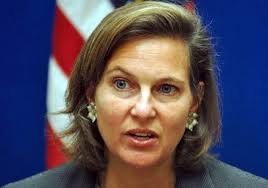
Victoria Nuland

By Jeffrey Sachs, CommonDreams, 6/28/22

The war in Ukraine is the culmination of a 30-year project of the American neoconservative movement. The Biden Administration is packed with the same neocons who championed the US wars of choice in Serbia (1999), Afghanistan (2001), Iraq (2003), Syria (2011), Libya (2011), and who did so much to provoke Russia’s invasion of Ukraine. The neocon track record is one of unmitigated disaster, yet Biden has staffed his team with neocons. As a result, Biden is steering Ukraine, the US, and the European Union towards yet another geopolitical debacle. If Europe has any insight, it will separate itself from these US foreign policy debacles.

The neocon movement emerged in the 1970s around a group of public intellectuals, several of whom were influenced by University of Chicago political scientist Leo Strauss and Yale University classicist Donald Kagan. Neocon leaders included Norman Podhoretz, Irving Kristol, Paul Wolfowitz, Robert Kagan (son of Donald), Frederick Kagan (son of Donald), Victoria Nuland (wife of Robert), Elliott Cohen, Elliott Abrams, and Kimberley Allen Kagan (wife of Frederick). 

The main message of the neocons is that the US must predominate in military power in every region of the world, and must confront rising regional powers that could someday challenge US global or regional dominance, most important Russia and China. For this purpose, US military force should be pre-positioned in hundreds of military bases around the world and the US should be prepared to lead wars of choice as necessary. The United Nations is to be used by the US only when useful for US purposes.

This approach was spelled out first by Paul Wolfowitz in his draft Defense Policy Guidance (DPG) written for the Department of Defense in 2002. The draft called for extending the US-led security network to the Central and Eastern Europe despite the explicit promise by German Foreign Minister Hans-Dietrich Genscher in 1990 that German unification would not be followed by NATO’s eastward enlargement. Wolfowitz also made the case for American wars of choice, defending America’s right to act independently, even alone, in response to crises of concern to the US. According to General Wesley Clark, Wolfowitz already made clear to Clark in May 1991 that the US would lead regime-change operations in Iraq, Syria, and other former Soviet allies.

The neocons championed NATO enlargement to Ukraine even before that became official US policy under George W. Bush, Jr. in 2008. They viewed Ukraine’s NATO membership as key to US regional and global dominance. Robert Kagan spelled out the neocon case for NATO enlargement in April 2006:

[T]he Russians and Chinese see nothing natural in [the “color revolutions” of the former Soviet Union], only Western-backed coups designed to advance Western influence in strategically vital parts of the world. Are they so wrong? Might not the successful liberalization of Ukraine, urged and supported by the Western democracies, be but the prelude to the incorporation of that nation into NATO and the European Union—in short, the expansion of Western liberal hegemony?

Kagan acknowledged the dire implication of NATO enlargement. He quotes one expert as saying, “the Kremlin is getting ready for the ‘battle for Ukraine’ in all seriousness.” The neocons sought this battle. After the fall of the Soviet Union, both the US and Russia should have sought a neutral Ukraine, as a prudent buffer and safety valve. Instead, the neocons wanted US “hegemony” while the Russians took up the battle partly in defense and partly out of their own imperial pretentions as well. Shades of the Crimean War (1853-6), when Britain and France sought to weaken Russia in the Black Sea following Russian pressures on the Ottoman empire.

Kagan penned the article as a private citizen while his wife Victoria Nuland was the US Ambassador to NATO under George W. Bush, Jr. Nuland has been the neocon operative par excellence. In addition to serving as Bush’s Ambassador to NATO, Nuland was Barack Obama’s Assistant Secretary of State for European and Eurasian Affairs during 2013-17, where she participated in the overthrow of Ukraine’s pro-Russian president Viktor Yanukovych, and now serves as Biden’s Undersecretary of State guiding US policy vis-à-vis the war in Ukraine.

The neocon outlook is based on an overriding false premise: that the US military, financial, technological, and economic superiority enables it to dictate terms in all regions of the world. It is a position of both remarkable hubris and remarkable disdain of evidence. Since the 1950s, the US has been stymied or defeated in nearly every regional conflict in which it has participated. Yet in the “battle for Ukraine,” the neocons were ready to provoke a military confrontation with Russia by expanding NATO over Russia’s vehement objections because they fervently believe that Russia will be defeated by US financial sanctions and NATO weaponry.

The Institute for the Study of War (ISW), a neocon think-tank led by Kimberley Allen Kagan (and backed by a who’s who of defense contractors such as General Dynamics and Raytheon), continues to promise a Ukrainian victory. Regarding Russia’s advances, the ISW offered a typical comment: “[R]egardless of which side holds the city [of Sievierodonetsk], the Russian offensive at the operational and strategic levels will probably have culminated, giving Ukraine the chance to restart its operational-level counteroffensives to push Russian forces back.”

The facts on the ground, however, suggest otherwise. The West’s economic sanctions have had little adverse impact on Russia, while their “boomerang” effect on the rest of the world has been large. Moreover, the US capacity to resupply Ukraine with ammunition and weaponry is seriously hamstrung by America’s limited production capacity and broken supply chains. Russia’s industrial capacity of course dwarfs that of Ukraine’s. Russia’s GDP was roughly 10X that of Ukraine before war, and Ukraine has now lost much of its industrial capacity in the war.

The most likely outcome of the current fighting is that Russia will conquer a large swath of Ukraine, perhaps leaving Ukraine landlocked or nearly so. Frustration will rise in Europe and the US with the military losses and the stagflationary consequences of war and sanctions. The knock-on effects could be devastating, if a right-wing demagogue in the US rises to power (or in the case of Trump, returns to power) promising to restore America’s faded military glory through dangerous escalation.

Instead of risking this disaster, the real solution is to end the neocon fantasies of the past 30 years and for Ukraine and Russia to return to the negotiating table, with NATO committing to end its commitment to the eastward enlargement to Ukraine and Georgia in return for a viable peace that respects and protects Ukraine’s sovereignty and territorial integrity.

Intellinews: Russia’s manufacturing PMI in the black in June as the sanction shock starts to wear off

aluminum artisan brass bright
Photo by Pixabay on Pexels.com

Intellinews, 7/1/22

The seasonally adjusted S&P Global Russia Manufacturing Purchasing Managers’ Index (PMI) was back in the black in June, posting 50.9, in line with 50.8 registered in May, as Russia’s economy stabilises after the initial shock of Western sanctions starts to wear off.

Any result above the no-change 50 represents an expansion in activity. The positive result signals “a slight upturn in the health of the Russian manufacturing sector midway through 2022,” S&P said in a note. The rate of expansion was also close to the long-run series average, the consultant added.

The positive manufacturing result comes on the back of the latest RosStat results that showed Russia’s economy was stable, but various sectors have been deeply wounded. Automotive production, for example, has completely collapsed with production down 97% in May. However, that was offset by growth in other sectors, mostly raw materials, and especially oil production, which returned to growth in May on the back of high global demand.

June’s PMI data signalled a marginal improvement in operating conditions across the Russian manufacturing sector, amid a return to growth in new orders, S&P said.

“Nonetheless, output continued to decline amid a further steep fall in exports and shortages of raw materials,” S&P said.

Inflation also remains a problem. The CBR doubled the prime rate to 20% only days after the invasion of Ukraine to head off inflation and instability in the exchange rate and the move seems to have been effective as the regular has cut rates four times since then to bring the rate back to the pre-war 9.5% on June 10 as inflation pressures rapidly eased. Analyst expect the CBR to continue to cut rates as the focus switches from containing inflation to promoting growth.

S&P reports its panellists are still seeing price rise pressures, due to input price rises stemmed from hikes in imported material costs, which have been affected by sanctions.

“That said, the rate of cost inflation eased to the slowest since February 2020, which fed through to the first fall in output charges since March 2017,” S&P added.

Inflation in May remains at a high 17.1%, putting pressure on the cost of living and leaving Russia with a deeply negative real interest rate, but economists believe it will keep falling in the coming months and the CBR is predicting inflation will return to its target rate of 4% by 2024.

Unemployment has been another bright spot, with RosStat reporting the official jobless rate has fallen to a post-Soviet low of 3.9% in May. However, analysts believe the low rate is artificial, as the state is preventing state-owned companies from sacking employees made idle by the sanction-related problems. Exiting foreign companies – around 200 foreign companies have either left the Russian market or suspended operations according to a study by Yale – have largely kept their local employees on the payroll for the meantime. Foreign-owned companies account for a total of about 10% of the Russian workforce. During the coronavirus (COVID-19) crisis unemployment rose to a peak of 8.1%, and unemployment is expected to rise to at least that level later in the year if state support is withdrawn.

In the meantime, S&P’s panellists report that employment was actually growing in June as firms stepped up their hiring activity to meeting new orders and domestic demand as imported goods disappeared from the shelves in a low-level import substitution drive.

“Longer-term, sentiment was also buoyed by greater new order inflows as business confidence ticked up to the highest since February,” S&P said. “Supporting the headline figure was a renewed rise in new orders received by Russian manufacturers during June. The increase in new sales was marginal overall but followed four successive monthly contractions. Where new order growth was noted, firms linked this to greater domestic demand and the agreement of new projects.”

An informal survey carried out by academic Maria Snegovaya of how sanctions have affected people’s everyday lives found that while the sanctions were noticeable, most ordinary Russian reports that their lives have not changed much.

“There are sharp regional disparities. Moscow and St. Pete are doing much better than the regions. This is reminiscent of Soviet times,” Snegovaya said in a social media post. “Both choice and quantity of goods are declining, substitution (if at all) mainly with lower quality products. Substituted either with lower-quality domestic or Chinese goods. Rising prices on almost everything. Plenty of closed stores. Worst situation is with car spare parts, imported appliances and clothes. Groceries are more or less OK, especially seasonal ones. However, the situation is not critical, many people in big cities do not even notice any change.”

Obviously exports have been one of the categories to be most affected by sanctions, S&P’s panellists confirmed, as export orders contracted further from the previous month. “The rate of decline was the slowest since February but remained steep, and was attributed to the impact of sanctions and the suspension of contracts with customers in Europe,” S&P said.

As bne IntelliNews reported in a recent blog, the West’s sanctions regime has significant leaks that have allowed Russia to continue to export significant amounts of oil in particular so that the state is currently running its largest current account surplus on record. However, sanctions have dramatically curtained imports, especially of spare parts and technology, so that “the only thing that Russia is importing at the moment is money”, many commentators on social media have quipped. That has caused the ruble to rise dramatically in value against the dollar, giving Russia a nasty dose of the Dutch Disease.

Output levels also decreased again in June. The pace of decline quickened from May and was solid overall, as firms stated that challenges sourcing raw materials due to shortages and higher imported input costs had hampered efforts to step up production.

Finally, output expectations regarding the year ahead across the Russian manufacturing sector remained upbeat in June. The degree of confidence was the strongest since February amid hopes of greater client demand and a stabilisation in economic conditions.