All posts by natyliesb

Russia Will Not Sell Out Iran for Washington, Suggests Possibility of Returning to Iranian Airbase; Ukrainian Media & Gov’t Sources Admit Kiev Re-ignited Recent Fighting in Donbass; Dennis Kucinich Speaks Out on Syria Trip with Tulsi Gabbard; Patrick Armstrong on Strengths of Russian Economy; What Do Average Americans Really Think of Russia?

Russian long range bomber taking off from a base in Iran, August 16, 2016

Russian long range bomber taking off from a base in Iran, August 16, 2016; © Russian Defense Ministry Press Service Photo via AP

Over the past week, the Russian government has dropped some subtle and not so subtle hints that it is unwilling to sell out it’s strategic economic and military relationship with Iran for promises of playing nice from Washington.   Alexander Mercouris has detailed Russia’s initial moves conveying this message:

First off was President Putin’s spokesman Dmitry Peskov, who made clear Moscow’s disagreement with Donald Trump’s description of Iran as “the world’s number one terrorist state”

We disagree with this postulate.  You all know that Russia has good relations of partnership with Iran and we cooperate with that country on a number of issues. We appreciate our relations in the trading and economic sphere and we hope for their further development
Peskov was followed by Foreign Minister Lavrov, who not only did not agree with Trump’s assessment of Iran as a “terrorist state”, but who on the contrary made clear his belief that Iran should be a party to any anti-ISIS coalition

Iran has never been found linked to Islamic State or Jabhat al-Nusra.  Moreover, Iran makes its own contribution to the struggle against the Islamic State.  We have long pressed for creating a genuinely universal front of struggle against terrorism. I am certain that if we make an unbiased approach to the potential members of such a coalition, Iran must be part of our common efforts

This came after Russia also made known its disagreement with the latest sanctions the US has imposed on Iran.

Within the past couple of days, the Russian ambassador to Iran, Levan Dzhagaryan, spoke publicly about the possibility of Russia working out of Iran’s air base near Hamadan, which they pulled out of months ago after briefly using it to run bombing missions into Syria.  He also highlighted other aspects of the military and technical partnership between the two countries.

In an interview with the Russian news agency TASS, Dzhagaryan said the following:

“If the leadership of the two countries will consider it necessary to use the Iranian military infrastructure to combat terrorism in Syria or elsewhere, such steps will be taken,” the diplomat said.

….By now, Moscow has fully closed a contract for the delivery of S-300 complexes to Iran, the Russian diplomat said.

“Last year, Russia finished completely the fulfillment of its obligations for the delivery of S-300 air defense systems to Iran,” the ambassador said.

….”Cooperation between Russia and Iran proceeds in many fields, including the military-technical sphere,” the diplomat said. “The two countries’ defense ministries are currently in talks at different levels on many projects of interest to Iran.”

*****************

Mark Nicholas at Russia Insider has pointed out how the Ukrainian media, quoting Ukrainian intelligence officials, has admitted that Kiev was the initiator of recent intensified conflict in the Donbass:

Take for example the reporting of the popular local news portal the Ukrainian Pravda:

Escalation in Avdiyivka Sunday January 29 began after the collision of ATO’s [‘Anti-Terrorist Operation’] reconnaissance and sabotage unit with the militants.

This was revealed to Ukrainian Pravda by the source in the intelligence structures familiar with the situation.

The source said the fighters of the intelligence garthering unit encountered DPR militants nearby.

“The battle began. Militants requested artillery support. Therefore, to save soldiers, Commander (23-year-old captain, deputy commander of a mechanized battalion of the Cornel Andrew Ombre 72 -red.) was forced to lead men forward and play a role as fighters,” said the UP source.

According to the UP source the militants are now trying to regain from ATO a strategic position (the position of the militants called “Diamond 2” – Ed.), since it fully controlls the roads Donetsk, Lugansk and Donetsk, Gorlovka. [emphasis in original]

********************

Former congressional Representative Dennis Kucinich, who recently accompanied Rep. Tulsi Gabbard on her fact-finding mission to Syria, has spoken out on his Facebook page about the cheap attacks against Gabbard by certain government officials and members of the media who don’t want to hear the truth that Gabbard speaks:

I have dedicated my life to peace. As a member of Congress I led efforts to avert conflict and end wars in countries such as Afghanistan, Iraq, Lebanon, Libya, Syria and Iran. And yet those of us who work for peace are put under false scrutiny to protect Washington’s war machine. Those who undermine our national security by promoting military attacks and destroying other nations are held up as national leaders to admire.

Recently Rep. Tulsi Gabbard and I took a Congressional Ethics-approved fact finding trip to Lebanon and Syria, where we visited Aleppo and refugee camps, and met with religious leaders, governmental leaders and people from all sides of the conflict, including political opposition to the Syrian government.

Since that time we have been under constant attack on false grounds. The media and the war establishment are desperate to keep hold of their false narrative for world-wide war, interventionism and regime change, which is a profitable business for Washington insiders and which impoverishes our own country.

Today, Rep. Gabbard came under attack yet again by the Washington Post’s Josh Rogin who has been on a tear trying to ruin the reputations of the people and the organization who sponsored our humanitarian, fact-finding mission of peace to the Middle East. Rogin just claimed in a tweet that as community organization I have been associated with for twenty years does not exist.

The organization is in my neighborhood. Here’s photos I took yesterday of AACCESS-Ohio’s marquee. It clearly exists, despite the base, condescending assertions of Mr. Rogin.

Enough of this dangerous pettiness. Let’s dig in to what is really going on, inside Syria, in the State Department, the CIA and the Pentagon. In the words of President Eisenhower, let’s beware (and scrutinize) the military-industrial-complex. It is time to be vigilant for our democracy.

*******************

Patrick Armstrong, Russia expert and former adviser on Russia issues to the Canadian government, provided the following critique of Wikipedia’s claims that Canada and Germany have a bigger GDP than Russia and what this does not take into account in terms of the Russian economy:

RUSSIA INC.  Summarising three recent authorities, Wikipedia says Canada’s GDP is greater than Russia’s and Germany’s is about two and a half times greater. There’s something deeply misleading and, in fact, quite worthless about these GDP comparisons. Russia has a full-service space industry including the only other operating global satellite navigation system. Neither Canada nor Germany does. It has an across the board sophisticated military industry which may be the world leader in electronic warfare, air defence systems, silent submarines and armoured vehicles. Neither Canada nor Germany does. It has a developed nuclear power industry with a wide range of products. Ditto. It builds and maintains a fleet of SSBNs – some of the most complicated machinery that exists. Ditto. Its aviation industry makes everything from competitive fighter planes through innovative helicopters to passenger aircraft. Ditto. It has a full automotive industry ranging from some of the world’s most powerful heavy trucks to ordinary passenger cars. It has all the engineering and technical capacity necessary to build complex bridges, dams, roads, railways, subway stations, power stations, hospitals and everything else. It is a major and growing food producer and is probably self-sufficient in food today. Its food export capacity is growing and it has for several years been the leading wheat exporter. It has enormous energy reserves and is a leading exporter of oil and gas. Its pharmaceutical industry is growing rapidly. It is intellectually highly competitive in STEM disciplines – a world leader in some cases. Its computer programmers are widely respected. (Yes, there is a Russian cell phone.) It’s true that many projects involve Western partners – the Sukhoy Superjet for example – but it’s nonetheless the case that the manufacturing and know-how is now in Russia. Germany or Canada has some of these capabilities but few – very few – countries have all of them. In fact, counting the EU as one, Russia is one of only four. Therefore in Russia’s case, GDP rankings are not only meaningless, but laughably so. While Russians individually are not as wealthy as Canadians or Germans, the foundations of wealth are being laid and deepened every day in Russia. What of the future? Well there’s a simple answer to that question – compare Russia in 2000 with Russia in 2017: all curves are up. Of course Russians support their government – why wouldn’t they? It’s doing what they hired it to do; we others can only dream of such governments. For what it’s worth, PwC predicts Russia will be first in Europe in 2050, but, even so, I think it misses the real point: Indonesia and Brazil ahead of Russia? No way: it’s not GDP/PPP that matters, it’s full service. Russia is a full-service power and it won’t become any less so in the next 30 years. Autarky. Very few aren’t there? And… in that little group of four autarkies on the planet, who’s going up and who’s going down? A big – fatal even – mistake to count Russia out.

***********************

And, finally, some heartening news on the Russia front.  Russia scholar Pietro Shakarian went to several cities in Ohio and interviewed a cross-section of average Americans – on the streets, in bars and coffee shops, etc. – to get their views on Russia, U.S.-Russia relations and what they think about the recent allegations of the Russian government having hacked the U.S. presidential election.

Before I get to an excerpt and link to the results, here is a little more background on Shakarian:

Pietro A. Shakarian, a PhD Candidate in Russian History at The Ohio State University in Columbus, Ohio.  He earned his MA in Russian, East European, and Eurasian Studies at the University of Michigan in Ann Arbor, his MLIS at Kent State University, and his BA in History at John Carroll University in Cleveland.  In addition to Reconsidering Russia, he has written about developments in Russia and the former Soviet space for The Nation, Hetq Online, and Russia Direct and he has appeared on The John Batchelor Show and the podcast for Sean’s Russia Blog.

Here is an except of what Americans in Cleveland told Shakarian:

My first stop in Cleveland was the Clevelander Bar & Grill in the city’s downtown on 27 December 2016. After ordering a beer, I asked the people behind the bar about the Russians.

“Can we get along with them?” I inquired.

“Look, if there was a war or something, I would want Russia on my side,” said the bartender, “They’re big and tough, man. Who was the guy who led them during the war? You know, with the mustache?”

“You mean Stalin?”

“Yeah. He was tough, man.”

“What do you think?” I asked the barmaid.

“Of course, we should have them as our allies,” she said. “We need to have a dialogue with them, but I don’t trust them. You know what they say: keep your friends close, but your enemies closer. Still, I don’t trust Russia. It’s a very scary country.”

“Why do you think Russia is scary?” I asked.

“I dunno. That’s what the media says,” she responded. “However, I don’t think the people are bad. Our neighbor is a Russian. He’s married to a Serbian woman. We have no problems with them. In general, I think that people can get along. The governments can’t. That’s the problem.”

Later, I walked down the street to a Subway restaurant. After ordering a sandwich, I casually began a conversation about the Russians with the owner and his assistant, both middle-aged, round and jovial African-American men.

“The Russians are tough,” said one of the men. “They mean business. You don’t wanna mess with them, man.”

“Do you think that US-Russian relations can improve?”

“Not while Donald Trump is in the White House,” he chuckled heartily. “That man’s crazy! He can’t even keep his Twitter under control! How can we expect him to deal with the Russians?”

Walking back, I traveled to the old beaux arts Leader Building on Superior Avenue. The building is under construction, being converted into condos. This was a perfect place to continue inquiries about the Russians. I found a group of affable construction workers on their break. The men were middle-aged. Three were white, one was black.

“Can we get along with the Russians?” I asked.

“Why not?” said the black construction worker, smiling easily. “We need them.”

“We do need them,” said another construction worker smoking a cigarette, “I mean, look how big their country is! They’re a lot of people. We need as many people to be our friends as possible. We don’t need anymore enemies. You know, my neighbors are Russian immigrants. I have no problems with them. Honestly, I think conflict now between the two governments is basically one big pissing match. If you just bring the people together and leave the politicians out of it, then we’d be fine.”

“I know the authors Dostoevsky and Bulgakov,” interjected another worker. “Crime and Punishment and The Master and the Margarita are among my favorite novels. If Russians can write such great novels, then they must not be bad people. We can work with them.”

Read the full article here


Kiev Attacks Donbass, Russian Foreign Ministry Responds, German Newspaper Reports Berlin Believes Kiev is Trying to Provoke & Sabotage US-Russia Detente; Russia Reveals Draft Constitution for Syria After Astana Talks, Includes Autonomy for Kurds; Rep. Tulsi Gabbard’s Trip to Syria; Is Saudi Arabia Giving Up on Armed Rebels in Syria?; Trump & Putin Have Their First Official Telephone Conversation

(House in Donetsk region damaged by Ukrainian Shelling, Jan. 2017; https://www.newcoldwar.org/kyiv-forces-lose-27-killed-dozens-wounded-two-attempts-break-donetsk-republic-defences/)

The Donetsk News Agency (DAN) is reporting 27 dead and dozens wounded resulting from two different attempts by Kiev forces to break through the DPR’s defense lines in recent days.   The dead and wounded were from Kiev’s forces.

As they retreated to initial positions, Ukrainian forces left their fatalities and wounded in the battlefield. However, that did not stop Kyiv. A second attempt to break through DPR defences was made which failed as well.

….Earlier reports said two DPR militiamen were killed and six others were wounded by Ukrainian forces shelling on Tuesday.

In another report, DAN discussed a joint statement by the leaders of the Lugansk People’s Republic and the Donetsk People’s Republic:

“We ask you to stop Ukraine and compel Poroshenko to cease criminal actions against Donbass people. Make Poroshenko stop shooting at civilians and lift the economic blockade. It must be done before it is too late. Prevent great trouble before an environmental and humanitarian disaster occurs in our land,” reads the statement received by Donetsk News Agency.

The statement noted that the Ukrainian military has targeted industrial facilities and infrastructure, thus creating the danger of environmental and humanitarian disaster both in Donbass and adjacent Ukrainian regions.

The Russian Foreign Ministry subsequently issued an official statement on the latest actions by Kiev:

The situation in Donbass has deteriorated sharply in recent days. Ukrainian troops continue to conduct offensive operations to seize positions held by self-defence forces, including in the suburbs of Donetsk. Heavy weapons, including heavy artillery and multiple launch rocket systems, are being actively used to shell residential areas. According to Minsk Package of Measures of February 12, 2015, such weapons should long since have been withdrawn from the contact line. There are casualties and wounded among the civilian population. As a result of the shelling by Ukrainian troops, the Donetsk Filtration Station and the Avdeyevka Coke Chemical Plant have lost power. The lives of miners working in the mines are under threat.

We see southeastern Ukraine, which is already suffering from the economic blockade imposed by Kiev, again on the verge of a real humanitarian and environmental disaster.

All of this is a direct outcome of ongoing violations by Ukraine of its obligations under the Minsk agreements, which no one in Kiev intends to act on. Instead of efforts to achieve sustainable peace, the Ukrainian authorities are trying hard to achieve a military solution to the conflict. Everyone should remember what kind of outcome this kind of reckless behaviour has led to on previous occasions.

Read the complete statement at the link above.

It is being reported by Russian news outlet RIA Novosti that the German media is reporting that Berlin believes Kiev’s actions to be a provocation to sabotage possible conciliatory actions between Moscow and the new administration in Washington.

MOSCOW – Berlin is increasingly concerned about the deteriorating situation in the east of Ukraine because they understand that the blame for what is happening in many ways lies with Kiev, writes Süddeutsche Zeitung , citing its own sources in the German government.

According to available data from Germany, partly based on the reports of the OSCE mission, the Ukrainian military is trying to move the front line in eastern Ukraine in its favor. The newspaper notes that German government circles believe that Kyiv is deliberately trying to increase tensions in the hope that an escalation of the conflict will help derail any plans by U.S. President Donald Trump plans to mitigate anti-Russian actions.

“In Berlin, they understand that Petro Poroshenko would do anything to prevent the lifting of sanctions against Russia”, the author writes.

***************

With respect to Syria, although the Astana talks did not end in any concrete resolution of the Syrian war, it marked the first time that representatives of (any of ) the armed opposition negotiated with the Syrian government and is recognized as an important “stepping stone” toward further resolution of the war.  The Turkish newspaper Al-Monitor, in an in-depth analysis, explained ongoing efforts, led by Russia, including the unveiling of a new draft constitution:

Russia’s diplomatic blitz did not end in Astana, however. On Jan. 27, Russian Foreign Minister Sergey Lavrov met with Syrian opposition parties in Moscow for further discussion of a Russian draft of a new Syrian Constitution that had been offered in Astana. While representatives of the Saudi-backed High Negotiations Committee of the Syrian opposition and the National Coalition for Syrian Revolutionary and Opposition Forces refused to attend, the Syrian Kurdish Democratic Union Party (PYD), which Turkey had excluded from the Astana talks, participated in the Moscow meeting.

Maxim Suchkov reports that the draft constitution includes restrictions on the power of the Syrian presidency, with most powers deferred to the parliament and a newly created “Assembly of Regions.” Under the draft, the president would serve for seven years with no option for a second consecutive term.

Most controversial in the draft may be the decentralization of government authorities and the empowerment of local councils. “One issue that has stirred debate,” Suchkov writes, “is a provision allowing for ‘autonomy of Kurdish regions,’ which Russia sees as an adequate compromise for the country’s federalization. A provision stipulating equal rights for Kurds and Arabs on Kurdish territories is also remarkable. Moreover, under the proposed draft, every region in the country should be given the right to legalize the use of a language of the region’s majority — in addition to the state language and in accordance with the law.”

Not surprisingly, Suchkov continues, the draft elicited strong reactions from the parties to the conflict. “So far,” he writes, “the Kurdish issue is the most controversial. Turkey, Damascus and the Arab opposition forces all have their own caveats about the proposed autonomy — and it doesn’t please the Kurds, either, as they want more.”

Lavrov later elaborated on the intent behind Russia’s work on the draft constitution:

“The draft Constitution attempts to bring together and find shared points in those approaches that were outlined to us both by representatives of the government and representatives of the opposition, including all those present here, over the past several years,” Lavrov said.

“Some of the oppositionists said the other day that the Constitution should be written by the Syrians themselves and compared this draft to the Constitution, which the United States had imposed on Iraq. This is a very incorrect position because in Iraq the talk was about occupants who had written the Constitution and it was imposed on the Iraqi people as an uncompromising text. In this case, the talk is about the proposals that have been transferred for consideration by the Syrian sides themselves,” the Russian foreign minister said.

Russia is not imposing its draft Constitution on anyone and the talk is about the proposals called upon to stimulate a discussion on this issue in Geneva, the Russian foreign minister said.

“We are convinced that it is time to stop arguing round and round the subject and it is necessary to focus on discussing specific issues that were outlined in Resolution 2254, including the work on the Constitution,” the Russian foreign minister said.

“Moscow does not impose its own solutions, it just offers to speed up very complex work on drafting such a document,” the diplomat said. “No one is going to argue with the Syrians themselves about these sovereign issues for Syria.”.

UN-sponsored talks are set to take place in Geneva for further negotiation of a settlement, but have reportedly been postponed.

U.S. representative from Hawaii, Tulsi Gabbard, spoke about her recent fact-finding trip to Syria in a series of media interviews. Below is an article she wrote for The Medium about the trip:

As much of Washington prepared for the inauguration of President Donald Trump, I spent last week on a fact-finding mission in Syria and Lebanon to see and hear directly from the Syrian people. Their lives have been consumed by a horrific war that has killed hundreds of thousands of Syrians and forced millions to flee their homeland in search of peace.

I traveled throughout Damascus and Aleppo, listening to Syrians from different parts of the country. I met with displaced families from the eastern part of Aleppo, Raqqah, Zabadani, Latakia, and the outskirts of Damascus. I met Syrian opposition leaders who led protests in 2011, widows and children of men fighting for the government and widows of those fighting against the government. I met Lebanon’s newly-elected President Aoun and Prime Minister Hariri, U.S. Ambassador to Lebanon Elizabeth Richard, Syrian President Assad, Grand Mufti Hassoun, Archbishop Denys Antoine Chahda of Syrian Catholic Church of Aleppo, Muslim and Christian religious leaders, humanitarian workers, academics, college students, small business owners, and more.

Their message to the American people was powerful and consistent: There is no difference between “moderate” rebels and al-Qaeda (al-Nusra) or ISIS — they are all the same. This is a war between terrorists under the command of groups like ISIS and al-Qaeda and the Syrian government. They cry out for the U.S. and other countries to stop supporting those who are destroying Syria and her people.

I heard this message over and over again from those who have suffered and survived unspeakable horrors. They asked that I share their voice with the world; frustrated voices which have not been heard due to the false, one-sided biased reports pushing a narrative that supports this regime change war at the expense of Syrian lives.

I heard testimony about how peaceful protests against the government that began in 2011 were quickly overtaken by Wahhabi jihadist groups like al-Qaeda (al-Nusra) who were funded and supported by Saudi Arabia, Turkey, Qatar, the United States, and others. They exploited the peaceful protesters, occupied their communities, and killed and tortured Syrians who would not cooperate with them in their fight to overthrow the government.

Read the full article at the link above.

Academic expert on the Middle East, Vijay Prashad, stated in a recent interview with The Real News Network that it appears that both Turkey and Saudi Arabia are giving up the ghost on supporting regime change in Syria:

[S]omehow it feels to me, and I’m generally not overly optimistic about many of these initiatives, but this feels to me as something different.

Well, it took place in Kazakhstan and that’s important because Kazakhstan has close relationships with Russia but also a close relationship on cultural grounds with Turkey. Now, why is this important?

Well, for over the last six years, Turkey and Russia were on separate sides of this conflict and over the course of the last eight months or so, these two countries have begun to harmonize their view of the conflict. In other words, they claim to be on the so-called “peace camp” side of things.

So, the fact that they picked Kazakhstan to have this meeting is important. It’s territory where both Turkey and Russia feel, in a sense, comfortable. So, they’ve shifted the center of gravity from a city, which the United Nations has made its preferred location for peace talks – that’s Geneva – out into the center of Asia.

At this meeting, the three main regional powers that were there were Iran, Russia and Turkey. The purpose of the meeting really, in my opinion, was to cement the ties between Iran, Russia and Turkey, which had been greatly strained over the war in Syria. And indeed, that seems to have been the case because the final communiqué was really about Russia, Turkey and Iran helping to create a cease-fire mechanism inside Syria.

But this was also the first meeting in six years of the Syrian government on the one side and the armed Syrian opposition on the other. This is very significant because a section of the armed Syrian opposition has now decided that the peace route is more important than continuing the battle inside Syria, and to some extent I think what one needs to read here is that the external supporters of, at least this part of the armed Syrian opposition, has decided that this war can now wind down.

And by that, I mean, on the one side there’s Turkey, which obviously has decided that the war should wind down. It is, after all, joined with Russia and Iran in this process.

But also, very significantly, Saudi Arabia, Qatar, the Emirates, etc., were not at the table – they were not interested. And nonetheless, despite the fact that they were not at the table, it’s important to understand that the leader of the armed Syrian opposition, the person who led that delegation at the meeting, was Mohammad al-Alloush, whose group, Jaysh al-Islam, is essentially the proxy of Saudi Arabia. In other words, Saudi Arabia didn’t insist on a seat at the table, which it has had at previous peace discussions, but it allowed its proxy to lead the armed Syrian opposition to the table.

And a great deal was accomplished at this meeting. I think people generally like to understand peace talks or cease-fires as a one-off thing: either you do it or you don’t do it. But peace is a confidence-building process. So, I think there was a part opened up around the question of a cease-fire mechanism and I think around the fact that they just sat at the table for the first time despite the posturing on all sides, which is important because everybody has a constituency that they need to deal with.

….The fact that the Saudis were not there and they, let’s say, allowed their proxy to lead the armed Syrian opposition, suggests to me that Saudi Arabia has basically thrown in the towel in Syria. It is stuck in a quagmire in Yemen, where it has not been able to make any gains. It has its own internal economic problems. And I think the Saudis have read the tea leaves fairly clearly, which is that it’s unlikely that the Trump administration is going to put any resources towards overthrowing Bashar al-Assad. So, I think this indicates that the Saudis have thrown the towel in.

Let’s hope he is right.

This past Saturday, President Trump and President Putin had their first telephone conversation, which lasted around 45 minutes.  According to RT:

In their telephone conversation, the two leaders agreed that they share a common view on “uniting efforts in the fight with the common enemy number one – international terrorism and extremism,” the Kremlin said in a statement published on its website late Monday. The Kremlin added that Putin and Trump also discussed ways to settle the Syria crisis.

Putin and Trump paid special attention to the importance of establishing a stable basis for bilateral relations by developing trade and economic ties between the two countries and working toward “constructive cooperation,” the Kremlin said.

The president and the president-elect agreed to keep in contact by telephone and have discussed the idea of meeting in person.


Latest on Syria & Peace Talks; RT Joins Official UN News Sources; Russian Economic News

Syria peace talks


A number of Russian dignitaries and media professionals gathered in Midtown Manhattan at the United Nations headquarters on Tuesday evening to mark the occasion. Speaking at the official ceremony in the UN Conference Room 4 were Russia’s UN ambassador Vitaly Churkin, UN Under-Secretary-General Cristina Gallach, and RT Director General Alexey Nikolov.

RT’s hashtag #QuestionMore could be seen on all of the UN member states’ digital desktop name displays throughout the auditorium.

Under-Secretary-General Gallach welcomed RT’s addition to the UN’s in-house network, “The UN in-house television network is viewed by UN staff members, delegates and visiting officials. It is home to a diverse range of news broadcasting networks from around the world and in different languages, and today welcome the newest member to the network.”

In an earlier press statement, RT head Alexey Nikolov said, “Today, in the era of sweeping, global political changes, it is more important than ever to consider different points of view – to compare them, to draw independent conclusions.  In just 11 years, RT has won worldwide acclaim as a go-to source for alternative perspectives on current events. The diversity of views and stories that we represent is the embodiment of the fundamental principles of the Organization. We are pleased that the voice of RT will now be heard at UN level”.

“People must have the right to know different news coming from different sources – and then make their own judgment,” said Nikolov, in conclusion to a very moving personal speech about his own family’s experience of propaganda during the mid 20th-century Soviet era.

************************

In economic news, Alexander Mercouris discusses the Russian Central Banker’s designation by (British) Banker magazine as central banker of the year.   He also points out that Russia’s GDP may grow better than predicted, based on the results of the last quarter in 2016:

On the question of GDP growth, early indications are that it might be higher this year than earlier forecasts had predicted, with evidence in the final quarter of 2016 that the economy was recovering more strongly than expected.  Former Finance Minister Kudrin, a consistent pessimist about the Russian economy from within the government who is however also [central banker] Nabiullina’s strong ally, is now predicting GDP growth to rise to 3.5% by 2019, reaching the target rate of 4% by 2021.

Meanwhile,  The Duran reports that “According to a new report released by the Austrian Institute of Economic Research (WIFO), losses from EU anti-Russian sanctions and Russian counter sanctions have been calculated at 17,6 billion euros in 2015, and have cost Europe 400 thousand jobs.”

 “In compact Austria the job loss figure stands at 7000, while in Germany nearly 100,000 jobs are believed to have been affected.”
So it looks like the EU policy on Russia – pushed by Washington – has backfired on them.  Russia has shown admirable stamina since 2014 and appears to be headed for a rally, while the EU’s economy is stumbling with nothing positive to show from all this.

Update on Syria; Latest Government Report on “Russian Hacking” Still Woefully Lacking on Evidence; The Intercept Exposes Navy Seal Team 6’s War Atrocities

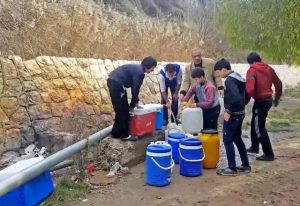
(Syrians fill water containers at roadside in Damascus; AP Screenshot of Damascus-based media outlet)

AFP reported on January 7th that repair teams were set to enter the area affected by damage to the water mains and infrastructure in Wadi Barada region northwest of Damascus.

Clashes continued there overnight and into Saturday morning, killing seven Syrian government soldiers and two civilians, the Syrian Observatory for Human Rights said. But by late morning, state media said maintenance teams had arrived in the area 15 kilometres northwest of Damascus and were “prepared to enter” to begin repair work.

A source close to the regime said a temporary ceasefire had been agreed to allow the repair crews to enter, though it could take days before the mains supply is restored.

Fighting has raged in Wadi Barada for several weeks, despite the December 30 start of a ceasefire brokered by regime ally Russia and rebel backer Turkey. The truce has held across much of the country, though it does not apply to the Daesh terror group or former Al Qaeda affiliate Al Nusra Front, now known as Fateh Al Sham Front.

On Monday, Democracy Now! reported dozens of deaths as a result of a fuel truck explosion in front of a courthouse in rebel-held Azaz in northern Syria.  No group had yet claimed responsibility.  It was also reported that airstrikes had resumed on Sunday in a rebel-held area near Damascus after the failure of negotiations with the Syrian government.

Democracy Now! reported on Tuesday that the Pentagon had acknowledged launching an air raid into Eastern Syria over this past weekend:

Unnamed U.S. officials said the raid was carried out by the Expeditionary Task Force and was aimed at capturing top ISIS militants. The U.K.-based Syrian Observatory for Human Rights says 25 people were killed in the operation. The website Deir Ezzor 24 quoted witnesses who said the U.S. troops landed by helicopter and then left an hour and a half later carrying prisoners and bodies.

Meanwhile, according to Reuters, the Syrian truce hammered out by Russia and Turkey was showing signs of strain as president Assad publicly stated his willingness to negotiate everything at the (as yet undated) peace summit in Kazakhstan:

In comments to French media [full text below], Assad also said his government was ready to negotiate on “everything” at peace talks his Russian allies hope to convene in Astana, Kazakhstan, including his own position within the framework of the Syrian constitution.

But he indicated any new constitution must be put to a referendum and it was up to Syrians to elect their president….

….Russia, Turkey and Iran, the three foreign powers involved in the latest peace drive, plan to divide Syria into informal zones of influence under an outline deal they reached, sources told Reuters in Moscow last month. But such a deal would still need buy-in from Assad, his opponents and, eventually, the Gulf states and Washington.

Rebel groups fighting under the “Free Syrian Army” banner have already frozen any discussion of their possible participation in the Astana talks.

The Syrian government dismisses opposition groups backed by Assad’s enemies as foreign creations. In his comments to the French media, Assad asked: “Who will be (in Astana) from the other side? We do not yet know. Will it be a real Syrian opposition?”

It should be interesting to see how these settlement negotiations actually play out.

*************************

And yet another government report, this one put out by the Director of National Intelligence, seeking to persuade the public that Russia hacked the US presidential election is found just as embarrassingly wanting as the last one.  Below I will provide the reactions of a few noteworthy people, starting with one of the targets of this accusation, Wikileaks’ Julian Assange, who stated in a press conference that it was not an intelligence report but an embarrassment and was a press release for political effect:

“It [the report] is clearly designed for political effect.  And US intelligence services have been politicized by the Obama administration in the production of this report and on a number of other things.”

Glenn Greenwald, appearing on CNN’s Reliable Sources explains that what has been provided by Washington so far with respect to Russian hacking constitutes not “inadequate or weak evidence, but no evidence.”  Assertions repeated over and over with the admonition by intelligence agencies to “trust us” also do not constitute evidence.  He goes on to explain why the history of the last 60 years of US foreign policy provides an excellent basis for not automatically trusting these very agencies when it comes to war and peace issues.  Watch the 4 minute and 40 second interview here:

https://www.youtube.com/watch?v=xU4mRKwlMeI

John McAfee, the founder of the anti-virus software company, also pokes numerous technical and logical holes in the case presented by Washington and subsequently lapped up by the American corporate media on this matter.  Watch his 4 and a half minute interview with RT’s Ed Schulz:

https://www.youtube.com/watch?v=djDu3ygXY9A

Investigative reporter Robert Parry does his deconstruction of the latest report over at Consortium News.  The following excerpt will give you a good synopsis of the quality of the report’s evidence:

Repeating an accusation over and over again is not evidence that the accused is guilty, no matter how much “confidence” the accuser asserts about the conclusion. Nor is it evidence just to suggest that someone has a motive for doing something. Many conspiracy theories are built on the notion of “cui bono” – who benefits – without following up the supposed motive with facts.

But that is essentially what the U.S. intelligence community has done regarding the dangerous accusation that Russian President Vladimir Putin orchestrated a covert information campaign to influence the outcome of the Nov. 8 U.S. presidential election in favor of Republican Donald Trump.

Just a day after Director of National Intelligence James Clapper vowed to go to the greatest possible lengths to supply the public with the evidence behind the accusations, his office released a 25-page report that contained no direct evidence that Russia delivered hacked emails from the Democratic National Committee and Hillary Clinton’s campaign chairman John Podesta to WikiLeaks.

The DNI report amounted to a compendium of reasons to suspect that Russia was the source of the information – built largely on the argument that Russia had a motive for doing so because of its disdain for Democratic nominee Clinton and the potential for friendlier relations with Republican nominee Trump.

But the case, as presented, is one-sided and lacks any actual proof. Further, the continued use of the word “assesses” – as in the U.S. intelligence community “assesses” that Russia is guilty – suggests that the underlying classified information also may be less than conclusive because, in intelligence-world-speak, “assesses” often means “guesses.”

The DNI report admits as much, saying, “Judgments are not intended to imply that we have proof that shows something to be a fact. Assessments are based on collected information, which is often incomplete or fragmentary, as well as logic, argumentation, and precedents.”

But the report’s assessment is more than just a reasonable judgment based on a body of incomplete information. It is tendentious in that it only lays out the case for believing in Russia’s guilt, not reasons for doubting that guilt.

Read the complete piece here.

And last but not least, military blogger Moon of Alabama has pointed out that even members of the usual crowd of “let’s hate evil Russia” pundits have admitted the paltriness of the report’s substance, including Julia Ioffe who tweeted:

It’s hard to tell if the thinness of the report is because the proof is qualified, or because the proof doesn’t exist.

As Moon of Alabama comments:


When you lost even Julia Ioffe on your anti-Russian issue …

Clapper as DNI and Brennan as CIA chief should have been fired years ago. They will both be gone by January 20. The Intelligence Community will remember them as the chief-authors of this devastating failure.

 ****************************
Amy Goodman interviewed Matthew Cole, The Intercept‘s national security reporter, about his recent expose of the elite SEAL Team 6’s atrocities in Afghanistan.  This is the team that reportedly killed Osama bin Laden:
A stunning new exposé published today in The Intercept about the elite military unit SEAL Team 6 reveals a darker side of the group best known for killing Osama bin Laden. National security reporter Matthew Cole spent two years investigating accounts of ghastly atrocities committed by members of the unit, including mutilating corpses, skinnings and attempted beheadings. According to sources, senior command staff were aware of the misconduct but did little to stop it—and often helped to cover it up.
Warning:  a strong stomach is required to watch this interview or read the transcript.


Syria: UN Security Council Approves Turkish-Russian Resolution, Truce Largely Holding, Water Mains Damaged in Damascus; Deconstructing the Latest “Evidence” for Russia Hacking

(Precious water of the Wadi Barada River flowing into Damascus; https://www.newcoldwar.org/damascus-water-source-remains-cut-and-threatened-by-further-damage/)

At the end of December, the UN Security Council passed a resolution drafted by Russia and Turkey for a ceasefire in Syria – meaning that Washington did not exercise its veto, despite the fact that it did not participate at all in the drafting of the resolution.   As of December 30th, the ceasefire was reportedly holding, although it is unclear if all of the rebel groups, outside of ISIS and Al Qaeda/Al Nusra which are not included, have agreed to participate.  There are reports that Al Nusra has taken control of areas in which the water mains serving Damascus are located and is attempting to get other rebel groups to not participate in the ceasefire by arguing that the Syrian government had attacked the area.

The destruction of the water mains, which Al Nusra claims were attacked by the Syrian government and Syrian/Russian sources say were intentionally poisoned by Al Nusra-affiliated “rebels,” has created a crisis in which residents of Damascus are forced to buy overpriced bottled water or resort to water reserves.  Reuters reported on December 29th:

Water supplies from the Wadi Barada and Ain al-Fija springs which serve 70 per cent of Damascus and its surroundings had been cut, the UN’s Office for the Coordination of Humanitarian Affairs (OCHA) said.

OCHA said in a statement that supplies had been cut because “infrastructure was deliberately targeted and damaged”, without saying who was responsible.

The Wadi Barada valley is a rebel-held pocket of territory northwest of Damascus that the Syrian army and its allies have been trying to recapture in an offensive that started last week.

The Associated Press reported further on December 30th:

A resident and rebels in the area said air strikes had damaged a water pumping station. The government accused rebels of polluting the springs with diesel, forcing authorities to cut the supplies on Friday and use reserves instead.

A Damascus resident said each neighborhood only gets water for about two hours a day and bottled water prices had increased dramatically on the open market to more than double the cost at state-subsidised grocery stores.

“The UN is concerned the water cut could lead to diseases transmitted through dirty water, especially in children, in addition to the extra financial burden for families,” OCHA said.

“(People) are having to purchase water from private vendors, where prices and water quality are unregulated,” it said.

Press TV added that:

The terrorists in Wadi Barada have cut water supplies several times in the past to prevent the Syrian army from recapturing the area.

Last week, the Ministry of Water Resources and the Ministry of Local Administration ordered authorities in the provinces of Rif Dimashq and Damascus to start using water reserves until the problem was resolved.

Military analyst blogger, Moon of Alabama, describes the water crisis in Damascus in more detail, pointing out that ISIS and Al Nusra have been using the tactic of destroying or cutting utility supplies rather frequently:

On December 22 al-Qaeda aligned Takfiris in the Wadi Barada valley shut down the main water supply for the Syrian capital Damascus. Since then the city and some 5-6 million living in and around it have to survive on emergency water distributions by the Syrian government. That is barely enough for people to drink – no washing, no showers and no water dependent production is possible.

This shut down is part of a wider, seemingly coordinated strategy to deprive all government held areas of utility supplies. Two days ago the Islamic State shut down a major water intake for Aleppo from the Euphrates. High voltage electricity masts on lines feeding Damascus have been destroyed and repair teams, unlike before, denied access. Gas supplies to parts of Damascus are also cut. A similar tactic was used by the Zionist terrorists of the Haganah who in 1947/48 poisoned and blew up the water mains and oil pipelines to Palestinian Haifa.

********************

On December 29th, New York Times published a “report” (known as the Grizzly Steppe report) put out by the Obama administration (FBI and DHS more specifically) that was supposed to provide more evidence to support hysterical claims of Russia having hacked into DNC emails as well as those of John Podesta, giving them to Wikileaks for publication so as to tilt the election to Donald Trump by airing the Clinton campaign and the Democratic Party’s dirty laundry.   The report was also intended to justify applying new sanctions on Russia.

I looked at the report and found that the majority of the 13 pages described how to prevent and/or mitigate a hack.

Common Dreams quoted cyber-expert, Robert M. Lee’s critique on this point last Friday,

“the FBI/DHS report “is intended to help network defenders; it is not the technical evidence of attribution.”

As such, Lee argued, it is likely to “confuse readers” who are seeking such evidence.”

Now why would the Obama administration want to confuse readers looking for the evidence that the administration claims to be providing?

The few pages that dealt with the actual alleged hack provided no substantive evidence that any hack occurred in relation to these particular emails and were connected to the Russian government.  It is a lot of obfuscation illustrated with some meaningless diagrams.

Common Dreams spoke to Jeffrey Carr, another cyber-expert who stated:

If the White House had unclassified evidence that tied officials in the Russian government to the DNC attack, they would have presented it by now. The fact that they didn’t means either that the evidence doesn’t exist or that it is classified.

If it’s classified, an independent commission should review it because this entire assignment of blame against the Russian government is looking more and more like a domestic political operation run by the White House that relied heavily on questionable intelligence generated by a for-profit cybersecurity firm with a vested interest in selling “attribution-as-a-service.

The most detailed deconstruction of this report is by an academic who specializes in web design and security named David Spring.  Some of the points he makes include:

The government press release written by DHS-FBI did not mention Wikileaks in its report. Nor did the report provide any evidence of Russian hacking in the US elections. Instead, the press release stated that “technical indicators” of Russian hacking were in the “CSV file and XML file attached with the PDF.” However, there was no CSV or XML file or link attached with the PDF. I was eventually able to find these two files at this link.
https://www.us-cert.gov/security-publications/GRIZZLY-STEPPE-Russian-Malicious-Cyber-Activity

To see the evidence of Russian hacking first hand, I downloaded the CSV file and converted it into a spreadsheet. The CSV file and the XML file both contained the same data. Here is the XML link to this data which can be viewed online in a web browser.
https://www.us-cert.gov/sites/default/files/publications/JAR-16-20296.xml

Both files provide a list of 895 “indicators” of Russian Hacking. Unfortunately, nearly all of these indicators are simply IP addresses. In other words, it is a list of 895 servers from from more than 40 countries around the world. But the list also includes a few website domain names. (Domain names are simply the name of the website such as Youtube.com). I looked up these website domain names with the the following tool which tells us who owns the domain names and where they are located:
https://www.whois.net/

My review of these domain names confirmed that none of these domain names have any relationship to Russian government hackers. Here are the results for four of the domain names provided by the DHS and the FBI as evidence of Russian hacking:

ritsoperrol.ru is not in use. It is registered to a private person. The named server hosting the domain is nserver: ns0.xtremeweb.de. This is a German web hosting and consulting company whose address and phone number are publicly listed on their website. It is highly unlikely that Russian hackers would use a public German web host to register and host their domain names.

littlejohnwilhap.ru is not in use and is available to be purchased. It is unlikely that Russian hackers would use a domain name like this to launch a cyber attack on the US.

wilcarobbe.com is taken and is not in use. It is registered to Arsen Ramanov in Groznenskaya Russia. His address, phone number and email address are all publicly listed. It is highly unlikely that Russian hackers would use a domain name that was publicly listed. Hackers are not idiots.

one2shoppee.com is taken and is registered with GoDaddy.com. It is not currently in use. But it is highly unlikely that Russian Hackers would register their domain names with GoDaddy – which is a US server. In fact, it is very unlikely that Russian hackers would ever use any US servers. They would only use their own servers.

How did these four domain names get on a list of Russian hackers? It is possible that some unknown agents took over these domain names and may have used them for some kind of hacking activity. However, the agents could have just as easily been from the US as from Russia. In fact, it is not likely that these domain names were taken over by Russian hackers for the simple reason that Russian hackers are way to smart to be using these silly tactics.

None of the 885 IP addresses have any confirmed relationship to Russian Government Hackers
An IP address is simply a numerical designation for a server. The 885 IP addresses listed in the DHS – FBI CSV file were even more interesting. The IP addresses were located on servers from the US and more than 40 nations around the world including more than 30 IP addresses supposedly located in China. Here are a few of the IP addresses

167.114.35.70

185.12.46.178

46.102.152.132

178.20.55.16

I looked up several of these IP addresses using the following tool:
http://whatismyipaddress.com/ip-lookup

Here are a four examples of IP addresses in the DHS-FBI report:

167.114.35.70 is a Canadian Corporate server specializing in the promotion of Bitcoin. They are within a few miles of the US border.

185.12.46.178 is a Swiss corporate server associated with the domain name leavesorus.com. The domain name leavesorus.com is currently available to be purchased. This indicates that this is a fake domain name and likely a fake corporation.

46.102.152.132 is another Swiss corporate server this one specializing in emails and associated with the domain name maxsultan.xyz which is a fake domain name. This also indicates that this is another fake corporation.

178.20.55.16 is a proxy server with no known location but has been used as a TOR router exit node. A proxy server is another name for a mirror or server used to bounce information from one server to another in order to hide the true location of the original server. This proxy server is associated with the domain name nos-oignons.net. This domain name was registered on December 31 2012 and is valid until December 31 2017. In other words, whoever got this domain name paid for its use for 5 years. But they did registered the domain name anonymously. The website associated with this server appears to be a group in France promoting the TOR router. They became an association in May 2013 – 5 months after getting the domain name. The group currently has 5 members and it costs one Euro to join this group. Their website was reported 9 days ago as having been infected with the Zues virus. This infection does not leave tracks on server logs. So it is difficult to tell where it came from. Removal of this virus requires a complete rebuild of the server. In short, some agency decided to take out this server and then use it to make a cyber attack on some US government agency and thus have the IP address listed on the DHS-FBI list as one of 895 indicators of Russian hacking.

Many of the IP addresses yielded the same dead end or otherwise highly suspicious result – meaning that some very large agency is using hundreds of servers in various countries around the world as a front for hacking attacks. I recently researched a series of attacks on my personal websites from hundreds of IP addresses using hundreds of servers that were supposedly located in the Ukraine. I was able to confirm the exact location in the Ukraine that was supposedly being used to launch literally thousands of attacks on my websites. However, it is not credible that anyone in the Ukraine has the millions of dollars needed to be running hundreds of servers in a remote Ukrainian location. Nor is it likely that anyone in rural Ukraine would even have the knowledge to take care of hundreds of servers even if they did have the millions of dollars needed to plow into buying these servers. Nor are they likely to have the knowledge needed to be running very complex cyber attacks. Ukraine is just not a good location for servers. This experience convinced me that attacks were being launched from other locations and were merely being routed through Ukraine in order to mislead people about where the attacks were really coming from.

Next, the CSV file provided by DHS-FBI listed the physical location of all 885 IP addresses. What is most ironic is that, only two of the 885 IP addresses were from servers in Russia. The most common location of the hacking servers was the United States. Over 30 of the servers were supposedly located in China. But it is known that the NSA has the ability to use satellite mirrors to hide the locations of their servers – making folks believe that the attacks are coming from China (or Ukraine or Mongolia) when in fact they are coming from servers located in the US.

Read the complete article here

Robert Parry points out some additional problems:

The tip-off to how little proof was being offered came in the report’s statement that “The U.S. government assesses that information was leaked to the press and publicly disclosed.” When you read a phrase like “the U.S. government assesses,” it really means the U.S. government is guessing – and the report notably uses a passive tense that doesn’t even assert that the Russians did the leaking.

A well-placed intelligence source told me that there’s little doubt that elements of Russian intelligence penetrated the emails of the Democratic National Committee and Clinton campaign chairman John Podesta, but the Russians were far from alone. Indeed, placing various forms of malware on computers is a common practice, as average folks who periodically take their laptops to an I.T. professional can attest. There’s always some kind of “spyware” or other malicious code to be discovered.

FBI whistleblower Colleen Rowley stated the following in a discussion at the Real News Network:

As far as the new “Grissly Steppe” report, the consensus of my retired intelligence colleagues is that there is the same vague wording indicating conjecture but nothing new in it by way of actual evidence.

And in light of this morning’s news that Putin (wisely) did not take the bait and retaliate tit for tat, which makes Russia appear to be above the fray and thus superior in this stupid propaganda war, I would also add that the U.S. has to be losing respect in the eyes of the rest of the world for its half-baked, unjustified over-reactions.

Here is the official statement by the Russian president on December 30th about the sanctions and the expulsion of 35 Russian diplomats from the U.S. and Russia’s response:

We regard the recent unfriendly steps taken by the outgoing US administration as provocative and aimed at further weakening the Russia-US relationship. This runs contrary to the fundamental interests of both the Russian and American people. Considering the global security responsibilities of Russia and the United States, this is also damaging to international relations as a whole.

As it proceeds from international practice, Russia has reasons to respond in kind. Although we have the right to retaliate, we will not resort to irresponsible ‘kitchen’ diplomacy but will plan our further steps to restore Russian-US relations based on the policies of the Trump Administration.

The diplomats who are returning to Russia will spend the New Year’s holidays with their families and friends. We will not create any problems for US diplomats. We will not expel anyone. We will not prevent their families and children from using their traditional leisure sites during the New Year’s holidays. Moreover, I invite all children of US diplomats accredited in Russia to the New Year and Christmas children’s parties in the Kremlin.

It is regrettable that the Obama Administration is ending its term in this manner. Nevertheless, I offer my New Year greetings to President Obama and his family.

My season’s greetings also to President-elect Donald Trump and the American people.

I wish all of you happiness and prosperity.

It appears that Putin is taking the high road here and is going to just allow Obama to show his bare butt on his way out the White House door.