This kind of reminds me of Putin in 2009 paying a last-minute visit to a factory in Pikalyovo after getting a note from a local trade union leader about a plant that had been closed down due to squabbling among the owners, leaving most of town’s residents out of work and with dysfunctional infrastructure. Putin showed up and reamed the owners of the factory, including Oleg Deripaska. Putin basically told the owners to get off their duffs and get the factory re-opened so the locals could go back to work, otherwise the factory would be taken out of their control. After a sheepish Deripaska had to be persuaded to sign an agreement promising he’d do what he was supposed to do, he started to walk off with Putin’s pen. Putin exclaimed: “And give me my pen back.” A video of the whole thing went viral on YouTube.
Putin recently flew out to the Irkutsk area of Siberia in the aftermath of terrible floods that destroyed many homes, leaving people stranded with complaints that local officials were making access to any assistance difficult and confusing. This video gives you a window into why Putin is still popular among many Russians. Contrast Putin’s taking the time to personally talk to dozens of local people who gathered to ask him for help (and having his aides take down everyone’s name and number for follow-up) with Bush’s handling of Hurricane Katrina or Obama’s handling of the Gulf oil spill or Trump’s handling of the hurricanes in Puerto Rico. I’m also thinking of a recent incident in which a poor homeless woman encounters New York City mayor Bill DeBlasio at a gym and tries to ask him about doing more to help the homeless. He refused to address her question and gave her the brush off.
Does anyone know of any western leader who would take this kind of time and show this kind of patience in listening to scores of citizens’ problems? I wish they would, but most would likely exchange a few words with a handful for a photo op and leave.
Of course, this was video-taped with a reporter shadowing Putin to get it all down for public consumption on the news. Putin will be happy for the PR points, but if that’s all he was after, he wouldn’t have taken this much time. And, like the results of Putin’s intervention with the factory in Pikalyovo 10 years ago, I imagine he will follow up with Irkutsk in September like he promised to ensure that there have been results.
Another point to consider is that bureaucrats lower down the food chain often serve as an obstruction to getting things done, whether it’s implementing reforms or discharging their duties in a conscientious manner. Either they are complacent or they intentionally obstruct for their own reasons. This problem has existed to varying degrees since the czarist era. This is a partial reason for why Putin has to periodically go out into the field and give local officials and business owners the equivalent of a swift kick in the pants by either publicly shaming them and/or threatening to take action against the footdraggers.
Note: I’ve been including a lot of videos of Putin’s speeches, interviews and activities recently to show readers original material so they can see and hear Putin directly and judge for themselves, since most of our media and politicians spin Putin as simply a “thug” and a “brutal dictator” with no redeeming qualities.
Siberia has also been suffering from an unprecedented number of wildfires. In a telephone conversation yesterday with Putin, Trump offered U.S. assistance in fighting the fires in Siberia. Putin said he would take advantage of the offer if it became necessary. He also said that he took the gesture as a positive sign that bilateral relations could potentially be re-built between the two nations.
At a recent conference of the Non-Aligned Movement in Venezuela (I must admit I didn’t know that it still existed), the Grayzone’s Anya Parampil interviewed Russia’s Deputy Foreign Minister, Sergei Ryabkov. Among other interesting things, he discussed the fact that Washington, with its abuse of financial and economic sanctions, is actually provoking many nations of the world to find a way to supplant the U.S. dollar as a reserve currency. I think the phrase is cutting off one’s nose to spite their face. The remarks about the U.S. dollar are around the 15-minute point in the interview.
The arrogance and solipsism displayed by the editors of the New York Times never fails to amaze me. After spending almost 3 years doing their part to push a conspiracy theory in which Russia was the devil to blame for the fact that we have Trump, which just represented an escalated level of the vilification that has been heaped on Putin and Russia in stages since 2003, the New York Times finally decided in a July 21st oped that just maybe Washington should now try to sorta kinda saddle up to Russia just a tiny bit because…you know, China.
Really?
Allow me to provide a short explanation to the out-of-touch NYT editors about why Russia will not be trusting Washington any time soon and has decided that it will likely get better results from the continued strengthening of relations with other important and influential countries.
First, there is the matter of the western corporate media, which is the mouthpiece for the political class, pushing accusations of every incredible crime against Russia’s leader short of cannibalism, and characterizing the Russian people as being inherently dishonest and so primitive that a significant percentage of them are still going to the bathroom in the bushes.
More importantly, however, there are the actual policies that Washington has implemented against Russia since Reagan and Gorbachev negotiated the end of the Cold War, after which Washington chose to take a triumphalist attitude, seeking to press its foot on a supine Russia’s chest as it flexed its muscles in the middle of the ring while the crowds lapped it up.
As readers of this blog are well aware, Secretary of State James Baker, along with other prominent members of the leadership of the western world, promised Gorbachev in early 1990 that in exchange for allowing a reunified Germany into NATO, the military alliance would not move “one inch east” further toward Russia’s borders. This promise was crucial in getting Gorbachev’s agreement as Germany had marched into Russia through the Polish-Ukrainian corridor twice in the first half of the 20th century, the second time resulting in the deaths of 27 million Soviets and the utter destruction of a third of the USSR during WWII.
In 1999, against the advice of knowledgeable diplomats and others, Bill Clinton broke that promise and welcomed Poland, Hungary and the Czech Republic into the alliance.
In 2002, George W. Bush unilaterally withdrew from the Anti-Ballistic Missile (ABM) Treaty, one of three legs of the nuclear arms control arrangements between the two nuclear superpowers, in order to pursue a possible first strike advantage over Russia, upsetting the strategic nuclear balance.
In 2004, NATO was expanded further with the entry of seven new members, including the Baltic states right on Russia’s western border.
In 2006, then-Secretary of State Condoleezza Rice, during a visit to Moscow, had a heated exchange with Putin about the eventual entry of Ukraine and Georgia into NATO. Putin explained that Ukraine was a culturally and ethnically divided country and pushing Ukraine into NATO would likely set off a negative cascade of consequences that would ultimately be detrimental to both Ukraine and Russia. He warned Rice that such a move would amount to “playing with fire.” Two years later, in a cable back to Washington, then ambassador to Russia, William Burns, relayed a conversation with Russian foreign minister, Sergei Lavrov, in which Lavrov reiterated that Ukraine in NATO was a red line for Russia, presciently citing the possibility that exploiting Ukraine’s divisions on behalf of NATO expansion could lead to a civil war and Russia would be faced with having to choose whether or not to intervene – a decision Lavrov said Russia did not want to make.
In 2013-14, the democratically elected leader of Ukraine was pushed out in an illegal coup, actively supported by Washington with neo-Nazis acting as the muscle, that brought an anti-Russian government into power. Crimea, which had historically been part of Russia since the late 18th century with a majority of its population comprised of ethnic Russians and Russian speakers, also had an important naval base on its coast called Sevastopol. Crimea/Sevastopol had been administratively moved by Khrushchev in 1954 from Russia to Ukraine, with no one yet foreseeing the future breakup of the USSR. In 1991, as Ukraine gained its independence, Crimea remained with Ukraine as an autonomous region and Russia retained its naval base in Sevastopol via a leasing agreement with Kiev. As events unfolded on the Maidan in February of 2014, the Russian government feared that NATO could move in on its naval base in Sevastopol.
Earlier this year, with U.S.-Russia relations at an all-time low amidst the constant media rants of Trump being an agent of the Kremlin with Robert Mueller in the role of Mighty Mouse on his way to save the day, the Trump administration announced its unilateral withdrawal from the INF Treaty, the second leg of the nuclear arms control stool.
The New START Treaty, the third and last remaining leg of the stool, which expires in 2021, does not look like it’s long for this world either.
At this point, it’s no wonder that Russia would decide to turn toward constructive working relationships with other countries and multilateral institutions that aren’t controlled by Washington, such as China, the BRICS (Brazil, Russia, India, China and South Africa), SCO, the Chinese Asian Investment Infrastructure Bank, and others.
China is the world’s other major economic power and the leadership in both Russia and China have publicly described the relationship between the two countries as a “strategic partnership.” And the ties seem to be strengthening all the time. According to news recently aggregated by Russia Matters, Russia and China have stepped up joint military practices:
Russian and Chinese bombers conducted their first long-range joint air patrol in the Asia-Pacific on July 23.
To reinforce the strategic importance of Russian-Chinese relations, the day after these maneuvers, the Chinese government published a “white paper” in which it promised to further increase military cooperation between the two countries. More from Russia Matters:
Releasing a new defense “white paper” on July 24, China vowed to step up military cooperation with Russia and accused the U.S. of undermining regional stability, the Wall Street Journal reported. The Sino-Russian military relationship, in contrast, plays “a significant role in maintaining global strategic stability,” the paper said.
Though it aspires to have the leadership role in the region, unlike Washington, China generally does not appear to adhere to a zero-sum mentality in its relations with other nations, opting to focus on investing in mutually beneficial economic projects such as the Belt and Road Initiative (BRI). The Russian-led Eurasian Economic Union is working with the BRI, as is Europe, many of the central Asian countries, Iran and Pakistan. In order for this ambitious project of a modern, high-tech trade route on land and sea that parallels the old Silk Road, China and its partners need a stable Eurasia with a developed infrastructure. Therefore, peace is in all these players’ interests.
As for those who say that ties between the two countries are undermined by China’s potential future designs on Russian territory, I see no substantive evidence that China would do anything of the sort in connection with Russia – a nuclear superpower and, as Obama even begrudgingly admitted before leaving office, is the world’s second most powerful military. There is simply no reason to believe that China’s leadership is stupid or crazy enough to think such a move would be in their interests. It’s not the 1960’s with loose cannons like Khrushchev and Mao at the helm.
Moreover, what Tao Wang of Yicai Research Institute stated at the East Asia Forum three years ago about the Russian-Chinese relationship is still relevant:
….China and Russia are still complementary economies. One is rich in resources and high military technology, while the other is good at mass manufacturing and rich in cash. This complementarity is well demonstrated by their partnership in Central Asia, where China provides investment in resource-rich yet unpredictable countries while Russia ensures the stability of ruling regimes.
So the question becomes: what does Washington really have to offer Russia at this point that would be worth them seriously considering throwing themselves into the Washington camp at China’s expense?
The only truly valuable things that Washington could offer are 1) meaningful nuclear arms control negotiations, and 2) putting a freeze on NATO expansion. Unfortunately, I don’t see either of these things happening in Washington any time soon. Even if Trump decided he really wanted to pursue these things, there is no one around him that could competently conduct negotiations and the infrastructure for meaningful diplomacy – as opposed to the “everything for me and nothing for you” approach that Washington mistakes for diplomacy – is non-existent right now.
But even more than that, why in the world would Russia trust any agreement that Washington got them to sign when it repeatedly breaks agreements whenever it wants? If there’s one thing that Washington has been a smashing success at since the end of the Cold War, it would be convincing the rest of the world that its word isn’t worth 2 cents.
Too many people in the insulated political class in Washington (I’m looking right at you, NYT editors) continue to see the world as a bad facsimile of a professional wrestling show where the goodies and the baddies can switch sides from week to week with just a change of costume and a ham-handed change of narrative at their direction. In the real world, when you’ve spent years pitching diplomacy out the window and systematically destroying any modicum of trust, it works a little differently.
The resolution acknowledged the profound dangers of the recent abrogation of the INF Treaty and called on all candidates to pledge to get back into the agreement, officially renounce a first strike policy, abide by the NPT obligation of nuclear powers to work toward disarmament, and reverse Washington’s opposition to the UN Treaty on the Prohibition of Nuclear Weapons – a treaty supported by virtually all countries of the world except for the current nuclear powers.
United for Peace and Justice described the USCM as:
[T]he nonpartisan association of 1,408 American cities with populations over 30,000, has unanimously adopted Mayors for Peace resolutions for 14 consecutive years. Resolutions adopted at annual meetings become USCM official policy.
As noted in this year’s resolution, “Mayors for Peace is working for a world without nuclear weapons and safe and resilient cities as essential measures for the achievement of lasting world peace, and has grown to 7,756 cities in 163 countries and regions, with 215 U.S. members.”
*****
In a recent post, I expressed skepticism about a Levada Center poll reported on by western media claiming that 10 percent of Russians had been tortured by Russian law enforcement authorities. This post was forwarded by my mentor, Sharon Tennison, to her large network of followers, which includes both Russian and American professionals, including members of academia, law, journalism, retired diplomatic personnel and others who are interested in her three decades of work fostering good will, understanding and citizen-to-citizen ties between the U.S. and Russia. Last week, Sharon posted some important feedback on my post from a Russian-American lawyer, Igor Brusil, who was able to review the original report by the Levada Center. He was also able to speak to the authors of the Levada Center report for clarification on the methodology used. Here is what he reported back:
Yesterday and today I received three emails from the individuals involved in the Levada Center’s survey on torture. These emails clarified what was meant as “torture” in the context of that survey. However, it became clear to me that the key question – “what exactly happened to you that you consider to have been torture” – was not answered by the survey. In fact, such a question was not even posed to the responders.
First, according to Levada Center, it approached the survey from the standpoint of “torture” as this term is defined in the UN Convention Against Torture, which may be found at https://www.ohchr.org/en/professionalinterest/pages/cat.aspx. In that document “torture” is defined in Article 1 as “any act by which severe pain or suffering, whether physical or mental, is intentionally inflicted on a person for such purposes as obtaining from him or a third person information or a confession, punishing him for an act he or a third person has committed or is suspected of having committed, or intimidating or coercing him or a third person, or for any reason based on discrimination of any kind, when such pain or suffering is inflicted by or at the instigation of or with the consent or acquiescence of a public official or other person acting in an official capacity. It does not include pain or suffering arising only from, inherent in or incidental to lawful sanctions.”
Second, it appears that another, more expansive, understanding of “torture” was at play, as described on page 44 of the Levada report. According to page 44, “torture” includes verbal abuse, threats of extortion and other non-physical acts, as well as threats directed at third persons.
Third – and more important – is that those respondents (all 356 of them), who said they had been “tortured” relied on their own understanding of torture. Even more interesting is that Levada did NOT ask those 356 individuals what exactly happened to them that the respondents regarded as “torture.”
I find it curious that those 356 individuals could not even agree on what acts constitute torture. For example, as shown in Table 32 on page 56 of the report, of those “tortured” respondents only 54% regard the use of electrical shock, wet towels and cellophane bags as torture; 73% regard acts like “rape and physical violence that leads to trauma” as torture; and 41% regard verbal abuse as “torture.”
Considering that there may have been up to three understandings of torture at play (one – UN Convention, two – explanation on page 44, three – whatever the respondents thought), the study would have been stronger, in my view, if Levada had asked its respondents to list specific acts of their alleged torture and then applied the same definition of torture to those acts. However, as the survey stands now, it suggests that about 10% of those who had “a conflict” with law enforcement subjectively regard at least some of the acts of law enforcement as torture, but we do NOT know what those acts are.
You may print my initial comment on this survey and follow it up with this summary of the responses I have received from Levada. I think that any intelligent analysis of a survey requires that we know the survey’s methodology and assess its validity in light of the limitations of the methods used.
In a glimmer of hope, a Brussels-based think tank that is funded by the Soros Foundation along with Sweden, Norway, Finland, France, Canada and Australia (among others), has issued a report on the Ukraine conflict that acknowledges what some of us have been saying for a long time: the Donbass rebels are not Russian puppets, but mostly Ukrainian citizens who executed an uprising due to legitimate grievances in the aftermath of the 2014 coup in Kiev.
The International Crisis Group recently publishedRebels Without a Cause: Russia’s Proxies in Eastern Ukraine. According to academic Russia expert Paul Robinson – who brought this report to my attention in a recent blog post:
“The ICG’s report is based on interview[s] with ‘rebels, Russian fighters, former and current Russian officials, and de facto republic officials, as well as analysis of public statements and other open sources.’ It is very clear about the origins of the war in Donbass, telling readers that:”
The conflict in eastern Ukraine started as a grassroots movement. … demonstrations were led by local citizens claiming to represent the region’s Russian-speaking majority. They were concerned both about the political and economic ramifications of the new Kyiv government and about moves, later aborted, by that government to curtail the official use of Russian language throughout the country.
The fact that a western organization is acknowledging this represents a significant change in the narrative, which up to now has insisted that the Donbas rebels were mostly Russians who had spilled over the border (or Ukrainians who were controlled by Moscow) to cause trouble for the new “democracy revolution” government in Kiev.
I’d like to think that this may portend a willingness on the part of some of the political class in the west to work toward the resolution of this conflict in particular and a lowering of tensions with Russia in general. The conflict in the Donbass or with Russia more generally is not in the interests of the people of the west, much less the people of Ukraine or Russia.
With that thought in mind, I’m pleased to report that the latest behind-the-scenes negotiations have resulted in the successful brokering of a ceasefire on the contact line in the Donbas, with both sides having pulled back. According to the OSCE report of July 18th:
BRATISLAVA, 18 July 2019 – OSCE Chairperson-in-Office and Slovak Minister of Foreign and European Affairs Miroslav Lajčák welcomed the new recommitment to an unlimited ceasefire in eastern Ukraine, starting from 21 July at 00 hrs. 01 min. (Kyiv time), as agreed at the meeting of the Trilateral Contact Group held in Minsk on 17 July.
Chairperson Lajčák stressed that this development constitutes an urgently needed and significant step, particularly considering the rising number of civilian casualties along the contact line reported by the OSCE Special Monitoring Mission to Ukraine (SMM). Noting the importance of ensuring the sustainability of the ceasefire in order to avoid the failures of previous recommitments, the Chairperson-in-Office underlined that maintaining the ceasefire is as crucial as the recommitment itself. “A meaningful ceasefire needs to be permanent and irreversible. I urge all sides to live up to their commitments, and finally establish a comprehensive, sustainable and unlimited ceasefire, which can open the door for the peaceful resolution of the conflict,” Lajčák said.
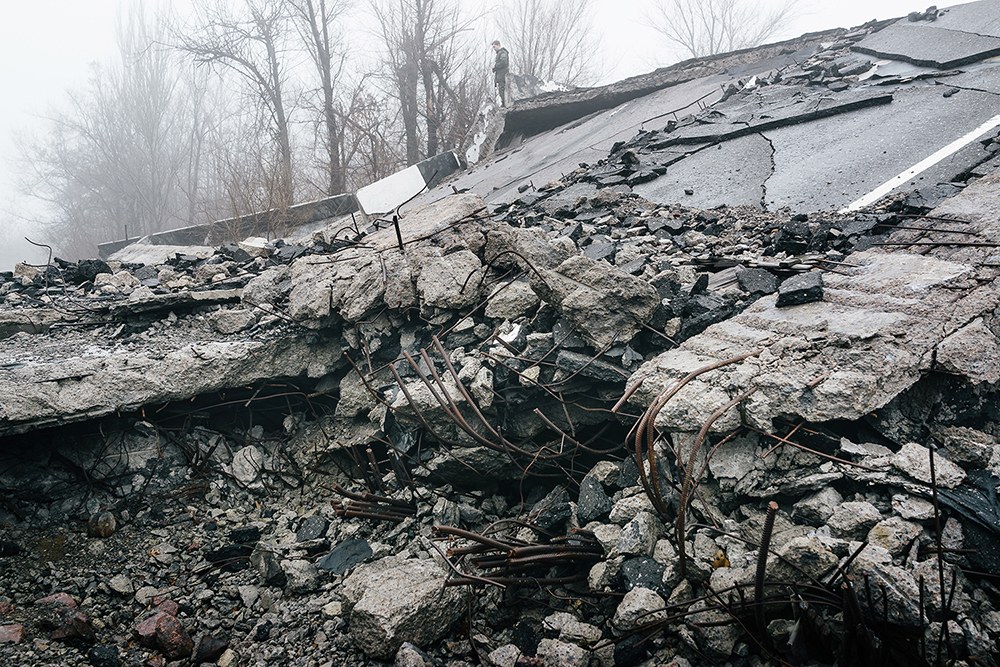
Lajčák noted that this recommitment builds on the positive developments in the recent process of disengagement of forces and hardware from Stanytsia Luhanska, which has been facilitated and monitored by the SMM, as well as in concrete plans to finally repair the bridge –a crucial daily crossing point for thousands of people in the Luhansk region and badly damaged by the conflict. “I particularly welcome the common understanding reached by the sides yesterday in Minsk regarding the need to start repair work on the bridge at Stanytsia Luhanska. These repairs are urgent; they need to happen without delay. The people on the ground have suffered for too long already. And, we need to use this momentum to take even more positive steps forward,” he stressed.
The following day, Ukrainian president Zelensky announced the details of a possible prisoner swap between Ukraine and Russia. The AP reported:
KIEV, Ukraine — Ukraine’s president on Friday outlined the details of an impending prisoner swap with Russia, saying that Kiev is willing to release a jailed Russian journalist in exchange for a Ukrainian film director.
President Volodymyr Zelenskiy’s statement comes at the end of the week of shuttle diplomacy, with the Russian and Ukrainian human rights ombudswomen holding talks both in Moscow and in Kiev. The flurry of activity around imprisoned Russians and Ukrainians follows last week’s first telephone call between Zelenskiy and Russian President Vladimir Putin….
….Zelenskiy said in televised comments Friday that Ukraine could release journalist Kirill Vyshinskiy, who has been in jail for a year on treason charges, if Russia releases film director Oleg Sentsov from a Russian prison colony. Sentsov is serving 20 years in a Russian prison for allegedly plotting acts of terrorism.
I will keep an eye on this development and post any updates if the exchange actually takes place.
Zelensky’s Servant of the People party appears to have won yesterday’s snap parliamentary elections, according to exit polls, but did not win an outright majority. Andriy Purbiy, an avowed neo-Nazi who has served as the speaker for the past several years, will now be out of office. [Update: Zelensky’s Servant of the People party did, in fact, win a majority in the Rada, which gives Zelensky much more room to implement whatever program he wants – NB]
And now for a splash of cold water…
In a recent article, Russia expert Nicolai Petro discussed an incident that doesn’t bode well for the idea of Zelensky resisting the inevitable pressure he’s going to get from the ultra-nationalist elements in Ukraine who won’t stand for any agreement with Russia or reconciliation with the Donbas. A major Russian TV station and a Ukrainian TV station had planned to hold direct people-to-people talks between the two countries but were forced to cancel it due to threats of violence:
On July 7 the Russian television channel Russia-24 and the Ukrainian television channel “NewsOne” announced that they would hold a two-hour live studio discussion called “We Need to Talk” on July 12. NewsOne explained its initiative as a response to the fact that “today in Ukraine roughly 70 percent of people expect direct political discussions with Russia.” It also recalled that during the late 1980s space bridges between Phil Donahue and Vladimir Pozner had “laid the beginnings for contacts between peoples who, thanks to their politicians, found themselves in a Cold War.” Within 24 hours, however, the show was cancelled. Organizers cited “direct physical threats to journalists and their families,” as the reason they had been forced to abandon their attempt to “organize a space for the discussion of nonpolitical questions through the efforts of ordinary people who had never questioned the territorial integrity of Ukraine, without politicians and odious propagandists.”
Needless to say, if this program had been allowed to proceed it could have potentially laid the groundwork for reconciliation between the two neighbors. Perhaps the fact that extremists sabotaged such an effort is not a surprise, but the reaction by various government representatives – including Zelensky – is disturbing. Petro goes on:
The mere idea of engaging in a dialogue with Russians was attacked by nearly every political party. The prime minister said it “played into the hands of the enemy.” The speaker of parliament demanded that the Ukrainian Security services respond immediately to this “brutal violation of Ukrainian law.” The National Council for Television and Radio said it would meet in extraordinary session to consider revoking NewsOne’s broadcasting license. The prosecutor general stated that there was ample legal reason for doing so, and for his part initiated a criminal investigation of NewsOnes owners for support of terrorism and treason. With a bit of Orwellian flair, the National Union of Journalists of Ukraine issued a statement that, while affirming the rights of Ukrainian journalists, declared its “outrage” at the idea of any interaction with “a Russian propaganda channel.”
Such a reaction was more or less expected from the Old Guard that had just been thrashed electorally, but how did the new president respond? He recorded a video and posted it on the Internet, calling the attempt at dialogue “cheap and risky PR-hype on the eve of the elections.” Instead of a televised discussion among average people, Zelensky challenged Putin to sit down with him and four other world leaders—Trump, May, Macron and Merkel—to talk about “who Crimea belongs to and who is ‘not there’ in Donbass.”
It seems to me that Zelensky had an opportunity here to show some leadership, but failed. By agreeing with the suggestion that merely talking to average Russians – whom most Ukrainians have familial ties with – was “cheap” and “risky PR” he is reinforcing the idea that Russians are inherently not to be trusted and an enemy. Instead of allowing a space to be opened up for Ukrainians and Russians to see and talk to each other as regular human beings, he dismissed it out of hand.
As stated in a previous post, if Zelensky is to have any prayer of achieving a positive resolution of the Donbas conflict and a modus vivendi with Ukraine’s next door neighbor – as he promised to do and earned him the election victory, he’s going to have to take on some heavy opposition. The only way he can hope to work around that opposition is by motivating average Ukrainians to have his back. The people-to-people talks could have been a tool on behalf of that if he’d had the savvy to recognize it.
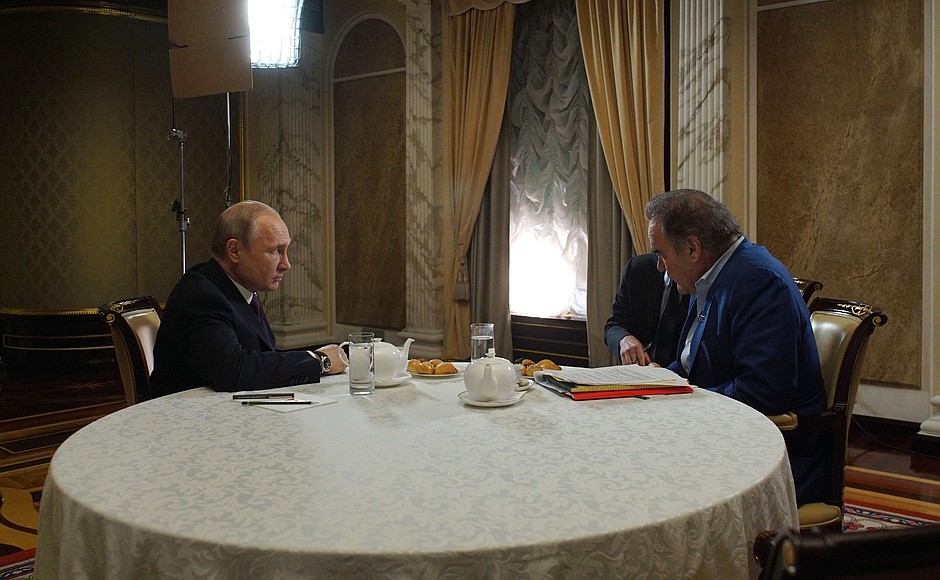
Interview with film director Oliver Stone, June 19, 2019.
On June 19th, Oliver Stone conducted an interview with Putin at the Kremlin. Topics included a heavy focus on Ukraine, as well as touching on U.S. politics and U.S. tensions with Iran.
I’d like to include below a direct quote from Putin in this interview about nationalism. I’ve heard many American pundits and politicians call Putin a nationalist, which I’ve always found to be a disingenuous characterization of him. Putin is what I would call a sovereigntist. He believes unequivocally in national sovereignty and in Russia’s right to be an independent nation that freely makes its own decisions in its perceived interests – engaging in multilateralism when appropriate, but as a respected equal. This is not nationalism in the commonly understood meaning of the word, which denotes a form of national chauvinism – the idea that a country (or ethnic group) is superior to others and has the right to do what it wants at anyone else’s expense. I have never heard Putin say anything that suggests this kind of ideology – unless he’s being quoted out of context, which happens frequently in the west. Moreover, there are real nationalist politicians in Russia, namely Vladimir Zhirinovsky, leader of the LDPR Party. Putin has had public disagreements with Zhirinovsky and those like him. Here is the quote – emphasis is mine:
Vladimir Putin: In general nationalism is a sign of narrow-mindedness but I do not want to offend Mr Medvedchuk [Ukrainian politician and negotiator].
Another excerpt of this interview that I’d like to include involves Iran. I’ve heard several analysts – typically those who do not have a very deep understanding of Russia – claim that Russia would benefit from a U.S. war or continued tensions with Iran. This is nonsense. Whatever short-term benefits Russia might get in the form of fossil fuel economics or other items mentioned, it would pale in comparison to the the larger problems that a conflict in the area would cause: further destabilization of the Middle East – which is much closer to Russia’s backyard than the U.S., and intensified sectarian conflict and increased risk for terrorism that Russia does not want to infect it’s Muslim region in the Caucasus. Here is what Putin had to say about this, preceded by Stone’s question:
Oliver Stone: Continuing that theme of strategy of tension, how is Russia affected by the US-Iranian confrontation?
Vladimir Putin: This worries us because this is happening near our borders. This may destabilize the situation around Iran, affect some countries with which we have very close relations, causing additional refugee flows on a large scale plus substantially damage the world economy as well as the global energy sector. All this is extremely disturbing. Therefore we would welcome any improvement when it comes to relations between the US and Iran. A simple escalation of tension will not be advantageous for anyone. It seems to me that this is also the case with the US. One might think that there are only benefits here, but there will be setbacks as well. The positive and negative factors have to be calculated.
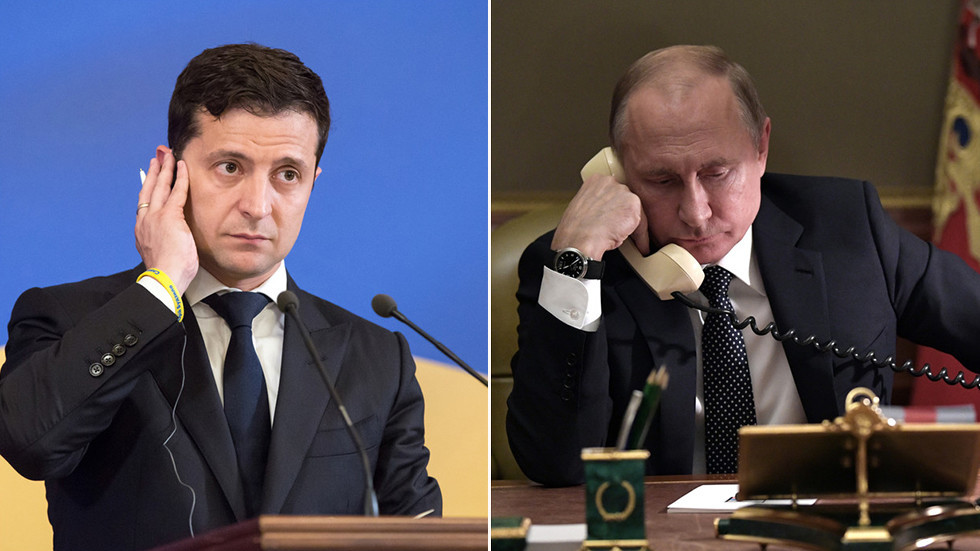
It was reported on July 11th, that Putin had his first direct conversation via telephone with new Ukrainian president Zelensky. According to RT, the call was initiated by Zelensky and focused on possible future negotiations on the Donbas conflict. However, it seems that Putin was irritated by Zelensky’s suggestion that the Normandy format be modified to include the U.S. and outgoing UK Prime Minister Theresa May who would likely be out of office by the time of any such talks:
The two presidents also touched upon the idea of continuing the talks in the ‘Normandy format’, which includes French and German leaders alongside those of Russia and Ukraine. Earlier, Zelensky urged Putin to talk in person in a video address he released on Monday. Yet, he also said that he expects the leaders of the US, the UK, Germany and France to chaperone him during such a meeting.
Zelensky’s decision to invite the outgoing British Prime Minister Theresa May prompted Putin to chide the Ukrainian leader. Putin particularly asked in what capacity she would be present at the talks, which are unlikely to take place before she leaves her post.
It doesn’t seem like Zelensky – an actor and complete political novice – is doing a good job of earning Putin’s respect so far, acting like he needs to be babysat if he’s going to talk to the Russian president. Granted, Trump was also an entertainer with no political experience, but he at least tried to give the impression that he was going to be his own man. Zelensky doesn’t come across as very confident in holding the office that he voluntarily pursued.
The Kremlin put out a very short summary of the phone call:
At the initiative of the Ukrainian side, Vladimir Putin had a telephone conversation with President of Ukraine Vladimir Zelensky .
They discussed issues of settlement in the south-east of Ukraine and joint work on the return of persons held on both sides. An agreement was reached to continue this work at the expert level.
The possibility of continuing contacts in the “Norman format” was also discussed.
We’ve all heard the claims from the MSM and self-serving politicians and pundits that Putin is rehabilitating his “favorite” Soviet/Russian leader, Josef Stalin. But genuine unbiased experts on Russia know that this isn’t true.
Putin has publicly condemned Stalin’s crimes numerous times, most notably in 2007 when he visited Butovo, a mass grave outside of Moscow that holds the bodies of over 20,000 who were shot dead during the height of Stalin’s purges from 1936 – 1938. Putin’s comments, as reported by Reuters, after the visit:
“We know very well that 1937 was the peak of the purges but this year was well prepared by years of cruelty,” Putin said beside a mass grave after laying flowers at a memorial.
Putin said such tragedies “happen when ostensibly attractive but empty ideas are put above fundamental values, values of human life, of rights and freedom.”
“Hundreds of thousands, millions of people were killed and sent to camps, shot and tortured,” he said. “These were people with their own ideas which they were unafraid of speaking out about. They were the cream of the nation.”
Moreover, in October of 2017, Putin attended the opening of the Wall of Grief Monument to the Victims of Repression in Moscow – a monument specifically dedicated to the victims of Stalin’s repressions and a project that he helped get approved. An excerpt of his comments follows:
“Millions of people were branded as enemies of the people, were executed or crippled, underwent torture in prisons and forced deportations,” he said. “This terrible past cannot be erased from the national memory. And certainly cannot be justified by whatever imaginary greater good of the people…
…. “The persecution campaign was a tragedy for our people, our society, a ruthless blow to our culture, roots and identity. We can feel the consequences now and our duty is not to allow it to be forgotten.”
Recently, the Washington Post and The Guardian both ran articles pushing the claim yet again that Putin – in his admiration for Stalin – is seeking to rehabilitate his image in Russia and whitewash his crimes. British Russia expert Paul Robinson, with some research assistance from Russia-based journalist Bryan MacDonald, refutes these accusations:
The more important questions are whether the Post and the Guardian are right that a) Stalin is being rehabilitated in Russia, b) this is the fault of the Russian state, and of Vladimir Putin more personally, and c) allowing the possibility of any ‘heroic’ achievements by the Soviet state – most notably victory in the Second World War – inevitably leads to a whitewashing of Soviet repression. Fortunately, in his Twitter thread Bryan points us to a document which provides an answer, namely a statement issued yesterday by the Permanent Commission on Historical Memory of the Council of the President of the Russian Federation. It’s worth translating this in full [note: I have copied in bold only the first few paragraphs which I think are the most relevant – Natylie]:
We have heard that monuments to I.V. Stalin are being constructed in towns in Russia.
Those of our fellow citizens and those political forces, who are prepared to forget and even justify the death and deprivation of freedom of millions of our compatriots, incite both bitterness and sympathy. Those who were victims of political repression, the deportation of peoples, collectivization, and the Holodomor, were often the best in the country. These repression are firmly connected to the name of I.V. Stalin.
And those who erect monuments voluntarily or involuntarily justify these repressions. These fellow citizens of ours are also victims of that regime: they’ve lost their sense of sympathy for our deeply suffering country.
We do not call for the establishment of monuments to I.V. Stalin on private plots of land to be banned. But civil servants of all levels must know that it is impermissible to allow state or municipal land or buildings to be used for this purpose. Such acts not only contradict morality and respect for our deceased, innocently suffering predecessors, but also contradict official state policy.
In answer to our questions above, what this makes clear is that a) yes indeed, there are moves afoot to rehabilitate Stalin, but b) the Russian state isn’t too fond of these and is pushing back against them, and c) it’s perfectly possible to take pride in the Soviet victory in the Second World War while condemning Stalinist repressions – the idea that celebration of wartime victory inevitably morphs into rehabilitation of Stalin simply isn’t true.
Russians in general have a complicated view of Stalin’s legacy, with his popularity waxing and waning over the years. According to a 2017 Levada poll, 46 percent of Russians had a positive view of Stalin and 43 percent had a negative or indifferent view of him. The majority of respondents in a 2016 poll characterized Stalin as a tyrant and acknowledged that his repressions led to “millions of casualties among innocent Soviet citizens.”