Category Archives: Uncategorized

Politico: Leaked U.S. strategy on Ukraine sees corruption as the real threat

By Nahal Toosi, Politico, 10/2/23

Biden administration officials are far more worried about corruption in Ukraine than they publicly admit, a confidential U.S. strategy document obtained by POLITICO suggests.

The “sensitive but unclassified” version of the long-term U.S. plan lays out numerous steps Washington is taking to help Kyiv root out malfeasance and otherwise reform an array of Ukrainian sectors. It stresses that corruption could cause Western allies to abandon Ukraine’s fight against Russia’s invasion, and that Kyiv cannot put off the anti-graft effort.

“Perceptions of high-level corruption” the confidential version of the document warns, could “undermine the Ukrainian public’s and foreign leaders’ confidence in the war-time government.”

That’s starker than the analysis available in the little-noticed public version of the 22-page document, which the State Department appears to have posted on its website with no fanfare about a month ago.

The confidential version of the “Integrated Country Strategy” is about three times as long and contains many more details about U.S. objectives in Ukraine, from privatizing its banks to helping more schools teach English to encouraging its military to adopt NATO protocols. Many goals are designed to reduce the corruption that bedevils the country.

The quiet release of the strategy, and the fact that the toughest language was left in the confidential version, underscores the messaging challenge facing the Biden team.

The administration wants to press Ukraine to cut graft, not least because U.S. dollars are at stake. But being too loud about the issue could embolden opponents of U.S. aid to Ukraine, many of them Republican lawmakers who are trying to block such assistance. Any perception of weakened American support for Kyiv also could cause more European countries to think twice about their role.

When it comes to the Ukrainians, “there are some honest conversations happening behind the scenes,” a U.S. official familiar with Ukraine policy said. Like others, the person was granted anonymity to discuss a sensitive issue.

Ukrainian graft has long been a concern of U.S. officials all the way up to President Joe Biden. But the topic was deemphasized in the wake of Russia’s February 2022 full-scale invasion, which Biden has called a real-life battle of democracy against autocracy.

For months, Biden aides stuck to brief mentions of corruption. They wanted to show solidarity with Kyiv and avoid giving fuel to a small number of Republican lawmakers critical of U.S. military and economic aid for Ukraine.

More than a year into the full-scale war, U.S. officials are pressing the matter more in public and private. National security adviser Jake Sullivan, for instance, met in early September with a delegation from Ukrainian anti-corruption institutions.

A second U.S. official familiar with the discussions confirmed to POLITICO reports that the Biden administration is talking to Ukrainian leaders about potentially conditioning future economic aid on “reforms to tackle corruption and make Ukraine a more attractive place for private investment.”

Such conditions are not being considered for military aid, the official said.

A spokesperson for Ukraine’s foreign ministry did not respond to requests for comment. But Ukrainian President Volodymyr Zelenskyy has fired several top defense officials in a recent crackdown on alleged graft — a message to the United States and Europe that he’s listening.

The Integrated Country Strategy is a State Department product that draws on contributions from other parts of the U.S. government, including the Defense Department. It includes lists of goals, timelines for achieving them and milestones that U.S. officials would like to see hit. (The State Department produces such strategies for many countries once every few years.)

A State Department official, speaking on behalf of the department, would not say if Washington had shared the longer version of the strategy with the Ukrainian government or whether a classified version exists.

William Taylor, a former U.S. ambassador to Ukraine, said many ordinary Ukrainians will likely welcome the strategy because they, too, are tired of the endemic corruption in their country.

It’s all fine “as long as it doesn’t get in the way of the assistance we provide them to win the war,” he said.

The document says that fulfilling American objectives for Ukraine includes making good on U.S. promises of equipment and training to help Ukraine’s armed forces fend off the Kremlin’s attacks.

The confidential version also describes U.S. goals such as helping reform elements of Ukraine’s national security apparatus to allow for “decentralized, risk-tolerant approach to execution of tasks” and reduce “opportunities for corruption.”

Although the NATO military alliance is not close to allowing Ukraine to join, the American strategy often cites a desire to make Ukraine’s military adopt NATO standards.

One hoped-for milestone listed in the confidential version is that Ukraine’s Defense Ministry “establishes a professionalized junior officer and non-commissioned officer corps with NATO standard doctrine and principles.”

Even the format and content of Ukrainian defense documents should “reflect NATO terminology,” a confidential section of the strategy says.

One target includes creating a “national level resistance plan.” That could allude to ordinary Ukrainians fighting back if Russia gains more territory. (The State Department official would not clarify that point.)

The U.S. also wants to see Ukraine produce its own military equipment by establishing a “domestic defense industry capable of supporting core needs” as well as an environment that boosts defense information technology start-ups, according to one of the confidential sections.

U.S. officials appear especially concerned about the role of an elite few in Ukraine’s economy.

“Deoligarchization, particularly of the energy and mining sectors, is a core tenet to building back a better Ukraine,” the public part of the strategy declares. One indicator of success, the confidential version states, is that the Ukrainian government “embraces meaningful reforms decentralizing control of the energy sector.”

The United States appears eager to help Ukrainian institutions build their oversight capacities. The goals listed include everything from helping local governments assess corruption risks to reforms in human resources offices.

As one example, the strategy says the U.S. is helping the Accounting Chamber of Ukraine enhance its auditing and related work in part so it can track direct budget support from the United States.

The strategy describes ways in which the United States is helping Ukraine’s health sector, cyber defenses and organizations that battle disinformation. It calls for supporting Ukrainian anti-monopoly efforts and initiatives to spur increased tax revenue for the country’s coffers.

The confidential portion calls for Ukraine’s financial systems to “increase lending to encourage business expansion” and a reduction in the state’s role in the banking sector.

One envisioned milestone for that section is that “Alfa Bank is transparently returned to private ownership.” That appears to be a reference to an institution now known as Sense Bank, which was previously Russian-owned but nationalized by Ukraine.

The U.S. strategy appears intent on ensuring that Ukraine not only retains its orientation toward the West but that it develops special ties with America.

One way Washington believes that will happen is through the English language. The strategy indicates the United States is offering technical and other aid to Ukraine’s education ministry to improve the teaching of English and that it believes offering English lessons can help reintegrate Ukrainians freed from Russian occupation.

U.S. officials also are helping Ukraine build its capacity to prosecute war crimes in its own judicial system. The desired milestones include the selection of more than 2,000 new judges and clearing up a backlog of over 9,000 judicial misconduct complaints.

The strategy also calls for rebuilding the U.S. diplomatic presence in Ukraine, expanding beyond Kyiv to cities such as Lviv, Odesa, Kharkiv and Dnipro.

Due to earlier staff drawdowns spurred by the full-scale Russian invasion, “the embassy remains in crisis mode,” one of the public sections states. (The State Department official would not discuss the current Embassy staffing numbers.)

As they have in past communications reported on by POLITICO, U.S. officials note inventive ways in which the United States is providing oversight of American aid to Ukraine despite facing limitations due to the war. Those efforts have included using an app called SEALR to help track the aid.

The Maidan Massacre, Censorship & Ukraine: My Interview with Ivan Katchanovski

By Natylie Baldwin, Consortium News, 10/20/23

Canadian-Ukrainian professor Ivan Katchanovski’s investigation of the Maidan massacre in Kiev in February 2014  found an organized mass killing of both protesters and the police, with the goal of delegitimizing the Yanukovych government and its forces and seizing power in Ukraine, as he wrote for Consortium News in an in-depth article in 2019. (On Wednesday three policemenwere sentenced for the massacre, one was acquitted and one was released for time served. The official investigation ignored Katchanovski’s academic research.)

Natylie Baldwin: Tell us about your Ukrainian background and how you came to be an academic focused on the 2014 coup in Ukraine and the subsequent war?

Ivan Katchanovski: I was born in Western Ukraine. I became interested in politics and conflicts since I was about 10 years old, and I wanted to become professor since then.

The dangerous Cold War and my family experience were motivating factors. My family and I did not participate in any political parties, wars, or other armed conflicts. But politics and conflicts shaped our lives.

My mother lived in four countries and my grandmother lived in five countries without ever moving on their own. I grew up listening to recollections of my mother about her and her family survival during World War Two in Poland when she was a teenager and recollections of my grandmother about her experience as a small child of being a refugee during World War One. They always wished that there would not be another war. 

Although I was interested in studying politics and read hundreds of books about politics of different countries, I could not pursue this formally since there was no such academic discipline in the Soviet Union.

The only department of international relations in Ukraine was in Kyiv University, and it required a recommendation from the regional committee of the Communist Party of the Soviet Union. I could not get such a recommendation, since I was not a party member. When the head of the local party committee asked me in 1985 why I am not joining the Communist Party, which was the only party in existence in the Soviet Union, I told her that I had not decided yet which party to join. But Petro Poroshenko [Ukraine’s post-coup president from 2014 to 2019] and Mikhai Saakashvili [former president of Georgia] were students in this department at Kyiv university at that very time, which means that they got such recommendations from the regional Communist Party committee.   

Poroshenko, on right, with U.S. Vice President Biden in Kiev on Dec. 7, 2015. (U.S. Embassy Kyiv, Flickr)

While I was a student in another Kyiv university in 1988, I attended a small rally organized by the Ukrainian Helsinki Group. This smally rally with a few dozen participants was the first opposition demonstration in Kyiv in some 70 years. I also attended all rallies by Rukh and other Ukrainian organizations in Kyiv in 1988-1990. But I was in a very small minority. I supported the then and now multiparty system, freedom of the media, speech, assembly and rights of ethnic minorities and language rights.

I was threatened with expulsion from my university in Kyiv when I proposed to write my undergraduate thesis based on theories of Max Weber and Western economists. I also proposed to write it in Ukrainian, and the administration told me that I can write it even in Chinese. I wrote it anyway and concluded that the Soviet system was bound to collapse.

While I was not expelled from the university because [Mikhail] Gorbachev’s glasnost started making headway in Ukraine, I was given a “C” grade and could not pursue graduate education then because this required recommendation from the university from which I graduated.

After the Soviet Union collapsed in 1991, I was able to pursue my graduate education in the West. I wrote my PhD dissertation under the direction of Seymour Martin Lipset at George Mason University on regional political divisions and separatist conflicts in Ukraine and Moldova. This study, which I published as a book, predicted a real possibility of a violent break-up and civil war in regionally divided Ukraine, especially with pro-Russian separatism in Crimea and Donbas, similar to what happened in neighboring Moldova after de facto secession of pro-Russian Transdniestria Region with Russian military support following a civil war.

I specialized in the study of comparative politics, conflicts, and political violence in Ukraine since. I researched all major conflicts and cases of political violence in Ukraine since the end of the 1930s, including Stalin’s Great Terror; World War Two; the Nazi collaboration and mass murder of Jews, Poles and Ukrainians by the OUN and the UPA; and the “Orange Revolution.” 

Orange-flag waving demonstrators in Independence Square in Kiev on Nov. 22, 2004. (Serhiy, Wikimedia Commons, CC BY-SA 3.0)

Therefore, as soon as the Maidan started in 2013 and almost immediately turned violent, I started to research it. I published op-eds warning that the violence during the Maidan, specifically by the far-right, could lead to a violent break-up of Ukraine and a civil war. 

But such a possibility was dismissed then by almost all scholars researching Ukraine. I was watching the start of the Maidan massacre live over several Internet streams, but on the next day I noticed that all recordings of these streams disappeared. 

Helmeted protesters face off against police on Dynamivska Street during the Maidan uprising in Kiev, Jan 20, 2014. (Mstyslav Chernov, Wikimedia Commons, CC BY-SA 3.0)

I researched the civil war and Russian military interventions in Donbas as soon as the separatist conflict in Donbas started following the violent overthrow of the Yanukovych government by means of the Maidan massacre and assassination attempts against Yanukovych. 

Before the Russian invasion of Ukraine in February 2022, I warned in my publications, media interviews and social media posts about a real possibility of a war between Russia and Ukraine. I am researching this ongoing war now. My books on the Russia-Ukraine war and its origins, on the Maidan massacre, and on modern Ukraine are forthcoming from three major Western academic presses.

Baldwin:  How did your investigation of the events surrounding the 2014 coup in Ukraine evolve and what are your conclusions?

Katchanovski: I researched the Maidan massacre for almost 10 years. I published a book chapter and two peer-reviewed journal articles on this massacre. Another of my articles on this crucial massacre is in press following very positive peer reviews by two experts. All these articles are open-access thanks to crowdfunding, and can be freely viewed, downloaded, shared, translated and republished.

Donate to CN’s Fall Fund Drive

My studies found that the Maidan massacre was a false-flag mass killing of the protestors and the police in order to seize power in Ukraine. It was conducted with the involvement of oligarchic and far-right elements of the Maidan opposition using concealed groups of Maidan snipers in Maidan-controlled buildings. The evidence shows this beyond any reasonable doubt. 

[Related:  The Buried Maidan Massacre and Its Misrepresentation by the West]

Baldwin: It sounds like your work on these events has been censored.  Please explain what challenges you’ve had in presenting and publishing your work and why you think this has been happening.

Katchanovski:  My comprehensive article concerning the Maidan massacre was accepted for publication with minor revisions by a major peer-reviewed journal but then the decision was reversed in a clear case of political censorship. My appeal, with a supporting letter by Jeffrey Sachs, was rejected. Now the same article has been published as two separate articles in two other major peer-reviewed journals.  

In retaliation for my academic studies of the Maidan massacre, my own house, land, and all property in Western Ukraine were seized by court decisions, which were issued on the orders from the top, despite all the documents and dozens of witness testimonies and in reversals of the decisions by the same judges and courts which confirmed my ownership. My house and all my property there have been damaged. 

I faced ad hominem attacks, denunciations and defamation from a few researchers, most of whom are linked to the Ukrainian far right and obviously have vested interest in whitewashing the far right and denying their involvement in the false flag mass killing of the Maidan protesters. 

Ukrainian opposition leaders Oleh Tyahnybok, seated on van, with Vitali Klitschko and Arseniy Yatsenyuk, addressing Euromaidan demonstrators, Nov. 27, 2013. (Ivan Bandura, Wikimedia Commons, CC BY 2.0) 

A far-right activist linked to Svoboda, which my studies show was implicated in the Maidan massacre, was involved in the creation of several dozens of identical blogs and social media sites calling me “falsifier of the Maidan massacre.” It is telling that he used what he called “scientific anti-Semitism” to justify the OUN-led pogrom of Jews in Nazi-occupied Lviv. 

A small group of Wikipedia editors resorted to similar defamation and fraud in order to whitewash the far right and the far-right involvement in the mass murder of the Maidan protesters and the police. They systematically whitewash the contemporary far right in Ukraine and their historical predecessors from the OUN and the UPA, and their Nazi collaboration and involvement in mass murder of Jews, Poles, and Ukrainians, and smear and defame many scholars of Ukraine.

They include editors who were identified by “Wikipedia’s Intentional Distortion of the History of the Holocaust” article by the University of Ottawa professor. Most of them are identified by various publications and online sources as academics, who are not experts in Ukraine but whitewash the far right and Maidan mass murders and smear scholars either because of political agenda or even possibly for pay.

Silhouette of a victim painted on a sidewalk in Hrushevskoho Street, Kiev, July 2015, over a year after the clashes in Maidan square. (Skoropadsky, Wikimedia Commons, CC BY-SA 4.0)

But my Maidan massacre studies were reported or cited, overwhelmingly positively by over 100 Western scholars and experts. Such leading scholars and experts as Richard Sakwa, (University of Kent), Professor David Lane (Cambridge University), Jeffrey Sachs (Columbia University), Jack Matlock (Duke University and the former U.S. ambassador to the Soviet Union), Stephen F. Cohen (New York University), Anatol Lieven (Quincy Institute), and many others in their peer-reviewed articles, books, and media publications either accepted my research findings concerning the Maidan massacre or [have] written favorably about my studies of this massacre.

Similarly, more than a hundred Western media outlets and over 50 Ukrainian media outlets positively reported or cited findings of my Maidan massacre studies: They include major American, Austrian, Canadian, Danish, Dutch, German, Greek, Italian, New Zealand, Norwegian, Spanish, and Swiss media outlets such as The NationHuffington PostCourthouse NewsJacobinConsortium NewsCounterpunchThe GrayzoneTruthout, and Ukraina Moloda.

Their number is dozens of times higher than the few Western and Ukrainian media which attacked or denounced my Maidan massacre studies by resorting to outright fraud or the deliberate omission of overwhelming evidence revealed by my studies and the Maidan massacre trial.  

But the absolute majority of the Western media deliberately does not report concerning findings of my studies of this massacre and various overwhelming evidence that this was a false-flag operation with the far-right involvement. 

Feb. 18, 2014: Protesters throwing pieces of brick pavement at Ukrainian troops obscured by the smoke of burning tires in Kiev. (Mstyslav Chernov, Wikimedia Commons, CC BY-SA 3.0)

In contrast, my interviews, comments and publications concerning my other research areas, such as the Russia-Ukraine war, the war in Donbas and World War Two, appeared in more than 3,000 media reports in some 75 countries. They include the following media: Associated Press, BBC Ukrainian, Canadian Press, CBC News, CTV News, Daily Express, France 24, Global TV, Globe and Mail, The Guardian, Hill TV, Le Figaro, National Post, Reuters, Times Higher Education, Toronto Star, Vice, Voice of America, The Washington Post, Euronews, Sky News Australia and CNN Brazil.

My research-based tweets and interviews concerning the standing ovation to the SS Galicia Division veteran by the Canadian parliament, the Canadian prime-minister and [Ukraine’s President Volodymyr] Zelensky were reported by several hundred media in dozens of countries and helped to make it the top story in Canada and one of major stories in the U.S., Poland and other countries.

[Related: Apologies in Canada for Honoring Ukrainian Nazi

There is also outright media censorship concerning my Maidan massacre research. A popular Polish media outlet Onet removed my interview following a request from the office of president of Poland. British OpenDemocracy accepted for publication in 2014 a popular version of my original study but did not publish it. A dozen of my interviews concerning the Maidan massacre were either not reported or canceled by major TV networks, radio stations and newspapers in the U.S., Canada and the EU. 

My applications for research funding or research positions in Canada and the U.S. were denied since I first presented my study of the Maidan massacre in 2014, including during the current war, even though I am one of the most cited political scientists specializing primarily in the conflicts and politics in Ukraine and earlier held such research positions at Harvard, the University of Toronto, and the Kluge Center at the Library of Congress.

Donate to CN’s Fall Fund Drive

I published four books, 20 articles in peer-reviewed journals, and 12 book chapters, and have three forthcoming books on Ukraine. And I am one of a few Ukrainian political scientists in the Western academy specializing in conflicts in Ukraine.

I was denied presentations in Ukrainian studies conferences in Canada and the U.S. One of the persons, who denied me a Canadian government-funded research grant, denounced me on Twitter for my Maidan massacre studies and suggested that she contacted my university demanding my removal. She is a professor specializing in Canada and not Ukraine but claims to know simply because she is from the Ukrainian diaspora.

I intended to use this large research grant to pay for open access publication of my articles and book. I used my own money to fund my Maidan massacre research, and I am thankful for ongoing crowdfunding support for open access publication of my articles and a book from over 100 donations.   

It is simply astonishing and revealing that I am the one punished for my academic studies of the Maidan massacre, while mass murders of the Maidan protesters and the police are supported, whitewashed, and even glorified by the Westen governments, politicians, the media, and even by many academics.

Baldwin: You’ve talked periodically about investigations and court proceedings in Ukraine regarding the events surrounding the Maidan and the change of government that resulted from it. Can you tell us more about those court proceedings and investigations – how are they set up and what are they investigating?  What are the most interesting revelations that have come out of them and do you think there will be any meaningful accountability for illegal and/or violent actions?

Ukrainian Internal Troops form a phalanx against protesters with Berkut special police grouped behind them. (Amakuha, Wikimedia Commons, CC BY-SA 3.0)

Katchanovski: The Maidan massacre trial, which started in 2015, examined charges against five members of Berkut [a special police unit] who are charged with the massacre of the Maidan protesters on Feb. 20, 2014.  

My recent peer-reviewed journal article and video appendixes show that the absolute majority of wounded protesters testified at the trial and the investigation that they were in fact shot by snipers from Maidan-controlled buildings or areas or that they witnessed snipers there. 

Some 100 prosecution and defense witnesses and relatives of killed protesters also testified about snipers in the Maidan-controlled buildings and areas. This is consistent with testimonies by several hundred other witnesses and confessions by 14 self-admitted members of Maidan sniper groups.

Statements by the far-right Svoboda Party, videos and numerous witnesses show that the Hotel Ukraina and other buildings, which were locations of snipers who massacred the protesters and the police, were controlled then by the Maidan forces. My analysis of synchronized videos revealed Maidan snipers in these buildings during the massacre.

Forensic medical examinations by government experts showed that nearly all protesters were shot from the top, the back, and from the side directions, which match these Maidan-controlled buildings. 

Government forensic ballistic experts determined that many protesters were killed or wounded from the Hotel Ukraina and other Maidan-controlled buildings or areas. A forensic ballistic examination by government experts with use of an automatic computer-based system found that bullets extracted from killed protesters did not match bullets from the Kalashnikov assault rifles of Berkut police. My analysis of synchronized videos showed that the specific time and direction of shooting by Berkut policemen did not coincide with the killing of specific protesters. 

But the government investigation in Ukraine in a most blatant cover-up simply denies that there were any snipers in these Maidan controlled buildings in spite of the undeniable evidence. As part of such a cover-up, no one was convicted or under arrest for the massacre of the protesters and the police for almost 10 years after this massacre, which was one of the most documented cases of mass killing in history. 

Crucial evidence, such as security cameras recordings, bullets, shields and helmets, “disappeared” or were destroyed. There is also tampering with evidence, such as bullets and forensic ballistic examinations, whose results were reversed without any explanation and contrary to videos, witnesses and forensic medical examinations. There is no trial for the killing of the police even though Maidan snipers, in particular, members of a far-right-linked group, publicly confessed in Ukrainian and Western media interviews of killing or shooting the police during the massacre.    

Baldwin: Given that Ukraine is your family homeland, what is currently happening there must inform your work in a way that is different from other experts who may not have a personal connection. How has this war, both from 2014 and from 2022, personally affected you and your family?

Katchanovski: My relatives live in Western Ukraine which was not much affected by the war. One distant relative was wounded during the war in Donbas. My best friend, who lived then in Mariupol with his family, disappeared after the Russian invasion in 2022. We studied together at Central European University in Prague and communicated over Skype often when he was in Mariupol or taught in American universities in Iraq and Afghanistan. 

War-damaged Mariupol on March 12, 2022. (Mvs.gov.ua, CC BY 4.0, Wikimedia Commons)

Baldwin:  You made reference on Twitter to a recent poll of Ukrainians living both in and outside Ukraine that found 43 percent of those in Ukraine and 36 percent of those in Europe disagree that Neo-Nazi ideology is not a significant problem in Ukraine.  It also revealed that 29 percent of those in Ukraine and 35 percent of those in Europe disagree that the 2014 Maidan events were not a coup. Can you discuss these results and their significance given the western media narrative about what’s been going on in Ukraine since 2014?

Katchanovski: Since the poll question does not specify “no spread” as an answer, this poll means that 46 percent of respondents in Ukraine agree that Nazi/neo-Nazi ideology has a small spread in Ukraine, while 43 percent disagree, i.e. regard Nazi/neo-Nazi ideology spread as either significant or non-existent.

This poll, like other polls in Ukraine during the Russia-Ukraine war, underestimate responses that go against the narrative propagated by the Ukrainian government, in particular concerning the Maidan. Russian-annexed parts of Ukraine, including pro-Russian Crimea and Donbas, are excluded. There are also social/political desirability bias and fear to express views contrary to the official narrative of the Zelensky government. 

Protesters in Kiev with neo-Nazi symbols – SS-Volunteer Division “Galicia” and Patriot of Ukraine flags, 2014. (CC BY-SA 3.0, Wikimedia Commons)

The poll results show that contrary to the narrative propagated by Western and Ukrainian governments and the media, Ukrainians have different views concerning the Maidan and the far-right in Ukraine. But this poll also contradicts the narrative propagated by the Russian government and the media about Nazi or neo-Nazi regime in Ukraine since a “fascist coup” in 2014.  

Baldwin:  I’ve seen you mention on social media that there is a Neo-Nazi element in the Wagner forces.  Can you tell us more about that?  Does it have to do with a lot of them being convicts?

Katchanovski: It was Dmitry Utkin, the Wagner military commander, who used Nazi SS symbols as his signature and the name of the Hitler’s favorite composer as his nom de guerre, which became the name of the Wagner mercenary company. The Wagner company also included small “Rusich” unit, which was organized and led by Russian neo-Nazis. 

Natylie Baldwin is the author of The View from Moscow: Understanding Russia and U.S.-Russia Relations. Her writing has appeared in various publications including The Grayzone, Antiwar.com, Covert Action Magazine, RT, OpEd News, The Globe Post, The New York Journal of Books and Dissident Voice. She blogs at natyliesbaldwin.com.  Twitter: @natyliesb.

Views expressed in this article may or may not reflect those of Consortium News.

Simplicius The Thinker: Army War College Report Predicts Mass Casualties in Near-Peer Fight Against [Russia] – Analysis (excerpt)

Substack, 10/3/23

A few weeks ago the U.S. Army War College released a paper which was an urgent call for the U.S. armed forces to adapt to the modern style of warfare being innovated in the Ukrainian conflict. [https://press.armywarcollege.edu/cgi/viewcontent.cgi?article=3240&context=parameters]

The paper made the rounds due to some startling admissions, which we’ll get to. But what’s most important to understand is that it represents a general shift in thinking that’s propagating throughout the entire sphere of the Atlanticist West, and was released in concert with several other key thinktank pieces and policy shift announcements from the EU, NATO, etc., which holistically represent an internal panic deep within their structures, resulting in an urgent need for a strategy change.

And this point is one of the central themes of the War College paper itself. Its opening preamble can be summarized in a single sentence: the current time period marked by the Ukrainian conflict represents the largest “inflection point” in 50 years of military history. The authors believe that the Yom Kippur War of 1973 was the previous most impactful inflection point. They recount how the U.S. army was demoralized by its experience in Vietnam, and inability to meet its objectives, followed by Israel almost losing to a Soviet-equipped Egypt in the Yom Kippur War.

As a very brief and over-generalized backdrop, though Israel is listed as officially having “won” the Yom Kippur War, Egypt in fact achieved most of its political objectives, which was to seize some land east of the Suez in order to eventually take back the Sinai peninsula, which they did. And although Egypt made huge blunders that caused part of their army to be routed, ultimately the war proved to Israel, the U.S., and allies that the future would be dangerous as the Arabs were getting much stronger, particularly under Soviet backing. In fact, for anyone interested, just purely coincidentally there’s a new article from a week ago in the Jerusalem Post about the irony that years later, Israel views the Yom Kippur War as a somber experience whereas in Egypt it’s celebrated as a grand victory.

Either way, the War College explains that as a result of this inflection period, the U.S. founded TRADOC (United States Army Training and Doctrine Command) school. Which is actually a network of schools tasked with creating new operational doctrines to prepare the U.S. military for future conflicts. In short, they were spooked by the developments of the previous years, and needed a way to “jump ahead” of the competition. This resulted in a series of new doctrines like the AirLand Battle I wrote about at length in this previous dissection of a U.S. internal thinkpiece:…

But this seems to highlight the odd dichotomy: on one hand the entire report, entitled Escalation in the War in Ukraine, appears to go into overdrive in attempting to convince readers and policymakers that Russia is surrounded by a plethora of escalation options, insinuating that it will have no choice but to use one of them as it gets increasingly ‘desperate’ in the war effort. But on the other hand, they admit Russia actually doesn’t see any reason to escalate. [https://www.rand.org/pubs/research_reports/RRA2807-1.html]

This leaves us to conclude that the real current course in Western military command centers and thinktank-land revolves around finding further pressure points and ways to make Russia want to escalate in a way that could turn global perception against it, and could justify further NATO intervention of some kind to save Ukraine. In a sense, as I implied before, this report appears more like a handbook or guidebook on how to make Russia give us the casus belli to increase our own provocations and escalations to save a floundering AFU.

What it ultimately highlights is the fact that the West appears greatly irked and peeved by Russia’s stoic, mannered approach to this war. They are beside themselves, and can’t believe that Russia can fight such a devastatingly protracted conflict in so calm and measured a manner, without major political, societal, and economic upheaval to throw them off-kilter and create the ripe groundswell of turmoil which would necessitate an off-balancing “escalation” that would prove a major blunder, and hand the salivating NATO thinktankers an enormous gift.

Thus, in light of this, the West plans to use all possible means to coax Russia into shooting itself in the foot by disproportionately responding to one of the planned provocations they have in store, in order to give raison d’etre for some intervention to save Ukraine. This doesn’t have to be something of maximal proportions yet, like full-on NATO invasion or something like that. No, even the justification of further increased support, or the activation of more lethal strategic weaponry supplied to Ukraine would suffice.

Remember, a major portion—perhaps the biggest one—of the West’s support is convincing their own publics and lawmakers in justifying increasingly more provocative weapons pledges. Even provoking a relatively minor Russian rash response could be used to convince wearying Western populaces in warming to the hand over of things like ATACMS or other items.

Of course, I find all this to be a relatively pointless exercise and strategic dead-end because I don’t think they have much left to hand over that could do anything in changing the now-crystallized trajectory of this conflict. The only other potential pivot I could glean from the Rand document which could conceivably form the axis of a strategy is in the final item on their escalations options list: Option G.

It reads: Ukraine expands its strikes inside Russia. Motivation: Increase domestic political costs for Russian leadership.

That encapsulates just about the only realistic option they have left, and given recent trends it appears to be one of the main thrusts they’re going with. I’m referring to the other big recent provocation, German Bundestag member Marie-Agnes Strack-Zimmermann’s statement that Ukraine has the right to strike Russian territory with German Taurus missiles. Putting the two together, we can only come to the conclusion that the progressive push for Ukraine to strike deeper and deeper into Russian territory has nothing whatever to do with any strategic or military considerations, but rather revolves entirely around Rand’s assessment of “putting political pressure on Russian leadership.”

To wit, they believe that by striking deep into Russia they can cause enough fear, panic, and public distress as to force Russian citizens to begin pressuring the government to end the war, or simply create enough unpopularity as to give Western intel services opportunities to oust key leadership, whether that might be election, overthrow, etc. Unfortunately, this has virtually no chance of having any effect as the Russian public either doesn’t care nor notice any strikes, including the ones to the heart of Moscow, or is simply unified into greater solidarity by them.

Dmitry Medvedev’s “populist” pandering-style response to both the aforementioned provocative announcements likely leaves Western thinktankers with an inkling of hope:

“The number of leadership idiots in NATO countries is growing.

“One newfangled cretin – the British defense minister – has decided to move British training courses for Ukrainian soldiers to the territory of Ukraine itself. That is, to turn their instructors into a legal target for our Armed Forces. Realizing perfectly well that they will be ruthlessly destroyed. And not as mercenaries, but as British NATO specialists.

“Another fool – the head of the Defense Committee of the Federal Republic of Germany with a hard-to-pronounce surname – demands to immediately supply the Khokhobanderites with Taurus missiles, so that the Kiev regime can strike at the territory of Russia to weaken the supply of our army. They say this is in accordance with international law. Well, in that case, strikes on German factories where these missiles are made would also be in full compliance with international law.

“After all, these morons are actively pushing us towards World War III….”

– Medvedev

But alas, ever the stoic practitioner of the ‘long game’, I doubt Putin will give them the uncharacteristic slipup they’re counting on to salvage their disastrous Ukrainian campaign. Painful as it might be for us to take some of the obviously deliberate provocations ‘on the cheek,’ good chance remains that sometime in the future, after Ukraine’s rapid disintegration and subsequent capitulation—perhaps even only a year or two from now—we may recognize, in hindsight, the wisdom of the strategy which staved off nuclear war by way of a methodical, unwavering, and strategically disciplined approach.

“Prove it or it didn’t happen!” Putin tells Israel show us the proof; Israel v. Hezbollah? | Redacted News

Putin says Israel needs to publish satellite evidence that it didn’t bomb Gaza hospital. Link here, embed below.

Israel v. Hezbollah? Link here, embed below.

Scott Ritter: No ‘End of History’ in Ukraine

By Scott Ritter, Consortium News, 10/3/23

“What we are witnessing is not just the end of the Cold War, or a passing of a particular period of postwar history, but the end of history as such: that is, the end point of mankind’s ideological evolution and the universalization of Western liberal democracy as the final form of human government.”

These words, written by the American political scientist Francis Fukuyama, who in 1989 published “The End of History,” an article that turned the academic world upside down.

“Liberal democracy,” Fukuyama wrote, “replaces the irrational desire to be recognized as greater than others with a rational desire to be recognized as equal.”

“A world made up of liberal democracies, then, should have much less incentive for war, since all nations would reciprocally recognize one another’s legitimacy. And indeed, there is substantial empirical evidence from the past couple of hundred years that liberal democracies do not behave imperialistically toward one another, even if they are perfectly capable of going to war with states that are not democracies and do not share their fundamental values. “

But there was a catch. Fukuyama went on to note that, 

“[N]ationalism is currently on the rise in regions like Eastern Europe and the Soviet Union where peoples have long been denied their national identities, and yet within the world’s oldest and most secure nationalities, nationalism is undergoing a process of change. The demand for national recognition in Western Europe has been domesticated and made compatible with universal recognition, much like religion three or four centuries before.”

Global Model 

This growing nationalism was the poison pill to Fukuyama’s thesis regarding the primacy of liberal democracy. The foundational premise of the then-burgeoning neoconservative philosophical construct of a “new American century” was that liberal democracy, as practiced by the United States and, to a lesser extent, Western Europe, would become the model upon which the world would be rebuilt, under American leadership, in the post-Cold War era. 

These paragons of the twisted confluence of capitalism and neoliberalism would have done well to reflect on the words of their arch-nemesis, Karl Marx, who famously observed that,

“Men make their own history, but they do not make it as they please; they do not make it under self-selected circumstances, but under circumstances existing already, given and transmitted from the past. The tradition of all dead generations weighs like a nightmare on the brains of the living.”

E. Capiro’s 1895 oil painting of Karl Marx and Friedrich Engels in the printing house of their German daily Neue Rheinische Zeitung, published in Cologne at the time of the Revolution of 1848-1849. (Wikimedia Commons, Public domain)

History, it seems, can never end, but rather is reincarnated, over and over, from a foundation of history influenced by the actions of the past, infected as they are with the mistakes that are derived from the human condition.

One of the mistakes made by Fukuyama and the proponents of liberal democracy, who embraced his “end of history” ideal in reaching their conclusion, is that the key to historical progression lies not in the future, which has yet to be written, but in the past, which serves as the foundation upon which everything is built.

Historical foundations run deep — deeper than the memories of most academics. There are lessons of the past that reside in the soul of those most impacted by events, both those recorded in writing and those passed down orally from generation to generation. 

Academics such as Fukuyama study the present time, drawing conclusions based upon a shallow understanding of the complexities of times past. 

Donate to CN’s Fall Fund Drive

According to Fukuyama, history ended with the conclusion of the Cold War, perceived as a decisive victory of the liberal democratic order over its ideological opponent, world communism. 

But what if the collapse of the Soviet Union — the event seen by most historians as signaling the end of the Cold War — wasn’t triggered by the manifestation of the victory over communism by liberal democracy, but rather by the weight of history defined by the consequences of prior “end of history” moments? What if the sins of the fathers were transferred to the progeny of previous historical failures? 

War & Revived Nationalism 

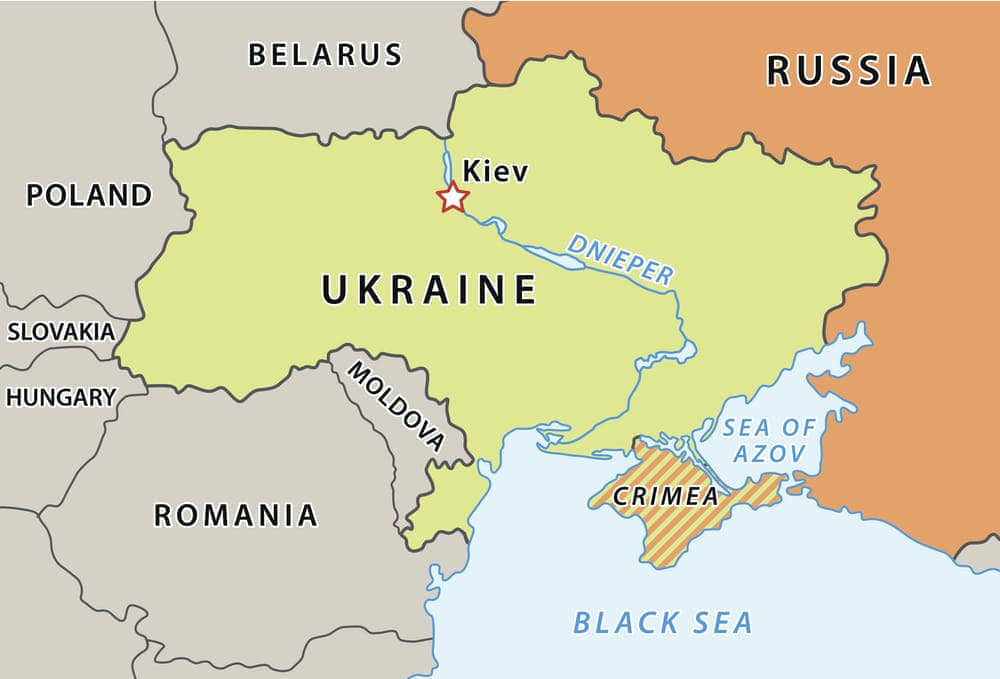
Of the many points of conflict occurring in the world today, one stands out as a manifestation of the ongoing fascination liberal democracy adherents have with the victory over communism, which they thought was won more than three decades ago, namely, the ongoing conflict between Russia and Ukraine.

Political scientists in the Fukuyama “end of history” school view this  conflict as being derived by the resistance of the remnants of Soviet regional hegemony (i.e., modern-day Russia, led by its president, Vladimir Putin) over the inevitability of liberal democracy taking hold.

But a closer examination of the Russian-Ukraine conflict points to the present conflicts being born of not simply the incomplete divorce of Ukraine from the Soviet/Russian orbit that occurred at the end of the Cold War, but also the detritus from the collapse of previous ruling systems, especially the Tsarist Russian and Austro-Hungarian Empires.

Treaty of Brest-Litovsk map showing territory lost by Bolshevik Russia in 1918. (Department of History, U.S. Military Academy, Public domain)

Indeed, the current conflict in Ukraine has nothing to do with any modern-day manifestation of the Cold War bipolarity, and everything to do with the resurrection of national identities which existed, however imperfectly, centuries before the Cold War even began.

To understand the roots of the Ukrainian-Russian conflict, one needs to study  German actions after the 1918 Treaty of Brest-Litovsk, the rise and fall of Symon Petliura and the Polish-Soviet War — all of which predated the Molotov-Ribbentrop Pact and the dissection of Galicia that took place in 1939 and 1945. 

These actions were all triggered by the collapse of Tsarist and Austro-Hungarian power, and then united by violent efforts to allow local realities to shape the final disposition of a region frozen in place by the rise of Soviet power.

The dislocation felt by many Ukrainians today from all things Russian can be traced to the failed attempt at forming a nascent Ukrainian nation in the chaotic aftermath of the First World War and the collapse of both Tsarist Russia and the Austro-Hungarian Empire – all prior to the consolidation of both Polish and Bolshevik power.

The Brief Rise and Fall of a Ukrainian State, 1918-1921

The Ukrainian People’s Republic, led by the nationalist Symon Petliura, proclaimed its independence from Russia in January 1918. It did so backed the German army, which occupied the Republic after the Central Powers, led by Germany, signed the Brest-Litovsk Treaty with Ukraine in February 1918. (Russia and the Central Powers signed a separate Brest-Litovsk Treaty in March 1918).

The German military occupiers then dissolved the socialist, Ukrainian People’s Republic in April 1918, replacing it with the Ukrainian State, also known as the Second Hetmanate. (The First Hetmanate was a Ukrainian Cossack State that existed in the Zaporizhian region from 1648 until 1764).

Symon Petliura (Wikipedia/Public Domain)

But the Ukrainian State survived only until December 1918, when forces loyal to the deposed Ukrainian People’s Republic, led by Petliura, overthrew the Second Hetmanate, and reclaimed control over Ukraine.

During this time the physical dimensions of the Ukrainian People’s Republic was in constant flux. In the short first tenure of the Ukrainian People’s Republic, two territories claimed as Ukrainian — centered round Odessa and Kharkov — declared their independence from the Ukrainian People’s Republic, and instead opted to join Russia [as four regions today have similarly opted to join Russia]. 

In November 1918 a portion of the Austro-Hungarian Empire’s Galician territories possessing a Ukrainian majority declared its independence, organized itself as the Western Ukrainian Republic, and in January 1919 merged with the Ukrainian People’s Republic.

But upon its creation, the Western Ukrainian Republic found itself at war with a newly independent Poland and, following the merger between the Western Ukrainian Republic and the Ukrainian People’s Republic, the war morphed into a general conflict between Poland and Ukraine.

One of the major battlegrounds of this conflict was the western Galician territory of Volhynia. It was here that Ukrainian troops undertook the slaughter of thousands of Jews, for which Petliura has been blamed.

End of Ukrainian Republic

The Polish-Ukrainian war ended in December 1919 with the defeat of the Ukrainian People’s Republic. One of the major reasons for this defeat was the rise of Soviet power as the Russian Civil War reached its violent conclusions in the territories abutting the Ukrainian People’s Republic, allowing the victorious Red Army to turn its attention to consolidating Bolshevik authority over the territory of Ukraine.

This led to a peace treaty between the Ukrainian People’s Republic and Poland which saw the territories of the former Western Ukrainian Republic turned over to Poland in exchange for Polish assistance against the Bolsheviks.

The alliance between Poland and the Ukrainian People’s Republic, concluded in April 1919, led to a Polish offensive against the Soviet Union which ended with the capture of Kiev by Polish troops in May 1919. A Soviet counterattack in June took the Red Army to the gates of Warsaw, only to be thrown back in August by Polish forces, which began to advance eastward until the Soviets sued for peace, in October 1920.

While various efforts to end the Polish-Soviet conflict had been brokered on the basis of a delineation of territory known as the Curzon Line, named after the British Lord who first proposed it back in 1919, the final demarcation of the border was negotiated via the Treaty of Riga, signed in March 1921, which formally ended the Polish-Soviet war.

The so-called “Riga Line” had Poland taking control of large amounts of territory well east of the Curzon Line, leading to longstanding resentment by Soviet authorities.

The Treaty of Riga imposed boundaries on a region with no regard to the ethnic composition of the people living there, leading to a mixing of populations that were inherently hostile toward one another.

The end of the Western Ukrainian Republic, in 1919, led to the political leadership of that entity going into diaspora in Europe, where they pressed the governments of Europe to recognize the independent status of the Western Ukrainian nation.

Rise of Bandera

Stepan Bandera torchlight parade in Kiev, Jan. 1, 2020. (A1/Wikimedia Commons)

This diaspora worked closely with disaffected Ukrainian nationalists who found themselves under Polish governance in the aftermath of the Polish-Soviet war. Among these Ukrainian nationalists was Stepan Bandera, an adherent of Symon Petliura (assassinated in exile in Paris in 1926 by Jewish anarchist Sholom Schwartzbard who said he was avenging the deaths of 50,000 Jews. Schwartzbard was acquitted.)

Bandera rose to lead the Ukrainian nationalist movement in the 1930’s, eventually allying himself with Nazi Germany following the 1939 partitioning of Poland between Germany and the Soviet Union, which ran roughly along the Curzon Line demarcation.

Bandera was the driving force behind Ukrainian nationalist forces operating alongside the German occupying forces after the German invasion of the Soviet Union in June 1941. These forces participated in the massacre of Jews in Lvov and Kiev (Babyn Yar) and the slaughter of Poles in Volhynia in 1943-44.

When the Soviet Union and the western allies defeated Germany, the Curzon Line was used to demarcate the border between Poland and Soviet Ukraine, putting the western Ukrainian territories under Soviet control.

Reinhard Gehlen (Bundesarchiv/Wikimedia Commons)

Bandera and hundreds of thousands of western Ukrainian nationalists fled to Germany in 1944, ahead of the advancing Red Army. Bandera continued to maintain contact with tens of thousands of Ukrainian nationalist fighters who remained behind, coordinating their actions as part of a resistance campaign managed by Reinhard Gehlen, a German intelligence officer who ran Foreign Armies East, the German intelligence effort against the Soviet Union.

After the surrender of Nazi Germany, in May 1945, Gehlen and his Foreign Armies East organization was subordinated to U.S. Army intelligence, where it was reorganized into what became the BND, or West German intelligence organization.

The Cold War began in 1947, following the announcement by U.S. President Harry Truman of the so-called Truman Doctrine, which aspired to stop the expansion of Soviet geopolitical expansion.

That same year, the newly created C.I.A. took over management of the Gehlen organization. From 1945 until 1954, the Gehlen organization, at the behest of U.S. and British intelligence, worked with Bandera and his Organization of Ukrainian Nationalists (OUN) to direct the efforts of the Banderist fighters who remained on Soviet territory.

They fought in a conflict that claimed the lives tens of thousands of Soviet Red Army and security personnel, along with hundreds of thousands of OUN and Ukrainian civilians. The C.I.A. continued to fund the OUN in diaspora up until 1990.

Link to Today

In 1991, the first year of Ukraine’s independence, the neo-fascist Social National Party, later Svoboda Party, was formed, tracing its provenance directly to Bandera. It had a street named after Bandera in Liviv, and tried to name the city’s airport after him. 

In 2010, pro-Western Ukrainian President Viktor Yushchenko declared Bandera a Hero of Ukraine, a status reversed by Ukrainian President Viktor Yanukovych, who was later overthrown. 

More than 50 monuments, busts and museums commemorating Bandera have been erected in Ukraine, two-thirds of which have been built since 2005, the year the pro-American Yuschenko was elected.

At the time of the 2014 overthrow of the elected Yanukovych, Western corporate media reported on the essential part the descendants of Petliura and Bandera played in the coup. 

As The New York Times reported, the neo-Nazi group, Right Sector, had the key role in the violent ouster of Yanukovych. The role of neo-fascist groups in the uprising and its influence on Ukrainian society was well reported by mainstream media outlets at the time.  

The BBC, the NYT, the Daily Telegraph and CNN all reported on Right Sector, C14 and other extremists’ role in the overthrow of Yanukovych.

Thus today’s Ukrainian nationalism draws a direct link to the history of extremist nationalists beginning with the post World War I-period.  

Where Does History Begin?

Almost every discussion about the historical roots of today’s Russian-Ukrainian conflict begins with the partition of Poland in 1939, and the subsequent demarcation that took place at the end of the Second World War, solidified by the advent of the Cold War.

However, anyone searching for a solution to the Russian-Ukrainian conflict that is grounded in post-Cold War policies will run afoul of the realities of history that pre-date the Cold War, and which continue to manifest in the present day by reincarnating still unresolved issues.

They all have a precedent that dates to the tumultuous period between 1918-1921.

The reality is that the collapse of the Tsarist and Austro-Hungarian empires had a far greater influence on the history of modern-day Ukraine than did the collapse of the Soviet Union.

History, it seems, will never end. It is folly to think so, with those embracing such a notion simply prolonging and promoting the nightmares of the past, which will forever haunt those who live in the present.

Scott Ritter is a former U.S. Marine Corps intelligence officer who served in the former Soviet Union implementing arms control treaties, in the Persian Gulf during Operation Desert Storm and in Iraq overseeing the disarmament of WMD. His most recent book is Disarmament in the Time of Perestroika, published by Clarity Press.

The views expressed are solely those of the author and may or may not reflect those of Consortium News.