The West’s liberal-globalist elite weaponizes identity politics at home and abroad in advance of their New Cold War bloc’s strategic interests, with there being no principle except for the pursuit of power over their domestic and foreign rivals.
Two statements from leading Ukrainian officials this month about their country’s Russian minority should have raised eyebrows among Westerners but regrettably went unnoticed despite them being deemed unacceptable by that bloc if someone within them said the same about their own minorities. Deputy Prime Minister for European integration Olga Stefanishina claimed that no such minority exists anymore, while Rada Speaker Ruslan Stefanchuk said their rights deserve to be infringed.
The first told a press conference on 9 November that “There is no Russian minority in Ukraine. It does not exist. There is not a single judicially defined community identifying itself as a Russian minority.” As for the second, he told state-controlled TV on Monday that “There are no Russian ethnic minorities in Ukraine as of now and there can be none…If a people do not show respect but commit aggression against Ukraine, their rights should be infringed upon in this field.”
Both comments followed the European Commission recommending in early November that Ukraine begin talks on joining the EU, and the bloc didn’t chastise either of those two officials for what they said about their country’s Russian minority, both of whom claimed that the EU supports their stance. Their comments are counterfactual as proven by the US government’s own official statistics per the CIA World Factbook, which reports that 17% of the Ukrainian population is comprised of ethnic Russians.
This is more than the percentage of African Americans in the US and slightly less than the rate of Hispanic Americans so Kiev’s policy towards its Russian minority would be the same as if Washington denied that either of those two exist on subjective administrative and moral grounds. That former Soviet Republic’s “de-Russification” and “Ukrainization” policies created the aforesaid administrative conditions for precisely that purpose, which in turn provoked an uproar that led to the latter faux moral one.
It’s understandable that any people would protest the state’s aggressive persecution of their ethnicity, language, and even religion like post-“Maidan” Ukraine has done to its Russian minority, and it’s within their UN-enshrined rights to peacefully demonstrate against this. Nevertheless, as all objective observers already know by now, the West only arbitrarily upholds the implementation of international law whenever its policymakers expect to derive some strategic benefit from doing so.
In this case, the West in general and the EU in particular turn a blind eye towards Ukraine’s persecution of its Russian minority, its administrative elimination of them from national legal existence, and its official’s justification of the preceding internationally illegal policies as part of their proxy war on Russia. This selective approach embodies the so-called “rules-based order” as was explained above, the specific standard of which in this example would be deemed unacceptable if applied within the West itself.
This insight shows that the West’s liberal-globalist elite weaponizes identity politics at home and abroad in advance of their New Cold War bloc’s strategic interests, with there being no principle except for the pursuit of power over their domestic and foreign rivals. It’s undeniable that Ukraine’s Russian minority is treated much worse than the US’ African American or Hispanic American ones, yet the US won’t say a word since it agrees with Stefanchuk that Russians deserve to have their rights infringed.
With news breaking that the Ukrainians are moving towards a final, total mobilization against Russia – and me regretting I didn’t post about it yesterday when I had a hunch on the matter – something occurred to me. I’ve underestimated the Russians before. What if I still am?
The Russians, after all, could quite easily attack and seize huge swathes of Ukraine via high-speed maneuver. The Ukrainians have a thousand kilometers of lightly-defended and barely-fortified left flank running from Kharkov to Lvov. The Russians could crash through it quite easily if they actually wanted to and they’ve always had forces in reserve that could do it – these days a huge mass of them. As things currently stand Russian special forces roam at will in Sumy and Chernigov, preying on the thinly-stretched garrisons.
But, no, the Russians have consolidated their position in Ukraine into a convenient stretch of highly defensible terrain in the country’s east and then just sat there, for over a year now, killing Ukrainian soldiers at horrifyingly lopsided ratios. When they can defend, they defend. When they must attack to keep the pressure on, they find some Ukrainian salient and turn it into a shooting gallery. Where they don’t want to push the front up, they just mow the lawn and pull back – they have to have taken the same line of strongholds east of Kupyansk a dozen times by now, each time pulling back and letting the AFU flood the same old trenches with new recruits again.
Ukrainian casualties have been so astronomical they’re now deep into desperate measures trying to keep soldiers in the ranks, drafting women and looking at emptying out the small pool of privileged young students to feed the front. When the war is over, Ukraine will be a broken society in which most of the people willing to fight for an independent Ukrainian state – and a Western-oriented Ukrainian national identity separate from Russia – will be dead.
What if that’s the point? Objectively speaking, if the Russian plan was simply to kill as many Ukrainian combatants as possible, as efficiently as possible, with as little risk to themselves as possible, then they’re doing it. The Russians know full well that the current iteration of Ukrainian national identity is implacably hostile to Russia and they cannot coexist with it – and they’re very coldly killing anyone and everyone willing and able (or coercible) to bear arms in its defense on the battlefield. In their manic drive to expel the Russians and fight for every inch of their land, the Ukrainian leadership is facilitating this.
Is this genocide? No. The Russians are fighting armed combatants. It’s no violation of the law of war to inflict horrific casualties on the enemy, and any comparison with the ongoing war in Gaza will show that the Russians have been meticulous to avoid civilian casualties. Will it have the effect of breaking the Ukrainian nation at the end of the war? Yes.
Is it an ugly thought that the Russians may very well have planned it this way? Very.
From Ivan Katchanovski, of the University of Ottawa, on the peace deal that was all but signed and delivered back in April, 2022. The interview, which I am posting in an English-dubbed version, shows David Arakhamia, head of Zelensky’s parliamentary faction, admitting pretty much what Putin, Gerhard Schröder, Naftali Bennet, and others have claimed: that there was a deal, already initialed, but scuttled after Boris Johnson made a sudden visit to Kyiv. The main Russian demand was Ukrainian neutrality, plus language protections for the Russian-speakers in east Ukraine. A month after the war started, Putin would have settled for that! Well, there it is.
Ivan Katchanovski:
Wow! In his interview, the head of the Zelensky party faction in the Ukrainian parliament & the head of the Ukrainian delegation in the Ukraine-Russia talks confirms that a peace deal could have been reached in spring 2022 if Ukraine agreed to neutrality. He said that Russia was ready to end the war in such case & that Ukrainian neutrality/no NATO membership was the key Russian condition, which also included “denazification,” “Russian language rights,” etc. He also confirmed that Western countries knew everything concerning peace talks and told Zelensky not to sign peace deal and that British PM Johnson during his visit told them to continue fighting. P.S. Subtitles can be automatically translated. [https://www.youtube.com/watch?v=g5hrJNGZxYE&t=1s]
Translation of interview by Davyd Arakhamiia, head of Zelensky faction in Ukraine parliament & head of Ukrainian delegation at peace talks with Russia: “They really hoped almost to the last moment that they would force us to sign such an agreement so that we would take neutrality. It was the most important thing for them. They were prepared to end the war if we agreed to, – as Finland once did, – neutrality, and committed that we would not join NATO.
In fact, this was the key point. Everything else was simply rhetoric and political ‘seasoning’ about denazification, the Russian-speaking population and blah-blah-blah…
Moreover, when we returned from Istanbul, Boris Johnson came to Kyiv and said that we would not sign anything with them at all, and let’s just fight.”
Arakhamiia added that Western partners knew about the negotiations and saw drafts of documents, but did not attempt to make a decision for Ukraine, but rather gave advice.
“They actually advised us not to go into ephemeral security guarantees [with the Russians – ed.], which could not have been given at that time at all,” said Arakhamiia, who headed the negotiating delegation.”
Yves Smith is creator of the influential blog, Naked Capitalism, a top ranked economics and finance blog with over 250,000 unique visitors each month. She is the author of ECONned: How Unenlightened Self Interest Undermined Democracy and Corrupted Capitalism. Smith has been working in and around the financial services industry since 1980 as an investment banker, management consultant, and corporate finance advisor. Smith has appeared, on CNBC, CNN, and FOX Business News, and has written over 40 articles in venues such as The New York Times, Slate, and the Christian Science Monitor. She lives in Manhattan.
Putin and Medvedev recently made statements that took an expansive view of what “Russian lands” in Ukraine amounted to. At least as far as Putin is concerned, what he said at the November 3 meeting with members of the Civic Chamber is, philosophically, not all that different than the sort of historical observations Putin had made before. Nevertheless, both Ukrainian Pravada and Alexander Mercouris regarded the Putin remarks as potentially significant, and Medevedev reiterating them would seem to confirm that take. And both suggested that Kiev might wind up as part of Russia. From Medvedev, who loves trolling Western officials:
Now admittedly, Ukraine has plenty of reason to be jumpy, Putin was arguably just ringing the changes on favored themes before a relevant audience, and Medvedev was putting on his usual tough cop hat. Or perhaps both Russian leaders are trying to get Ukraine and the West to understand that Russia will control the end-game and reset their views as to what that could amount to.
Regardless of whether these remarks represent a meaningful shift, they serve as a reminder that Russia is on track to take a maximalist stance in terms of territorial acquisition. For instance, even Russia-friendly commentators wondered if Russia would take Odessa. Most now seem to see that as a given and are adding more sections of Ukraine as potential acquisitions. But as we flagged from the very outset, Russia could lose the peace by not coming up with a good solution as to what to do about Western Ukraine.
So does the renewed talk about Ukraine being an artificial construct carved out of Russia, and of Ancient Rus? Or is this just posturing, to make those paying attention less unhappy about the endgame, to act as if Russia has serious designs on parts of Western Ukraine so that when Russia integrates less into Russia, that the West can claim a face saving success?
Ukraine’s Appallingly Poor Prospects
Things are so bad it is hard to know where to begin.
Big Serge recently posted a fine, detailed account of why it was vanishingly unlikely that Ukraine would achieve its aims of pushing Russia back to Ukraine’s 1991 borders. Admittedly, hindsight is 20/20. At the start of the war, many thought, including many in Russia, that the shock and awe sanctions would cripple Russia, ideally lead to Putin’s ouster or at least severely destabilize Russian leadership, and undermine industrial, particularly military, output. The West also believed what is now clear was its own nonsense, that Russia had a poorly armed and led military, when it was was the US and NATO that had optimized their forces to fight insurgents, and had gotten very good at building super expensive, fussy weapons systems that didn’t necessarily perform all that well when tested. Even worse, it still has not been adequately acknowledged that Russia is ahead in many critical categories, such as air defense, hypersonic missiles, and signal jamming.
What is striking about the current state of play is not simply that Ukraine is losing the war with Russia, and it’s just a matter of time before Russia dictates terms, but that the Ukraine government is acting in ways that benefits the Russian military, to the destruction of what is left of its society and economy.
Militarily, Ukraine is approaching a catastrophic condition. That does not mean a collapse is imminent; key variables include whether the Ukraine military leadership revolts against Zelensky and how hard Russia pushes into growing Ukraine weakness. Russia may prefer to go slowly (mind you, it is making a concerted effort to crack the well fortified Avdiivka1), not just to reduce losses of its troops, but also to more throughly bleed out Ukraine and give the West time to adjust psychologically to Ukraine’s prostration.
Another factor that bears repeating is that Russia knows well this is a war against NATO. That will make the eventual defeat more consequential, even if the US and its minions come up with a face-saving pretense, like Putin was going march all the way to Paris (or Poland) and they succeeded in stopping that. That is one aspect that Big Serge gives short shrift: that this was a messy coalition war, which meant that for Ukraine to message success often trumped realistic assessments (how often was Russia just about to run out of missiles? Or having to raid washing machines for chips?). So not only were Ukraine’s backers not making enough weaponry to keep up with Russia’s output (which Russia then kept increasing), it was not the right equipment. Ukraine first stripped NATO cupboards bare of old Soviet style gear, which their troops were trained to handle. They then got a hodge podge of Western materiel, which they were often not well trained enough to handle proficiently, plus the mix of weaponry created a logistical nightmare. Scott Ritter argued that so many different types of equipment put Ukraine in a worse position.
And that’s before getting to poorly (barely) trained forces. Depending on how you are counting, Ukraine is on its third or fourth army. A recent story in Time Magazine serves as one-stop shopping for the deteriorating state of its forces and its difficulty in replenishing losses. The average age at the start of the war (30 to 35, due in part to a demographic dearth of men in their 20s) is now up to 43. And:
Now recruitment is way down. As conscription efforts have intensified around the country, stories are spreading on social media of draft officers pulling men off trains and buses and sending them to the front. Those with means sometimes bribe their way out of service, often by paying for a medical exemption. Such episodes of corruption within the recruitment system became so widespread by the end of the summer that on Aug. 11 Zelensky fired the heads of the draft offices in every region of the country.
The decision was intended to signal his commitment to fighting graft. But the move backfired, according to the senior military officer, as recruitment nearly ground to a halt without leadership. The fired officials also proved difficult to replace, in part because the reputation of the draft offices had been tainted. “Who wants that job?” the officer asks. “It’s like putting a sign on your back that says: corrupt.”
A new CNN article also discusses Ukraine’s manpower problems, but weirdly tries to spin Ukraine as having headroom by not having yet gone to full conscription. But it does point out that Ukraine has imposed martial law and restricts travel
Ukraine’s military was about 15% female as of 2020, and recent rule changes allowed for conscription of women with medical and pharmacy training, so recent claims that Ukraine is conscripting women look largely to be misrepresentations of existing policy. However, it may still be that Ukraine is using more women in combat roles of late: Dima of Military Summary reported this week of seeing a video of a trench with dead women soldiers in it.
Experts have argued that even with diminishing levels of equipment and shells, that absent a revolt or surrender by the military, Ukraine could keep up a fight for a while. The West, after all, is probably capable of sending in materiel at some level. But the manpower, particularly trained manpower, problem is only going to get worse. And it’s now acknowledged in the Western press as pretty bad.
There’s been much less discussion of the Ukraine economy, which is set to go off a more dramatic cliff than its combat capability. Western journalists go almost entirely to Kiev, and then likely only near government buildings and foreign-official venues (tony restaurants) and so have little feel for day to day life. The reporters who do venture further afield are going mainly to combat areas. We need to do a bit more digging and give a fuller report, but it doesn’t take a lot of effort to work out that the near and long-term prospects for Ukraine are terrible, and it was staring out as the poorest and most corrupt country in Europe.
Ukraine is facing a demographic disaster, as Moon of Alabama and others have chronicled. It already had a dearth of young adults due to a birth collapse (similar to what Russia suffered) in the 1990s. It’s no secret that many Ukrainians have fled for Europe and the majority are not expected to come back. Moreover, that population is also likely to skew young. Douglas Macgregor had said that his sources estimate that Ukraine is down from a pre-war population of 43 million to 19 million in the territories the government in Kiev controls. And the scuttlebutt is Zelensky, to keep the fight up, is looking to or has actually started throwing more young people into the meat grinder, by tightening up on essential employment and college exemptions.
And keep in mind that Ukraine is also suffering a high level of debilitation among war survivors. The Wall Street Journal reported months ago that orders for prosthetics might be as high as 50,000. That was before the famed counteroffensive got going.
As we pointed out and the Western press has also been acknowledging, Ukraine has not done a very good job of repairing its grid after the Russian attacks last fall and winter, to the degree it may fall over in certain areas under higher winter loads. Some sources have suggested the repair funds were partly looted. That may be true. But we’ve also pointed out that Ukraine is using Soviet gear and has been exhausting stocks of spared among former Warsaw Pact members. No one is going to set up new factories to do a very large but limited run of various components for Ukraine’s rebuilding. That means that any of the areas that have suffered critical damage that can no longer get replacements from the West will find Russia controls their reconstruction.
Ukraine tax receipts have collapsed as defense spending has spiked. Ukraine projected a budget deficit of $38 billion in March. Given optimistic assumptions about its super duper counteroffensive, one has to think that forecast was similarly optimistic. Set that against two stopgap spending bills with no Ukraine funding and Europe saying loudly that it can’t fill the US money gap. I have no idea what the lag is between allocation approvals and cash actually arriving in Ukraine official coffers, but one would have to think the US till is about to be emptied. And Ukraine will crash from its already fallen level of functioning. In Russia even during its mass privatizations, loss of services and economic/demographic decline, some critical public servants kept working for no or little compensation. Putin made a point of giving teachers their back pay in his early years as President. How much social cohesion is there in Ukraine, particularly after so many have already abandoned it?
Also keep in mind Ukraine had a nominal GDP in 2022 of $160 billion on a nominal basis, nearly $380 billion on a PPP basis. Those figures are likely exaggerated by including the parts of Ukraine that voted to join Russia. So even looking at these results in the most generous way possible, Ukraine is running a deficit of 10% of GDP, when it already has inflation of 30%. Big deficits after a sudden reduction of productive capacity is a textbook prescription for hyperinflation.
We’ve also pointed out the Western reconstruction talk was a bunch of hooey, since private sector types do infrastructure deals only as exercises in looting (we’ve posted on how new-build deals go bankrupt). So at best, this initiative was set to be an exercise in strip mining what was left of Ukraine. That’s now been indirectly confirmed by the reconstruction czar Penny Pritzker herself. From Ukrainska Pravda via Yahoo in Imagine there may be no help: conclusions of US Special Representative’s visit to Ukraine:
Penny Pritzker, US Special Representative for Ukraine’s Recovery, has suggested that officials imagine how the country could survive economically without US aid during her first visit to Ukraine….
Ukrainska Pravda stated that her first visit to Ukraine had left “a rather disturbing aftertaste in many government offices” here.
One of the sources, familiar with the course of Pritzker’s meetings, said that she tried to “lead [them] to the idea” of how Ukraine could survive economically without American aid.
Quote from the source: “At the meetings, Penny tried to get people to think, like, let’s imagine that there is no American aid: what do you need to do over the next year to make sure that your economy can survive even in this situation? And it really stressed everyone out.”
More details: Andrii Hunder, the president of the American Chamber of Commerce in Ukraine, told Ukrainska Pravda that Pritzker’s main question during her visit and meetings with businesses was “What hinders success and who hinders it?”
The UP article reads that perhaps the strongest concern among most people who interacted with Biden’s representative was her call not to wait for Western assistance, but to seek areas of growth as if it wouldn’t be coming.
Does the Russian Map Talk Represent New Thinking About the End Game?
John Mearsheimer has argued that Russia wants a dysfunctional rump Ukraine. The same way the US, NATO and Ukraine obliged Russia’s war of attrition game plan by continuing to throw ever weaker forces against Russian lines, so to have they managed to do even more damage to Ukraine’s economy that the war already would have done by pumping up the military and government with support it could not maintain for the long haul, and then withdrawing it abruptly.
However, even though Russia looks like it will eventually impose its will on Ukraine, Russia still faces constraints. The more of Ukraine Russia decides to incorporate, the more it will have to rebuild. Those efforts would compete with another Putin initiative, announced early in the SMO, of greatly improving public amenities in remote areas (I envision manufacturing and mining towns in the hinterlands). Russia is also already facing labor shortages. To some degree, it might be able to redeploy men now working in manufacturing, particularly arms related, to reconstruction. But Russia may face labor constraints on how quickly it can restore infrastructure and buildings.
Putin and his inner circle likely also recognize the risk and cost of tying to hold areas where Russia is not welcome. Putin even said words to that effect early on. Putin also seems to value referendums as validating integrating territory into Russia. These would argue, all things being equal, for limiting the parts of Ukraine that are candidates for integration to ones with a solidly ethnic Russian majority.
To look at an overlapping set of consideration, ever since the Munich Security Conference, Putin has been trying to get a hostile Europe and US to acknowledge and respect Russia’s security needs. So what territorial end state is optimal, or alternatively, the least bad compromise, particularly given that ex Hungary and Belarus, Russia would continue to have hostile neighbors to its west?
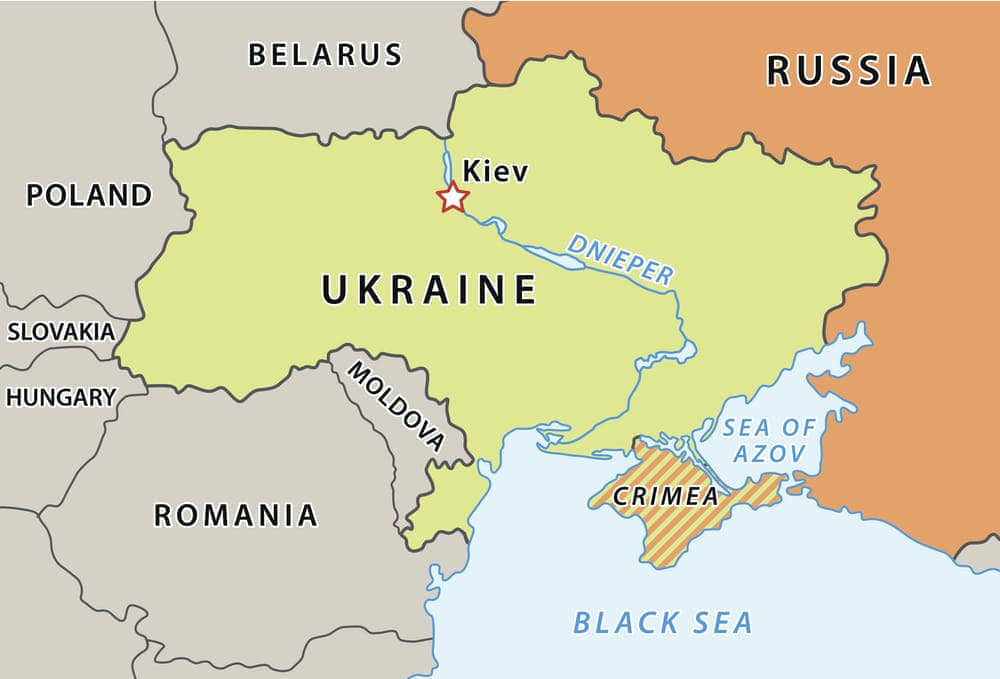
This is why both Putin and Medvedev suggesting Kiev might be part of the equation would seem to be a significant shift. There are lots of maps of electoral results that Western pundits have used as proxies for ethnic Russian versus ethnic Ukrainian representation. This one from the Washington Pos is indicative. You can see Kiev is most assuredly in a European-leaning part of the country, as if that were in doubt:
But in Putin’s November 3 speech, he described long form as to how Russia has claims on “Ancient Rus” and that would seem to include Kiev2:
Contrast this with Medvedev’s not-exactly-a-joke earlier proposal:
Admittedly, Putin has said repeatedly, such as in his 2021 article, On the Historical Unity of Russians and Ukrainians, that Russians and Ukrainians are one people and the recent divisions were engineered to facilitate control. But it’s going to be hard to put the discord genie back in the bottle.
One guess is that Russia has decided it eventually has to take, or ideally, find some other way to subdue Kiev as the administrative center of Ukraine. But what does it do then? Even if Russia is able to create a puppet state, how does it exercise enough control without it becoming a governance and financial albatross? Remember, Kiev is a physically sprawling city of 3 million, straddling the Dnieper. It would be hard to secure it against the will of its inhabitants….unless, say, even more could be encouraged to decamp.
But it seems any other way, with rump Ukraine entering into some sort of victor’s peace with Russia, is ripe for the West trying to undo that. Perhaps (as we and John Helmer have suggested) Russia creates a particularly impoverished and very low population buffer zone (one way is by de-electrifying it) as a DMZ of sorts.
Again, at a minimum Russia’s leadership recognizes it has ever more degrees of freedom in terms of what Ukraine’s end state might be. And I may not be imaginative enough. But I don’t see how things have gotten much better regarding the potentially festering problem of western Ukraine. Perhaps there have been better remedies bandied about by Russian pundits and pols that have not gotten coverage here. Any reader intel or informed speculation very much welcomed.