Category Archives: Uncategorized

Dmitry Kovalevich: Update on the situation in Ukraine: January 2023, Ukraine’s defeat in Soledar and the forced conscriptions of military recruits on the country’s streets

By Dmitry Kovalevich, New Cold War, 2/3/23

Dmitriy Kovalevich is the New Cold War’s special correspondent in Ukraine. He writes a monthly update as well as special reports for the NCW website. In this report Dmitriy Kovalevich examines the situation in the Donbass region, the various reports coming from Ukraine officials and the media, and the serious losses among the Ukraine forces in the area. He also sets out the evidence of people being directly conscripted (kidnapped) from the street and taken to the frontlines.

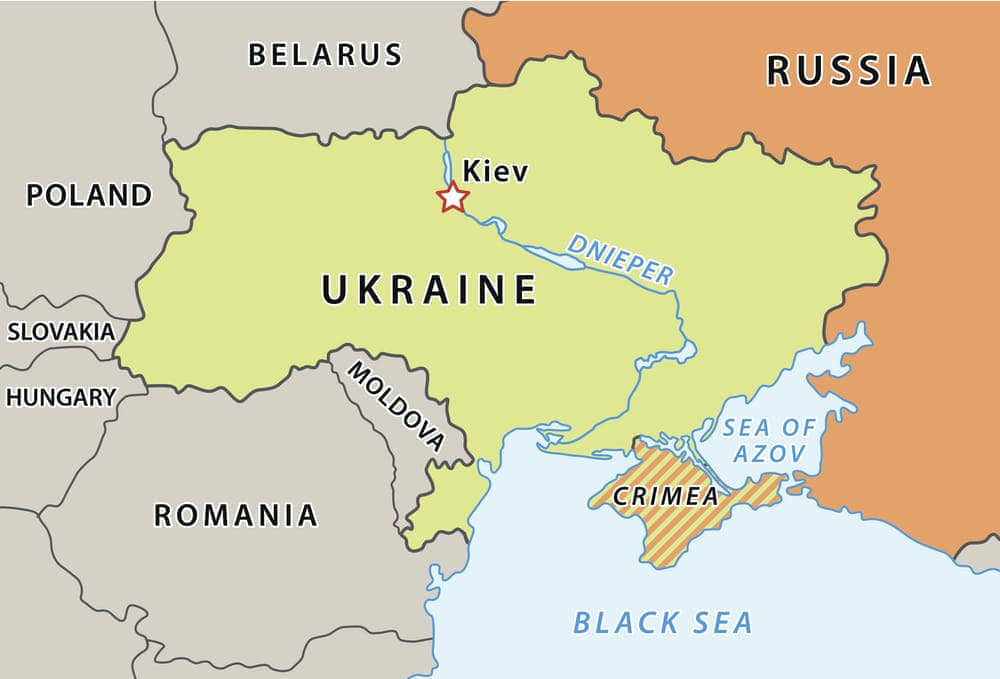
The first month of 2023 in Ukraine was marked by the defeat of Ukrainian troops near Soledar, the ‘meat grinder’ village in the Donbass region, located near the strategic, small city of Artyomovsk (called ‘Bakhmut’ in Ukraine, per-war population 75,000). Ukraine has suffered heavy losses in fighting around the city in January. It is continuing with the capture and forced conscription of young men on the streets of its towns and cities to compensate for its large military losses in Bakhmut.

Fierce fighting has taken place in and around Soledar in the Donetsk region since the middle of last year. The town, whose pre-war population was around 10,000, was practically destroyed in the fighting and became a huge grave for Ukrainian soldiers. It was stormed mainly by Russian units recruited from among prisoner volunteers. Their criminal records were expunged in exchange for six months of military service.

Kyiv recognized the loss of Soledar only two weeks after the fact. It has stopped mentioning the town altogether in its reports. The largest salt mines in Ukraine are located in and around the town. With the loss of the town, even products such as salt are now beginning to be imported to Ukraine, mainly from Poland.

Aleksey Arestovich, an adviser to the office of the Ukrainian president, said in January that many Ukrainian soldiers could not withstand the Russian onslaught against Soledar and fled. According to him, during the entire defense of the city there were “a substantial number” of refuseniks who declared they “cannot fight any longer in this terrible war”. Arestovich said, “We have people who refused to dig trenches, and when they were led into ready-made trenches, they just stood still. Many said the enemy (Russian soldiers) were too close and it was better to move several miles back from the front lines.”

This and other revelations by Arestovich caused a flurry of criticism from Ukrainian nationalists. At the end of January, a missile hit a residential building in Dnieper (Dnipro) city and killed 46 civilians. Arestovich admitted that a Russian missile was hit by a Ukrainian air defense missile and fell on a residential building, causing the injuries. After this confession, the Ukrainian parliament began collecting signatures calling for Arestovich to resign. Within several days, he announced he was resigning, but not before his revelations had once again exposed the falsehoods routinely contained in the official statements of the Ministry of Defense of Ukraine.

For its part, Russia said the missile shot down over Dnieper was aimed at military installations and repeated that it does not target civilians in Ukraine.

The battle for Soledar also showed the eroding motivation of military personnel in Ukraine. Many of those being forcibly mobilized are showing no desire to fight. In mid-January, the Ukrainian media published a video in which Sgt. Igor Bondarenko, deputy platoon commander of the 60th brigade, berates his subordinate Ukrainian soldiers who had taken refuge in a residential building and were unwilling to fight. The video was filmed for the purpose of reporting to a higher command, which demands that military recruits be driven into battle by all necessary means.

The German magazine Der Spiegel, referring to German intelligence information, reported at the end of January that in and around Bakhmut alone, Ukraine was seeing hundreds of its soldiers killed every day. The Ukrainian Telegram channel ‘XUA-photo of the war’ has broadcast terrible film footage demonstrating the extent of deaths among the Armed Forces of Ukraine in the area. It comments, “Of course, the full scale of this tragedy needs to be documented in the future. On the front lines of Bakhmut-Soledar, the Ukrainian military command has displayed complete failure. There are huge numbers of deaths among the manpower of the Armed Forces of Ukraine.”

In order to try and hold Soledar and Bakhmut, Kyiv transferred military units from other directions. As a result, at the end of January, Russian troops went on the offensive in the Zaporozhye direction, crushing the first line of defense of the Armed Forces of Ukraine and capturing many prisoners of war.

The Russian army, as before, uses the tactics of long-range artillery followed by assault groups entering the destroyed positions. If significant pockets of resistance still remain, retreats followed by more artillery strikes take place. As Russian military correspondent German Kulikovsky writes on Telegram, “We do not take high losses in our offensives, or even in our defensive postures. This explains, by the way, the slow pace of our offensives. Surely, old-school generals are sad that it is not possible to send 10,000 soldiers out in dashing attacks and then, having lost some 30% or whatever, report success to the top-command. For today’s good divisional commanders, everything is completely different. They take care of people, actively using military deceptions, as needed.”

This is actually what is taking place today at front-line positions. Russian forces advance in relatively small assault groups on clearly selected targets – Soledar, Bakhmut, Maryinka, Avdeevka, Kremennaya. At the same time, missile strikes against the energy infrastructure of Ukraine are taking place, increasing the cost and the complications for the U.S. and European allies of Ukraine engaged in combat.

At the same time, the Russian Armed Forces have reserves concentrated in all sectors of the front, ready to stop a large offensive of the Armed Forces of Ukraine if such can be organized at all. If this scenario holds, then the Armed Forces of Ukraine will continue to be squeezed out of the Donetsk republic while a shift to Zaporozhye region takes place. The main idea here is to achieve psychological exhaustion of Ukrainian forces and its Western allies and implant an understanding that a prolonged war will only cause greater costs to Ukraine and produce a peace on much worse terms than Ukraine might otherwise be able to negotiate.

Most of the Zaporozhye region is already under Russian control, but the city of Zaporozhye (population 750,000, fifth largest in Ukraine) as well as a large stretch of the east bank of the Dnieper River remain under Ukrainian control.

Pentagon chief Lloyd Austin told a meeting of NATO-country war ministers at the U.S. Air Force base in Ramstein, Germany at the end of January that a crucial moment in the fighting in Ukraine had arrived and Russia was gathering strength.

Almost the same thing was said by NATO Secretary General Stoltenburg at the meeting of global elites several days earlier in Davos, Switzerland. “This is a pivotal moment in the war and there is need for a significant increase in support for Ukraine. If we want a negotiated peaceful solution tomorrow, we need to provide more weapons today,” he said.

Russian military experts are once again noticing that Western media and politicians are constantly talking about “crucial moments” and “imminent turning points” in Ukraine. Russians note with some surprise that not only Ukraine’s opponents but also their supporters in the West are constantly talking about ‘turning points’ being reached. Ukrainian politicians are also using this language, though in their case, they hope that all their previous words about impending victories over Russia are quietly forgotten. Past ‘turning points’ were talked about in March, April, May, September and December of 2022…

Russian analysts conclude that the dependence of Western politicians on the media relaying of messaging and on classical, capitalist economic belief is turning them into something resembling stock market players or actors in a Hollywood blockbuster film, obsessed with big and conclusive endings. For these analysts, the preoccupation with ‘tipping points’ suggests that a prolonged conflict and the long-term costs of supplying and maintaining weapons to Ukraine from NATO countries will not last long. They see the West actively pressuring Kyiv to send more military recruits to the slaughter in order to achieve a ‘tipping point’ as quickly as possible. In contrast, Russian tactics involved orderly entries or exits from selected territories designed to wear down the Ukrainian army and economy while maintaining main forces in reserve in case of a major conflict with NATO in the future.

Against the backdrop of its serious losses, military conscription has intensified throughout Ukraine. Sometimes, it resembles the straightforward kidnapping of men of military age. Military commissars are increasingly trying to hand out summonses in the most unlikely and inappropriate places (albeit fully permitted legally), such as entrances to shops, in parking lots or at gas stations. Sometimes they resort to roadblocks.

In Odessa, there have been cases of people being directly conscripted (kidnapped) from the street. A subscriber of the ‘Typical Odessa’ channel on Telegram reported, “This morning, my friend, near the railway station, was put into a car and taken to the military registration and enlistment office, without even being presented a written summons. He passed a medical examination at half past six in the evening and was then told he is being sent to Nikolaev. Apparently, this is a new tactic. Authorities realize that no one is reacting to military summonses, and so they have begun to take people and deliver them right to the frontline.”

Other subscribers from Odessa comment that men are brought to the military enlistment offices by ambulances and ‘Nova Poshta’ (delivery service) vehicles. Military commissars often go about their work in civilian clothes. Not everyone surrenders without a fight. “Near Kulikovo field (a neighborhood in central Odessa) in the courtyard of a nine-story building, two unknown people put up serious physical resistance to two “messengers of death” (as military conscription officers are called), as a result of which the young civilian men prevailed and the losing ‘military’ side lost their package of documents and money,” writes ‘Typical Odessa’.

The director of the Institute for the Study of the Consequences of Military Actions in Ukraine, Russian political scientist Kirill Molchanov, calls Ukraine a “kamikaze state”. He emphasizes that there exists another Ukraine, which is represented by refugees and residents in the south of Ukraine who are attending protest rallies organized by the wives and mothers of servicemen. According to him, these are the people who voted for Zelensky in 2019 because of his promise to end the nationalist dictatorship and the war in Donbass of his predecessor, Petro Poroshenko. (Poroshenko was elected in May 2014 as the suppression of opposition to the coup of February 2014 was already well advanced.) Molchanov argues that, “In order to get away from the Western-imposed role of Ukraine as a kamikaze state, a platform is needed to find consensus and develop a common vision for Ukrainians who disagree with Kyiv’s current course.”

The former commander of Polish Land Forces, reserve Colonel-General Waldemar Skrzypczak, gave an interview on January 16 to the pro-government Polish outlet wPolityce on the prospects for ending the armed conflict on the territory of Ukraine. According to the Polish general, the president of the Russian Federation is convinced that if Russia succeeds in expelling Ukrainian forces from the Donbass region, Ukraine will not be able to survive economically and will revert to being an exclusively agrarian country. “Unfortunately, Russia will get its way, because now it is increasing its advantage. The key to its success will be what it is doing now – preparing for a full-scale war in which Russia will have the advantage of several times superiority over the Ukrainian army. The Russians will achieve this, and, unfortunately for Ukraine, there is no point in disputing this,” said the general.

According to the Polish military, the West is not able to help Ukraine enough to create a military potential superior to Russia’s. Skrzypczak believes that Russia can only be strangled politically and economically. “Where are we going? Are we betting that all Ukrainians will die in this war?” he asked rhetorically. He answered himself in the affirmative, calling for the mobilization of those Ukrainians residing in Western countries who managed to escape military service in Ukraine. When asked by a journalist that Ukrainians in the West probably do not want to fight, the general replied that their opinions do not matter. “Ah, so now we are going to ask them if they want to be soldiers or not? It is necessary to mobilize, draft into the army – and that’s all,” said the Polish general.

The real reasons for such interest in the fact that “all Ukrainians die in this war” was unequivocally explained by Canadian finance minister Chrystia Freeland at a gathering of the richest people of the world in Davos, Switzerland. Her maternal grandfather edited a pro-Nazi, Ukrainian newspaper out of Vienna during the Nazi German occupation of Ukraine. According to her, Ukrainians are fighting for the interests of Western countries, and the defeat of the Russian Federation will lead to a boost in the global economy.

Boosting the world economy for the benefit of the super-rich gathered or represented in Davos will mean, first of all, an increase in their personal profits and, secondly, the acquisition of the resources of the Russian Federation through a new military crusade. After all, even the head of the IMF told the assembled faithful in Davos in January that the conflict in Ukraine is global, not regional. For the sake of this, hundreds of Ukrainians are dying every day in and around Bakhmut, and such losses are being replaced by forceful kidnappings on the streets of Ukraine.
Elliot Smith: Nearly a year on from the supposed Russian exodus, most major companies have yet to withdraw

dirty vintage luck table
Photo by Rūdolfs Klintsons on Pexels.com

By Elliot Smith, CNBC, 1/31/23

After Russian troops invaded Ukraine in February 2022, companies across the G-7 major economies and the European Union announced plans to cease business operations in Russia.

Yet by the end of the year, very few had fully delivered on that promise, according to new research from Switzerland’s University of St. Gallen.

The report published earlier this month documented a total of 2,405 subsidiaries owned by 1,404 EU and G-7 companies that were active in Russia at the time of the first military incursion into Ukraine.

By November 2022, fewer than 9% of that pool of companies had divested at least one subsidiary in Russia, and the research team noted that these divestment rates barely changed over the fourth quarter of 2022.

“Confirmed exits by EU and G7 firms that had equity stakes in Russia account for 6.5% of total profit before tax of all the EU and G7 firms with active commercial operations in Russia, 8.6% of tangible fixed assets, 8.6% of total assets, 10.4% of operating revenue, and 15.3% of total employees,” professors Simon Evenett and Niccolo Pisani wrote.

“These findings mean that, on average, exiting firms tended to have lower profitability and larger workforces than the firms that remain in Russia.”

More U.S. firms were confirmed to have exited Russia than those based in the EU and Japan, Evenett and Pisani noted, but the report still found that fewer than 18% of U.S. subsidiaries operating in Russia were completely divested by the end of 2022, compared with 15% of Japanese firms and just 8.3% of EU firms.

Of the EU and G-7 companies remaining in Russia, the research found that 19.5% were German, 12.4% were American owned and 7% were Japanese multinationals.

“These findings call into question the willingness of Western firms to decouple from economies their governments now deem to be geopolitical rivals,” Evenett and Pisani wrote.

“The study’s findings are a reality check on the narrative that national security concerns and geopolitics is leading to a fundamental unwinding of globalisation.”

Pressure to exit will build

Europe’s status as a laggard in the push for Russian divestment was also highlighted by Barclays in a note on Jan. 20.

The British lender’s European consumer staples analysts said that while most of the companies they cover had pledged to exit Russia, partly in response to ESG-related pressure from stakeholders and the threat of sanctions, few have managed to do so yet. Various companies told Barclays that there was a host of challenges to fully divest.

“In addition to the lack of clarity over what assets there might be worth, the list of potential buyers is short, and the list of potential buyers who are sanction exempt is even shorter,” Barclays analysts noted.

“There have also been suggestions that the assets (including intellectual property) of companies that leave Russia will be nationalised.”

Barclays suggested that with no end to the conflict in sight, the disconnect between pledges and outcomes will need to be resolved, and will force companies into some tough decisions.

“If exiting Russia at anything approaching a fair valuation is highly challenging (if not outright impossible), then the choice facing companies is whether to exit at an unfair valuation (or indeed for nothing at all), or remain in Russia,” the analysts said.

“Few commentators seem to think a near term end to the conflict is likely, and we suspect pressure to make good on pledges to exit may build as time goes on.”

They added that companies that have paused advertising and reduced product assortments but still intend to stay in Russia will be increasingly challenged by wider stakeholders and tightening sanctions.

In particular, Barclays named CCH, Henkel, PMI, JDE Peet’s and Carlsberg as having the largest sales exposure to Russia within the European consumer staples sector.

Henkel has repeatedly stated its intention to exit Russia and been transparent with the investment community on the likely impact, since around 5% of sales and 10% of EBIT (earnings before interest and tax) are derived from Russia. Barclays’ Henkel forecasts assume no contribution from Russia for full-year 2023 and beyond.

“While country level EBIT data is hard to come by, we assume that given that most companies have stopped advertising in Russia, it is currently disproportionately profitable,” Barclays said.

“Henkel has been explicit about the likely impact to earnings of a Russia exit (5% sales, 10% EPS) and this should be well known to investors, but we suspect that Russia deconsolidation may be a source of margin mix headwind elsewhere in Staples.”

Of the 29 consumer staples firms the unit covers, 15 have committed to exiting Russia, but Barclays analysts are only aware of six that have actually done so.

Henkel, CCH, Carlsberg, JDE Peet’s and PMI did not respond to CNBC’s request for comment.

‘Writing off isn’t selling off’

A new report from a U.K. think tank last week highlighted that some of the world’s biggest companies have announced their planned exists by writing off assets rather than selling them, thereby making “announcements of accounting entries instead of making Russian exits.”

“Many people think that when something is written off it has been lost. A write-down or write-off just means the owner has put a lower or zero value on an asset at that point in time. It is a paper value that can be revised at any moment at the whim of the owner,” said Mark Dixon, a London-based mergers and acquisitions consultant who founded the Moral Ratings Agency think tank in February following the Russian invasion.

“If the company drags its heels long enough and doesn’t leave Russia, it can write up the value whenever the world situation changes.”

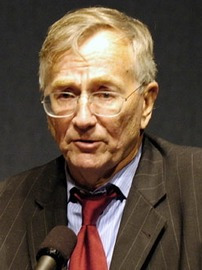
Radio War Nerd Interviews Seymour Hersh About His Article on Nordstream

Seymour Hersh

We talk to legendary Pulitzer Prize winning reporter Seymour Hersh about his latest bombshell scoop: the United States, on President Biden’s orders, blew up the Nord Stream pipelines that were foundational to Germany’s export economy until last year.

-Read Seymour Hersh’s article, “How America Took Out The Nord Stream Pipeline”  

https://www.patreon.com/posts/radio-war-nerd-78596220

Chris Hedges: Ukraine — The War That Went Wrong

By Chris Hedges, Scheerpost, 1/30/23

Empires in terminal decline leap from one military fiasco to the next. The war in Ukraine, another bungled attempt to reassert U.S. global hegemony, fits this pattern.

The danger is that the more dire things look, the more the U.S. will escalate the conflict, potentially provoking open confrontation with Russia.

If Russia carries out retaliatory attacks on supply and training bases in neighboring NATO countries, NATO will almost certainly respond by attacking Russian forces. That will ignite World War III, which could result in a nuclear holocaust.

U.S. military support for Ukraine began with the basics — ammunition and assault weapons. The Biden administration, however, soon crossed several self-imposed red lines to provide a tidal wave of lethal war machinery:

Stinger anti-aircraft systems; Javelin anti-armor systems; M777 towed Howitzers; 122mm GRAD rockets; M142 multiple rocket launchers, or HIMARS; Tube-Launched, Optically-Tracked, Wire-Guided (TOW) missiles; Patriot air defense batteries; National Advanced Surface-to-Air Missile Systems (NASAMS); M113 Armored Personnel Carriers; and now 31 M1 Abrams, as part of a new $400 million package.

These tanks will be supplemented by 14 German Leopard 2A6 tanks, 14 British Challenger 2 tanks, as well as tanks from other NATO members, including Poland. Next on the list are armor-piercing depleted uranium (DU) ammunition and F-15 and F-16 fighter jets.

Since Russia invaded on Feb. 24, 2022, Congress has approved more than $113 billion in aid to Ukraine and allied nations supporting the war in Ukraine. Three-fifths of this aid, $67 billion, has been allocated for military expenditures. There are 28 countries transferring weapons to Ukraine. All of them, with the exception of Australia, Canada and the U.S., are in Europe. 

The rapid upgrade of sophisticated military hardware and aid provided to Ukraine is not a good sign for the NATO alliance.

It takes many months, if not years, of training to operate and coordinate these weapons systems. Tank battles — I was in the last major tank battle outside Kuwait City during the first Gulf war as a reporter — are highly choreographed and complex operations. Armor must work in close concert with air power, warships, infantry and artillery batteries.

It will be many, many months, if not years, before Ukrainian forces receive adequate training to operate this equipment and coordinate the diverse components of a modern battlefield. Indeed, the U.S. never succeeded in training the Iraqi and Afghan armies in combined arms maneuver warfare, despite two decades of occupation.

I was with Marine Corps units in February 1991 that pushed Iraqi forces out of the Saudi Arabian town of Khafji. Supplied with superior military equipment, the Saudi soldiers that held Khafji offered ineffectual resistance.

As we entered the city, we saw Saudi troops in commandeered fire trucks, hightailing it south to escape the fighting. All the fancy military hardware, which the Saudis had purchased from the U.S., proved worthless because they did not know how to use it.

War as a Laboratory

NATO military commanders understand that the infusion of these weapons systems into the war will not alter what is, at best, a stalemate, defined largely by artillery duels over hundreds of miles of front lines. The purchase of these weapons systems — one M1 Abrams tank costs $10 million when training and sustainment are included — increases the profits of the arms manufacturers.

The use of these weapons in Ukraine allows them to be tested in battlefield conditions, making the war a laboratory for weapons manufacturers such as Lockheed Martin. All this is useful to NATO and to the arms industry. But it is not very useful to Ukraine.

The other problem with advanced weapons systems such as the M1 Abrams, which have 1,500-horsepower turbine engines that run on jet fuel, is that they are temperamental and require highly skilled and near constant maintenance. They are not forgiving to those operating them who make mistakes; indeed, mistakes can be lethal.

The most optimistic scenario for deploying M1-Abrams tanks in Ukraine is six-to-eight months, more likely longer. If Russia launches a major offensive in the spring, as expected, the M1 Abrams will not be part of the Ukrainian arsenal.

Even when they do arrive, they will not significantly alter the balance of power, especially if the Russians are able to turn the tanks, manned by inexperienced crews, into charred hulks.

Another ‘Surge’

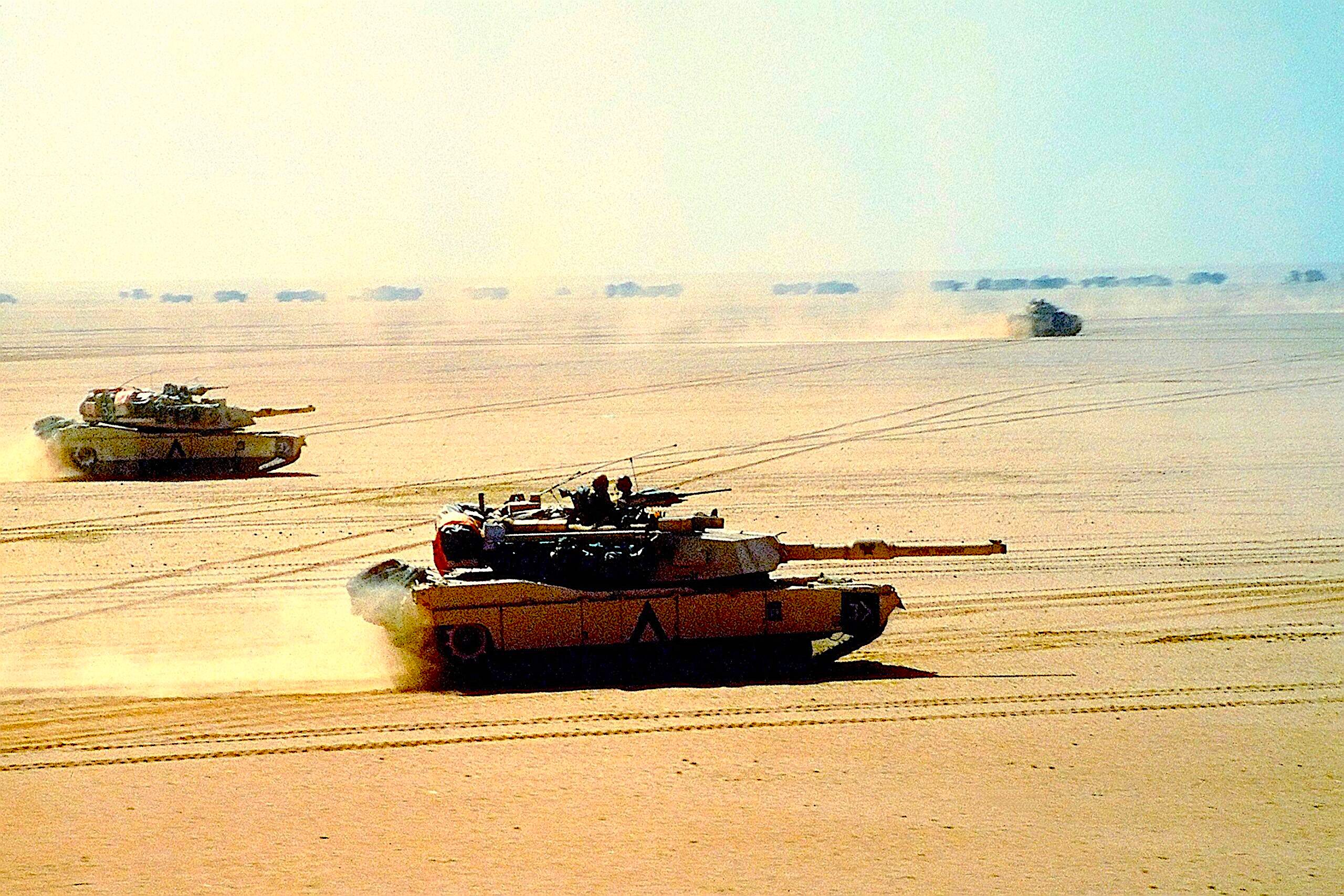
U.S. M1A1 Abrams tanks on a mission during Desert Storm in February 1991. A Bradley IFV and logistics convoy in background. (W. Homes, II, U.S. Navy, Public domain, Wikimedia Commons)

So why all this infusion of high-tech weaponry? We can sum it up in one word: panic.

Having declared a de facto war on Russia and openly calling for the removal of Vladimir Putin, the neoconservative pimps of war watch with dread as Ukraine is being pummeled by a relentless Russian war of attrition.

Ukraine has suffered nearly 18,000 civilian casualties (6,919 killed and 11,075 injured). It has also seen  around 8 percent of its total housing destroyed or damaged and 50 percent of its energy infrastructure directly impacted with frequent power cuts.

Ukraine requires at least $3 billion a month in outside support to keep its economy afloat, the International Monetary Fund’s managing director recently said. Nearly 14 million Ukrainians have been displaced — 8 million in Europe and 6 million internally — and up to 18 million people, or 40 percent of Ukraine’s population, will soon require humanitarian assistance.

Ukraine’s economy contracted by 35 percent in 2022, and 60 percent of Ukrainians are now poised to live on less than $5.50 a day, according to World Bank estimates. Nine million Ukrainians are without electricity and water in sub-zero temperatures, the Ukrainian president says.

According to estimates from the U.S. Joint Chiefs of Staff, 100,000 Ukrainian and 100,000 Russian soldiers have been killed in the war as of last November.  

“My feeling is we are at a crucial moment in the conflict when the momentum could shift in favor of Russia if we don’t act decisively and quickly,” former U.S. Sen. Rob Portman was quoted as saying at the World Economic Forum in a post by The Atlantic Council. “A surge is needed.”

Palpable Rot of Empire

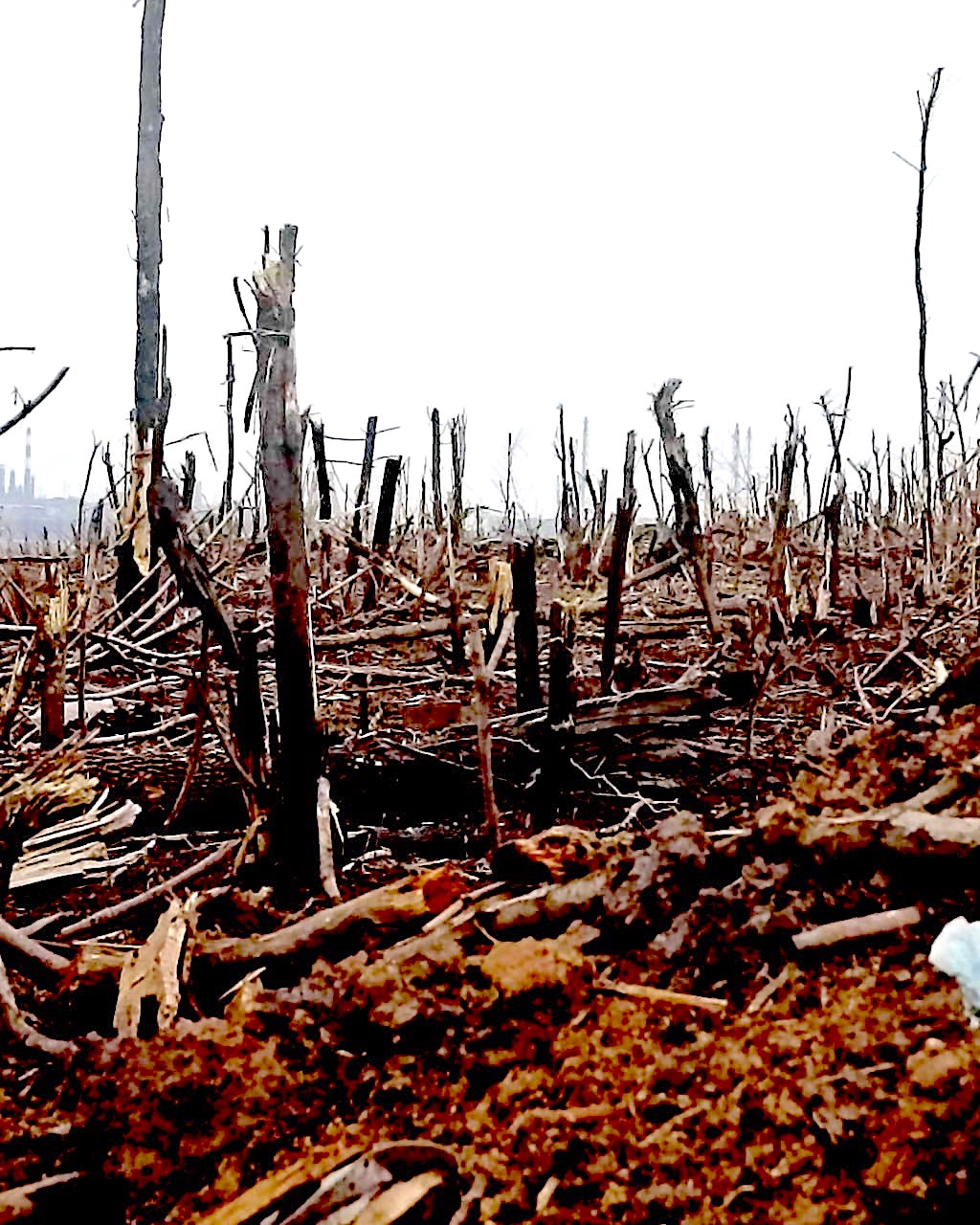
No Man’s Land between Russian and Ukrainin forces during the Battle of Bakhmut, November 2022. (Mil.gov.ua, CC BY 4.0, Wikimedia Commons)

Turning logic on its head, the shills for war argue that “the greatest nuclear threat we face is a Russian victory.” The cavalier attitude to a potential nuclear confrontation with Russia by the cheerleaders for the war in Ukraine is very, very frightening, especially given the fiascos they oversaw for twenty years in the Middle East.

The near hysterical calls to support Ukraine as a bulwark of liberty and democracy by the mandarins in Washington are a response to the palpable rot and decline of the U.S. empire.

America’s global authority has been decimated by well-publicized war crimes, torture, economic decline, social disintegration — including the assault on the U.S. Capitol on Jan. 6, the botched response to the pandemic, declining life expectancies and the plague of mass shootings — and a series of military debacles from Vietnam to Afghanistan.

The coups, political assassinations, election fraud, black propaganda, blackmail, kidnapping, brutal counter-insurgency campaigns, U.S. sanctioned massacres, torture in global black sites, proxy wars and military interventions carried out by the United States around the globe since the end of World War II have never resulted in the establishment of a democratic government.

Instead, these interventions have led to over 20 million killed and spawned a global revulsion for U.S. imperialism. 

Pumping Money into the War Machine

In desperation, the empire pumps ever greater sums into its war machine. The most recent $1.7 trillion U.S. spending bill by Congress included $847 billion for the military; the total is boosted to $858 billion when factoring in accounts that don’t fall under the Armed Services committees’ jurisdiction, such as the Department of Energy, which oversees nuclear weapons maintenance and the infrastructure that develops them.

In 2021, when the U.S. had a military budget of $801 billion, it constituted nearly 40 percent of all global military expenditures, more than the next nine countries, including Russia and China, spent on their militaries combined.

As Edward Gibbon observed about the Roman Empire’s own fatal lust for endless war:

“[T]he decline of Rome was the natural and inevitable effect of immoderate greatness. Prosperity ripened the principle of decay; the cause of the destruction multiplied with the extent of conquest; and, as soon as time or accident had removed the artificial supports, the stupendous fabric yielded to the pressure of its own weight. The story of the ruin is simple and obvious; and instead of inquiring why the Roman Empire was destroyed, we should rather be surprised that it had subsisted for so long.”

A state of permanent war creates complex bureaucracies, sustained by compliant politicians, journalists, scientists, technocrats and academics, who obsequiously serve the war machine.

This militarism needs mortal enemies — the latest are Russia and China — even when those demonized have no intention or capability, as was the case with Iraq, of harming the U.S. We are hostage to these incestuous institutional structures. 

Earlier this month, the U.S. House and Senate Armed Services Committees, for example, appointed eight commissioners to review Biden’s National Defense Strategy (NDS) to “examine the assumptions, objectives, defense investments, force posture and structure, operational concepts, and military risks of the NDS.”

The commission, as Eli Clifton writes at the Quincy Institute for Responsible Statecraft, is “largely comprised of individuals with financial ties to the weapons industry and U.S. government contractors, raising questions about whether the commission will take a critical eye to contractors who receive $400 billion of the $858 billion FY2023 defense budget.”

The chair of the commission, Clifton notes, is former Rep. Jane Harman (D-CA), who “sits on the board of Iridium Communications, a satellite communications firm that was awarded a seven-year $738.5 million contract with the Department of Defense in 2019.”

Reports about Russian interference in the elections and Russia bots manipulating public opinion — which Matt Taibbi’s recent reporting on the “Twitter Files” exposes as an elaborate piece of black propaganda — was uncritically amplified by the press. It seduced Democrats and their liberal supporters into seeing Russia as a mortal enemy.

The near universal support for a prolonged war with Ukraine would not be possible without this con.

America’s two ruling parties depend on campaign funds from the war industry and are pressured by weapons manufacturers in their state or districts, who employ constituents, to pass gargantuan military budgets. Politicians are acutely aware that to challenge the permanent war economy is to be attacked as unpatriotic and is usually an act of political suicide. 

“The soul that is enslaved to war cries out for deliverance,” writes Simone Weil in her essay “The Iliad or the Poem of Force,” “but deliverance itself appears to it an extreme and tragic aspect, the aspect of destruction.”

Trying to Recoup Lost Glory

Historians refer to the quixotic attempt by empires in decline to regain a lost hegemony through military adventurism as “micro-militarism.”

During the Peloponnesian War (431–404 B.C.) the Athenians invaded Sicily, losing 200 ships and thousands of soldiers. The defeat ignited a series of successful revolts throughout the Athenian empire.

The Roman Empire, which at its height lasted for two centuries, became captive to its own army that, similar to the U.S. war industry, was a state within a state. Rome’s once mighty legions in the late stage of empire suffered defeat after defeat while extracting ever more resources from a crumbling and impoverished state.

In the end, the elite Praetorian Guard auctioned off the emperorship to the highest bidder.

The  British Empire, already decimated by the suicidal military folly of World War I, breathed its last gasp in 1956 when it attacked Egypt in a dispute over the nationalization of the Suez Canal. Britain withdrew in humiliation and became an appendage of the United States. A decade-long war in Afghanistan sealed the fate of a decrepit Soviet Union.

“While rising empires are often judicious, even rational in their application of armed force for conquest and control of overseas dominions, fading empires are inclined to ill-considered displays of power, dreaming of bold military masterstrokes that would somehow recoup lost prestige and power,” historian Alfred W. McCoy writes in his book, In the Shadows of the American Century: The Rise and Decline of US Global Power.

“Often irrational, even from an imperial point of view, these micro-military operations can yield hemorrhaging expenditures or humiliating defeats that only accelerate the process already under way,” he wrote. 

The plan to reshape Europe and the global balance of power by degrading Russia is turning out to resemble the failed plan to reshape the Middle East.

It is fueling a global food crisis and devastating Europe with near double-digit inflation. It is exposing the impotency, once again, of the United States, and the bankruptcy of its ruling oligarchs.

As a counterweight to the United States, nations such as China, Russia, India, Brazil and Iran are severing themselves from the tyranny of the dollar as the world’s reserve currency, a move that will trigger economic and social catastrophe in the United States.

Washington is giving Ukraine ever more sophisticated weapons systems and billions upon billions in aid in a futile bid to save Ukraine but, more importantly, to save itself. 

Chris Hedges is a Pulitzer Prize–winning journalist who was a foreign correspondent for 15 years for The New York Times, where he served as the Middle East bureau chief and Balkan bureau chief for the paper. He previously worked overseas for The Dallas Morning News, The Christian Science Monitor and NPR.  He is the host of show “The Chris Hedges Report.”

Author’s Note to Readers: There is now no way left for me to continue to write a weekly column for ScheerPost and produce my weekly television show without your help. The walls are closing in, with startling rapidity, on independent journalism, with the elites, including the Democratic Party elites, clamoring for more and more censorship. Bob Scheer, who runs ScheerPost on a shoestring budget, and I will not waiver in our commitment to independent and honest journalism, and we will never put ScheerPost behind a paywall, charge a subscription for it, sell your data or accept advertising. Please, if you can, sign up at chrishedges.substack.com so I can continue to post my Monday column on ScheerPost and produce my weekly television show, “The Chris Hedges Report.”

This column is from Scheerpostfor which Chris Hedges writes a regular columnClick here to sign up for email alerts.