It has been my rule not to join the vast majority of my fellow political commentators at the scrimmage line in sterile debates of the one subject of the day, week, month that has attracted their full attention. Their debates are sterile because they ignore all but a few parameters of reality in Russia, in Ukraine. For them, ignorance is bliss. They do not stir from their armchairs nor do they switch channels to get information from the other side of the barricades, meaning from Russia.
I will violate this overriding rule and just this once join the debate over how Russia’s ‘special military operation’ will end. Nearly all of my peers in Western media and academia give you read-outs based on their shared certainty over Russia’s military and political ambition from the start of the ‘operation,’ how Russia failed by underestimating Ukrainian resilience and professionalism, how Putin must now save face by capturing and holding some part of Ukraine. The subject of disagreement is whether at the end of the campaign the borders will revert to the status quo before 24 February in exchange for Ukrainian neutrality or whether the Russians will have to entirely give up claims on Donbas and possibly even on Crimea.
As for commentators in the European Union, there is exaggerated outrage over alleged Russian aggression, over any possible revision of European borders as enshrined in the Helsinki Act of 1975 and subsequent recommitments by all parties to territorial inviolability of the signatory States. There is the stench of hypocrisy from this crowd as they overlook what they wrought in the deconstruction of Yugoslavia and, in particular, the hiving off of Kosovo from the state of Serbia.
I mention all of the foregoing as background to what I see now going on in Russian political life, namely open and lively discussion of whether the country should annex the territories of Ukraine newly ‘liberated’ by forces of the Donetsk and Lugansk People’s Republics with decisive assistance of the Russian military. By admission of President Zelensky yesterday, these territories now amount to 20% of the Ukrainian state as it was configured in 2014.
In the past several weeks, when Russia concentrated its men and materiel on the Donbas and began to score decisive victories, most notably following the taking of Mariupol and capitulation of the nationalist fighters in the Azovstal complex, leading public officials in the DPR, the LPR and the Kherson oblast have called for quick accession of their lands to the Russian Federation with or without referendums. In Moscow, politicians, including Duma members, have called for the same, claiming that a fait accompli could be achieved already in July.
However, as I see and hear on political talk shows and even in simple political reportage on mainstream Russian radio like Business FM, a counter argument has raised its head. Those on this side ask whether the populations of the potential new constituent parts of the RF are likely to be loyal to Russia. They ask if there is truly a pro-Russian majority in the population should a referendum be organized.
This is all very interesting. It surely is a continuation of the internal debate in Moscow back in 2014 when the decision was taken to grant Crimea immediate entry into the RF while denying the requests for similar treatment from the political leaders of the Donbas oblasts.
However, there surely are other considerations weighing in on the Kremlin that I have not seen aired so far. They may be likened to the considerations of France following the fall of the Berlin Wall in 1989, when the possible reunification of Germany was the talk of the day. Sharp witted observers said at the time that President Mitterand liked Germany so much that he wanted to continue to see two of them. Today Vladimir Putin may like Ukraine and its brethren Slavs so much that he wants to see three or four of them.
To be specific, from the very beginning the number one issue for Moscow as it entered upon its military adventure in Ukraine was geopolitical: to ensure that Ukraine will never again be used as a platform to threaten Russian state security, that Ukraine will never become a NATO member. We may safely assume that internationally guaranteed and supervised neutrality of Ukraine will be part of any peace settlement. It would be nicely supported by a new reality on the ground: namely by carving out several Russia-friendly and Russia-dependent mini-states on the former territory of East and South Ukraine. At the same time this solution removes from the international political agenda many of the accusations that have been made against Russia which support the vicious sanctions now being applied to the RF at great cost to Europe and to the world at large: there will be no territorial acquisitions.
If Kiev is compelled to acknowledge the independence of these two, three or more former oblasts as demanded by their populations, that is a situation fully compatible with the United Nations Charter. In a word, a decision by the Kremlin not to annex parts of Ukraine beyond the Crimea, which has long been quietly accepted by many in Europe, would prepare the way for a gradual return of civilized relations within Europe and even, eventually, with the United States.
This is a Russian-made documentary produced by Masterskaya Movie Company in 2022. I’ve been told that it originally aired on Russia 1 TV channel. The description from Rumble is:
Film traces the history of the Ukrainian tragedy from 1917 to some of the newest footage we’ve all been watching…
Introduction and English translation of May 30th RBC article via Memri.
As Russia has tightened its hold over information channels to the point of virtually criminalizing criticism of the “special operation” in Ukraine, Russia’s business dailies sometimes succeed in providing unwelcome information to the authorities. Perhaps the authorities do not fear the select readership of these dailies, perhaps it assumes that the readership has access to sources of information. In any case RBC media has provided an article proving that the sanctions imposed on Russia are taking their toll on Russia’s defense industry. It turns out that even the quintessentially Russian Kalashnikov has foreign components. The absence of foreign components has caused extensive production delays, reliance on obsolete equipment, disruption of maintenance schedules and even layoffs.
“Following the launch of Russia’s military special operation in Ukraine, the US and the European countries imposed a series of new sanctions against the Russian military industrial complex. Now defense industry complex plants are still assessing the risks, but it is already apparent that due to the new restrictions a number of contracts will be postponed. There are problems with the lack of marine diesel engines, import substitution of helicopter and aircraft engines, electronics, replacement of imported components installed in tank’s fire control systems, as well as aircraft repairs. Yet, defense industries claim that the state defense order will be fulfilled at the same level, as in the previous year.
“The industry doesn’t have the task of achieving a 100% level of import substitution for all products, as “Rostec” [corporation] and the Ministry of Industry and Trade emphasize. Reliance is being shifted to parallel imports. RBC has been taking with leading defense industry enterprises and experts to find out from them, how extensive are the problems caused by the new sanctions and what are the plans for resolving them.
“How Did The Authorities In Charge Of The Military-Industrial Complex React
“In early March, Deputy Prime Minister for the Defense Industry, Yury Borisov stated that ‘the full magnitude and depth of the current sanctions… was difficult to forecast.’ However, Borisov noted that in 2021 the state defense order was fulfilled by 98% and that ‘every opportunity for maintaining such indicators in the future’ exists.”
Yuri Borisov (Source: Rg.ru)
“At Rostec they explained to RBC that the corporation’s revenues are comprised of three elements: civilian goods, state defense orders and exports According to the corporation, the latter two accounted for about 55% of corporate revenues, while civilian products accounted for over 45%. ‘Naturally changes (considering today’s reality) are inevitable, the ratio will change. How exactly it will happen? We are now scrutinizing this issue. Approximately by the middle of the year the picture will become clear,’ stated Rostec. ‘Now the companies belonging to the state corporation adjust their plans on a number of projects, in consideration of the new inputs. Their deadlines have been objectively “shifted to the right” (that is, they were postponed to a later date),’ said the Rostec representative, without specifying what these projects are.
“Among the measures being taken, Rostec cited the following: development of new cooperation opportunities, fundamental changes in the suppliers, as well as intensification of import substitution programs in critical areas. For instance, regarding aviation, these concerns: propulsion systems (both for aircraft and helicopters), onboard systems and specialized software for production. Nevertheless, the task of producing absolutely everything [domestically] didn’t and doesn’t exist, the state corporation emphasized. “This is unreasonable, as there are alternative suppliers, there is also a mechanism of parallel import,” they summed up at Rostec.
“The Ministry of Industry and Trade also told RBC that no country in the world is able to completely abandon the use of foreign technologies and components. ‘Statements about 100% import substitution are populist ones,’ argued the ministry. Regarding the decisions to support of the industry, the ministry recalled that during the COVID-19 pandemic the department generated the necessary measures, some of which were perceived as redundant at the time. Thus some measures, brought to a state of readiness, weren’t implemented. ‘And now we are applying these “drafts”,” summarized the ministry, without specifying what tools they were referring to.
“What’s Going On In The Aircraft Industry
“A representative of the United Aircraft Corporation (UAC) stated in an interview to RBC that after the new sanctions were imposed ‘there is more work to be done.’ In the civilian segment [of the industry], the short term maintenance of the serviceability of the existing fleet of Sukhoi Superjet 100 aircraft is an important area of work for Russian manufacturers of planes, systems and components. The work is being performed with the airline companies and each [aircraft] operator has its own “road map” of joint actions. According to UAC, for the past period spare parts depots have been established including a pool of replacement engines. However, ‘there are of course sensitive positions’ regarding the Superjet 100 repairs, admitted the company.
“In early April, Yury Lapin, General Director of IrAero airlines, warned that due to the US and EU sanctions, airlines operating domestically-produced “Sukhoi Superjet 100” aircraft are unable to provide repairs and maintenance to assure the technical fitness of Russian-French SaM146 engines. Such a situation, according to Lapin, may lead to ‘a stoppage of [maintenance] on the fleet of Superjets in the short term perspective. Engine service problems were also reported by managers of three other airlines that fly Superjet planes. One of them noted that his airline will have to stop passenger flights on these planes as early as the fall of 2022, provided the engine tech support won’t improve.
“‘There are the two largest programs in civil aviation: manufacturing and exploitation of the short-haul Superjet 100 and of the medium-haul MS-21.’ Both programs presumed the utilization of a significant number of foreign-produced components, reminded Oleg Panteleev, Executive Director at the AviaPort industry agency. We are talking in particular about American-produced Pratt & Whitney engines for the MS-21 and Russian-French SaM146 engines for the Superjet 100 planes’, he specified. ‘The Americans stopped the supplies, in turn, the French side has also blocked the delivery of its component, i.e., of the generator module and other components. Therefore, it’s not possible to maintain production at the planned speed,’ elaborated the expert.
“‘Regarding combat aircraft, even if somewhere isolated foreign-produced components are being used, they belong to the category where their usage is allowed, because large warehouse inventories of them were created in advance, and they can be bought in the countries that don’t support sanctions’, noted Panteleev.
“At the end of March, the newspaper Kommersant reported that UAC had failed to receive the majority of the MS-21 engines from the American “Pratt & Whitney” company, due to which the commissioning and supply plan for this aircraft had to be reduced. Rostec plans to start deliveries of the MS-21 equipped with a home-produced PD-14 engine in 2024, but even these terms are considered way too optimistic in the industry, stressed the newspaper.
“Deputy Prime Minister, Borisov stated in mid-March that the Russian authorities at the background of sanctions were considering the prospects of increasing the serial production of IL-96 and Tu-214 passenger planes, which are currently produced in small batches for special customers. The UAC told RBC that they are already increasing the manufacturing of Tu-214 planes. ‘These planes will make it possible to support the air transport industry through a difficult period, stated the company.
“As for the helicopter-manufacturing programs, it’s necessary to replace imported engines for Ansat, Ka-62 and Ka-226 helicopters, Panteleev continues. ‘At the same time, there are more concerns about future maintenance and repair of Western-produced machines involved in the production of aircrafts. It’s necessary to purchase them in order to increase the production volume,’ concluded the expert.
“According to the Disclose investigative journalism portal, between 2014 and 2018, the French Thales group of companies equipped 60 twin-seat Su-30 multi-purpose fighters with the latest TACAN navigation systems. What’s more, similar TACAN systems were delivered to Russia for upgrading MiG-29 fighters, as well as special high-tech pilot helmets.
“Since 2014, Russian Air Force jets have been equipped with Sigma 95N navigation systems developed by the French Safran” company, which allow autonomous navigation without satellite signals. According to the Disclose website the target detection systems were supposed to be installed on Ka-52 helicopters.
“What Shipbuilders Say
Commenting on RBC’s question regarding the components, which are in short supply due to new restrictions, the United Shipbuilding Corporation (USC) stated that the volume of domestic production must be increased, first for all for marine diesel engines, for components of propulsion systems, for anchor-mooring equipment and ship systems (water circulation, waste water management, etc.).
“Russian shipbuilders today are going through enormous difficulties regarding the supply of engines for ships of all types: from boats to large warships, Ilya Kramnik Researcher at the Center for North American Studies of IMEMO Russian Academy of Sciences, and Navy expert, confirmed to RBC.
“For instance, multipurpose corvettes of ‘Project 20380′ equipped with guided missiles were initially fitted with engines made by the Kolomna plant. According to Kramnik, the practice of their usage demonstrated that the domestic diesels didn’t meet expectations. As the expert explained, there were complaints about engines’ reliability, power, and upgrade potential. It was decided to equip the improved corvettes of this type (project 20385) with German engines. However, due to the new restrictions the deal was derailed. Thus the fleet continues to use domestically-produced diesel engines, while for some projects the purchase is made in China, noted the expert.
“There are relatively few companies in the world that are capable of producing powerful modern diesel ship engines. And Russian companies aren’t among them, although Russia possess some competence in manufacturing diesel, stressed Kramnik. Regarding the propulsion systems and anchor-mooring equipment, traditionally the emphasis was put on imported components, and it remains unclear how promptly domestic developments can be introduced, summed up the expert.”
Ilya Kramnik (Source: Newprospect.ru)
“The USC has developed and is implementing import substitution plans for these types of equipment, as stipulated by the Shipbuilding Industry Development Strategy drawn up to 2035. It is planned to start serial production of cycloidal propellers for a series of river-sea vessels, in addition to domestic engines, whose [production] has been already mastered, and which are supplied en masse to such vessels. Besides, the Russian enterprises, which deal with engine production are upgrading them to the requirements of the register.
“The corporation has been working in this direction for some time, but now the magnitude of such work has grown considerably and at the USC they are sure that it aims to become a full-fledged business segment capable of generating proceeds. It will take about two years to work out tactical solutions. “From 2024 till early 2025, we expect to transform [our production] to be based entirely on Russian-produced piston machines and other systems that were traditionally bought from foreign countries,” explained the USC. ‘The situation demands, first of all, a tough stance of state customers with regard to meeting civil demand with Russian-produced ship equipment. This will provide the main support for shipbuilders, stressed the corporation.’
How Serious Are The Problems With Electronics?
“Deputy Prime Minister Borisov has repeatedly mentioned the ‘collapse of microelectronics’ in Russia and the need to restore this industry. In mid-May, he stressed again that the country is facing the task of acquiring technological independence.
“Ruselectronics holding told RBC that in the face of restrictions, the holding’s companies continue to fulfill contracts under state defense orders and produce civilian goods. In order to facilitate an uninterrupted work, the holding’s stocks of electronic components are being used, while cooperation chains are being reviewed
“‘In terms of exports, we record stable demand from foreign customers for a number of electronic components, particularly sealed magnetically controlled contacts. Thus, we expect export revenue in the first half of 2022 to remain at the level of 2021,’ Ruselectronics summed up.
“According to Kramnik, the company grossly underestimates the situation claiming that there are no problems. ‘There are big problems with microprocessor production, in particular in military, military- defensive and space areas. The equipment that we possess now allows for production of some things, but one has to be aware that such goods are already quite obsolete,’ explained the expert.
“When the issue concerns their introduction in modern arms systems with AI capability, for example, of real-time data transfer and support for tactical decision-making, it requires growing foundation capacities that are not always accessible via older solutions, stressed Kramnik. Especially when compact equipment is needed, added the expert. ‘If there’s some kind of ground facility, a building, it’s generally not that important whether to equip such a building with 100 or 500 kilograms of equipment, however, when it comes to a guided missile, the dimension and weight requirements increase dramatically. The product has to be light and small, which is difficult to achieve,’ explained Kramnik.
“There are also issues with modern optical and thermal imaging equipment, continued Kramnik. Russian plants enjoy their own matrices, but they usually cannot satisfy the demand and don’t meet the required characteristics, noted the expert. ‘Even enclosures, switches, and cables are imported. That is, we should start not with electronics, but with electrical engineering,’ concluded the expert.
“What Issues Is Russia’s Only Tank Manufacturer Facing?
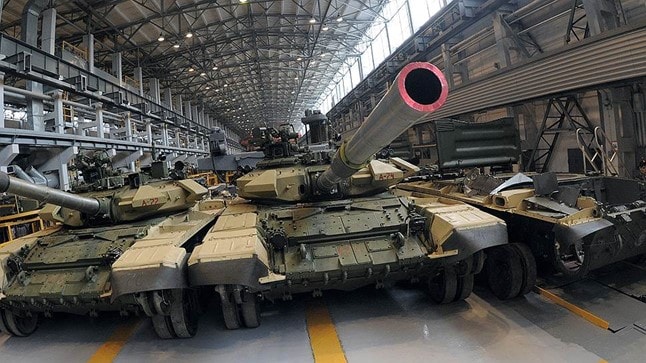
“The press service of UralVagonZavod (UVZ) told RBC that the holding’s enterprises are operating steadily and are even increasing their production volume. The concern has been operating under sanctions since 2014, recalls the company’s representative. Import substitution doesn’t concern the holding’s products of both military and civilian use, stressed Uralvagonzavod.
“Meanwhile, at the end of March, as Kommersant reported referencing the plant’s press service, that “a small part” of the employees at the car assembly line were sent on short-term leave with 2/3 pay. The exact number of employees on leave wasn’t specified. However, the press service stressed that there are pending orders until the end of the year and with regard to a number of products -until the end of 2024.
“According to a statement of representative of the plant’s trade union, Alexander Ivanov made to URA.RU agency in early April, there are, actually no issues with the quantity of orders, however, there are problems with their fulfillment. Ivanov claimed that Uralvagonzavod is facing a shortage of components, because of the transition to import substitution. ‘The plant is searching for Russian suppliers; we are developing schemes of raw materials’ purchase from friendly states that haven’t joined the sanctions,’ said Ivanov. In addition, he claimed that the employees at the car assembly line are being laid off (with 2/3 of their pay intact) on a massive scale, rather than on a case-by-case basis, as the plant’s press office told Kommersant.
“On the whole, Uralvagonzavod fulfills the state defense order, but the components for the fire control systems (including those deployed at the Russian main battle tank T-90M) were purchased via Belarus from the French Thales company, recalled Colonel Victor Murakhovsky, the Editor-in-Chief of Arsenal of Fatherland. According to Murakhovsky, this concerns not the fire control system as a whole, but only its ‘night time module.’ It’s not yet known how critical this issue is and whether there is a potential for production of domestic substitutes, said the expert. The European online EU Observer’ magazine also reported that Russian T-72s are equipped with thermal imaging sight made by the French Thales company.
Tank assembly at Uralvagonzavod (Source: Kommersant.ru)
What is the Position of the Gunsmiths?
“On April 7, a meeting of the Board of Directors of the Union of Russian Armorers named after M.T. Kalashnikov was held. The meeting was chaired by Alan Lushnikov, a [major] shareholder of the Kalashnikov Concern. The meeting was dedicated to the issues of import substitution, simplification of export procedures for arms and cartridges, work on elimination of excessive administrative obstacles regarding the arms circulation [on the civilian market], as well as to state support measures of the [gunsmith] industry (according to the holding’s own statement).
“Vladimir Zhikharev, Executive Director at the Union of Russian Armorers, told RBC that the organization scrutinized the risks that may appear in connection with sanctions pressure on part of unfriendly states. He also concluded that some enterprises – that are part of Kalashnikov holding are at risk of not receiving many components, 70% of which (and sometimes more than 80%) were previously bought abroad. Also, there is the short-term issue of the repair and replacement of imported equipment.
“‘Many companies [of Kalashnikov holding] find themselves in a very difficult situation. The air guns production as well as that of cartridges of many civilian arms experience shortage [of materials and components?] Some companies of the holding have ceased production of certain types of civilian products,’ said Zhikharev. In addition, he stated that Kalashnikov holding may experience a twofold decrease in the export of civilian small arms due to the recent tightening of the sanctions regime.
“The Kalashnikov press service didn’t respond to RBC’s inquiry, the same is also true for RBC’s inquiries to ‘Russian Helicopters’ and ‘United Engine Corporation.’
The first Eurasia Economic Forum, held last week in Bishkek, Kyrgyzstan, should be regarded as a milestone in setting the parameters for the geoeconomic integration of the Eurasian heartland.
Sergei Glazyev, Russia’s Minister in Charge of Integration and Macroeconomics of the Eurasia Economic Union (EAEU), is coordinating the drive to design an alternative monetary-financial system – a de facto post-Bretton Woods III – in cooperation with China.
According to Glazyev, the forum “discussed the model of a new global settlement currency pegged to baskets of national currencies and commodities. The introduction of this currency instrument in Eurasia will entail the collapse of the dollar system and the final undermining of the US military and political power. It is necessary to start negotiations on signing an appropriate international treaty within the framework of the SCO.”
Glazyev described the initiative to upend the western global financial system in more detail during an exclusive interview with The Cradle in April.
It’s particularly relevant to understand how Glazyev interconnects the EAEU’s drive with the increasing geopolitical and geoeconomic role of the Shanghai Cooperation Organization (SCO), which unites at the same table key Eurasian powers: China, Russia, India, Pakistan, Kazakhstan and Iran.
That connects directly with Russian President Vladimir Putin, at the meeting of the Supreme Eurasian Economic Council, supporting the extension of a temporary free trade agreement between the EAEU and Iran, which is the newest (and only West Asian) full member of the SCO. Putin said this should go ahead despite the “confrontation by the collective West.”
The EAEU, inaugurated in 2015 with five full members – Russia, Kazakhstan, Kyrgyzstan, Belarus and Armenia – represents a market of 184 million people and a collective GDP of over $5 trillion. The next step with Iran will be to implement a full free trade agreement, possibly before the end of the year, according to Iranian deputy trade minister Alireza Peymanpak. Egypt, Indonesia and the UAE are also candidates to strike deals with the EAEU.
Iran, which has for over four decades now been forced to find creative solutions to bypass serial, imperial sanction packages, may have a conceptual lesson or two to teach Russia. Barter arrangements are gaining ground: Tehran is offering spare parts and gas turbines to Moscow’s power plants in exchange for much needed zinc, aluminum, lead and steel for its metal and mining industries, according to Iranian trade and industries minister Reza Fatemi Amin.
And more barter on a wide range of commodities is ahead, as discussed during a recent visit to Tehran by Russian Deputy Prime Minister Alexander Novak.
The other ‘RIC’
Slowly but surely, the new RIC (Russia-Iran-China) – as opposed to the old RIC in BRICS (Russia-India-China) – is attempting to integrate their financial systems. Iran is a matter of national security strategy for China, as an energy provider and essential partner of the Belt and Road Initiative (BRI) in West Asia.
Russia-China, though, is a much more complex matter. Extremely fearful of provoking US sanctions, Chinese banks are refraining – at least for the moment – to increase their deals with Russian banks, which brings us to the case of UnionPay:
The Chinese bank card provider – increasingly popular, especially across Asia – declined from partnering with Sberbank even before Russia’s largest bank was excluded by the EU and the US from the global bank messaging platform SWIFT. UnionPay also canceled plans with other Russian banks to issue UnionPay cards linked with the Russian Mir payment system, profiting from the exit of Visa and Mastercard from the Russian market.
This is still a careful balancing act for China. Earlier this year at the Boao Forum in Asia, President Xi Jinping was adamant in opposing the “wanton use of unilateral sanctions.” And over 80 percent of Chinese companies already established in Russia appeared to continue their business as usual.
Yet in practical terms, there are serious problems. The Bank of China and the Industrial and Commercial Bank of China (ICBC) have restricted financing for Russian commodities. Even the Asian Infrastructure Investment Bank (AIIB), absolutely essential for sustainable development projects, linked or not with BRI, decided to freeze all lending to Russia and Belarus in early March to “safeguard” its “financial integrity.”
On the financial front, cautious Chinese banks, with enormous western exposure, are always balancing the fact that nearly 80 percent of global cross-border transactions are still in dollars and euros, and only two percent in yuan. So the Russian market is not exactly a priority.
In parallel, the Russia-Iran front is quite lively. They are turbo-charging mutual settlements in their national currencies to “the highest possible level,” as highlighted by Deputy Prime Minister Alexander Novak: “We discussed together with central banks the spread and operation of the financial messaging system, as well as the connection of Mir and [Iranian] Shetab payment cards.”
As it stands, the Mir card is still not accepted in Iran, but that’s about to change – just as in Turkey, which this summer will start accepting Mir card payments from legions of Russian tourists. What this means in practice is that Russia and Iran will be connecting their banks to the System for Transfer of Financial Messages (SPFS), the Russian equivalent to SWIFT. The Chinese will obviously be examining how seamlessly the transition works.
Now compare all of the above with the prospect that soon there won’t be any SWIFT at all, as Mastercard CEO Michael Miebach let slip in Davos.
Miebach was participating in a panel on Central Bank Digital Currencies, discussing cross-border payments, when he suggested that SWIFT might soon be a thing of the past. No question about it: Moscow is eyeing crypto and digital currencies already, and Beijing is dead set on setting up the digital yuan to work around SWIFT and its linked CHIPS (Clearing House Interbank Payment System).
The Sanctioned Ones, now moving fast
The Russia-Iran front has been fast evolving since January this year, when Iranian President Ebrahim Raisi, on a visit to Moscow, handed a draft agreement to Putin on strategic cooperation for the next 20 years, building on “the very good experience of cooperation between Iran and Russia in Syria in combating terrorism,” and expanding to “economy, politics, culture, science, technology, defense, and military spheres, as well as security and space issues.”
Raisi also explicitly thanked Putin “for facilitating Tehran’s entry into the SCO.”
Iranian Oil Minister Javad Ouji went straight to the point in his meeting with Novak in Tehran last week: “Our countries are under strict sanctions, and we have the potential to neutralize them through the development of bilateral relations…We have created joint committees on banking, energy, transport, agriculture issues, as well as the issue of creation of nuclear power plants.”
And that brings us once again to the seemingly eternal soap opera of the Vienna-based Joint Comprehensive Plan of Action (JCPOA) talks, with Russian Deputy Foreign Minister Sergey Ryabkov now signaling the final draft “is at a high degree of readiness for adoption. There are some political problems, which are not related to the finalization of the text.”
Cutting through the proverbial fog of US swamp spin, Ryabkov stressed how “in terms of our interests, including in the context of peaceful nuclear cooperation with Iran, the text is quite satisfactory…there is nothing to ‘fine-tune’.” So when the Americans say that the deal is “out of reach,” Raybkov added, it means that they “broadcast the results of their internal discussions.”
The bottom line is that on the JCPOA, Tehran and Moscow are in sync: “We are what they call on edge, and it could happen very quickly if the political decision is made.”
Expanding on their synchronicity, Tehran even proposed to host negotiations between Moscow and Kiev over the Ukraine conflict – following the Turkish example. By now though, after Ankara’s failure, it is clear that Washington decision makers want no negotiation, but an endless war to the last Ukrainian.
Iranian Foreign Minister Hossein Amir-Abdollahian remains in sync with his counterpart Sergei Lavrov. At Davos, he said the Ukraine drama was caused by “the US and NATO’s provocative actions…they “provoked the Kremlin into this.” That’s essentially what Beijing has been discreetly implying.
All of the above shows some of the trials and tribulations of Eurasia integration, and the long and winding road to an EAEU-SCO new monetary system. But first things first: there’s got to be some action on the Mir-UnionPay front. When that news breaks, the die will be cast.