Category Archives: Uncategorized

Sonja Van den Ende: Business Cards of German and Canadian Government Officials Found in Abandoned Azov Battalion HQ in Mariupol

ukrainian flag waving in wind with clear sky in background
Photo by Nati on Pexels.com

By Sonja Van den Ende, Covert Action Magazine, 6/8/22

[This article presents a Russian view of the war, based on first hand reporting by a journalist whose reporting was made possible by DPR and Russian military protection.—Editors]

Left amidst the ruins of the Azov battalion’s headquarters in Mariupol were the business cards from the German embassy. One was of an attaché named Michael Faul, a Canadian colonel named Colonel Brian Irwin and the French Embassy staff member in Kyiv, First Secretary Christophe Boursin.

MICHAEL FAUL: According to the following information, Faul now works in the UK: “Michael Faul works at German Embassy London and Consulate General Edinburgh, which is a Federal company with an estimated 766 employees.” So he has been relocated or has always been working there, probably for MI6, the UK Secret Service. Last Update: 3/10/2022 5:43 PM (move March 3 to UK), EMAIL: m***@london.diplo.de.

COLONEL BRIAN IRWIN: This is very interesting; the following is known about him:

Colonel Brian Irwin [Source: cmea-agmc.ca]

Colonel Robert Brian Irwin
Ontario, Canada
Decorations for Meritorious Service – Military Division
Meritorious Service Cross
Issued: October 16, 2019
Invested on: May 27, 2021
Rank: Colonel

As Canada’s Defense Attaché to Ukraine from August 2016 to July 2019, Colonel Irwin proved instrumental in achieving Canada’s foreign policy goals. He quickly became an influential and important member of the [Canadian] mission [in Ukraine], where he advised successive commanders of the joint task force, promoted security sector reform and actively contributed to military cooperation between the two nations. Known for his professionalism and diplomacy, he has had an undeniable influence on the operations of the Canadian Forces in Ukraine.

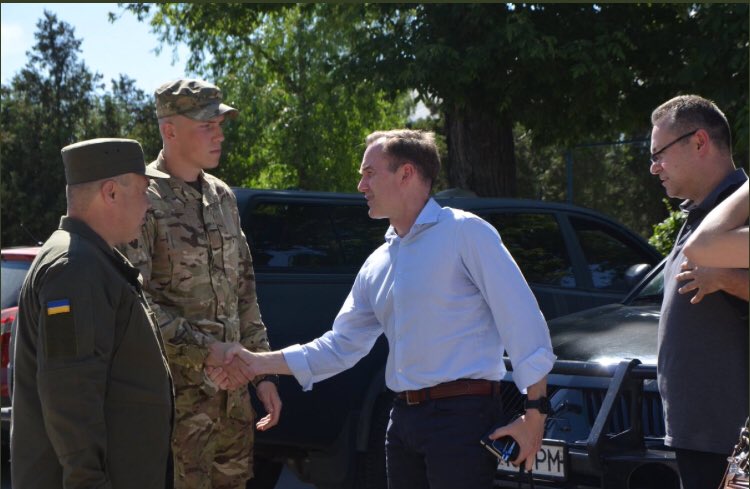
The likely authenticity of the documents is enhanced by the fact that in 2018, Irwin had been photographed shaking hands with a member of the Azov Battalion, indicating Canadian government support for the neo-Nazi outfit.
Image
Brian irwin shakes hands with member of Azov battalion during his sting as Canadian Defense attache in Ukraine. [Source: twitter.com]

The third business card found was of the assistant first secretary at the Embassy of France in Kyiv, Ukraine, Christophe Boursin. There are no pictures of him, but he may still be in Kyiv.

Along with the business cards found in Azov Battalion headquarters were Nazi insignia, making clear the Battalion’s admiration for Adolf Hitler and the original German Nazis.

Azov Headquarters in Mariupol. [Source Photo courtesy of Sonja van den Ende]
Azov HQ, Mariupol, business card. [Source Photo courtesy of Sonja van den Ende]

The documents were discovered on my second visit to Mariupol. My last visit, some two weeks ago, was a more emotional trip, as heavy shelling, rockets and fighting around the Azov steel factory were happening The port was partly freed and one could hear shelling from there as well.

The crews of many ships were held hostage by Azov. The remaining residents of the city were walking around, with “the gruesome experience of war in their eyes,” searching for clean water and waiting in line for food, which was distributed by the Russian army in cooperation with the Donetsk People’s Republic.

So I went back two weeks later and a lot has happened since then. The Azov neo-Nazi militia had surrendered and the remaining soldiers have been captured and transported to prison by buses. They will receive, hopefully, a fair trial, in the DPR or Russia. Same as what happened to the jihadists in Syria they were transported from Eastern Aleppo and Ghouta to Idlib, which until now is (unfortunately) for a large part still a stronghold of Al-Qaeda or Hayat-Tahrir-as-Sham.

Hitler painting, Azov HQ, Mariupol. [Source Photo courtesy of Sonja van den Ende]

The Port of Mariupol

According to the Russian Ministry of Defense, from which we received an update, the port was now liberated and demined:

“Specialists of the Black Sea Fleet and Engineer Troops have completed demining the territory of the Mariupol port. More than 12,000 explosive objects and weapons abandoned by Ukrainian radicals were found and neutralized. The approach channels and internal water areas were freed from sunken ships and other navigational obstacles, as well as the port was demilitarized. In total, more than 1.5 million square meters of water area, 18 berths and 32 vessels were inspected. In total, the specialists of the detachment of the International Mine Action Center have destroyed more than thousand explosive objects since the beginning of their work.”

Western media has claimed that where the Russians were, they left a trail of death and destruction; however, from what I have experienced so far in Volnovakha and Mariupol, the trail is mostly from the Ukrainian army and militia.

Arriving for the second time in Mariupol, DPR. [Source Photo courtesy of Sonja van den Ende]

Some public facilities in the cities were working again. The city square was cleaned, we even had a quick look in the zoo, where the animals were still alive. The Western media again are giving opposite stories.

Also, I visited the second largest steel factory in Mariupol, the Steel factory Illich, Mariupol’s second largest factory retaken by the 36th Russian Brigade. The steel factory was nearly totally destroyed and I believe it cannot be rebuilt, but as Dennis Pushilin (the leader of the DPR) told us on the square of Mariupol: “Every building will be rebuilt or newly built,” so one never knows.

In front of the Illich Steel Factory, Mariupol. [Source Photo courtesy of Sonja van den Ende]

The plant produced a wide range of hot-rolled and cold-rolled steel, including for shipbuilding, oil pipeline, drilling gas pipeline and water pipelines. The company is the only company in Ukraine to produce galvanized steel and liquefied gas tanks.

The company’s products were certified by international classification societies; such as Lloyd’s Register (UK, Germany), U.S. Bureau of Naval Personnel and by the Marine Register of Navigation (Russia), as well also by the German Certification Center TTSU. The company exported the products to more than 50 countries around the world.

In April, the Russian army captured the second largest steel factory in Mariupol. What they found was a major wreck and in the storage were (as can be seen in the photo gallery) self-made moving cars with machine guns on them. This form of warfare became popular in the Syria and Iraq wars, introduced by jihadists sponsored by the West.

The Ukrainian army made their military quarters in the factory, like in the Azov Steel factory, and sent the workers home or held them hostage and used them as human shields, as happened everywhere in Ukraine, especially in Mariupol, where many supporters of the Azov regiment could be found.

In the basements of the Illich factory were symbols of this Nazi ideology, symbols that are banned in the West, but are now ignored by Western governments and even all European Union (EU) heads of government. “SLAVA UKRAINE” which literally means: HEIL (HEIL means glory) UKRAINE.” Where have we heard this slogan before?

Inside the Illich Steel factory, a huge crater, Mariupol. [Source Photo courtesy of Sonja van den Ende]
Swastika inside the factory, where Ukrainian Azov were hiding, Illich Steel factory, Mariupol. [Source Photo courtesy of Sonja van den Ende]

The most shocking part of the day though was the visit to one of the former headquarters of the Azov battalion. It wasn’t only an office, but it was also a housing and a training facility. Even young children were trained there with guns and rifles.

As from the material which was left behind, you could clearly see the Nazi ideology, Hitler paintings, SS stickers, books and booklets with swastikas and brochures and manuals from NATO, filled with instructions—along with the business cards of the NATO advisers and western government officials.

This made clear the western complicity in the crimes of the Ukrainians and injustice of the war more broadly.

French Weapons Used to Kill Civilians in DonetskZelensky Vows to Turn Region into Ruin (CAM editors supplement)

Donbass Insider reported on June 7 that French Caesar guns opened fire on civilian areas in the Donbass and Donetsk.

This exemplifies the deadly consequences of western weapons shipments to Ukraine; these weapons are being used to kill and maim civilians. The same report noted that “the terror bombardments started again about 10 days ago on Donetsk and the cities of Donbass,” and that Ukrainians are now “firing every day on the cities of Donbass, especially on Donetsk, Gorlovka, Makeevka and YaccinovatayaYesterday (June 6) alone, 7 people were killed and 16 wounded and the killing continues.”

The report continued: “some of the shells had been fired by American M777 howitzers,” which had been supplied as part of the Biden administration’s weapons pipeline.

Armée ukrainienne - artillerie - Donbass
French Caesar guns used to kill civilians in Donbass. [Source: donbass-insider.com]

The shells, it was specified, do little material damage when they land on the streets or in the open, but are devastating when they hit a building, having the real capacity by their armor-piercing nature to penetrate structures better, with the devastation one can imagine.

The author of the report stated that he had never heard of such munitions being used on civilian areas of the Donbass in the past; thus what we are seeing is a new and more deadly phase of the conflict there. Ukrainian President Volodymyr Zelensky himself, in a very recent statement, said that Donbass would be a ruin and that it would be “deserted,” inferring that people will be killed before the conclusion of this war.

The western media blames the Russians for all the devastation when clearly Ukraine is at the forefront of itwith help from its friends in the West.
Anatol Lieven: Why Russian intellectuals are hardening support for war in Ukraine (re Dmitry Trenin)

By Anatol Lieven, Responsible Statecraft, 6/6/22

An article by Dmitri Trenin, entitled “How Russia must reinvent itself to defeat the West’s ‘hybrid war’: Russia’s very existence is under threat,” may be one of the most consequential published in Russia in recent times — partly for what it says, and partly for who is saying it.

Dr. Trenin, director of the Carnegie Moscow Center until the Russian government closed it in April, was for many years one of the most important pragmatic Russian voices in support of cooperation with the West and the “westernization” of Russia. He was one of the few Russian figures still to retain some of Gorbachev’s hopes for a “common European home.” (I should say that I have known Dr Trenin since I was a British journalist in Moscow in the 1990s, and I was his colleague at the Carnegie Endowment for International Peace between 2000 and 2004).

The significance of Trenin’s article lies in the evidence it gives of a consolidation of the Russian intellectual elites in support of the war effort in Ukraine. It is not in many cases out of a desire to conquer Ukraine (many of the figures joining this new consensus were strongly opposed to the invasion and loathe Putin), but out of an increasingly strong feeling that the United States is trying to use the war in Ukraine to cripple or even destroy the Russian state, and that it is now the duty of every patriotic Russian citizen to support the Russian government.

Trenin writes:

“[T]he US and its allies have set much more radical goals than the relatively conservative containment and deterrence strategies used toward the Soviet Union. They are in fact striving to exclude Russia from world politics as an independent factor, and to completely destroy the Russian economy. The success of this strategy would allow the US-led West to finally resolve the “Russia question” and create favorable prospects for victory in the confrontation with China. Such an attitude on the part of the adversary does not imply room for any serious dialogue, since there is practically no prospect of a compromise, primarily between the United States and Russia, based on a balance of interests. The new dynamic of Russian-Western relations involves a dramatic severance of all ties, and increased Western pressure on Russia (the state, society, economy, science and technology, culture, and so on) on all fronts.”

He continues:

“It is Russia itself that should be at the center of Moscow’s foreign policy strategy during this period of confrontation with the West and rapprochement with non-Western states. The country will have to be increasingly on its own…”Re-establishing” the Russian Federation on a politically more sustainable, economically efficient, socially just and morally sound basis becomes urgently necessary. We have to understand that the strategic defeat that the West, led by the United States, is preparing for Russia will not bring peace and a subsequent restoration of relations. It is highly probable that the theatre of the “hybrid war” will simply move from Ukraine further to the east, into the borders of Russia, and its existence in its current form will be contested…In the field of foreign policy, the most pressing objective is clearly to strengthen the independence of Russia as a civilization…In order to achieve this objective in the current conditions – which are more complex and difficult than even recently – there is a need for an effective integrated strategy – general political, military, economic, technological, informational and so on. The immediate and most important task of this strategy is to achieve strategic success in Ukraine within the parameters that have been set and explained to the public.”

This is a call for reforms, including anti-corruption measures; but explicitly part of a strategy of strengthening Russia and Russian society in order to resist the West and succeed in limited Russian strategic goals in Ukraine. Particularly striking is Trenin’s call for Russia to be strengthened as a separate “civilization” — an idea that he would never have supported in previous years.

It would be easy to dismiss the change in Trenin (now a member of Russia’s Foreign and Defense Policy Council) as simply a matter of bowing to regime pressure. This would however be to ignore that he only represents, in a more abrupt and radical form, a shift in the Russian centrist intelligentsia that has been building up gradually for many years.

For a time, from the fall of the Soviet Union to the mid-1990s, the attitude of most of the Russian intelligentsia to the West was one of blind adulation, and the change from this went through a whole series of stages. The shift began with the decision to expand NATO, generally seen in Russia as a betrayal. Fear of NATO expansion grew with NATO’s attack on Serbia during the Kosovo War. The U.S. invasion of Iraq in 2003 was widely seen as proof that the United States wished to impose rules on others that it had no intention of keeping itself.

A key turning point came with the offer of future NATO membership to Ukraine and Georgia in 2008, followed by the Georgian attack on Russian positions in South Ossetia, and the West’s misrepresentation of this as a Russian attack on Georgia. Western support for the Ukrainian revolution of 2014, generally seen in Russia as a nationalist coup against an elected president, finally doomed genuine rapprochement between Russian centrist intellectuals and their Western counterparts.

However, Russian hopes for some form of limited compromise either with America or Europe lingered on for many years. Realists to the core themselves, members of the Russian establishment found it hard to understand why America, faced with intractable problems in the Middle East and the rise of a powerful China, did not seek to reduce tensions with the far less dangerous Russia. Similarly, they were bewildered by what they have seen as a European failure to understand that with Russia as a friend, they would face no military threat on their own continent.

Three developments in particular kept these hopes alive. First, the French and German brokerage of the “Minsk II” peace agreement over the Donbas in 2015 allowed the Russians to believe in the possibility of an agreement with Paris and Berlin over Ukraine — though this hope faded as the French and Germans did nothing to get Ukraine actually to implement the agreement. Then the election of Donald Trump in 2016 gave hope of a friendlier America, a split between Europe and America, or both. And finally, the Biden administration’s prioritization of China as a threat revived hopes of diminished U.S. hostility to Russia.

Russian hopes for co-operation with France and Germany could revive if these governments seek a compromise peace in Ukraine — with or without the United States. Failing that, however, Trenin’s article indicates that not just Putin’s inner circle, but much of the wider Russian establishment, will approach the war in Ukraine in a spirit of grim determination, at least until there is a possibility of a peace agreement that meets basic Russian conditions.

Now the determination of a Moscow policy analyst of course is a different and less demanding thing than the determination demanded of a Russian soldier fighting Ukraine. Nonetheless, it is potentially an important counterpoint to the hope in many Western capitals for an early collapse of the Russian collective will to fight, or an elite coup against Putin.

There seems to be a growing belief in the Russian elites — including many who were horrified by the invasion itself — that the vital interests, and even perhaps the survival, of the Russian state are now at stake in Ukraine. Unlike the Russian masses, these well-informed figures have not been brainwashed by Putin’s propaganda. Most of them see quite clearly the appalling mess in which Russia has landed itself in Ukraine and the terrible suffering inflicted on ordinary Ukrainians. But the only way they seem to see out of it is through something that can at least be presented as a victory.

Partial Transcript of Putin’s Interview with Rossiya TV (re food and energy)

close up of wheat
Photo by Pixabay on Pexels.com

On June 3rd, Putin was interviewed by Pavel Zarubin of Rossiya 1 TV channel. This is a partial transcript focused on the portion of the interview relating to food and energy.

Pavel Zarubin: Mr President, we have just followed your meeting with the head of Senegal who is also the current leader of the African Union. He expressed, and actually in the past week many countries have expressed concern not so much about the food crisis, but they are afraid of large-scale famine because world food prices are climbing and so are oil and gas prices, These issues are interrelated.

Naturally, the West blames Russia for this, too. What is the real situation at this point, how is it developing? And what do you think will happen in the food and energy markets?

President of Russia Vladimir Putin: Yes, indeed, we are seeing attempts to place the responsibility on Russia for developments in the global food market and the growing problems there. I must say that this is another attempt to pin the blame on someone else. But why?

First, the situation with the global food market did not become worse yesterday or even with the launch of Russia’s special military operation in Donbass, in Ukraine.

The situation took a downturn in February 2020 during the efforts to counter the coronavirus pandemic when the global economy was down and had to be revived.

The financial and economic authorities in the United States, of all things, found nothing better than to allocate large amounts of money to support the population and certain businesses and economic sectors.

We generally did almost the same thing, but I assure you that we were much more accurate, and the results are obvious: we did this selectively and got the desired results without affecting macroeconomic indicators, including excessive inflation growth.

The situation was quite different in the United States. The money supply in the United States grew by 5.9 trillion in less than two years, from February 2020 to the end of 2021 – unprecedented productivity of the money printing machines. The total cash supply grew by 38.6 percent.

Apparently, the US financial authorities believed the dollar was a global currency, and it would spread, as usual, as it did in previous years, would dissolve in the global economy, and the United States would not even feel it. But that did not happen, not this time. As a matter of fact, decent people – and there are such people in the United States – the Secretary of the Treasury recently said they had made a mistake. So, it was a mistake made by the US financial and economic authorities – it has nothing to do with Russia’s actions in Ukraine, it is totally unrelated.

And that was the first step – and a big one – towards the current unfavourable food market situation, because, in the first place, food prices immediately went up, they grew. This is the first reason.

The second reason was European countries’ short-sighted policies, and above all, the European Commission’s policy in regard to energy. We see what is going on there. Personally, I believe that many political players in the United States and Europe have been taking advantage of people’s natural concerns about the climate, climate change, and they began to promote this green agenda, including in the energy sector.

It all seems fine, except for the unqualified and groundless recommendations about what needs to be done in the energy sector. The capabilities of alternative types of energy are overestimated: solar, wind, any other types, hydrogen power – those are good prospects for the future, probably, but today, they cannot be produced in the required amount, with the required quality and at acceptable prices. And at the same time, they began to belittle the importance of conventional types of energy, including, and above all, hydrocarbons.

What was the result of this? Banks stopped issuing loans because they were under pressure. Insurance companies stopped insuring deals. Local authorities stopped allocating plots of land for expanding production and reduced the construction of special transport, including pipelines.

All this led to a shortage of investment in the world energy sector and price hikes as a result. The wind was not as strong as expected during the past year, winter dragged on, and prices instantly soared.

On top of all that, the Europeans did not listen to our persistent requests to preserve long-term contracts for the delivery of natural gas to European countries. They started to wind them down. Many are still valid, but they started winding them down. This had a negative effect on the European energy market: the prices went up. Russia has absolutely nothing to do with this.

But as soon as gas prices started going up, fertiliser prices followed suit because gas is used to produce some of these fertilisers. Everything is interconnected. As soon as fertiliser prices started growing, many businesses, including those in European countries, became unprofitable and started shutting down altogether. The amount of fertiliser in the world market took a dive, and prices soared dramatically, much to the surprise of many European politicians.

However, we warned them about this, and this is not linked to Russia’s military operation in Donbass in any way. This has nothing to do with it.

But when we launched our operation, our so-called European and American partners started taking steps that aggravated the situation in both the food sector and fertiliser production.

By the way, Russia accounts for 25 percent of the world fertiliser market. As for potash fertilisers, Alexander Lukashenko told me this – but we should double-check it, of course, although I think it is true – when it comes to potash fertilisers, Russia and Belarus account for 45 percent of the world market. This is a tremendous amount.

The crop yield depends on the quantity of fertiliser put into the soil. As soon as it became clear that our fertilisers would not be in the world market, prices instantly soared on both fertilisers and food products because if there are no fertilisers, it is impossible to produce the required amount of agricultural products.

One thing leads to another, and Russia has nothing to do with it. Our partners made a host of mistakes themselves, and now they are looking for someone to blame. Of course, Russia is the most suitable candidate in this respect.

Pavel Zarubin: Incidentally, it has just been reported that the wife of the head of our largest fertiliser companies has been included in the new European package of sanctions.

What will all this lead to in your opinion?

Vladimir Putin: This will make a bad situation worse.

The British and later the Americans – Anglo-Saxons – imposed sanctions on our fertilisers. Then, having realised what was happening, the Americans lifted their sanctions, but the Europeans did not. They are telling me themselves during contacts: yes, we must think about it, we must do something about it, but today they have just aggravated this situation.

This will make the situation in the world fertiliser market worse, and hence the crop prospects will be much more modest, and prices will keep going up – that is it. This is an absolutely myopic, erroneous, I would say, simply stupid policy that leads to a deadlock.

Pavel Zarubin: But Russia is accused by high-ranking officials of preventing the grain that is actually there, in Ukrainian ports, from leaving.

Vladimir Putin: They are bluffing, and I will explain why.

First, there are some objective things, and I will mention them now. The world produces about 800 million tonnes of grain, wheat per year. Now we are being told that Ukraine is ready to export 20 million tonnes. So, 20 million tonnes out of 800 million tonnes amounts to 2.5 percent. But if we proceed from the fact that wheat accounts for merely 20 percent of all food products in the world – and this is the case, this is not our data, it comes from the UN – this means that these 20 million tonnes of Ukrainian wheat are just 0.5 percent, practically nothing. This is the first point.

The second. 20 million tonnes of Ukrainian wheat are potential exports. Today, the US official bodies also say that Ukraine could export six million tonnes of wheat. According to our Ministry of Agriculture, the figure is not six but about five million tonnes, but okay, let us assume it is six, plus it could export seven million tonnes of maize – this is the figure of our Ministry of Agriculture. We realise that this is not much.

In the current agricultural year of 2021–2022, we will export 37 million and, I believe, we will raise these exports to 50 million tonnes in 2022–2023. But this is apropos, by the way.

As for shipping out Ukrainian grain, we are not preventing this. There are several ways to export grain.

The first one. You can ship it out via the Ukraine-controlled ports, primarily in the Black Sea – Odessa and nearby ports. We did not mine the approaches to the port – Ukraine did this.

I have already said to all our colleagues many times – let them demine the ports and let the vessels loaded with grain leave. We will guarantee their peaceful passage to international waters without any problems. There are no problems at all. Go ahead.

They must clear the mines and raise the ships they sunk on purpose in the Black Sea to make it difficult to enter the ports to the south of Ukraine. We are ready to do this; we will not use the demining process to initiate an attack from the sea. I have already said this. This is the first point.

The second. There is another opportunity: the ports in the Sea of Azov – Berdyansk and Mariupol – are under our control, and we are ready to ensure a problem-free exit from these ports, including for exported Ukrainian grain. Go ahead, please.

We are already working on the demining process. We are completing this work – at one time, Ukrainian troops laid three layers of mines. This process is coming to an end. We will create the necessary logistics. This is not a problem; we will do this. This is the second point.

The third. It is possible to move grain from Ukraine via the Danube and through Romania.

Fourth. It is also possible through Hungary.

And fifth, it is also possible to do this via Poland. Yes, there are some technical problems because the tracks are of different gauges and the wheel bogies must be changed. But this only takes a few hours, that is all.

Finally, the easiest way is to transport grain via Belarus. This is the easiest and the cheapest way because from there it can be instantly shipped to the Baltic ports and further on to any place in the world.

But they would have to lift the sanctions from Belarus. This is not our problem though. At any rate, President of Belarus Alexander Lukashenko puts it like this: if someone wants to resolve the problem of exporting Ukrainian grain, if this problem exists at all, please use the simplest way – through Belarus. No one will stop you.

So, the problem of shipping grain out of Ukraine does not really exist.

Pavel Zarubin: How would the logistics work to ship it from the ports under our control? What would the conditions be?

Vladimir Putin: No conditions.

They are welcome. We will provide peaceful passage, guarantee safe approaches to these ports, and ensure the safe entry of foreign ships and passage through the Sea of Azov and the Black Sea in any direction.

By the way, several ships are stuck in Ukrainian ports at this point. These are foreign ships, dozens of them. They are simply locked up and their crews are still being held hostage.

The Bell: Long Recession

dirty vintage luck table
Photo by Rūdolfs Klintsons on Pexels.com

The Bell, 6/5/22

This week our top story is a dissection of April economic data released by the Russian authorities that – while better than many expected – still suggests a sustained recession. We also look at why the founder of IT giant Yandex – Russia’s Google – was sanctioned by the European Union, and what it means for the company.

Russia’s economy is faring better than expected – but the worst is yet to come

Economic indicators for April released last week painted a surprisingly good picture: Russia’s economy appears to have shrugged off the initial effects of Western sanctions. But don’t be misled: the long-term effects of these sanctions are only starting to make themselves felt. Moreover, the EU last week announced a new round of sanctions: including an oil embargo that – as recently as a few months ago – was all but unthinkable.

What’s happening?

Analysts last week finally got a chance to see what’s going on with the Russian economy when the State Statistics Service (Rosstat) published data for April. Unsurprisingly, the figures showed Russia sliding into recession – but the fall was not as steep as it might have been, and some of the numbers even allowed for cautious optimism.

According to the Ministry of Economic Development, Russian GDP fell 3 percent year-on-year in April. GDP in March rose by 1.3 percent.

  • Industrial output fell 1.6 percent year on year (manufacturing was down 2.1 percent). At the same time, energy production went from a 7.8 percent rise in March to a fall of 1.6 percent in April. However, according to unofficial figures published by state-owned news agency TASS, the situation for commodities improved in May – for the first time in two months oil production ceased falling and – in the first 29 days of May – was even up 1 percent compared with April.
  • Metals, pharmaceuticals and agriculture also did relatively well. And the construction sector is still being supported by new orders for housing projects.
  • State expenditure from January through April increased almost 15 percent (not least due to a rise in military spending that is currently running at 2.5 times pre-war levels). But the state can afford it: oil and gas revenues almost doubled (up 90.6 percent).
  • Russian salaries were still rising in real terms in March (up 3.6 percent year on year). But the figures for April and the more significant data about real disposable incomes will be known only in July. Salary rises were strongest in the private sector (7.1 percent) while they were down 3.9 percent in the public sector, according to Dmitry Polevoy, the director of investments at Loko-Invest.
  • The biggest falls in April were in logistics and consumer spending: wholesale trade turnover was down 11.9 percent, retail by 9.7 percent, freight transport by 5.9 percent, hospitality by 6.7 percent. Lending activity continues to decline, especially in the consumer sector (down 1.8 percent in March). The problems for retail are due to a correction from a March surge, a decline in real incomes that were hit by rising prices (annual inflation in April was 17.8 percent) and increased uncertainty, according to Sofia Donets, chief economist for Russia at Renaissance Capital.
  • Automobile sales in April plummeted 79 percent year on year after a 63 percent decline in March. The automobile industry is more dependent than most on imports and suffered a greater price shock as a result of Western sanctions.

How bad is it?

The government and the Central Bank are most concerned by the fall in consumer spending. However, the reduction in April (8.8 percent) was only a third of that seen at the peak of the coronavirus crisis in April 2020 (26.8 percent).

The recent data is evidence that the current crisis will be very different from the pandemic: back then we saw a sharp fall and a gradual rebound; this time the fall will be steady and prolonged, according to Raiffaissenbank’s chief macro-analyst Stanislav Murashov. Consumer demand will likely continue to decline, firstly due to shortages arising from import problems, then due to a deteriorating labor market (although, for the moment, unemployment remains close to a record low of 4 percent).

What happens next?

Imports will continue to fall, dragging productivity with them as reserves of foreign raw materials and components are exhausted, according to Central Bank analysts. And until new suppliers and restructured supply chains can provide strong evidence of a recovery in imports, it’s too early to talk of any structural transformation.

The main economic downturn is still to come and will hit in the second half of the year, according to Polevoy of Loko-Invest. Donets was surprised by the promising data for April and would not rule out the possibility of a second slump for the Russian economy.

Guessing what might happen after the end of this year is even more difficult.

But, by the end of 2022, Russia will lose its largest oil market. The EU confirmed last week that it will implement an oil embargo to close Europe’s borders to 90 percent of Russian oil before the end of the year. By the start of 2023, it will also block trade in oil products.

The effect of the embargo

Estimates vary, but the embargo could cost Russia up to $60 billion a year in export revenue. Oil sales remain Russia’s biggest single source of revenue, with exports worth $180 billion in 2021 (by comparison, natural gas exports generated $64 billion).

However, the level of damage to the state’s finances will depend on global oil prices and the effectiveness of Russia’s “planned pivot to Asia”. Independent analysts believe that the Asian market can only absorb about 1 million of the 3 million barrels of oil per day that will have nowhere to go after the EU embargo begins.

Global oil prices are currently about $120 per barrel, a level that means the Kremlin has little to worry about in the short term. However, Russia’s Urals cruise blend is selling at an unprecedented discount due to sanctions. And that discount is increasing as the fighting in Ukraine continues. According to official figures, the average price in April for a barrel of Urals was $71, almost $20 less than in March ($89) or the first quarter average of $88. Prices for Brent also fell, but slower: from $117.3 in March to $104.6 in April. Bloomberg calculated that from April through mid-May, Urals was selling at a 32 percent discount against Brent.

The announcement of the European embargo again inflated global prices: in the middle of last week, prices for Brent touched $125 and at present they are about $120. But prices can change. Oil cartel OPEC+ unexpectedly decided Thursday to increase production for the first time since spring 2020.Why the world should care: Economist Oleg Itskhoki told The Bell in March that we were seeing “an experiment on the Russian economy and the Russian population on a never-seen-before scale”. He wasn’t wrong. Even now, economists insist that “specific” and “unprecedented” circumstances make it almost impossible to make forecasts. The only thing we can say with certainty is that things will continue to change unpredictably and that a recession is unlikely to last for less than two years (something even admitted by the Ministry of Economic Development).

Sanctions on the founder of ‘Russia’s Google’

One of the biggest sanctions “guessing games” is over: Arkady Volozh, the founder of Yandex, Russia’s biggest IT company, was hit by Western sanctions last week. A crucial gateway to Russian-speaking internet users, Yandex has long been under pressure from the Russian authorities and has become a vehicle for state censorship.

  • Yandex founder Arkady Volozh was included in the sixth round of EU sanctions Friday. Alongside Volozh on the list was President Vladimir Putin’s alleged girlfriend Alina Kabayeva, metals billionaire Alexei Mordashov and controversial Foreign Ministry press secretary Maria Zakharova. Within half an hour of the news, Volozh announced his departure as Yandex CEO and Yandex board member. The company itself has not yet been sanctioned. Through a family trust, Volozh controls 45.6 percent of votes within Yandex’s shareholder structure.
  • The official explanation for sanctioning Volozh was that there are state-owned banks among Yandex investors, Yandex has a “golden share” that allows the government to veto key decisions (such as changing shareholders) and the company’s role in promoting Russian state-owned media sources in its search results.
  • As well as operating Russia’s most popular search engine, Yandex runs the largest aggregator of taxi and food delivery services, audio and visual streaming services, Russia’s most developed self-driving car project and much more. But the company has drawn the most ire for its news aggregator service Yandex.News (that, ironically, generates almost zero income).
  • Yandex has never produced its own journalism. The company simply created an algorithm that selects the most popular news from Russian media, picks out major events and displays the ‘top five’ stories on the homepage for Yandex’s search engine. However, Yandex has such a huge audience that – since the early 2010s – Yandex.News has been the biggest news source for the Russophone internet. In March, Yandex.News was attracting 14 million users a day.
  • The Kremlin has long understood the political importance of controlling Yandex.News. The first time officials pressed Yandex to tweak its algorithm came in 2008 after Russia’s invasion of Georgia. For several years, Yandex fought back and managed to stop political interference. However, after the annexation of Crimea in 2014, everything changed. Russia passed a law in 2016 obliging news aggregators to include only media sources officially registered in Russia. At the same time, Yandex was required to restrict itself to 15 Kremlin-approved sources when filling its ‘Top Five’. None of the chosen publications were critical of the government.
  • At the same time, Yandex has spent years fighting attempts at nationalization. In 2008, metals billionaire Alisher Usmanov attempted to buy a large stake in the company with the Kremlin’s backing. Then another state-owned company, Sberbank, acquired a “golden share” in Yandex, allowing it to block any change of shareholder. Thus, the Kremlin ensured that Yandex could not be sold to a foreigner. In 2018, Sberbank’s growing ambitions led to speculation that it could bid for a large stake in Yandex. But Yandex fought back, and its “golden share” is currently held by a specially-established “Public Interest Fund,” which is under de facto Kremlin control.
  • With the outbreak of war in February, Yandex faced a double crisis: not only the “golden share,” but also Yandex.News was toxic and made it at risk of sanctions. At the same time, any sudden moves perceived as anti-war in Russia raised the specter of nationalization. “If we remove news from the home page, we will get 10 minutes of fame. But nothing will change. Ten minutes later, everything will be back to normal and there will be no more Yandex,” the head of Yandex’s Russian office Elena Bunina told a staff meeting in March. Later that month the company agreed to sell Yandex.News to state-controlled internet holding VK. But it was already too late: three days earlier managing director Tigran Khudaverdyan was sanctioned by the EU and the United Kingdom. This week, Volozh joined him on the list.
  • Yandex finds itself in a very awkward position. Most Yandex staff are young, educated IT specialists who do not support the war and are frustrated that Yandex.News has harmed their company’s reputation. About 10 percent of staff have fled abroad since the start of the war. Several senior managers have also left the country. Volozh himself has lived in Israel for several years. 

Why the world should care: While Yandex’s future remains unclear, its experience is a stark illustration of the ethical dilemma facing Russian businesses. Before the start of the war, making compromises with the government was relatively risk-free. After the war began it became clear that those compromises carry a very high price. But, by then, it was already too late.