The share of American voters who believe the U.S. is doing too much to help Ukraine increased from 6% in March 2022 to 38% this month, according to WSJ surveys. The same period of time saw the share of those who believe the U.S. should do more for Ukraine fall from 46% to 20%. The share who believe the U.S. is doing the right amount has not changed, staying at 35%.
Those of us living in the West are shown the Ukraine war almost entirely from the Ukrainian perspective.
Moreover, what we see is heavily filtered by media personalities whose bias is overwhelmingly pro-NATO and pro-Ukraine.
Although it’s unquestionably important that we have unfettered access to the Ukrainian perspective, we cannot understand the causes and consequences of this (or any) war by confining ourselves to the perspective of only one party to the conflict. This is particularly true when the intermediaries who communicate that party’s perspective to us have a long and sordid record of lying to us about war.
As I’ve stated many times over the past year, the Western mainstream discourse about this existentially dangerous conflict is wildly imbalanced. Therefore, a core purpose of my coming to Russia at this time is to contribute in any way I can to generating a more balanced discourse about this war.
With that overarching objective in mind, I decided last week to visit a refugee centre staffed by Russian volunteers and situated in Russian-controlled territory.
Full Disclosure
In anticipation of facing the standard accusation that I’m acting as a mouthpiece of Russia’s government, I offer to you full disclosure of the background of this journey.
First, no one invited me to travel to a refugee centre under Russian control, or to visit the Crimean border. I made this decision on my own initiative, just as I decided on my own initiative to come to Crimea.
Second, for purposes of visiting that refugee centre, I hired a driver by the name of Mikhail and a translator by the name of Tanya. Both of them reside in Crimea. Tanya has lived here her entire life. Mikhail has lived here for about nine years and came to Crimea from Moscow. He told me that he came to Crimea from Moscow because Moscow is too big for his liking. Tanya and Mikhail were recommended to me by Regis Tremblay, an American documentary film-maker who currently lives in Crimea. I learned of Regis last year, by chance, when I stumbled upon some videos he had posted on YouTube.
My understanding is that Tanya and Mikhail derive an income from the tourism trade. Tanya is also a professional translator and Mikhail is also a yoga instructor. I have no reason to believe that either of them is an employee or agent of the Russian government or any governmental authority. If I had reason to believe that they act for any government or governmental authority, I would not have hired them.
Third, I compensated both Tanya and Mikhail out of my own pocket. No one is reimbursing me for these expenses and, if any one offered to me reimbursement, I would refuse it. Regis accompanied us on this journey. He filmed my interview of Nicolai, a humanitarian worker at the refugee centre. (The full video of my interview of Nicolai appears toward the end of this article.) Regis did not ask to be compensated for this service, nor will I compensate him. I have agreed with Regis that he is free to use all footage he shot at the refugee centre for his own documentary purposes.
Finally, no one has compensated me, or offered to compensate me, for visiting the refugee centre or for writing this article. If anyone offered to compensate me for these services, I would refuse that offer.
Some historical context
The history of Crimea is extraordinarily complex. A comprehensive review of that history is beyond the scope of one article. Below, I offer what I consider to be a few of the more salient historical facts. Hopefully, these facts will give you a sense of the ethnic, cultural, linguistic and political complexity of this region.
The recorded history of the Crimean Peninsula begins around the 5th century BCE when several Greek colonies were established along its coast, the most important of which was Chersonesos near modern day Sevastopol. The south coast remained in Greek culture for almost two thousand years, including under Roman successor states and the Byzantine Empire.
In the 1400s, the Crimean Peninsula came under Ottoman rule. A major source of commerce during this period was frequent raids into Russia for slaves.
In 1774, the forces of Catherine the Great defeated the Ottoman Empire. Catherine the Great’s incorporation of Crimea into the Russian Empire increased Russia’s power in the Black Sea area.
In 1954, the Soviet government, led by Nikita Khrushchev, transferred Crimea from the Russian Soviet Federation of Socialist Republics (RSFSR) to the Ukrainian Soviet Socialist Republic (UkrSSR). At the time, about 75% of Crimea’s population was ethnically Russian.
Historians have struggled to understand why Khrushchev’s government effected the transfer. According to the Wilson Center, Khrushchev believed that adding Crimea’s ethnically Russian population to the UkrSSR would strengthen Moscow’s control over Ukraine.
As the Center for Strategic and International Studies explained in 2014, control of Crimea ensures Russia’s access to a natural, warm-water port having extensive infrastructure (Sevastopol) and “provides Russia with important strategic defence capabilities.”
As of 2014, when Crimea merged with Russia, approximately 68% of Crimea’s population was ethnically Russian, while only 16% was ethnically Ukrainian. In a referendum held that year, 97% of voters reportedly supported Crimea’s reunification with Russia. The turnout for the vote was reportedly 83%. Remarkably, control of Crimea passed from Kyiv to Moscow without any blood being shed.
In the week that I have spent in Crimea, I have traveled to Yalta, Sevastopol, Simferopol and the Crimean border with Kherson. I have yet to meet a single person who expressed a desire to see Crimea returned to Ukrainian control. On the other hand, I have spoken to many people who are adamant that Crimea is part of Russia.
From Simferopol to the Crimean Border
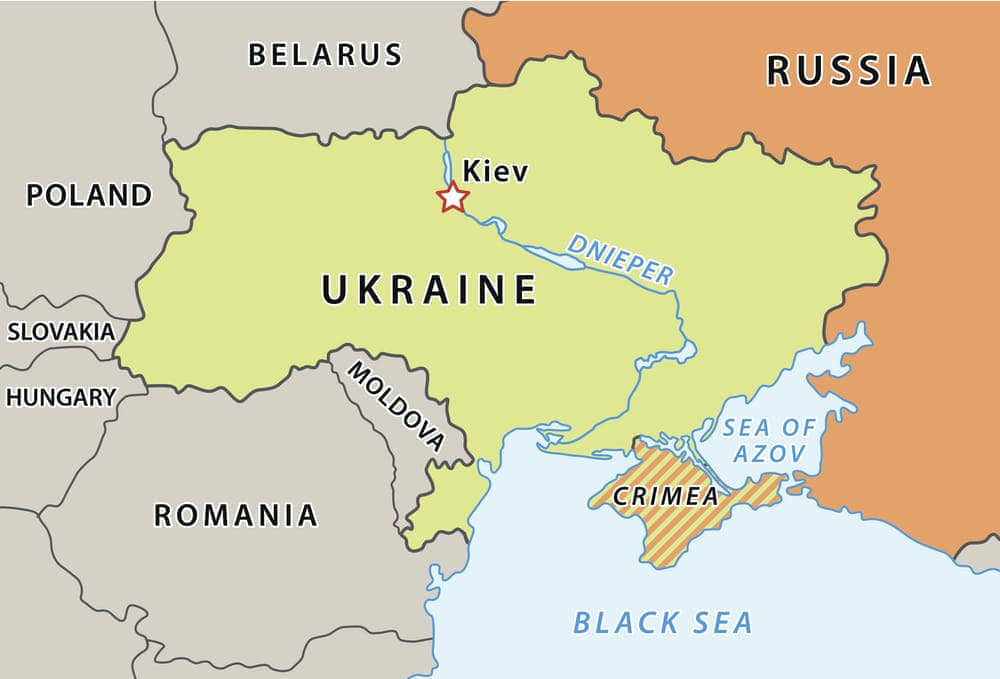
On Easter weekend, Regis, Tanya, Mikhail and I travelled by car from Simferopol, the capital of Crimea, to the Crimean Border Volunteer Camp (CBVC), a refugee centre situated steps away from Crimea’s northern border. The CBVC lies about fifty kilometres from the nearest point of the front line in the Ukraine war. The CBVC is operated by Organized Volunteers of Russia, an NGO founded by activists from St. Petersburg.
On the northern side of the Crimean border lies Kherson, one of the four oblasts being contested by Ukrainian and Russian forces. Russian forces currently control the entire territory of Kherson lying to the east of the Dnieper River. This constitutes approximately 60 percent of the Kherson oblast.
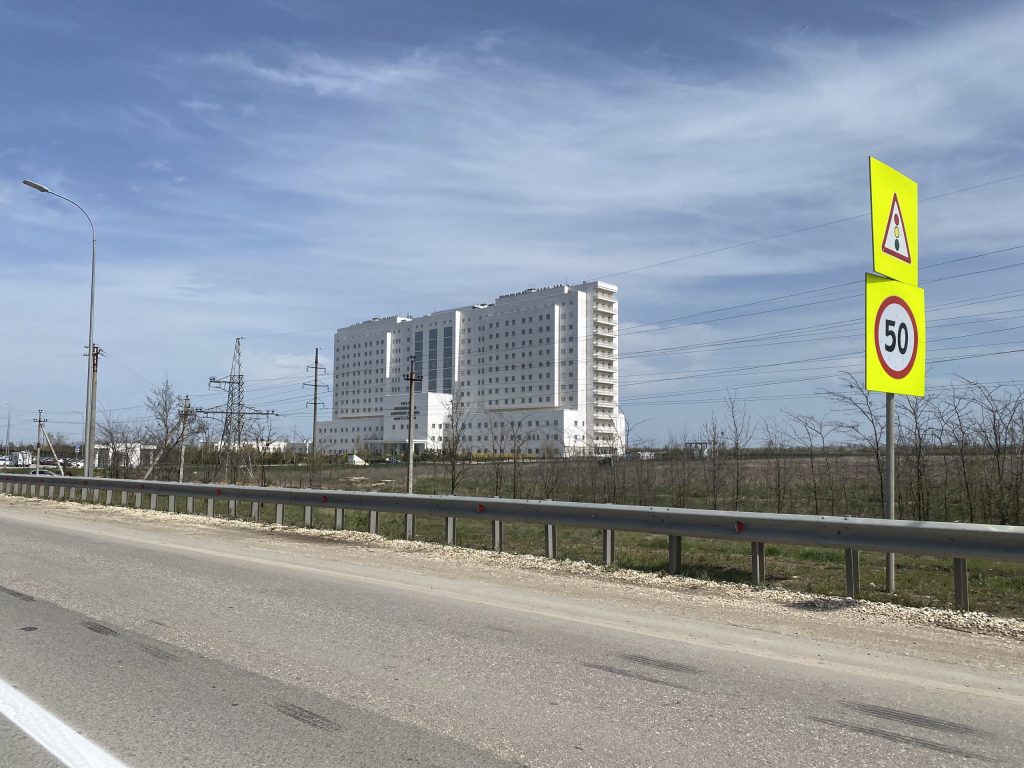
As we drove out of Simferopol, I was struck by the amount of development going on. I repeatedly saw high-rise apartment buildings that were either brand new or that were under construction. At one point, we passed by a newly constructed hospital, which Tanya described as a state-of-the-art medical facility.
After the merger of Crimea with the Russian Federation, Ukraine’s coup regime and far-right Ukrainian groups targeted Crimea’s residents with collective punishment.
After the 2014 referendum, Ukrainian banks ceased doing business with many residents of Crimea. This resulted in some Crimeans losing funds previously held in these banks. Tanya tells me that she herself lost the equivalent of about US$10,000 when her Kyiv-based bank refused to deal with her any further. She also said that she knows of some businesses operating in Crimea’s tourism industry that lost as much as US$100,000 in bank deposits.
In 2014, Ukraine cut off the fresh water supply to Crimea by damming a canal that had supplied 85% of the arid peninsula’s needs before Crimea merged with Russia.
In 2022, after seizing control of much of the Kherson region, Russian troops destroyed the concrete dam that Ukraine had built in 2014. This has relieved much of the water stress that Crimea experienced during the prior eight years. As we were driving through Simferopol, we passed by a massive reservoir that had dried up after Ukraine’s construction of that dam. As this video shows, that reservoir is now essentially full:
In 2015, Ukrainian ultra-right extremists destroyed electrical infrastructure that was used to supply electricity to Crimea and that was situated in Kherson, which was then under Ukrainian control. According to Tanya, this resulted in severe disruptions to Crimea’s economy, but the government of the Russian Federation managed to restore Crimea’s electricity supply within about eight months.
As we sped away from the Simferopol reservoir and toward Crimea’s northern border, we saw more and more Russian military vehicles.
Can Ukraine recover Crimea?
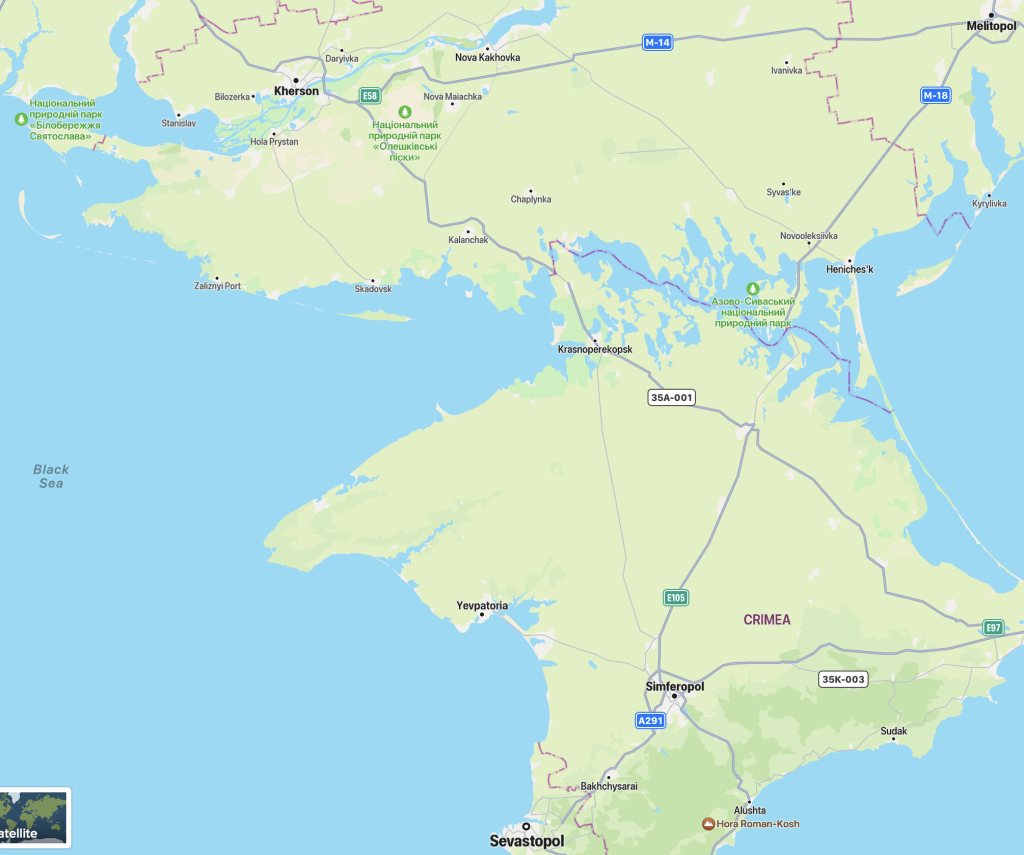
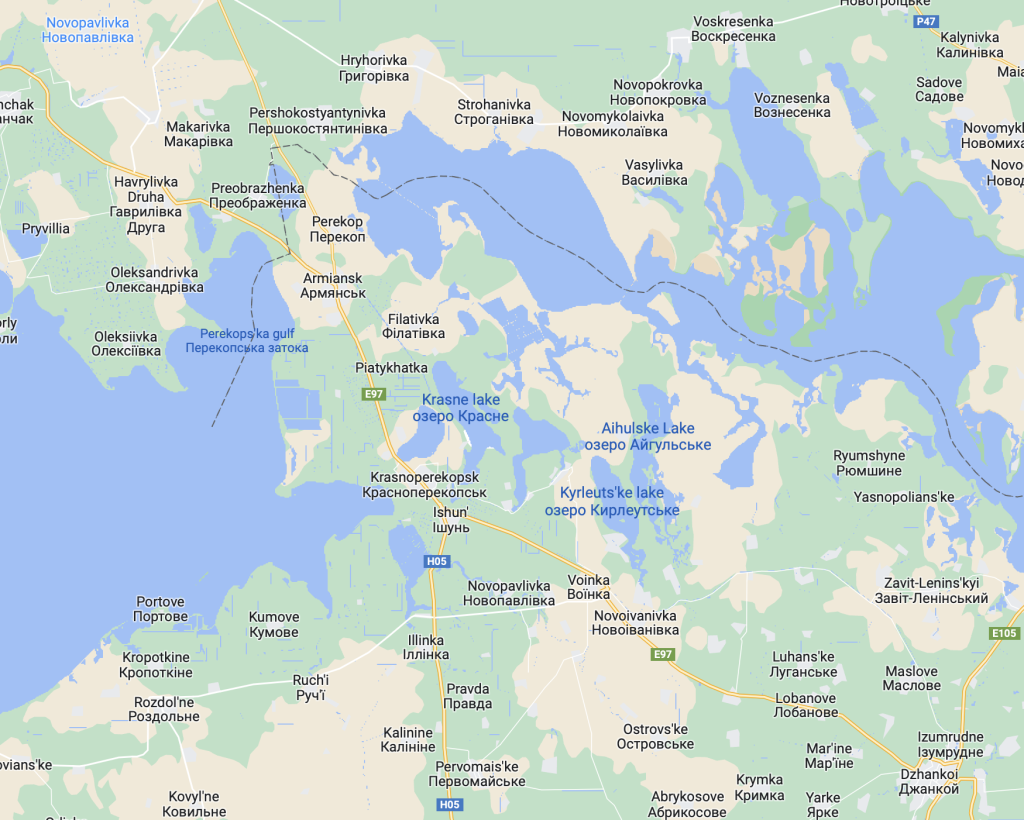
Until I came to Crimea, I had not understood that any ground attack by Ukrainian forces against the Crimean peninsula would have to pass through very narrow corridors of land flanked on either side by bodies of water. There are two such corridors.
One is the strip of land on which the town of Armiansk is situated. That land corridor appears in the northwestern (upper left-hand) quadrant of the map below:
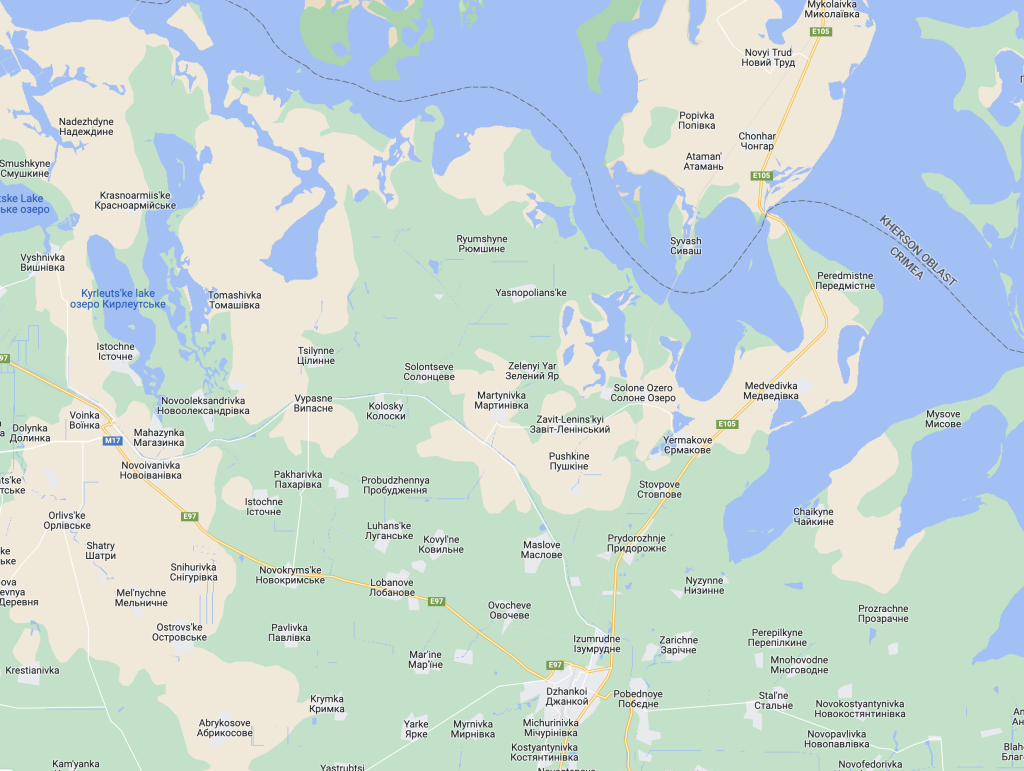
The second corridor connecting Kheron to Crimea lies to the northeast of Dzhankoi, on the E105 roadway. It is the narrow strip of land on which Peredmistne is situated and appears in the northeastern (upper right-hand) quadrant of this map.
The CBVC is situated in this second corridor, to the north of Peredmistne, and just south of the Crimea-Kherson border.
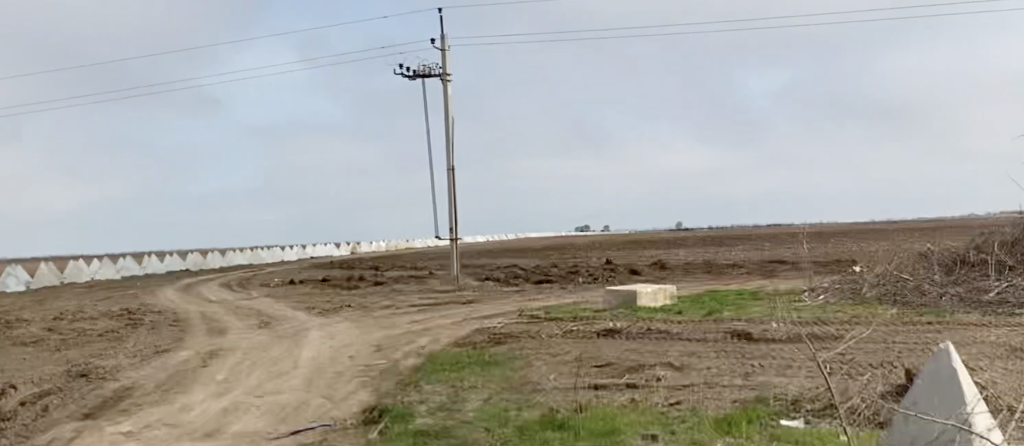
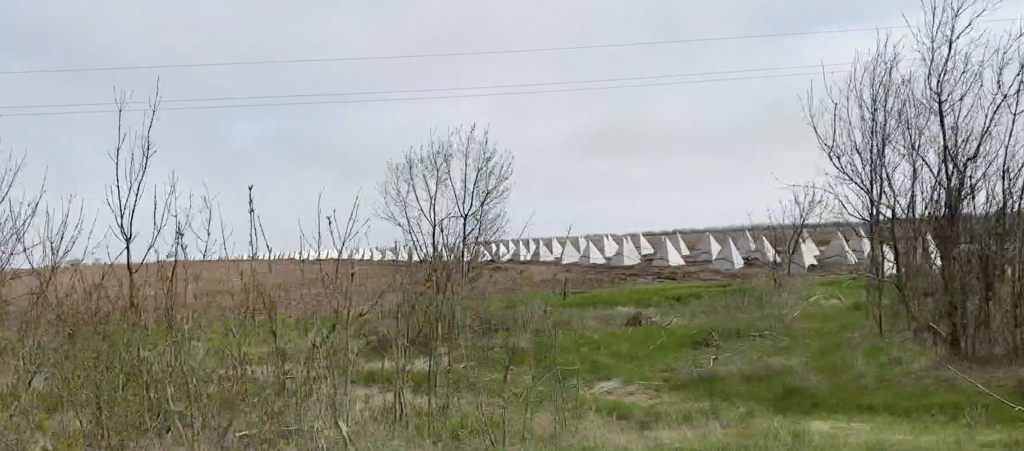
As we drove northward on the E105 through that narrow corridor, we saw multiple lines of trench-works and concrete, anti-tank obstacles on both sides of highway.
I do not profess to be a military expert, but I cannot imagine how Ukrainian forces could pierce this narrow corridor of heavily fortified territory .
Here, there is precious little room for attacking forces to manoeuvre. Moreover, Russian forces have established multiple defence lines. The land is flat and open, with virtually no tree cover. Also, it may well be that Russian forces have heavily mined some or all of the open fields in this area. Therefore, even if Ukrainian forces could reach the Crimea-Kherson border (which is highly doubtful), their prospects of penetrating into the Crimean peninsula in large numbers would be minuscule to non-existent.
In light of these realities, it is irresponsible for Zelensky’s government to define ‘victory’ for Ukraine to include the recovery of Crimea and, even worse, to issue regular assurances to the Ukrainian people that the recapture of Crimea is imminent. It is one thing to raise the morale of your people. It is quite another to deceive them about what is realistically possible. Even U.S. officials have publicly dismissed the claim that Ukraine can recover Crimea militarily.
By setting the bar of victory impossibly high, Zelensky is dooming the Ukrainian people to a prolonged war that can only end in defeat. Moreover, if by some miracle Ukrainian forces could achieve ‘victory’ as Zelensky has defined it, that ‘victory’ would likely bring perpetual instability to Ukraine, because a majority of Crimea’s residents are fiercely opposed to Ukrainian rule.
The Crimean Border Volunteer Camp
As we neared the CBVC and the Crimean border, the E105 became congested with Russian military vehicles.
Upon arriving at the CBVC, we discovered it to be a small facility. It is too close to the war zone to constitute a sanctuary for refugees. The purpose of the facility is to provide temporary relief from the war and to organize incoming refugees for rapid transfer to safer facilities further from the war zone (for example, facilities situated in Simferopol or Sebastopol).
When we visited the camp, there were only three refugees there: two young parents and their seven-year old daughter. They did not wish to be interviewed on camera. We learned that the family’s goal was to reach Poland, which has provided extensive military and economic support to Ukraine and has received a large number of Ukrainian refugees. The family had decided to travel to Poland through Crimea because they feared that, if they had attempted to enter Poland directly from Ukraine, Ukrainian forces would have apprehended the father at the border and would have forced him to serve in the Ukrainian military.
We spoke to six workers at CBVC. All of them were volunteers from diverse parts of the Russian Federation. They advised us that they do not discriminate between refugees who wish to travel to Russia and those who wish to travel to other European states, even if the governments of those states are hostile to Russia. The camp workers explained that, although most refugees they encounter wish to transit to Russia, they have encountered numerous male refugees who wish to transit into Western Europe through Crimea because they are afraid of being apprehended by Ukrainian forces at the Poland-Ukraine border.
I spoke for about thirty minutes with one of the CBVC volunteers. His name is Nicolai and he hails from Siberia. In 2022, before coming to CBVC, Nicolai volunteered as a humanitarian worker in Donetsk. There, he witnessed Ukrainian shelling of civilian areas, including a hospital. In my interview of Nicolai, he and I discussed his experiences at CBVC and Donetsk, and also discussed the International Criminal Court’s allegation that Russia’s government is separating Ukrainian children from their parents – an accusation which Nicolai described as “fake news”.
After I interviewed Nicolai, and as our team was loading our gear into Mikhail’s vehicle in preparation for our departure from the camp, Nicolai ran up to me and handed me an arm patch as a parting gift. His gift (pictured below) came as a pleasant surprise to me, because as much as I admire Che Guevara, I never mentioned Che to Nicolai.
High-level meetings in Washington and New York this week could have wide-reaching implications for the war between Ukraine and Russia, geopolitical hotspots like Taiwan and the South Pacific, and the global economy and international finance.
With Russian Foreign Minister Sergey Lavrov at the U.N. to preside over the Security Council and meet with United Nations Secretary-General António Guterres, and Guterres then traveling to Washington to visit lawmakers and Secretary of State Antony Blinken, new diplomatic initiatives regarding the 14-month-old war are underway.
Amid that diplomacy, perhaps the most significant development in the war this week was a call Wednesday between Chinese President Xi Jinping and Ukrainian President Volodymyr Zelensky, who hadn’t spoken during the conflict so far due to China’s general alignment with Russia.
Guterres was scheduled to meet Wednesday with the top appropriators in the Senate, Patty Murray (D-Wash.) and Susan Collins (R-Maine), the secretary-general’s spokesperson’s office said. Those were followed by meetings with House appropriators Rep. Mario Diaz-Balart (R-Fla.) and ranking member Rep. Rosa DeLauro (D-Conn.), as well as House Foreign Affairs Committee leaders Rep. Michael McCaul (R-Texas) and Rep. Gregory Meeks (D-N.Y.). Meetings were likely to touch on Ukraine or other topics, like the conflict in Sudan.
The U.S. has been a staunch ally of Ukraine and the top international donor to the Ukrainian war effort since the war began, with more than $75 billion given as of February in military, humanitarian and financial aid to the country. According to the German Kiel Institute for the World Economy, the U.S. spent around $48 billion on military aid, around $27 billion on financial and administrative support, and around $4 billion on humanitarian aid between January 2022 and February 2023.
The meeting between Guterres and Blinken on Thursday was discussed at the United Nations on Tuesday.
Earlier this month, Blinken authorized an additional tranche of $325 million in military support for Ukraine that included artillery rounds, rockets, small arms and anti-armor systems.
“We will continue to stand with our Ukrainian partners in response to Russia’s continued war of aggression,” Blinken said in an April 19 statement. “This new security assistance will enable Ukraine to continue to bravely defend itself in the face of Russia’s brutal, unprovoked and unjustified war. Russia could end its war today. Until Russia does, the United States and our allies and partners will stand united with Ukraine for as long as it takes.”
A readout of the call between Zelensky and Xi, as reported and translated by China analyst Bill Bishop, cautions against the dangers of nuclear war in the context of the Ukraine war and encourages negotiations.
“Dialogue and negotiation are the only way out. There are no winners in a nuclear war. Regarding nuclear issues, all relevant parties should maintain calm and restraint, truly consider their own and the future of all humanity, and work together to manage and control the crisis,” the Chinese readout of the call says, according to Bishop.
Bishop reported that China will be sending an envoy to Ukraine and other countries in the region to facilitate talks and work toward a settlement.
“Xi Jinping finally held a call with Ukraine President Zelensky, and according to the PRC [People’s Republic of China] readout China will send its special representative on Eurasian affairs to ‘Ukraine and other countries to conduct in-depth communication with all parties on the political settlement of the crisis,’” Bishop wrote in an analysis.
The call between Xi and Zelensky came in the wake of remarkable comments last Friday on French television by the Chinese ambassador to France, Lu Shaye, who questioned the sovereignty of ex-Soviet states.
Those comments followed remarks earlier this month by French President Emmanuel Macron, who had concluded a state visit to China and cautioned against European overreliance on the U.S. that could obstruct European “strategic autonomy.” Macron’s comments were first reported in English by Politico.
If diplomatic tides in the war in Ukraine are now shifting, they are sure to be felt in the Black Sea, where the future of a trade and humanitarian corridor hangs in the balance. Russian and Ukrainian agricultural products, which are vital to world markets and affect global food prices, have been transiting through this corridor.
Experts have also noted the symbolic importance of the corridor, which was negotiated under the auspices of Turkey and the United Nations as an indication that international cooperation can still take place during times of war.
“Yesterday, Antonio Guterres told me that on the global markets, there are acute shortages of fertilizer, specifically from the ammonia group. Nobody thought about this up until very recently at the last moment,” Lavrov told reporters at the United Nations on Tuesday.
Lavrov also suggested it was important for his country’s agricultural bank, Rosselkhozbank, to be readmitted to the international bank transfer system, known as SWIFT.
“Either you want to systemically resolve the issue of food shortages on the global market, [in which case] there’s a need simply to bring our bank back into the fold of the SWIFT system. Or you want every time for us and the U.N. Secretary-General to run back and forth and to plead with any given U.S. financial structure for them to be so magnanimous — you understand that cannot work and it will not work,” Lavrov said.
While peace in one part of the world does not imply peace in another, international diplomats often emphasize the importance of de-escalation in general for alleviating regional conflicts.
“We all want the resolution to correspond to a peaceful environment,” Guterres said regarding tensions around Taiwan during a visit to Tokyo last year, as reported by the Japanese publication Nikkei. “It’s very important to appeal, first of all, to common sense, … and then to restrain allowing for the de-escalation.”
Members of Congress have been concerned about how the conflict in Ukraine could reverberate across the world and affect other areas of geopolitical tension, even as far away as the Pacific Ocean.
Russia is already a mining and minerals titan but as the green and EV revolutions unfold its position will only improve as metals and minerals gradually replace hydrocarbons as the country’s major exports and give the Kremlin fresh leverage over the rest of the world.
“While the country is already a leading producer of gas and oil, it possesses vast geological resources, including significant deposits of diamonds, gold, platinum, palladium and coal, as well as reserves of iron, manganese, chromium, nickel, titanium, copper, tin, lead and tungsten ores. These resources are estimated to represent a total value equivalent to $75 trillion, potentially making Russia the world’s richest country,” according to a report highlighting Russia’s potential to become a major player in the global mining industry from the French Institute of International Relations (IFRI).
Demand for raw materials on the international market is growing exponentially as a result of surging trade flows, demographic growth in emerging countries and ecological transition policies. The new renewables and electric vehicle (EV) industries are mineral intensive, changing the traditional demand profile in the extractive industries. And Russia is home to nearly every element found on the periodic table in vast quantities.
“The extraction of metals provides the necessary elements for energy, communication, transport and other infrastructure. The mass adoption of “green technologies”, such as electric vehicles and renewable energies (such as wind and solar power), is bringing about a further increase in global demand for metals,” says IFRI. “However, Russia’s mining sector currently faces significant challenges. Its largely privatised industry is hindered by obsolete infrastructure, insufficient investment and a shortage of qualified human resources. The situation may be further exacerbated by the war in Ukraine.”
In a context of growing global demand for critical metals and minerals to meet the challenge of the ecological and energy transition, the future of Russia’s mining industry depends on a comprehensive modernisation process that has yet to begin in earnest and on a reorientation towards new markets in Asian such as India, Malaysia and Vietnam, and Africa, where the growth is fastest. All these countries have retained their economic ties with Russia, despite the sanctions, and are looking to boost their mineral supplies.
For the Kremlin’s part, it is looking at the mining sector to boost revenues and slowly replace its dependency on hydrocarbons as a new source of revenues. This change is already well underway.
Over the last five years, Russia’s extractive economy has accounted for 58.6% of the total value of Russian exports, broken down as follows: crude oil (26.4%), refined oil products (16.5%), natural gas (10.5%) and ferrous metals (5.3%).
And there is plenty of scope to expand extraction. Russia holds the world’s third-largest reserve of nickel, fourth-largest reserves of uranium, and especially copper, which is predicted to see a rise in global demand of 275% to 350% by 2050 thanks to the advent of the EV industry.
“Russia’s mining industry has the potential to become a strategic sector that is not affected by sanctions,” says IFRI.
Modernisation and the environment
Russia’s extractive segment plays a vital role in the country’s overall economy, with nearly 17,000 businesses involved in the sector. Out of these, 3,000 companies are engaged in the extraction of metal ores, while 800 are dedicated to coal mining. The majority of these businesses, around 16,300, belong to Russian stakeholders, with only 200 owned by foreign or joint entities, and 100 owned by public bodies. In addition, Russia has 39,800 businesses involved in the transformation of metals, IFRI reports.
As the mining sector is considered to be strategic, the government tightly controls foreign investment. It has the right of review over any direct or indirect acquisition of a domestic company by foreign investors that reaches or exceeds 25% of the firm’s voting share capital. Foreign government-owned entities face even tighter restrictions, with any acquisition that exceeds 5% subject to a special authorisation and also capped at 25%.
Furthermore, foreign companies cannot directly hold mining rights for deposits considered “strategic” and of “federal importance”, according to the law on subsoil. The Ministry of Natural Resources and the Environment, the Federal Agency for Subsoil Use and the Federal Agency for the Oversight of Natural Resources oversee the institutional architecture of the mining sector.
The main challenge is that almost the entire sector relies on infrastructure inherited from the Soviet era, which is highly polluting and obsolete. Mining regions, such as Norilsk in the Far North and the coal-rich Kuznetsk Basin in the south, are ecological disaster zones. And the sector has not executed its modernisation strategy, which is necessary for securing its technology transfer chains in the long term, reports IFRI.
There has been some progress as the Kremlin tries to incentivise modernisation and an environmental clean-up. The Kuznetsk Basin region has one of the world’s largest coal deposits, with proven reserves of approximately 693bn tonnes, accounting for half of the country’s annual coal output. Small and medium-sized enterprises (SMEs) within the Kuzbass Technopark are encouraged to invest in R&D via tax breaks and an exemption from property tax. The Kuzbass university and research centre also offer R&D mechanisms aimed at improving the competitiveness of the coal sector. But these programmes have produced few tangible results.
Bigger listed businesses in the sector are also making substantial efforts to transform their industrial equipment to comply with international standards as ESG awareness grows and increasingly affects share prices. For example, Norilsk Nickel, the state-owned nuclear power company Rosatom, and diamond miner Alrosa are investing heavily in modernising their infrastructure, with Norilsk Nickel intending to invest RUB100bn €1.3bn) between 2020 and 2024 to modernise its energy complex. Norilsk Nickel has been one of the most active, after the Norwegian State Pension fund banned investments into its shares on poor ESG results grounds.
Logistical bottlenecks
While there is no shortage of deposits, the difficulty is accessing them and then getting the minerals out to the global markets. Most of the deposits are located deep in Russia’s frozen interior.
“Russia has vast deposits of raw materials, but they are difficult to exploit due to inadequate infrastructure. However, the Russian government has not yet initiated a major works policy aimed at remedying it,” IFRI says.
Russia’s railway network, which is a critical part of the logistics chain, has several weaknesses and limited capacity. The railway network suffers from a lack of competitiveness, unreliable investments, poor flow capacity and an absence of bridges, which are essential for the viability and continuity of transport chains throughout the country, reports IFRI.
Another problem is the privatisations of the 1990s, and the federal nature of Russia’s government has created a confusing welter of actors.
“Firstly, the diversity of the actors involved in the sector and the variety of minerals exploited make the development of a systemic investment policy complex. Secondly, the dysfunctional relations between the federal government and local and regional institutions can hinder the progress of infrastructure projects,” says IFRI.
The Russian government has yet to initiate a major unified works policy aimed at remedying the situation. The problem of transportation infrastructure particularly affects mining projects in the Arctic and the Far East.
Siberia illustrates the challenges faced in improving the transportation network, says IFRI. In 2020, 144mn tonnes of freight passed through the Siberian part of the railway network. The ongoing modernisation of the region’s network aims to increase this volume to 180mn tonnes by 2025. However, the consequences of the war in Ukraine has further destabilised certain rail network development projects, such as the new expansion of the freight hub (Vostočnyj poligon) in eastern Siberia. Unable to sell goods to the West thanks to sanctions, Russia’s rail system has become clogged as the volumes of bulk cargo headed east have ballooned.
“Alongside the development of road and rail infrastructure, the federal authorities are targeting the Northern Sea Route (NSR), a critical hub for Russia’s geopolitical, economic and military ambitions. Maritime transport, particularly via the NSR, gives rise to more flexible flow management, thereby making it possible to meet demand from markets located far away from Russian territory, such as Malaysia and Vietnam,” says IFRI.
Mining in the Arctic
The largely untapped Arctic territories are a key focus for the development of Russia’s extractive industries.
Since 2014, thanks to the global dependence on Russia’s raw materials, the mining exploitation has not been directly targeted by sanctions, allowing for ongoing investments and development.
The Russian government intends to guide and stimulate the development of the Arctic territory using tax cuts and incentives such as grants to fund infrastructure, driving plans for the economic development of the Arctic region.
Big groups such as Norilsk Nickel and Alrosa have a historic presence, and mines are a key component of the economic development of the northern region and new projects are being added. One of these is a plan to develop the Monchetundra deposit, which contains significant reserves of cobalt, copper, nickel, platinum and gold. The UK-based Eurasia Mining and Russian state-owned firm Rosgeologiya have formed a partnership to exploit these deposits.
Another significant gold-mining site in Russia is the Kyuchus deposit, located near Tiksi, a port on the Laptev Sea. Beloye Zoloto (“White Gold”) holds the licence to the deposit, which contains more than 175 tonnes of gold. The plan is to provide energy from Rostatom’s new line of small modular nuclear power reactors with a capacity of 35 MW that are helping to open up far flung deposits with their localised power supplies.
Another new project is between Russia’s Rustitan Group and Chinese state-owned China Communication and Construction Company, which have signed an agreement to develop a titanium deposit in the Republic of Komi, a former Gulag nexus.
Rosatom is playing a key role in opening up the interior with its modular reactors as well as floating nuclear power stations. But the state-owned nuclear power monopolist has also been expanding in the mining business in the last two years through its subsidiary AtomRedMetZoloto (ARMZ).
Historically, ARMZ has focused on extraction at uranium deposits to provide itself with fuel. But more recently ARMZ is diversifying and mining other minerals. First, the Pavlovskoye deposit (lead and zinc) on the Novaya Zemlya archipelago is under development, representing an investment of RUB72bn (€1.3bn). Secondly, in association with the Norilsk Nickel group, ARMZ plans to exploit the Kolmozerskoye deposit (Murmansk Oblast), the country’s largest lithium reserve (accounting for 18.5% of national reserves). Rosatom and Nornickel have established the joint venture Polar Lithium to exploit these deposits. Of the country’s 12 proven lithium reserves, 55% are located in Murmansk Oblast. Eventually Rosatom aims to supply 10% of the global lithium market.
Weaponising minerals
“For Western powers, the fact that Russia is so deeply integrated into the global metals and minerals market makes it difficult to adopt sanctions against this segment as a whole, when the world economy has already been shaken by the Covid-19 pandemic since 2020,” says IFRI.
Minerals could turn out to be a potent weapon in Russia’s clash with the West. Accounting for only a small part of Russia’s export earnings, curbing exports will have little effect on Russia’s budget, but would prove devastating for a variety of industries around the globe ranging from the automotive and plane-building to agriculture.
There have been some sanctions on the sector, but they have focused on individuals, while their companies have been left largely untouched.
The UK has placed individual sanctions on several extraction oligarchs including: Roman Abramovich (shareholder of steel mill Evraz and aluminium producer Rusal), Oleg Deripaska (chairman of Rusal), Andrey Guryev (founder and CEO of fertiliser makers PhosAgro), Sergey Ivanov (CEO of Alrosa) and Vladimir Potanin (CEO of Norilsk Nickel).
Amongst the Americans involved in Russian minerals, Boeing suspended its partnership contract with Russian titanium producer VSMPO AVISMA, a subsidiary of state-owned group Rostec, which has been subject to financial and trade sanctions since 2014. But replacing Russian titanium, essential for making planes, means that European group Airbus has continued to receive its titanium supplies from subsidiaries of Rostec.
In order to maintain supplies, but at the same time punish Russia, the UK also increased its customs tariffs for imports of platinum and palladium from Russia and Belarus as part of its sanctions regime.
Diamond miner Alrosa has proved particularly vexing. Belgium has lobbied against sanctions on the export of Russian diamonds, as Antwerp’s local economy is so dependent on trading prime diamonds. The US and the EU have failed to agree on a common line: while the Office of Foreign Assets Control (OFAC) of the US Treasury Department placed the diamond giant on its sanctions list, the EU decided not to impose similar sanctions under pressure from Belgium.
Likewise, Russia’s deep integration into the global metals market means that the London Metal Exchange (LME) also eventually decided not to prohibit trading and storing metals originating from Russia within its system, fearing a market meltdown if it did.
But the most potent weapons in Russia’s arsenal are the minerals connected to the EV industry.
“Palladium, in particular, of which 38% of global production takes place in Russia, could represent a powerful lever: an embargo or a slowdown in export procedures would have a minimal financial impact for the Russian state – palladium accounts for just 0.43% of domestic GDP – but would cause a major shock to the Western car industry and a global market upset,” says IFRI. “Likewise, the exponential growth in demand for nickel – an essential component in the manufacture of certain models of electric vehicle batteries – gives Russia an additional advantage in its economic war against the West.”
Africa rising
Even without explicit sanctions, Europe has begun to wean itself off imports of Russian minerals and the US is already almost totally self-sufficient in everything bar uranium and specialist metals like palladium and titanium for the meantime.
Africa is almost as rich in minerals as Russia, and is also one of the fastest growing markets. Both Russia and China has been actively investing in African mining operations for both commercial and geopolitical reasons. Raw materials have always been a major Kremlin foreign policy tool. And since sanctions were imposed on Russia, minerals have also become an extremely useful way of dodging the financial sanctions.
“The exploitation of African mineral resources is a means of bypassing the sanctions regime, particularly Russia’s isolation from the international banking system. Precious commodities such as gold and diamonds are useful for escaping banking sanctions because they can be sold and traded without oversight or restrictions,” says IFRI.
Russia’s mining companies, Alrosa and Rusal, have established a strong presence in African countries such as Angola, Zimbabwe, Guinea and the Democratic Republic of Congo (DRC). In addition to their economic interests, Russia has geopolitical ambitions in Africa that are facilitated by the exploitation of mineral deposits.
As part of the effort to strengthen mineral ties with African countries, the Kremlin has also made use of that other plank of its foreign policy power: the military.
The Wagner group, led by Yevgeny Prigozhin, has been active in certain African countries, offering security services in exchange for “lucrative mining contracts.” In some cases, African governments have paid for Wagner’s help with mining deals.
“For instance, in the Central African Republic, Wagner’s links with mining companies M Finans and Lobaye Invest reveal the nature of these ties. These firms are allegedly controlled by Prigozhin, and licences to exploit diamond and gold deposits were awarded to a Russian company believed to be close to the founder of Wagner,” says IFRI.
The Wagner group has sought to amend the local mining code to establish a monopoly on precious commodities such as gold and diamonds in the CAR.
Wagner is also acting in Sudan. In 2017, Prigozhin’s group obtained significant mining concessions for gold and diamond deposits in what is the world’s third-largest producer of gold. Russia’s ties with Khartoum have deepened in recent years, and Russian mercenaries are helping Sudan’s security forces to repress pro-democracy movements. Despite US pressure, Russia is still pursuing its plan to build a naval base in Port Sudan on the Red Sea.
The upcoming Russia-Africa economic forum to be held in St Petersburg in July will serve as a platform for the development of Russian mining activities in Africa and almost all the heads of state from the 54 African countries are expected to attend.
Key commodities
“Certain [Russian] commodities that are integrated into the global economy appear to be difficult to substitute. This is the case with diamonds, phosphate and nickel. These three segments represent the complexity of the mining sector, as well as the associated industrial and geoeconomic issues at play. Whether in relation to the high-tech sector for diamonds, agriculture for phosphate or the energy transition for nickel, Moscow has numerous assets that it is mobilising with a view to maintaining its sectorial competitiveness for each segment concerned,“ says IFRI.
Russia has a wide variety of important minerals at its disposal to influence the rest of the world, making it harder to sanction.
Coal: Global coal consumption has reached an all-time high since the Industrial Revolution, according to the International Energy Agency (IEA). In 2022, consumption of coal soared to a record 8,025mn tonnes and is expected to remain stable until 2025 at 8,038mn tonnes. Despite its negative impact on the environment, the Russian government plans to boost its coal industry through a programme that extends up to 2035.
To boost the industry, the Russian government has laid out plans to invest in the modernisation of industrial infrastructure in the Kuzbass basin, located in Kemerovo Oblast. Additionally, new deposits in the Siberian Arctic are being explored for exploitation. Russia’s share of international coal trade has grown from 9% to 15% in the past decade, with the Asia-Pacific region being the primary market.
While Russian researchers predict annual coal production to reach between 330mn tonnes and 365mn tonnes by 2035, the government’s most optimistic scenario envisages production of up to 670mn tonnes. However, this seems unrealistic as production capacity is limited, says IFRI. Coal production has risen gradually from 258mn tonnes in 2000 to 439mn tonnes in 2019, but the global health crisis caused a decline in output to 398mn tonnes in 2020.
Diamonds: Natural diamonds are often associated with the glamorous world of jewellery. However, these precious stones possess unique characteristics that make them a valuable material in the industrial sector for grinding and mining in particular.
“Moscow has both economic and political dominance over [the diamond] segment, with the conditions of the diamond market evolving rapidly,” says IFRI.
Russia is a major player in the global diamond market, with the Republic of Sakha (Yakutia) accounting for 25% of global diamond production and 80% of Russia’s national diamond output. The Alrosa group, which is controlled by the federal state (33%) and the regional government and municipal districts of Yakutia (33%), operates 24 diamond deposits in the country.
Unfortunately, the uncontrolled exploitation of diamond deposits in Yakutia has led to a disastrous environmental situation. Soil and waterways near the mining sites have been severely contaminated as a Soviet-era legacy.
Alrosa sells its diamonds on the international market through the global diamond syndicate, the Central Selling Organisation (CSO), established by South African company De Beers. The co-operation between De Beers and Russia began in 1959 with the launch of mining activities in Yakutia. Alrosa is the world’s leading supplier of natural diamonds, producing between 35mn and 40mn carats a year (equivalent to between 7 and 8 tonnes).
Russia also has considerable political clout as a key member of the Kimberley Process, an international trade forum established in 2000 to certify stones and stamp out the sale of “blood diamonds” used to financial civil wars in Africa, giving it another lever over the continent. For example, during Moscow’s chairmanship of the forum in 2021, diamond mines in the Central African Republic were allowed to continue to operate despite the blood tussle with pro-democracy forces there.
Even after the war in Ukraine started, Russia still leads two of the six Kimberley Process working groups. However, the definition of “conflict diamonds” has failed to expand to include the use of private or government-backed paramilitary forces.
To meet the needs of the high-tech industry, the production of synthetic diamonds is rapidly growing, where Russia also plays a dominate role. China, Japan and India are emerging as top competitors in the field. Synthetic diamonds represent about one quarter of Alrosa’s annual production, with its market share expected to grow by 9% annually until 2028. 70% of synthetic diamond production is used in industry, and another 13% is used for the production of semiconductors, sensors, laser systems and optical fibres.
To maintain its leading position in the synthetic diamond market, Russian company Synthesis Technology (Syntechno) has opened a factory for the production of synthetic diamonds in Pskov Oblast and intends to expand it.
Fertilisers: Russia is the biggest fertiliser maker in the world and as such can affect agricultural production throughout Europe and Africa.
“In Russia, the fertiliser sector is without doubt the one with the most complete and accomplished value chain, from the extraction phase right through to distribution on the market. Four groups dominate the country’s fertiliser segment: Acron, EuroChem, PhosAgro and Uralchem,” says IFRI. “Although Russia does not dominate the fertiliser sector, it is still a key actor due to the global economy’s heavy dependence on an intensive farming model. In fact, Russian industrial groups, which dominate the value chain in this sector, constitute an indispensable link in the planet’s agricultural system.”
Fertilisers are a critical component in the global food supply chain. In Russia, fertilisers are structured around the Russian Association of Fertiliser Producers (RAFP), which was founded in 2008 and reports directly to the Ministry of Industry and Trade (Minpromtorg). Currently, 100 Russian fertilisers account for 20% of the global market, equivalent to $12.5bn.
PhosAgro, established in 2001, is Europe’s leading supplier of phosphate-based fertilisers. The company is vertically integrated and carries out its extractive activities in Kirovsk, Murmansk Oblast, where six deposits are currently being exploited. This site is the world’s biggest in terms of production of highly concentrated phosphate rock, with an estimated lifespan of 60 years.
PhosAgro is the primary distributor of fertilisers to Russian farmers, selling 3.54mn tonnes in 2020. In other words, 30% of its production is destined for the domestic market. While the company has distribution points worldwide, it plans to improve its distribution network throughout the country, with a particular focus on the development of liquid mineral fertilisers, which are becoming essential in regions regularly exposed to drought.
Due to the threat of sanctions, some CEOs have stepped down or sold their shares. For example, oligarch Dmitry Mazepin resigned as CEO of Uralchem and reduced his shareholding to 48% to make himself a minority shareholder in the hope of avoiding sanctions.
The prospect of a reduction in fertiliser supplies for the global farming sector could have a devastating effect on harvests in 2023, says IFRI. Reduced fertiliser usage would result in a proportional drop in global agricultural yields, driving up inflation again and possibly causing famines in markets like Africa. Farming powers such as Brazil, one of the world’s leading exporters of maize, soya, sugar and coffee, are continuing to trade with Russia and replenish their fertiliser stocks, while bypassing banking and logistics restrictions, as part of the emerging “BRICS bloc,” a growing geopolitical co-operation between the leading emerging markets of the world.
As with metal, Western countries have been hesitant to directly target Russian fertilisers with sanctions, recognising their importance to the global food supply chain. As such, companies such as PhosAgro will continue to play an important role in global agriculture, with a focus on sustainable and innovative approaches to fertiliser distribution and usage. Again, the West has limited itself to sanctioning the owners of the large companies, but even there several oligarchs have been exempted.
Nickel: In May 2020, the spillage of 21,000 tonnes of diesel oil into the Ambarnaya river, in the Siberian Arctic, was declared a federal emergency and one of the worst environmental disasters in Russia’s history. The accident happened following the failure of a storage tank and put the spotlight on its owner, the mining group Norilsk Nickel.
In response, Potanin, the leading shareholder and CEO of Nornickel, decided to initiate a profound transformation of the group’s environmental policy. “This evolution is taking place in a context of transformation of the global nickel market. The market is being upended by the policy of decarbonisation, which calls for the implementation of a transition based on renewable energies and the electrification of transport,” says IFRI.
Nickel is a vital component in the production of sustainable energy and lithium-ion batteries for EVs. With demand for these vehicles anticipated to soar over the coming years, it is predicted that the need for nickel ore will increase by up to 100% by 2050 compared to current levels, reports IFRI.
Major EV makers are getting ready. Carmaker Tesla has signed commercial agreements with non-Russian partners to secure non-Russian supplies of nickel. In contrast, Norilsk Nickel is targeting growth of between 25% and 35% in its nickel output by 2030 compared to 2017 and intends to sell to Asia, not the West.
Norilsk Nickel is currently the world’s leading producer of nickel, accounting for 17% of the global total production volume. Despite sanctions pressure, the company has begun to modernise its industrial equipment and launched a major ESG-driven clean up.
The company has an ambitious plan to reduce its sulphur dioxide (SO2) emissions as part of its modernisation project and has already closed down several of the worst offending plants on the Kola peninsula. Its flagship Norilsk Metallurgical Complex, one of the largest emitters of SO2, makes the Norilsk region one of the most polluted in the world. The industrial renovation project aims to reduce SO2 emissions by 90% and concerns the entire polar division, covering both the Norilsk region and the Kola peninsula in the Arctic. The closure of the foundry complex in Nikel, a border town close to Norway, has already led to a reduction of 78% in SO2 emissions in 2021 compared to the previous year.
The need for sustainable development and adherence to the UN SDGs and ESG criteria have become a guiding principle for many investments. However, Norilsk Nickel continues to receive criticism from NGOs, particularly those associated with the indigenous populations of the region, who say the company could do more.
In the realm of foreign policy discourse, few memes have been more prevalent or misleading than the oft-cited comparison of Russia’s economy to that of Italy. The phrase, first coined by Senator Lindsey Graham in 2014, has been wielded like a blunt instrument by Western policymakers and commentators, the implication being that Russia’s economy is feeble and inconsequential when contrasted with the collective might of the West. This soundbite, depressingly, has informed and shaped our approach to Russia, and it is high time we abandon it.
For if Russia’s economy were as small and unimpressive as the statistics suggest, how could it withstand the sanctions imposed upon it? Why has President Joe Biden’s declaration that “the Russian economy will be cut in half” failed to materialize? Did not French finance minister Bruno Le Maire tell a French radio station that the West’s goal was to “cause the collapse of the Russian economy” and bring Moscow to heel? How does a nation with an economy purportedly the size of Italy manage to exert such global influence, to the point where U.S. Treasury Secretary Janet Yellen recently stated that Western sanctions are themselves putting U.S. dollar hegemony at risk?
On paper, Sen. Graham’s observation seems accurate; both Russia and Italy are close to each other in terms of nominal gross domestic product, or GDP, which has been the preferred method of measuring a country’s economic size and power since World War II. The figure is produced by determining the total cost of all goods and services either produced or sold in a country within a given time frame. According to World Bank data, in 2013, Russia’s nominal GDP was around $2.29 trillion while Italy’s was around $2.14 trillion. As recently as 2021, Russia’s nominal GDP was around $1.78 trillion while Italy’s stood at $2.11 trillion.
Yet error in this comparison lies in the reliance on measuring nominal GDP itself, as it fails to account for exchange rates and purchasing power parity (PPP), which accounts for the standard of living and productivity (and from there, per capita welfare and, importantly, resource use). Renowned French economist Jacques Sapir has pointed out the inadequacy of this metric, arguing that Russia’s GDP, when measured in PPP ($3.74 trillion in 2013, $4.81 trillion in 2021), is closer to Germany’s ($3.63 trillion in 2013, $4.85 trillion in 2021) than Italy’s ($2.19 trillion in 2013, $2.74 trillion in 2021). This is a crucial distinction, and it is both puzzling and troubling that so many continue to parrot the Russia-Italy comparison.
But even the PPP figures do not fully capture the significance of Russia’s economic power. Sapir further expanded his analysis in an essay for American Affairs, a policy journal, and noted that the PPP measurement “may not yet reflect the real importance of the Russian [economy] when strategic, geopolitical issues are at stake.”
Sapir notes that, over the past fifty years, Western economies have become increasingly dominated by service sectors, which, while contributing to GDP calculations, lose their importance during times of conflict. In such situations, it is the production of physical goods that matters, and by this measure, Russia’s economy is not only stronger than Germany’s but also more than twice as robust as France’s. Furthermore, Russia’s dominant position in the global energy and commodities trade—as it is a key producer of oil, gas, platinum, cobalt, gold, nickel, phosphates, iron, wheat, barley, buckwheat, oats, and more—provides it with substantial leverage over markets and economies, making it less susceptible to sanctions and less easily cowed by Western pressure. This reality has not been lost on many nations in the Global South, who have been reticent to support Ukraine in its struggle against Russian aggression.
Though Senator Graham made a significant mistake in deploying the Russia/Italy economic comparison, he can perhaps be forgiven on the grounds that he is a politician. The same, however, cannot be said for a number of economists and foreign policy experts who have repeated the line over the years up to and including the present.
Yet the persistence of the Russia-Italy myth among these professionals is perhaps not surprising given the allure of the service sectors in the West. The spectacular growth of these capital-intensive sectors, along with their nominal wealth and productivity, has led many in Washington and various Western capitals to not just embrace them, but also to politically, culturally, and ideologically prefer them. We Americans take particular pride, for example, in the success of our tech giants as drivers of innovation, growth, and national prestige. The Internet, and the various applications that flourished on smartphones, are considered by many to be inherently democratizing, effectively serving as a conduit for American values and an enabler of U.S. national interests.
This love for service sectors results in a tendency to view the labor-intensive industries of the past—energy, agriculture, resource extraction, manufacturing—as antiquated relics. But this skewed perspective has left us unprepared for a world in which tangible goods are once again of vital importance, as evidenced by our struggles in the face of the war in Ukraine. The conflict has “exposed a worrisome lack of production capacity in the United States.” In Europe, the United Kingdom has noted that “it will take 10 years to replace weapon stocks gifted to Ukraine and rebuild British weapon numbers to an acceptable level.” The EU, for its part, now cut off from cheap Russian energy, faces the terrifying possible prospect of rapid deindustrialization.
It is high time that we admit how much we severely underestimate the relative size and power of rival economies, including and especially Russia’s. It would also behoove policymakers to reevaluate their current policy approach to economic statecraft—sanctions are not a one-size-fits-all solution, particularly when dealing with a nation that wields significant economic power.
But above all, let us resolve to never again utter the words “Russia has an economy the size of Italy.”