What constitutes a progressive position on the war in Ukraine? What factors might bring about peace? Should the United States continue to send military aid, and other support, to Ukraine? What should be done about the parts of Ukraine currently occupied by Russian forces? What should be done about NATO?
Howie Hawkins and Jill Stein presented their perspectives on the Ukraine war and how peace might come about. Jill and Howie are the Green Party’s two most recent Presidential candidates, Jill having run in 2012 and 2016 and Howie having run in 2020.
Putin’s regime last week took a big step towards total control over its citizens. Both houses of Russia’s parliament approved amendments to a law on military service and military registration, formally equating an electronic summons with traditional call-up papers. In addition, they accepted serious restrictions on constitutional rights, including restrictions on foreign travel, in a bid to stop people evading military service. The regime is becoming more and more naked in its aggression against its own citizens. We’ll take a look at why this is bad news, not only for ordinary Russians but also for the economy and the authorities.
What’s happening?
In the space of less than a week, both houses of Russia’s parliament rushed to approve a law that gives full legal force to an electronic call-up for military service and creates a digital database of those eligible for military service. On Friday evening, the law was signed by Vladimir Putin. This is directly linked to the Gosuslugi portal – used by millions to handle day-to-day interactions with the government – and will be under the control of military commissariats. By order of the Defense Ministry, the Ministry of Digital Development will create the database and almost every ministry will contribute data: from the Tax Service and the Interior Ministry to employers and educational institutions. People can be added to the register without ever physically attending an enlistment office. For example, in the year when a man turns 17, or after gaining Russian citizenship, he will automatically be added to the service register.
The law comes into force from the moment of its publication. Digital Development Minister Maksut Shadayev was quick to calm the situation, saying that the register would only be working “in full” during the fall conscription period. However, that does nothing to prevent the register working to a limited extent (whatever that means) right now. The new law does not only affect conscripts, but everyone eligible for military service. Now, anyone with “grounds” (such as women who have a military specialty or men over 27 years but who did not complete their military service) can be remotely enrolled. Russia is continuing its latent mobilization, so anybody on the list could be called for military service at any time.
How will Russians be called up?
Alongside the traditional call-up papers, conscripts can also be summoned electronically. Any electronic summons is considered served as soon as it appears in a personal account, regardless of whether or not it has been read. This does not merely mean a message in a Gosuslugi account, it could be any account or “information system” among the many that are being created alongside the new military register. As a result, the now-popular tactic of simply deleting a Gosuslugi account will not save anyone from the draft.
As soon as a summons is delivered, the subject is banned from leaving the country. Anyone who fails to report to an enlistment office without good reason within 20 days of the date of the call-up will be unable to take out a loan, register ownership of property or vehicles, or register as self-employed. Banks will be obliged to check the register before issuing loans.
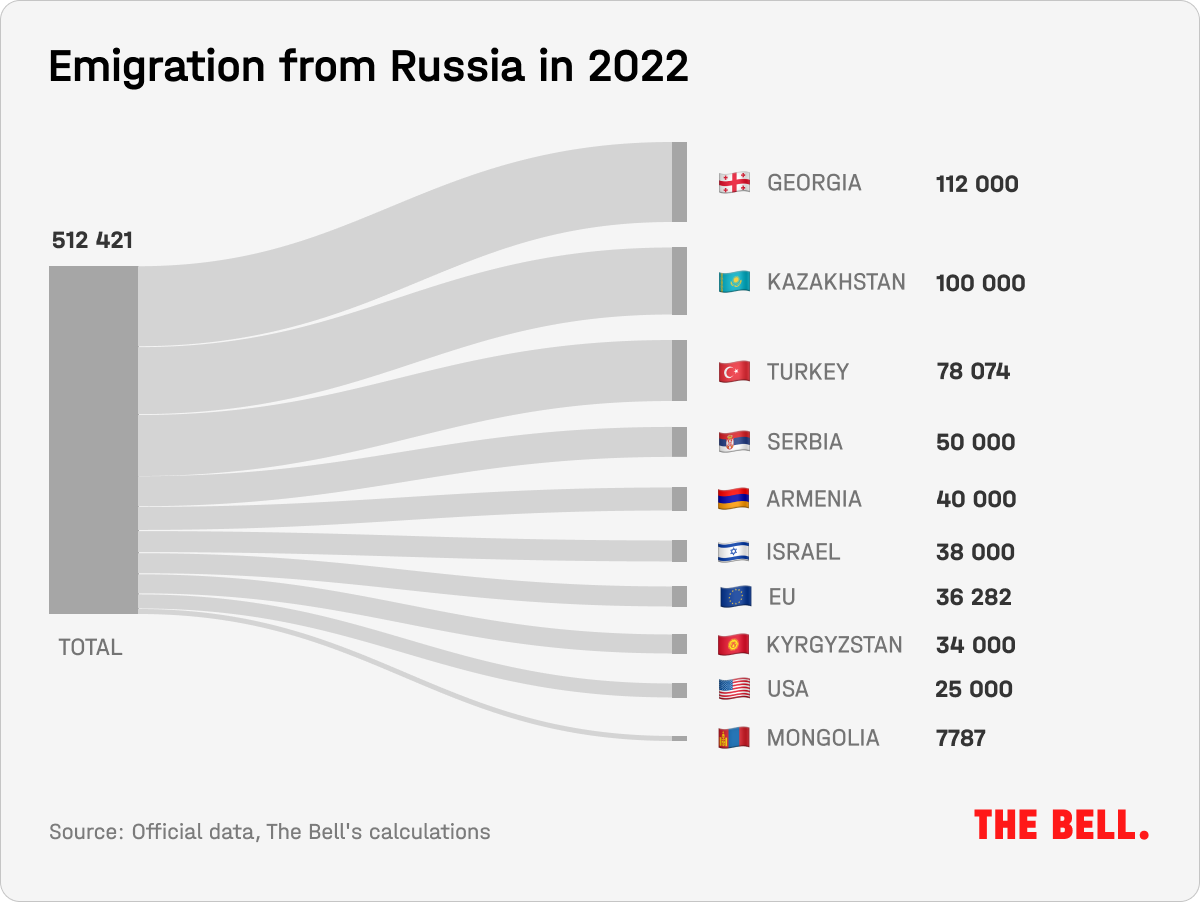
After Russia’s invasion of Ukraine, the country experienced two big waves of emigration. The first came in March 2022 and the second was in September after mobilization was announced. One of the more memorable images of that time showed traffic jams backed up for several kilometers at a checkpoint on the Georgian border. The authorities have not announced an exact figure for those who have left the country permanently. The Bell’s minimum estimate is that more than 500,000 people have gone into exile. Despite assurances from the authorities that few people left, it’s clear this is painful for the Kremlin.
Why is the law needed, and how was it adopted?
The authorities adopted the new legislation in blitzkrieg fashion. On the eve of the draft, Rear Admiral Vladimir Tsimlyansky, head of the main Organizational and Mobilization Directorate of Russia’s Armed Forces, let slip that electronic call-ups would be issued. State media were then banned from reporting this statement, an official told The Bell. This was confirmed by an employee of a state media organization: “the ban came from the Kremlin.” On the same day, the Gosuslugi portal removed the option of deleting an existing account (later it was returned).
Immediately after the bill was adopted, the authorities issued a “manual” (seen by Meduza) to explain to journalists how to report the new law. Apparently it is to do with “eliminating shortcomings in the military registration system.” However, on national television, Duma committee chief Andrei Kartapolov let slip that the law was essential to “deploy mobilization.”
Clearly, the deputies are just a front. However, it is not known who is behind the new law. For the government, which is also responsible for demographics and the labor market, the news came as a surprise, two federal officials told The Bell.
“There were no meetings, there was no consideration of a possible third wave of emigration,” one of them said.
Two sources close to the Kremlin told Meduza that Kremlin officials were unaware of the changes and played no role in drafting the legislation. Meduza’s sources are certain that the amendments came from the Defense Ministry. However, a federal official disputes this, insisting that it would be impossible to push through the bill without the Kremlin: “The military does not carry sufficient weight to push through a law that would have such a powerful impact on society and the economy while the country is in special operation mode,” he said. “Unless there have been some decisive changes in the structure of the regime.”
The economy and the labor market
Apart from an electronic summons, which is almost impossible to evade, the law makes it possible to sign up conscript soldiers for three year-contracts right away (previously, the maximum initial contract was just three months). At the same time, there are almost no limits on the nature of the contract during mobilization. This means that any conscript could theoretically be sent immediately “to the zone of the special military operation.” Thus the military can now ignore Putin’s public pledge that conscripts will not be sent to fight. There are plenty of examples of how the military forces conscripts to sign contracts (see here or here). Now, contract military service will become voluntarily-compulsory. In late March a source told Bloomberg that the Russian authorities wanted to avoid a second wave of mobilization, but also planned to recruit 400,000 contract soldiers for the war.
The law should not have a direct negative effect on the economy, but it will likely be destabilizing: increased anxiety among the population and the business community, coupled with rising uncertainty, discourages investment. Moreover, there is a risk of a third wave of emigration. For individuals and businesses, the key issue when planning is the likely duration of the conflict. Alexander Isakov of Bloomberg Economics said: “If the passage of the law is taken as a signal that [the conflict] will go on longer than expected, then we will see lower consumer confidence and a continued high level of savings.”
In 2022, 1.3 million people under the age of 35 left the workforce, according to official figures. Russians aged 25-29 were most likely to leave. Research attributes this to an aging demographic and emigration. The war in Ukraine is not mentioned, but it is a real factor that influences the labor market. The FSB estimates that Russia lost 110,000 people killed or injured in Ukraine, the New York Times writes with reference to leaked U.S. intelligence reports. Reuters, referring to another document from this leak, reported that the U.S. military estimates Russia’s losses from 189,500 to 223,000 men, of which up to 43,000 have been killed. In early April 2023, Mediazona and the BBC Russian Service, along with a team of volunteers, used open data to identify 19,688 Russian soldiers killed since the full-scale invasion of Ukraine. As the wounded leave the workforce, there is nobody to replace them. There are few men left on the labor market (we wrote about this here) and in several regions women are being hired to fill roles traditionally performed by men.
More bans and restrictions
In parallel with “digital mobilization,” lawmakers have been considering the possibility of imposing a life sentence for treason. Since the start of the year, at least 17 Russian citizens have been arrested for treason (there were 20 such cases in the whole of last year). “This stems from the fact that Putin’s model of government is now in place forever and any betrayal of him – whatever that means in an arbitrary interpretation of their own law – is punishable by eternal imprisonment,” expert Andrei Kolesnikov wrote in a recent analysis.
In addition, it recently emerged that officials and employees of state companies and corporations face restrictions on leaving the country. Recent changes mean that all top officials – from ministers down to heads of department – can only travel abroad with the express permission of Prime Minister Mikhail Mishustin.
And that permission is only given when there is a clear operational need, reported The Bell. Some officials have been obliged to hand over their passports. And there were media reports that, over the New Year holidays, both national and regional-level officials were banned from leaving Russia. The Federal Security Service (FSB) maintains a database of officials, governors and other state employees who must obtain special permission in order to leave the country. “An iron curtain for those associated with the state is… in place,” a senior Russian government official said at the time.
Why the world should care
When war broke out in Ukraine, the Kremlin did everything it could to prove that mass emigration from Russia was not something that troubled the authorities. However, the ever-widening restrictions (first security officers, then officials and now conscripts) on leaving the country tell a different story. It appears that the Kremlin cannot rule out a further deterioration in the situation, which might provoke another wave of emigration, but is still unwilling to close the borders. “The situation is something of an emergency, which has left the political regime writhing and convulsing. This could lead to transformations that it never even planned,” said political analyst Ekaterina Shulman.
Clear differences are emerging within the Ukrainian government as to whether Ukraine should make the reconquest of Crimea a nonnegotiable goal of its war effort or be prepared to trade at least provisional Russian control of the peninsula for Russian concessions elsewhere. This issue also has the potential to create a deep split between Kyiv and Western governments, which fear that Crimea and control of the strategically vital military base of Sevastopol might be the point on which Moscow would be willing to escalate toward nuclear war. The question is becoming more urgent as Ukraine prepares for an offensive that could potentially allow it to cut the land route between Russia and Crimea.
My own research in Ukraine last month suggests that Ukrainian President Volodymyr Zelensky would have very great domestic difficulty in supporting a cease-fire leaving Crimea in Russian hands. Not only would this face strong opposition from hard-line nationalists and the Ukrainian military, but the Ukrainian government has helped foster a general public mood that Crimea must be recovered at all costs.
In a departure from the previous government line, Andriy Sybiha, the deputy head of the presidential staff and a veteran Ukrainian diplomat, told the Financial Times last week: “If we succeed in achieving our strategic goals on the battlefield, and when we are on the administrative border of Crimea, we are ready to open a diplomatic page to discuss this issue … [though] this doesn’t mean that we exclude the way of liberation [of Crimea] by our army.”
In a recent interview rebroadcast by Radio Liberty, another advisor to Zelensky, former journalist and hard-line nationalist politician Mykhailo Podolyak, took a very different line from Sybiha, ruling out any compromise with Russia:
“Could there be talks about a diplomatic way out of Crimea? … Yes, of course, if [Moscow] starts withdrawing those troops today, then we can wait a day, two or three, while those troops leave together with the [Russian] inhabitants.”
Podolyak said that after Russia leaves all Ukrainian territory, negotiations should be about Russian compensation to Ukraine and punishment for war crimes, together with the creation of a 100-kilometer (62-mile) demilitarized zone on the Russian side of the border. He also raised another issue of crucial importance to the issue of Ukraine’s recovery of the territories controlled by Russia since 2014: that of the fate of their populations, much of which have historically identified with Russia. Referring to pro-Russian Crimeans as mankurts (roughly, “brain-dead slaves”), he said:
“We have to completely close everything related to the Russian cultural space there. We have to eradicate everything Russian. There should be only Ukrainian cultural space or global cultural space. We should not have a dialogue about whether a person has the right to use the Russian language or not. … There shouldn’t be this line: ‘Maybe these are our people, maybe we need to talk about something with them.’ I was constantly surprised by this concept of reintegration in 2014-2015 and [the argument that] let’s reintegrate the occupied territories with a smile. Gangsters live there, criminals live there, occupying armies and administrations live there, but let’s reintegrate them with a smile. … They should be expelled, and some should be imprisoned.”
This vision (which many in the world would likely see as tantamount to ethnic cleansing) was not shared by most of the Ukrainians with whom I spoke during three weeks in the country last month. A clear majority said Crimea should be returned to Ukraine—but with some (usually unspecified) measures for the peaceful reintegration of its population.
A substantial minority, however, said Ukraine should be prepared to give up Crimea in return for peace and the return of the territory taken by Russia since last February. The reasons they gave differed, but the three principal ones were that “otherwise this war will go on forever”; that Crimea (which was transferred from the Russian to the Ukrainian Soviet republics in 1954 by Soviet decree) “was never really part of Ukraine”; and that the pro-Russian population of Crimea would be a perpetual internal problem for Ukraine. According to an opinion survey conducted last July, 58 percent of the Ukrainians who responded said Crimea must return to Ukraine—a majority but not a huge one.
There was one striking difference between the two positions on Crimea and a negotiated peace with Russia. The people with whom I spoke who stated that the return of Crimea to Ukraine was essential and nonnegotiable mostly spoke on the record. Not one of the advocates of compromise was willing to do so.
As a former dissident from the Soviet days (and leading supporter of the 2004 Orange Revolution) told me:
“Certainly, a great many people do believe that we have to fight on indefinitely to reconquer Crimea, irrespective of losses; but at heart, most sensible people know that it is not possible. The problem is that it has become almost impossible to say this in public without losing your job and perhaps worse. You know that under the Soviet Union people were afraid to say what they thought. Well, I have to say that a similar situation exists in Ukraine today. This is due to the anger and hatred in the population caused by the Russian invasion but also to repression by the state. Anyone who advocates compromise with Russia is immediately publicly branded a traitor and targeted by the SBU [the Ukrainian security service], no matter if they have always supported Ukrainian freedom and independence.”
As in most recent wars, this public atmosphere is greatly reinforced by state control of television, which since the suppression of allegedly pro-Russian channels has become almost absolute as far as news and analysis are concerned. Voices on television now speak overwhelmingly in support of the government line (or perhaps, the previous government line) that the return of Crimea and the eastern Donbas is nonnegotiable. This is backed up by pressure on the print media. As a journalist in the city of Dnipro told me, “The biggest problem is the atmosphere of censorship. Nobody gives a direct order, but everyone knows that if you write certain things, you will have bad problems, from your employers and the security services. So discussion now takes place only within very narrow limits.”
As Ukrainian analyst Volodymyr Ishchenko has stated, the result is a “spiral of silence” in which views held by many in private are wholly absent in public.
Whether the planned Ukrainian offensive succeeds and brings Ukrainian forces to the border of Crimea or fails and leads to an ongoing stalemate, Ukraine is likely to face increasing calls from Western governments for some form of provisional territorial compromise with Russia, coupled with the threat of a reduction of Western aid—and Sybiha’s statement suggests that some Ukrainian officials at least understand this very well.
But as in so many wars, state propaganda aimed at motivating the population to fight has helped create what one Ukrainian analyst called a “Frankenstein’s monster” for itself when it comes to compromise with Russia, a public mood that it helped create but now cannot control. Oleksiy Danilov, the secretary of the Ukrainian National Security and Defense Council, has stated: “If Ukrainian President Volodymyr Zelensky proposes peace talks between Kyiv and Moscow, he will commit political suicide”—which is no doubt why Zelensky himself has not yet said anything about Sybiha’s remarks. All the Ukrainian analysts with whom I spoke agreed that only intense public pressure from Washington could allow Zelensky to agree to a territorial compromise—even if Zelensky himself felt compelled to respond to the pressure in public with bitter protest.
The Kyiv City Council may be set to name a street after a Nazi collaborator and SS official, the director of the Ukrainian Jewish Committee, Eduard Dolinsky has reported.
According to Dolinsky, a street in the Ukrainian capital will be renamed following a motion passed by the city council, and will bear the name of Volodymyr Kubiyovych, who during the Holocaust was heavily involved in the formation of the Waffen-SS Galizien, a Nazi military force made up of Ukrainian volunteers.
Speaking to The Jerusalem Post, Dolinsky explained that a historical expert commission within the Kyiv City Council had put forward several options for the renaming of what is currently Przhevalsky Street in Kyiv.
The names suggested by the historical commission were then put forward by the city council for a public vote on the Kyiv Digital app, where voting will remain open until April 16.
The option to rename the street after Volodymyr Kubiyovych has so far received a majority, with 31% of the vote, with the second and third highest options receiving just 18% and 10% respectively.
Once the public vote is closed, the Kyiv City Council will then vote to approve renaming the street after Kubiyovych.
Who was Volodymyr Kubiyovych?
Prior to the start of the Holocaust, Kubiyovych was a strong supporter of the Organization of Ukrainian Nationalists (OUN-M) and in April 1941, he requested the creation of an autonomous state within Ukraine in which Poles and Jews would not be allowed to live.
Later in the war, in 1943, Kubiyovych took on a key role in the formation of the Waffen-SS Galizien and publicly announced his willingness to take up arms and fight for the Nazi cause.
After the Red Army approached Poland in 1944, Kubiyovych fled to Germany, and then France after the Nazi surrender. In France, he served as the editor-in-chief of the Encyclopedia of Ukrainian Studies, the largest academic project taken on by Ukrainian expats during the Cold War.
The Encyclopedia of Ukrainian Studies was reflective of Kubiyovych’s nationalistic views and was intended to preserve Ukraine’s heritage under Soviet rule.
Kubiyovych’s airbrushed legacy
Today, the encyclopedia exists online, both in its native language and in English and is still frequently updated with articles focusing on Ukrainian heritage and culture.
The Internet Encyclopedia of Ukraine avoids mentioning Kubiyovych’s Nazi past, instead focusing on his work pre and post-World War Two, saying only that: “During the Second World War he headed the Ukrainian Central Committee (UCC) in Cracow and in 1943 took part in organizing the Division Galizien.”
Kubiyovych died in Paris in 1985, and to this day is recognized by many as a prominent and important Ukrainian scholar, and his works continue to be widely circulated, despite his Nazi past.
Should a road in Kyiv indeed be named after him, it will not be the first time that Ukraine has chosen to honor Kubiyovych. In 2000, a pre-stamped envelope was issued by the Ukrainian postal service in honor of the 100th anniversary of his birth, and in the Ukrainian city of Lviv, a plaque honoring the Nazi official still stands to this day.