To read the Quincy Institute Policy Note referenced below, click here.
Anatol Lieven and Mark Episkopos are historians with expertise on Russia who work for the Quincy Institute for Responsible Statecraft. They just published a Policy Note which attempts to answer:
Frequently Asked Questions About the Russia–Ukraine Negotiations.
Unfortunately the answers given miss the mark. They are not founded in reality and do not reflect the positions of the negotiating parties.
The first question the policy note tries to answer is:
“Has Russia made concessions in the negotiation process?”
Its answer:
“Yes. Russia has made significant concessions.
“Russia has agreed to lift all objections to Ukraine’s accession to the European Union, marking a major shift from its position before and after the 2014 Euromaidan revolution.”
Before the Euromaidan putsch the EU was offering an association agreement, not accession or membership, to Ukraine. This would have opened Ukrainian markets to tariff free EU products. At the same time Ukraine had a Free Trade agreement with the Commonwealth of Independent States, i.e. nine former Soviet republics including Russia. At that time some 60% of Ukraine’s foreign trade was with Russia and other CIS countries.
Russia opposed the EU Association Agreement for Ukraine because it would have exposed Russia to EU products without any tariff or custom barrier. It stated that it would have to close the open border with Ukraine if the agreement with the EU were signed. In consequence President Yanukovich of Ukraine had to reject the agreement:
[A] Ukrainian government decree suspended preparations for signing of the association agreement; instead it proposed the creation of a three-way trade commission between Ukraine, the European Union and Russia that would resolve trade issues between the sides. Prime Minister Mykola Azarov issued the decree in order to “ensure the national security of Ukraine” and in consideration of the possible ramifications of trade with Russia (and other CIS countries) if the agreement was signed on a 28–29 November summit in Vilnius. According to Ukrainian Deputy Prime Minister Yuriy Boyko Ukraine will resume preparing the agreement “when the drop in industrial production and our relations with CIS countries are compensated by the European market, otherwise our country’s economy will sustain serious damage”.
After the Ukraine government had paused the Association Agreement, the U.S. and EU activated their proxy forces to launch the Maidan coup to then impose the trade agreement. The violent putsch was successful. Russia closed its open border to Ukraine, the Ukrainian economy, especially its heavy industry, suffered immensely, but the association agreement was signed.
Russia thus did not make a “major shift from its position before and after the 2014 Euromaidan revolution.”
The circumstances on which the position was based have changed. Russia has adopted accordingly. A membership of Ukraine in the EU is by the way still not on offer. It will take a decade or longer after the war for Ukraine to even be marginally qualified.
Lieven and Episkopos continue:
“[Russia] has accepted the principle that Ukraine is entitled to a robust postwar domestic military deterrent. This includes very few qualitative restrictions on the types of weapons Ukraine can possess and a far larger peacetime standing army than Russia demanded during the 2022 Istanbul peace talks. Specifically, in 2022, Russia demanded that the Ukrainian military be limited to 85,000 troops, while current proposals would allow Ukraine to maintain a peacetime military of at least 600,000 and up to 800,000 troops, which would be by far the largest army in Europe.”
The ‘current proposals’ in question are those discussed between the U.S. and Ukraine. Russia is not at all involved in these nor has it agreed on any of the points made in them.
Specifically nowhere has Russia agreed to troop limit of 600,000 or 800,000 for Ukraine. A limit that is by the way higher than the current number of active soldiers in Armed Forces of Ukraine and neither financially nor demographically sustainable.
“During the August 2025 Alaska summit, Russian President Vladimir Putin agreed with President Trump that Ukraine is entitled to substantial, binding security guarantees from Western states, the scope and content of which are currently being negotiated.”
That statement as such is wrong. The link provided leads to the transcript of the press conference held on August 16 2025 after the Alaska summit between President Putin and President Trump. In that statement Putin did not mention any ‘guarantees’. He subordinated Ukraine’s security to a new security balance in Europe:
“[W]e are convinced that, for the conflict resolution in Ukraine to be long-term and lasting, all the root causes of the crisis, which have been repeatedly explained, must be eliminated; all of Russia’s legitimate concerns must be taken into account, and a fair security balance must be restored in Europe and the rest of the world.
“I agree with President Trump. He said today that Ukraine’s security must be ensured by all means. Of course, we are ready to work on this.”
Ukraine’s security must be ensured only after the implementation of a European security balance that satisfies Russia.
Moscow has pared down its September 2022 territorial demands by expressing a willingness to indefinitely freeze the front in Zaporizhzhia and Kherson, abandoning its original goal of conquering these regions.
“Combined, these Russian concessions would permit the establishment of a secure, sovereign, Western–aligned Ukrainian state on approximately 80 percent of its pre-2014 territory.”
I diligently follow the official Russian remarks about the territory in question. Nowhere has Russia or any of its officials said that it had ‘pared down’ its territorial demands. The territories in questions are in their full extend constitutional parts of the Russian Federation.
Lieven and Episkopos ask and answer further questions:
Has Ukraine made concessions in the negotiation process?
…
What are the key outstanding areas of disagreement?
…
Should it be possible to resolve these issues and reach an agreement?
…
… and so on.
On all points that follow the answers given by Lieven and Episkopos are based on unfounded wishful thinking.
Contrary to their fantasies:
-There will be no demilitarized part of Donbas. All of Donbas will be a part of Russia.
-The Zaporizhzhia Nuclear Power Plant is and will continue to be under full Russian control.
-The only country that can give real security guarantees to Ukraine is Russia. They require for Ukraine to be Finlandized.
I am wondering what the Quincy Institute is trying to do with this policy paper.
It gives the impression to those who are not aware of the details that a peace agreement between Russia and Ukraine requires only a little more compromise to be finished and signed.
That is as far from real world reality. There still are fundamental disagreements between Ukraine and Russia. The flim-flam theater of peace talks between the U.S., Ukraine and Europe have yet to involve core Russian demands.
Currently Ukraine is even rejecting (in Russian) to negotiate or sign a peace agreement with Russia. It wants two bilateral treaties but none between itself and the Russian Federation (machine translation):
Ukrainian Foreign Minister Andriy Sibiga said that the construction of a peaceful settlement involves two separate documents: Ukraine will sign a 20-point agreement with the United States (USA), and the United States will sign a separate document with Russia.
He said this in an interview with Evropeyskaya Pravda.
Sibiga stressed that the 20-point document, which is now at the center of the peace process, is a bilateral document of Kiev and Washington.
According to him, according to the same logic, the document with Russia should be signed by the United States.
“If we talk exclusively about this 20-point framework, it is still a bilateral document that will be signed by the United States and Ukraine. Well, with Russia-the United States should sign it. At the moment, such a design is being discussed, but negotiations are still ongoing, this is a process,” he said.
The government of Ukraine also wants a specific sequencing of those bilateral treaties. It demands a treaty with the U.S. about security guarantees before agreeing to any territorial ‘concessions’. This while the U.S. is pressing Ukraine to first make concessions and to only then receive whatever weak assurance the U.S. is willing to offer:
The Trump administration has indicated to Ukraine that US security guarantees are contingent on Kyiv first agreeing a peace deal that would likely involve ceding the Donbas region to Russia, according to eight people familiar with talks.
…
Volodymyr Zelenskyy, Ukraine’s president, had hoped to sign documents on security guarantees and a postwar “prosperity plan” with the US as early as this month, giving Kyiv leverage in future talks with Moscow.
But Washington is now signalling the US security commitments depend on reaching an accommodation with Russia. Ukrainian and European officials described the US stance as an attempt to strong-arm Kyiv into making painful territorial concessions Moscow has demanded in any deal.
If even the U.S. and Ukraine have such fundamental disagreement about basic items how can one expect that there will be any negotiated peace agreement between Russia and Ukraine anytime soon?
We can’t.
This war, as realist John Mearsheimer has asserted for some time, will be decided on the battlefield to eventually end with Ukraine’s capitulation:
“[W]ith regard to working out some sort of peace deal, Trump can’t do it. And the reason Trump can’t do it is because the Ukrainians and the Europeans, on one side, and the Russians, on the other side, are miles apart. There’s no basis for compromise here. And Trump can’t create a basis for compromise. And furthermore, he can’t coerce the Russians into agreeing to Ukraine’s terms, and he can’t coerce the Ukrainians and the Europeans, on the other side, to agree to Russia’s terms.
“So, this one is going to be settled on the battlefield. And what Trump wants to do is he wants to back away, and he wants to turn responsibility for this war mainly over to the Europeans and the Ukrainians. Let them see what happens on the battlefield, and then they could work out an arrangement with Putin. This is the direction that we’re headed in.”
The Policy Paper by the Quincy Institute tries to answer question around a purported peace agreement which is simply not on offer as neither side of the conflict agrees to it. The paper mangles the facts to give the impression that peace is nearly at hand.
It obscures the real disagreements which still need to be laid out and tackled to finally end the conflict.
The vast majority of American voters believe President Trump should accept Russian President Vladimir Putin’s offer to maintain the limits on the US and Russia’s nuclear arsenals set by the New START treaty, the last piece of nuclear arms control between the two powers that’s set to expire on February 5, according to a YouGov poll.
New START caps the number of nuclear warheads either side can deploy at 1,550 and also limits the deployment of delivery systems. The treaty doesn’t allow further extensions, but Putin has offered that the US and Russia maintain the limits for another year to allow time for diplomacy to negotiate a replacement. So far, Trump hasn’t agreed to the proposal.
The poll, commissioned by ReThink Media and the Nuclear Threat Initiative, found that 87% of registered voters, including 86% of Republicans, believe the US should accept Russia’s offer. Even more respondents, 91%, agreed that the US should negotiate a new deal with Russia to maintain current nuclear limits or further reduce both countries’ nuclear weapons.
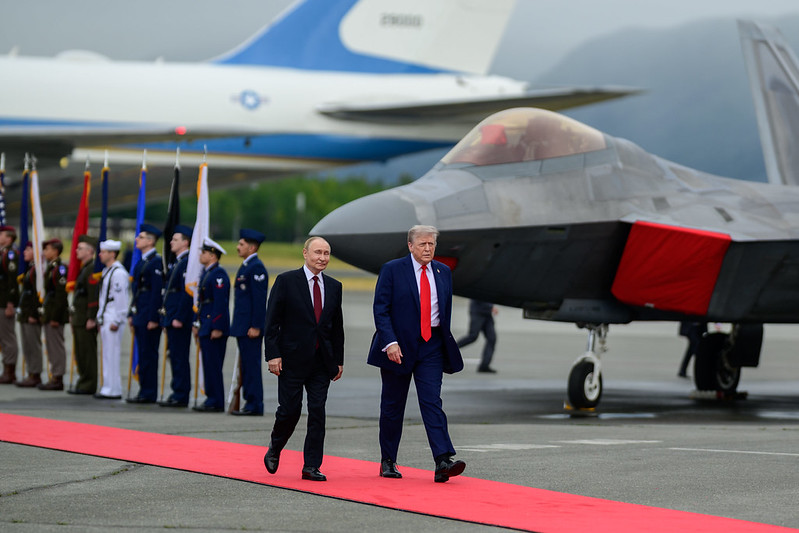
Trump and Putin walk on the tarmac at Joint Base Elmendorf Richardson in Anchorage, Alaska, Friday, August 15, 2025. (Official White House Photo by Daniel Torok)
If New START expires without a replacement or temporary deal, there will no longer be any limits on the nuclear stockpiles of the world’s two largest nuclear powers. The poll found that 72% of registered voters believe that removing all nuclear limits on the U.S. and Russian nuclear arsenals would make the US less secure.
Russia said on January 29 that it was still waiting for a response from the US on extending the limits of New START. “We keep waiting, but the deadline is approaching. There was no response from the United States,” said Kremlin spokesman Dmitry Peskov. “The Kremlin’s position is well known, and it is consistent.”
In an interview with The New York Times in early January, Trump signaled he was ready to let the treaty expire and wasn’t concerned about potential consequences. “If it expires, it expires. We’ll do a better agreement,” he said.
Arms control experts have warned that negotiating a new agreement will take time and that ending the New START limits could spark a major new arms race and result in increased nuclear deployments.
“If Trump fails to respond positively to Russia’s proposal for an interim deal to maintain the New START limits, each side likely will begin increasing the size of its deployed nuclear arsenal for the first time in more than 35 years by uploading additional warheads on existing long-range missiles,” Daryl Kimball, Director of the Arms Control Association, wrote last month. “Many members of the nuclear-weapons establishment are lobbying for such a buildup.”
“War is back in vogue, and a zeal for war is spreading,” Pope Leo XIV said in a forceful address on Jan. 9 to ambassadors from the 184 countries that have full diplomatic relations with the Holy See. “The principle established after the Second World War, which prohibited nations from using force to violate the borders of others, has been completely undermined.”
“Peace is no longer sought as a gift and a desirable good in itself,” he said, “Instead, peace is sought through weapons as a condition for asserting one’s own dominion. This gravely threatens the rule of law, which is the foundation of all peaceful civil coexistence.”
The annual address to the diplomatic corps is considered the pope’s most important of the year in terms of world politics. The United States was represented by its ambassador Brian Burch.
Leo’s words took on particular significance as they came from the first American-born pope, less than a week after the United States, at President Trump’s instruction, used force “to violate the borders” of Venezuela, in disregard of international law.
Leo lamented that multilateralism and dialogue are “being replaced by a diplomacy based on force, by either individuals or groups of allies,” he stated in the traditional New Year’s greeting delivered for the first time in English.
In his talk, the first Augustinian pope drew heavily on St. Augustine’s The City of God, which he said “interprets events and history according to the model of two cities,” the city of God and the earthly city.
In it, he said, Augustine “warns of the grave dangers to political life arising from false representations of history, excessive nationalism and the distortion of the ideal of the political leader.”
There is no one who does not wish to have peace. For even those who make war desire nothing but victory; they desire, that is to say, to attain to peace with glory. For what else is victory than the conquest of those who resist us? And when this is done there is peace…. For even those who intentionally interrupt the peace in which they are living have no hatred of peace, but only wish it changed into a peace that suits them better. They do not, therefore, wish to have no peace, but only the peace that they desire.
“It was precisely this attitude that led humanity into the tragedy of the Second World War,” Pope Leo observed.
The broken world order
He recalled that it was “from those ashes” of World War II that the United Nations was born in 1945, “as the center of multilateral cooperation, in order to prevent future global catastrophes, for safeguarding peace, defending fundamental human rights and promoting sustainable development.”
Recalling the role of the United Nations in mediating conflicts and protecting human rights, the pope said that “in a world facing complex challenges such as geopolitical tensions, inequalities and climate crises, the U.N. should play a key role in fostering dialogue and humanitarian support, helping to build a more just future.”
He emphasized the need for a reform of the United Nations to ensure that it “not only reflects the situation of today’s world rather than that of the post-war period, but that it is also more focused and efficient in pursuing policies aimed at the unity of the human family instead of ideologies.”
In this context, he drew attention to “the importance of international humanitarian law.” Sometimes called “the law of war” or “the law of armed conflict,” this is described by the International Red Cross as “a set of rules that seeks, for humanitarian reasons, to limit the effects of armed conflict. It protects persons who are not, or are no longer, directly or actively participating in hostilities, and imposes limits on the means and methods of warfare.”
In a strong message to states involved in war, though he did not name any, Pope Leo told the ambassadors that “Compliance with this cannot depend on mere circumstances and military or strategic interests.”
“Humanitarian law, in addition to guaranteeing a minimum of humanity during the ravages of war, is a commitment that states have made,” he said. “Such law must always prevail over the ambitions of belligerents, in order to mitigate the devastating effects of war, also with a view to reconstruction. We cannot ignore that the destruction of hospitals, energy infrastructure, homes and places essential to daily life constitutes a serious violation of international humanitarian law.”
Leo also condemned “any form of involvement of civilians in military operations” and said “the protection of the principle of the inviolability of human dignity and the sanctity of life always counts for more than any mere national interest.”
Freedoms violated
He reiterated the Holy See’s longstanding position in favor of multilateralism, and said its purpose is “to provide a place where people can meet and talk.” At the same time, he said, “in order to engage in dialogue, there needs to be agreement on the words and concepts that are used.”
Leo emphasized that “rediscovering the meaning of words is perhaps one of the primary challenges of our time. When words lose their connection to reality, and reality itself becomes debatable and ultimately incommunicable, we become like the two people to whom St. Augustine refers, who are forced to stay together without either of them knowing the other’s language.”
In our culture today, he said, “the meaning of words is ever more fluid, and the concepts they represent are increasingly ambiguous. Language is no longer the preferred means by which human beings come to know and encounter one another. Moreover, in the contortions of semantic ambiguity, language is becoming more and more a weapon with which to deceive, or to strike and offend opponents.”
He told the ambassadors that to prevent conflict, “We need words once again to express distinct and clear realities unequivocally. Only in this way can authentic dialogue resume without misunderstandings.”
Next, he spoke about freedom of expression: “It is painful to see how, especially in the West, the space for genuine freedom of expression is rapidly shrinking. At the same time, a new Orwellian-style language is developing which, in an attempt to be increasingly inclusive, ends up excluding those who do not conform to the ideologies that are fueling it.”
“Unfortunately,” he said, “this leads to other consequences that end up restricting fundamental human rights, starting with the freedom of conscience.” He mentioned here conscientious objection to military service and abortion and euthanasia.
He also highlighted threats to religious freedom, noting “the most recent data show that violations of religious freedom are on the rise, and that 64 percent of the world’s population suffers serious violations of this right.” He told the ambassadors that “in requesting that the religious freedom and worship of Christians be fully respected, the Holy See asks the same for all other religious communities.” He reiterated the church’s rejection “of all forms of antisemitism, which unfortunately continues to sow hatred and death.”
He drew attention to the persecution of Christians, who “suffer high or extreme levels of discrimination, violence and oppression because of their faith. This phenomenon impinges on approximately one in seven Christians globally, and it worsened in 2025 due to ongoing conflicts, authoritarian regimes and religious extremism. Sadly, all of this demonstrates that religious freedom is ‘not considered a fundamental human right.’”
At the same time, the pope said, “we must not forget a subtle form of religious discrimination against Christians, which is spreading even in countries where they are in the majority, such as in Europe or the Americas. There, they are sometimes restricted in their ability to proclaim the truths of the Gospel for political or ideological reasons, especially when they defend the dignity of the weakest, the unborn, refugees and migrants or promote the family.”
In a passage on migrants that is highly relevant to the United States at this moment in history, Pope Leo told the ambassadors, “It cannot be overlooked that every migrant is a person and, as such, has inalienable rights that must be respected in every situation.” He reminded them that many migrants “are forced to flee because of violence, persecution, conflict and even the effects of climate change.” He expressed the hope “that the actions taken by states against criminality and human trafficking will not become a pretext for undermining the dignity of migrants and refugees.”
War and peace
Turning to Ukraine, Pope Leo did not name Russia but reiterated “the pressing need for an immediate ceasefire, and for dialogue motivated by a sincere search for ways leading to peace.” He appealed to the international community “not to waver in its commitment to pursuing just and lasting solutions that will protect the most vulnerable and restore hope to the afflicted peoples” and expressed the Holy See’s “willingness to support any initiative that promotes peace and harmony.”
He next focused attention on the Holy Land, “where, despite the truce announced in October, the civilian population continues to endure a serious humanitarian crisis, adding further suffering to that already experienced.” He told the ambassadors—including those of Israel and Palestine—that “the two-state solution remains the institutional perspective for meeting the legitimate aspirations for both peoples; yet sadly, there has been an increase in violence in the West Bank against the Palestinian civilian population, which has the right to live in peace in its own land.”
He expressed “serious concern” at “the escalating tensions in the Caribbean Sea and along the American Pacific coast,” and, without mentioning the U.S. administration by name, he repeated his “urgent appeal that peaceful political solutions to the current situation should be sought, keeping in mind the common good of the peoples and not the defense of partisan interests.”
He said his last remark “pertains in particular to Venezuela, in light of recent developments,” alluding to the U.S. attack on that country and the capture of President Nicolás Maduro on Jan. 3. In this regard, he said, “I renew my appeal to respect the will of the Venezuelan people, and to safeguard the human and civil rights of all, ensuring a future of stability and concord.”
Pope Leo also called attention to dire situations in Myanmar, Sudan, the Great Lakes region of Africa, Haiti and other places hit by armed violence and appealed for international efforts to help negotiate peace and a return to stability in these lands.
In an important concluding paragraph, Pope Leo said, “At the heart of many of the situations I have mentioned, we can see something that Augustine himself pointed out, namely the persistent idea that peace is only possible through the use of force and deterrence.”
“While war is content with destruction, peace requires continuous and patient efforts of construction as well as constant vigilance,” he said. “Such efforts are required of everyone, starting with the countries that possess nuclear arsenals. I think in particular of the important need to follow up on the New START Treaty, which expires in February.”
He warned the ambassadors that “there is a danger of returning to the race of producing ever more sophisticated new weapons, also by means of artificial intelligence,” and said, “the latter is a tool that requires appropriate and ethical management, together with regulatory frameworks focused on the protection of freedom and human responsibility.”
The ambassadors warmly applauded when he finished speaking, and he then greeted each of them individually before going to the Sistine Chapel for a group photo.
Uriel Araujo has an Anthropology PhD, is a social scientist specializing in ethnic and religious conflicts, with extensive research on geopolitical dynamics and cultural interactions.
When President Volodymyr Zelensky announced, recently, that a bilateral US-Ukraine security guarantees agreement is “100% ready” and awaiting only a date and venue for signature, this sounded reassuring to a war-weary public and to increasingly divided Western backers. As a matter of fact, the timing of the announcement also reflects a broader unease in Europe, sharpened also by Washington’s recent willingness to brandish coercive tools against its own allies.
The deal, as described by Ukrainian officials, focuses on post-war guarantees against renewed hostilities, rather than NATO membership. Thus far, details remain deliberately vague, with Kyiv focusing on assurances before any broader settlement advances.
This US-led track in any case unfolds as Europe quietly repositions itself. Italian Prime Minister Giorgia Meloni and French President Emmanuel Macron have both called for reopening channels with Moscow, with Meloni proposing a special EU envoy to ensure Europe is not sidelined. This may signal a strategic shift.
The question many are asking is whether Europe might attempt to undermine, or at least dilute, the US-Ukraine security deal, as happened during earlier negotiation efforts, including the ill-fated Istanbul talks of 2022. Russian officials have repeatedly accused European capitals of sabotaging talks, a claim echoed again in late 2025 amid renewed US mediation attempts. Yet something may be changing: Europeans increasingly understand that Trump’s second administration is pursuing an unmistakably unilateral approach across theaters, with Europe also being a target. In other words, an understanding is emerging that the real threat lies West, not East.
Here the Greenland factor enters the equation. The American threats to annex the island by force or impose sweeping tariffs on European imports are part of a broader Arctic strategy, one that exposed Europe’s vulnerability to pressure from its principal “ally” and reinforced the logic of diversifying diplomatic leverage.
Though such threats were later dialed back into a “framework” arrangement with Denmark (involving expanded US access and arms purchases), Trump’s unpredictability remains a structural problem for Europe, amid speculations about cognitive decline.
European vulnerability in Greenland is well documented: analysts have warned that the European bloc is still unprepared to defend the island, despite its growing strategic value amid Arctic militarization. Legal scholars have also noted that Trump’s threats tested the credibility of international law’s prohibition on the use of force. In a way, a “Overton Window” approach is being employed by the US President on global law.
Against this backdrop, Europe’s renewed interest in dialogue with Russia may reflect leverage-seeking behavior, so to speak. With Washington willing to brandish tariffs and security ultimatums against allies, European leaders have incentives to diversify diplomatic options. As I’ve argued, from an European perspective, engaging Moscow, even cautiously, offers one such option, especially in energy security, reconstruction planning, and Arctic governance.
This dynamic intersects with the Trump administration’s broader peace framework circulated in the end of last year, a 28-point plan outlining limits on Ukraine’s military size, demilitarized zones, phased sanctions relief, and security guarantees from both sides. While many elements remain disputed and only partially confirmed, the mere existence of such a plan underscores the American desire for a managed exit in that theater (which has long been a US proxy war) as Washington now pivots elsewhere. In that case, what incentive is left for Europe to continue to carry such a burden?
Europe this time is therefore unlikely to sabotage the US-Ukraine security deal outright. Instead, it will likely pursue parallel engagement, seeking a seat at the table and “insurance” against abrupt US policy shifts. Poland and the Baltic states may resist any EU envoy seen as “weak”, but Berlin and Paris appear increasingly receptive. Recent data suggest Russian oil and gas revenues have faced some downward pressure since late 2025 due to price dynamics, logistical constraints, and sanctions enforcement, even as exports continue through alternative channels. Again, from a European perspective, this mixed picture could give European powers some confidence.
In that context, renewed dialogue would not be a zero-sum exercise. For Russia, engagement with Europe offers a channel to stabilize long-term energy trade and investment planning in a fragmented but still interconnected market. For Europe, talks with Moscow are about regaining strategic agency at a moment when US policy under Trump has become too unpredictable. Sustained communication thus reduces miscalculation risks and opens space for post-conflict reconstruction frameworks. Be as it may, such engagement can be framed as risk management rather than concession. This pragmatic logic explains why calls for engagement are resurfacing across European capitals, not as an ideological shift but as an acknowledgment of geopolitical realities.
A US open occupation or annexation of Greenland would threaten not only European sovereignty but also Russia, as I’ve detailed elsewhere. This means that the American appetite for Greenland has made European and Russian strategic interests converge in the Arctic.
The most plausible scenario is thus coordinated European engagement rather than open friction. Europe will neither torpedo the US deal nor subordinate itself fully to Trump’s whims; it will hedge. Greenland, unresolved enough to resurface at any moment, adds urgency to that hedging. Trump’s threats may have receded for now, but they linger as precedent and could re-escalate at any time.
In this scenario, Europe’s possible outreach to Russia is about autonomy. It would reflect an attempt to navigate a landscape in which Washington, as a volatile “partner”, is increasingly turning into an open enemy. Whether such a European balancing act gains traction will depend on February’s negotiations and on Trump’s next move. Thus, the “100% ready” deal may be only the beginning, not the conclusion, of a far more complex Eurasian realignment.
On January 12, Russia’s “special military operation” in Ukraine reached its 1,418th day—the same number of days that it took the Soviet Union to triumph over Nazi Germany during WW2 (known as the Great Patriotic War in Russia).
The milestone did not go unnoticed in Russia, even though the Great Patriotic War was an entirely different animal. The senseless bloodbath we are currently witnessing in Ukraine more closely resembles a hyper-neoliberal WW1, in which mercenaries sit in trenches and wait for drones to murder them as the “belligerent parties” openly do business with one another. Nonetheless, the SMO is actually framed as a WW2 redux by the Russian government and its propaganda organs. The Cult of WW2 is Russia’s state religion, and Russians have been told for the last four years that they are finishing what their grandparents started by defeating the “Nazi regime” in Kiev.
If this is indeed the case, then surely it is not unreasonable to ask what has been accomplished over the past 1,418 days?
But actually, this is an unreasonable and very offensive question. It is common knowledge among independent media’s most independent intellects that Russia is fighting a brilliant and humane war of attrition, and that with each passing day Moscow’s victory over NATO-backed Ukraine becomes more total and complete. Indeed, the 1,418-day mark is cause for celebration: It means Russia is winning.
Confirmed and reconfirmed: Russia is using its ingenious “snail offensive technique” to score a “ten for one kill ratio” in Ukraine, Pepe Escobar recently explained.
The Russian snail offensive technique, combined with the mincing machine technique, has already, gradually, knocked out the extensive bunker system set up by NATO in Donbass, superior to the Maginot Line. These methods achieved a ten for one kill ratio in favor of Russia in relation to Ukraine. That’s another immutable fact on the battlefield. Only unredeemable fools deride Russia as “slow” and “weak”. The snail offensive will extend into 2026.
Yippee.
As Putin explained on February 24, 2022, the goal of the SMO is to kill as many Ukrainians as humanly possible over the longest possible period of time [I am being facetious; he actually said the exact opposite — Edward], so a “snail offensive” allegedly resulting in mass carnage (but only for Ukrainians, thank goodness!) is a very good thing, and means the SMO can end whenever Russia feels like ending it.
In fact, Russia could snail-storm the rest of Donetsk Oblast whenever it wanted to, and then snail-slither to Odessa and Kiev—but that would betray the snail-like brilliance of the snail offensive technique.
This is very logical, and supported by YouTube videos published by The Duran.
However, some people—curmudgeons like the late Marko Marjanović—disagree with the widely held view that the longer the SMO drags on, the more Moscow wins.
Today I will share with you an article by Marko on this very subject.
In “Russia says it’s fighting the whole world. Has anyone told Putin?”, Marjanović warned in April 2022 of the “baked-in” costs of the SMO, arguing that NATO’s decision to fund and arm Kiev meant that the longer the conflict dragged on, the more difficult it would be for Russia to achieve its stated goals—or achieve anything, really—in Ukraine.
If you are tired of “alt media’s” ceaseless attempts to gaslight you into cheering for this absolutely catastrophic crime against the Slavic people, then you should definitely read the below article.
Read it anyway. The observations that Marko made in April 2022 have never been more relevant.
Miss you, Marko.
— Riley
Russia says it’s fighting the whole world. Has anyone told Putin?
Let’s do a mental exercise. Let’s try to imagine how much the US might be willing to spend to prop up Ukraine in its war with Russia?
What sum do you think is likely?
Would it be willing to spend as much as it spent on Afghanistan? Would it be willing to spend a lot more? Or a lot less?
On the one hand, Afghanistan was an American war where America’s own prestige and victory were on the line. On the other hand, there was the nagging feeling that they might not be the good guys.
And really what was the Afghan war for? To bring female education to the valleys of Pashtunistan? The benefit of backing Ukraine seems much clearer by comparison — to weaken, frustrate and humiliate Russia.
Backing Ukraine is the current hip thing and the current moral crusade. It has broad bipartisan support and — after 20 years of looking a lot like the baddies — American elites are embracing it as vindication that they are on the right side of history, and the benevolent empire after all.
I think Afghanistan has to be taken as the lower bound of how much the US is willing to spend.
After all, the US made no secret that in the case of a successful Russian invasion it intended to lavishly fund a Ukrainian insurgency. That it now gets to equip and bankroll a conventional war — which can inflict far greater losses on the Russians — instead, is Christmas come early for DC.
Dissident journalists calculate the Afghan war cost the US $2 trillion. But the Pentagon, which only counts the cost of military operations and reconstruction, puts the figure at $825bn. According to the Pentagon at the peak of the surge the US was spending $110bn on Afghanistan per annum, but as late as 2020 it was still spending $40 billion.
US Congress has voted in a $13.6bn Ukraine war “response” bill, but $3bn of that was for US redeployment in Europe and $4bn was allegedly to help refugees. However there was also $1.8bn there to help Kiev pay salaries and $3.5bn for weapons. Together that is $5.3bn but Biden has already said that the sum is almost exhausted and that soon Congress will have to allocate more. 60 days in and $5.3bn has almost already been spent.
If the US props up Ukraine with a new $5.3 billion every 3 months then per year that is $20 billion. But why should the US stop at this sum? The US has been steadily ramping up what weapons it is willing to send. In 60 days it has moved from man-portable missiles to heavy artillery. Janet Yellen has said the current aid packages are “only the beginning of what Ukraine will need” and other officials have said that the US is “always preparing the next package of security assistance.”
If the US feels it is getting a good return on its investment (which in Afghanistan was never the case) eg in dead Russians, then why wouldn’t the US ramp up the backing to $40-50 billion annually?
And that’s just the US. The EU has so far pledged $1.5 billion, Germany $1 billion, and Poland claims it has already transferred $1.6 billion in weapons. Can the US get its vast vassal swarm to collectively chip in another $10-20 billion?
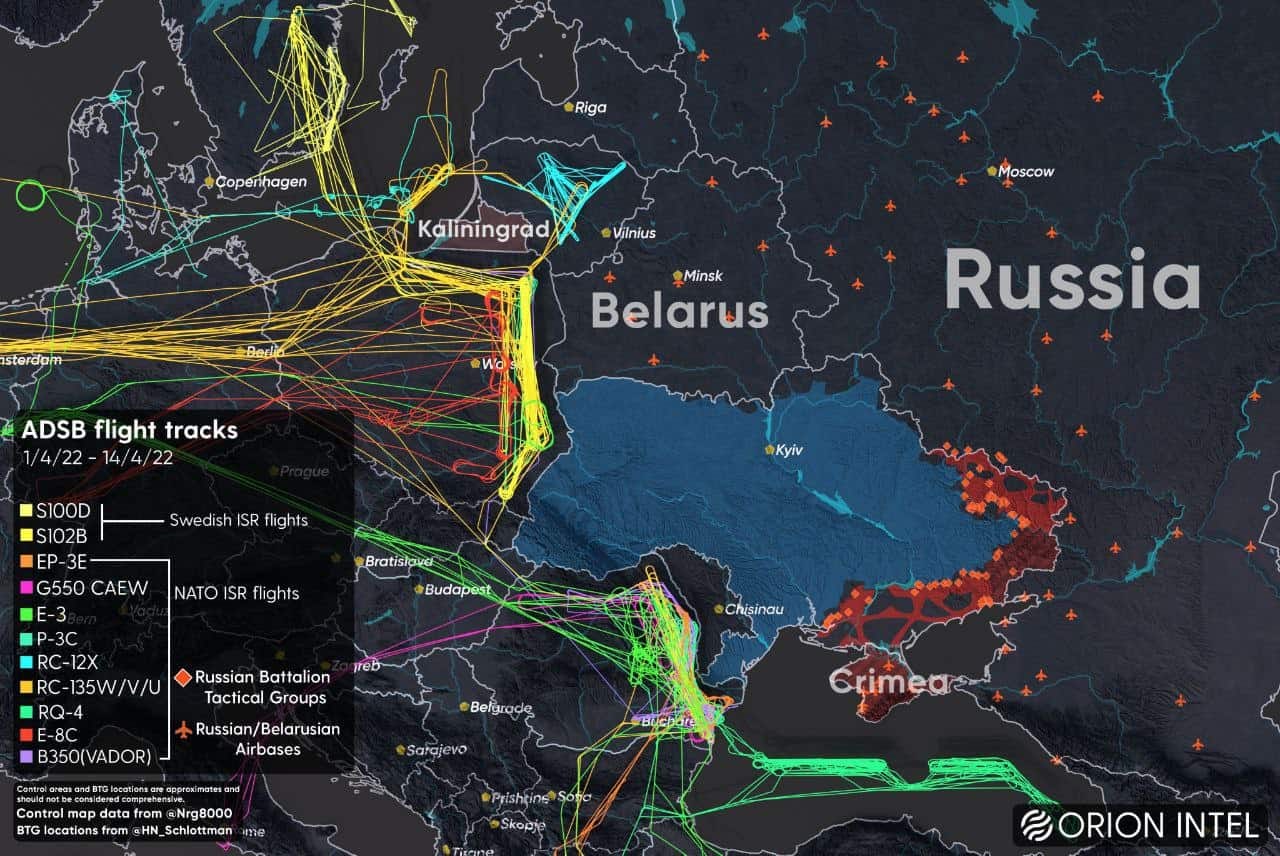
Why not? They helped out with Afghanistan and that was never nearly as popular. So we’re looking at $60bn in aid to Ukraine per annum, and that’s not even counting what they will spend directly on training Ukrainians in Poland, and on flying their fleet of intelligence-gathering planes.
And $60bn is very possibly much too conservative. The US printed $4 trillion to “fight COVID” and the EU about $2 trillion. Why wouldn’t they print up a couple of hundred billion to fight Russians?
America’s main competition is with China, but weakening Beijing’s number one ally sure would be helpful and sweet — especially when it can be done with foreign blood and for sums that for America’s printing presses aren’t large at all.
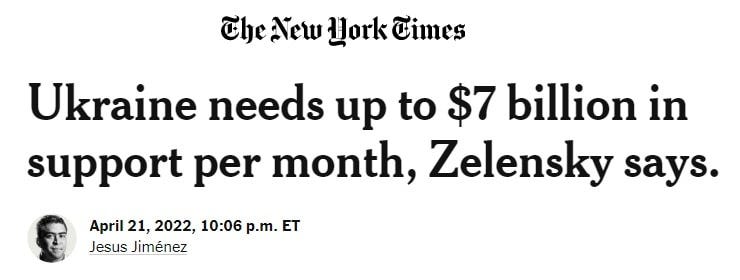
People are ridiculing Zelensky for asking for $7bn per month in financial injections alone, but that is just the opening bid. He will very much be getting assistance of this type. It will be much less than $7bn but it will also only be the start.
Now let’s do a second mental exercise. Let’s try to imagine what getting a $60bn injection every year of war does for Ukraine’s military.
Russia herself normally runs a $60bn defense budget. This year it’s doubtlessly going to be higher.
But assuming a $60bn injection from the West and adding Ukraine’s own spending, the two could soon have equivalent military budgets in nominal terms.
What would equal spending do for military balance?
Russia has been spending that sum every year for many years and is far ahead. But the qualitative gap would certainly start to narrow. Ukraine is still the much smaller country with the much smaller population so perhaps Ukraine can’t possibly field a very large army? Normally in a war of materiel the limiting factor on army size is the labor force needed at home. If everyone is drafted then who is going to work at the equally important steel mill?
But if the majority of your war effort is being supplied and bankrolled from abroad that falls by the wayside. If the US becomes Ukraine’s military-industrial complex then how many Ukrainians are available to work in Ukrainian plants becomes rather irrelevant.
Moreover, the war has been devastating for Ukraine’s economy, especially with the Russians blockading the ports and causing a serious fuel crunch. This means that many Ukrainians in the private sector will start to go unemployed or see their wages slashed. Meanwhile, Washington will make certain that there is money enough to pay the soldiers. Soon the military might be a rare well-paying and reliable employer. Ironically Russia might be growing Ukraine’s pool of available manpower and channeling it toward the military.
It’s a country of 35 million. It has over 5 million men between 18 and 38. If the US is willing to pay for it all, there is no limit to how big its army can grow.
The retort is that the war has also already caused 5 million refugees to evacuate the country. But a friend who works on the refugee trains reports that among evacuees there are almost no men.
Also keep in mind that Ukraine’s pre-war GDP is only equal to that of 5-million Finland. Even replacing its entire economy is not beyond the means of the collective West.
Russia has a peculiar feudal arrangement with Chechens where Mosow bankrolls 70% of their budget but expects them to repay the favor by helping massively in its wars.
Can Ukraine become Washington’s Chechnya? Heavily dependent on the US financially but massively militarized and earning its keep by tying down the Russians?
The US would surely welcome such an arrangement and can definitely afford it.
Question is, can Russia afford to live with such an arrangement? Locked in a forever frozen conflict with a heavily militarized polity of 35 million bankrolled by the equally hostile 1-billion Collective West?
Putin claims his “Special Military Operation” was launched in part to improve Russia’s security situation. But if Russia accepts to live with such a Ukraine then its security situation will have definitely been enormously degraded.
It will mean that looking just at the security equation — without even factoring in Western sanctions and the damage to Russian-Ukrainian social relations — the war will have been a giant blunder for Moscow, and a stinging defeat.
To win territories home to 4 million people at the cost of turning a relatively manageable 40-million Ukraine that the West was only arming to a symbolic extent into a 35-million Prussianized battering ram for the Americans, composed of your ethnic kin, is not a win. It is a disaster almost without precedent.
Russia cannot control to what extent the US is willing to back Ukraine. But Russia can control what is there to back. Make it so that Ukraine isn’t a 35-million entity but a 20-million one and things become a lot more manageable again. At that point even a victory of sorts (a mangy one) could be claimed.
But that means taking territory. A lot more territory. Territory that at the present level of mobilization Russia isn’t capable of taking.
Right now Russia isn’t on pace to win anything that would make the cost of launching the war, which has already been baked in, remotely worthwhile.
The transformation of Ukraine into an Anti-Russia that Putin railed against has now been completed precisely by him and cemented for centuries or at least until an even bigger boogeyman comes around.
He has also given DC exactly what it needed to mobilize its vassal swarm for an almost unrestricted economic siege of Russia.
Banished from the global division of labor Russia will find itself falling further and further behind the West technologically as happened to late-era USSR.
The majority of the world has not joined the siege but you can’t go to Argentina for machine tools, Tanzania has not yet mastered avionics, and you can’t start a joint chipmaking venture with Indonesia. Even if you could the Empire’s vassal swarm would soon threaten them with secondary sanctions and they would fall back in line.
This has nothing to do with Russian talent, but only with scale. If an industrial and technological superpower like Germany was similarly cut from the global division of labor it would just as surely start to fall off. Having to figure out every step of everything by yourself, and being able to collaborate with no one, isn’t a recipe for rapid advancement.
The only hope is offered by China. Perhaps China will soon have analogs for everything Russia was sourcing in the West. (Not likely.) Perhaps China will soon even be making these analogs without Western inputs (patents, components, machine tools) so that they will remain exportable to Russia.
Even then, it would leave Russia’s technological level dependent on the political winds in Beijing. The Chinese have the talent and the numbers to accomplish anything, but more than once in their history their advancement was arrested and reversed by their own state.
If Beijing continues to unlock China’s productive and deductive powers via increased economic liberalization that’s great. But if it turns again more to stifling command economics the first victim will be Russia’s hopes for competitive Chinese analogs.
To sum up, the situation for Russia is:
— The cost of having launched the war is very high and already baked in.
— The cost of not making very large territorial gains will raise the cost even higher.
— With each month meeting these objectives becomes more difficult.
You would think that in such a situation the Kremlin would be unambiguously signaling its iron resolve to make large gains that could make up for the negatives.
And you would think it would be taking action to realize these gains quickly before Western supplies and Ukraine’s mobilization make it even harder.
If so, you could not be more wrong.
The Russian government continues to utterly fail to explain what this war is about. What it hopes to accomplish, or what military goals need to be met to get there.
The Russian government is also acting like there is no urgency to the war. As if whether Russia springs into action today, 6 months from now, or 2 years from now doesn’t make a difference.
I have never seen anything so feckless.
The deputy commander of Central Military District (correctly) states that Russia has embroiled itself in a war against the entire world:
“Apparently, we are now at war with the whole world, as it was in the Great Patriotic War, all of Europe, the whole world was against us. And now the same thing, they never liked Russia.”
But the Kremlin stubbornly refuses to fight an actual war. The Russian effort is clearly crying out for manpower. At the same time there isn’t even a partial mobilization, there isn’t retention of conscripts, there isn’t even deployment of conscripts to Ukraine. The army has literally been told to treat one-third of its manpower as untouchable and to leave it at home.
Until very recently the vast, overwhelming majority of all soldiers in the world were conscripts. And conscripts have fought and won every major war in the past 200 years.
In two months the West has transferred to Ukraine $5 billion in arms. That is five times Ukraine’s annual military procurement budget. In two months.
Meanwhile, Vladimir Putin balks at deploying trained soldiers who became soldiers via conscription. Perhaps this is a reflection of his humanism? But if he is so humane perhaps he should not have started the war in the first place? Why start a war and *then* remember how pacifistic you are?
What will be said of Putin’s “humanism” if months from now conscripts nonetheless have to be sent in, but it’s a new batch that isn’t as well trained (the current one isn’t being retained) and only to face a larger, more experienced and reequipped Ukrainian army?
Where is the mercy of standing by as Ukrainian forces reform and expand, and only moving decisively many months into the war after the West has been allowed ample time to ensure the fighting will be of the utmost intensity?
Russia isn’t in a position to intercept the flow of Western arms as they enter Ukraine. The trucks are unmarked and Russia’s fleet of armed drones is tiny anyway. It doesn’t have a way to loiter and have permanent eyes in the sky at such distances.
But Russia could block the shipments from reaching the left bank. Destroy the crossing points across the Dnieper and Ukraine is reduced to transferring equipment via the pontoon and tugboat combo that is sure to become a bottleneck.
Russia has so far launched over 1700 precision-guided missiles. Precisely one has targeted a Dnieper bridge. Naturally, splitting Ukraine into two halves would also greatly harm its economy and impose hardships on its civilians. But maybe the time to think about that was before the war was launched? If you’re that humanistic maybe just don’t launch a war in the first place as I humbly suggested?
Putin is acting like a man who started a war and is now embarrassed to fight it. He looks like a man who doesn’t believe his cause justifies full-hearted war or can be realized by one. That’s too bad because full-hearted war is exactly what Kiev and NATO are fighting.
It’s also ironic because nobody else in Russia knows if this war is worth fighting because nobody knows what Putin’s objective is or what he would settle for. There’s precisely one man in Russia with the information to know if this is worth it and he apparently doesn’t have a clue.
Pray do tell what sort of a 5D move is it to embroil a nation of 150 million people in a war with the 1-billion Collective West that lords over another 6 billion and then decline to actually prosecute that war?
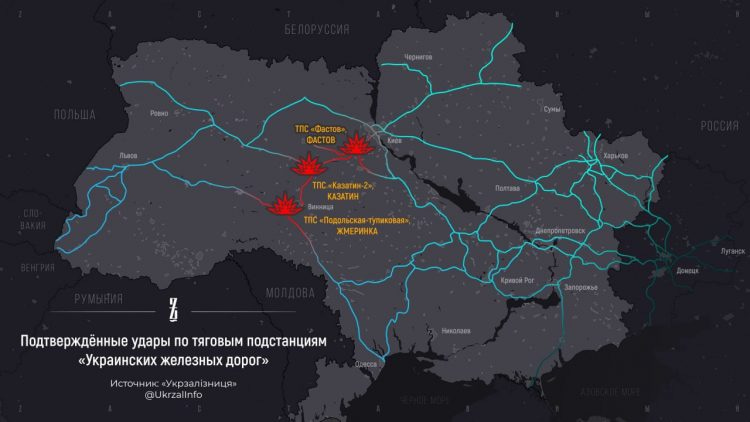
Instead of targeting the bridges the Russians are playing Whac-A-Mole vs rail junctions that can be repaired in a day or two. Even this is a new development. (Ukrainian rail network is more extensive than this map shows.)
Moscow went into Crimea in 2014 without a clear plan. The plan was to go in and wing it. Moscow was happy with the outcome and the Kremlin drew the lesson that improvisation works.
In reality, the outcome was mixed and showed just how unpredictable these type of adventures are. On the one hand Crimea was gained without a shot fired, but on the other hand, it sparked an uprising in Donbass to ask for the same liberation granted to Crimea that Moscow neither expected nor desired.
In addition to gaining the not-very-big Crimea, Moscow also became embroiled in intra-East Slavic bloodshed, gained the enmity of Ukraine, and peeled away 5 million pro-Russians so that pro-Russians could never again carry a Ukrainian election.
Russia cites Ukraine’s “Nazification” and “militarization” as gripes that need to be addressed by force, but until eight years ago Ukraine sold defense products to Russia and hosted Russian military bases. It honored May 9, its army retreated from Crimea under cherished Soviet battle flags, and only had 5000 combat-ready troops.
In fact, this utter lack of a serious military is the reason civilians, even neo-Nazi civilians, were welcomed to come help the military suppress the Donbass rising. Having fought they won prestige that made them impossible for politicians who had none to purge. And besides, what if they were needed to fight the Russians again?
A different lesson drawn from 2014 could have been that intervention causes yet more fallout that also calls for intervention. Another lesson might have been that not being able to decide if yours is a pacifistic or militaristic approach ultimately begets you the worst of both worlds. All the burned bridges of the militaristic strategy with none of the direct gains to show for it.
Anyhow, even if we accept that Crimea improvisation worked, it was a trick that was only going to work once.
Moscow’s belief that it can jump into things headlong and figure things out later immediately caused it to suffer $360 billion in “frozen” reserves that are now lost forever.
To escalate a frozen Donbass War into a hot Ukraine War and not think to evacuate your euros from foreign banks beforehand is quite something.
But it is only the most obvious facepalm in this disaster, but not at all the most consequential.
What if NATO ammunition had to be moved by pontoon?
To start a war with NATO and then spend two months pondering whether to allow the army to use a third of its complement, that’s the real fecklessness and catastrophe. But it’s worse. The Kremlin will in the same press conference tell the public it is in an existential struggle for the very survival of Russia, then “reassure” it that one-third of Russia’s military is off-limits for combat in Ukraine.
Meanwhile, US officials are already working on ramping up production for Ukraine. Early on ramping up production is difficult. Then it gets progressively easier. In 6 months or a year $100 million in aid can represent vastly more missiles than it does now.
Really, what is the game plan here? Take the rest of Donbass and declare victory? Fine, but that will actually be a defeat. Not the least because Washington and Kiev will get to vote on whether what follows is peace or years of positional warfare. Or is the plan to follow it up with Odessa or more of the left bank, or both? Fine, but that is going to take using conscripts so you might as well start doing it now and get a better correlation of forces that will make things faster and less painful for everyone.
The Kremlin is prosecuting this war with all the conviction of a provincial Russian cop enforcing the vax pass. The difference is the war was Putin’s idea. It was sprung on the nation and the soldiers as a surprise. There was literally no debate on its merits because officially war was beyond impossible.
At the time I thought the war was launched after months of denials because that’s what makes sense militarily. However the effort was accompanied by so much of what flies in the face of military logic that this explanation becomes doubtful. The whole point of surprising the enemy is to overwhelm his unprepared force quickly. Instead the enemy is being given ample time to build up its force, only after which Moscow will start using Russia’s draftee soldiers.
But this secrecy is perfectly in line with how the Russian government loves to do things to start with. To this very day, Russia only has the official tally of 374,902 covid deaths but not even a simple breakdown by age bracket. This information does not exist in the public domain. The number of vaccine injuries exists and that number is zero. The number of Ukrainian dead is known to the Russian MoD down to the single digit and provided regularly, but the Russian public has no right to know the number of the Russian dead.
Never having to explain itself to anyone, or even sharing just the most rudimentary information is exactly how Russia’s technocratic Caesarism system likes to roll. Transparency is treated as an even bigger enemy than Americans, Zelensky, Azov and sanctions combined. The government doesn’t just withhold information. It actively works to discourage the very notion the public is owed data or explanations or should have any expectation of such.
And here lies the problem with a national call to arms.
Sadly for the Russia power elite a national effort requires working with these guys — the people
Start mobilizing or using conscripts and the Russians will go along with it but they will also have a lot of questions, a lot of conditions, and a lot of ideas of their own. Techno Caesarism goes out the window.
Soulless staged rallies in front of government workers bused in for the occasion suddenly no longer do the trick. Suddenly you’re having to engage with people who are merely anti-anti-Putin but who aren’t United Russia cronies.
Waging a state effort is one thing, but a popular, national effort is another thing entirely. It means unlocking movements and forces you are not fully in control of.
On the one end of that spectrum lies Russia where Putin sitting in his covid cocoon can plunge the nation into a war with the whole world without even a debate.
On the other end of the spectrum lies Ukraine where every regiment has its own foreign policy and can veto the President.
Doubtlessly the Ukrainian way has its own pitfalls but the Kremlin way isn’t getting the job done either.
It is said that support for the war is high in Russia.
That’s not exactly right. What is high is the support for the war effort. The Russians are at war with the whole world, what other choice do they have but support Russia’s effort?
But that’s not the same thing as being an appreciator of the war. To support a war you first have to know basic things about it. What is the objective? How can it be accomplished? And at what cost?
If the nation is asked to finish what Putin started (without consulting with it) then it will go to Ukraine and finish the job.
And then the veterans will come back and will pass judgment on whether they were well-led in the war, was the war worth it, and was the war a wise decision or the work of a pyromaniac.
A leader who does not issue a call to arms when the situation clearly demands it is one who is not certain the people’s judgment would be in his favor.