By Sylvia Demarest, Substack, 7/19/26
The US Geopolitical Strategy Since WW2
At the end of World War 2 the US emerged as the unrivaled global military and economic power. The war left US cities and manufacturing plants untouched while the war destroyed most of the developed world. The US dollar became the world’s reserve currency giving the US financial system de facto control over global finance including the global messaging payment system SWIFT, the World Bank and the International Monetary Fund.
In 1992 after the dissolution of the USSR, the Wolfowitz Doctrine emerged. The Wolfowitz Doctrine declared the US to be the world’s sole superpower, and established the strategic objective of preventing the emergence (or re-emergence) of any global or regional competitor. This strategic objective included preventing any hostile power from dominating any important region whose resources could generate global power.
A review of US foreign policy since 1992 clearly shows that the Wolfowitz Doctrine of maintaining US global hegemony and preventing the rise of a peer competitor, has remained the central US strategic objective. Examples include; NATO expansion under Clinton, the Balkan wars and the attack on Serbia under Clinton, the wars on Iraq and Afghanistan under Bush, the wars on Libya and Syria under Obama, the drone campaigns under Bush Obama Biden and Trump, the propaganda campaign against the Russian Federation and President Putin under Obama and Biden, provoking the proxy war in Ukraine against Russia under Obama Biden and Trump, the blockade and takeover of Venezuela under Trump, and the war on Iran under Trump. The clear objective of these wars has been to confront, weaken and destroy any potential US (or Israeli) adversary, and to prevent the emergence of any potential competitor. The doctrine also seems to guide current actions against Venezuela, Cuba, Iran, Russia, China, and North Korea, as well as threats against Greenland and Canada, as the US attempts to exercise control over the resources of these and other counties.
In an essay written on March 25th this Substack discussed the potential geopolitical strategy of the Trump Administration as reflected in recent events including the war on Iran and concluded “a strategy of “full spectrum energy dominance” was in effect “… as part of an effort to maintain US global hegemony. The components of this strategy include: 1–global dominance over energy production including liquid natural gas (LNG); 2–controlling the energy and resources of Western Hemisphere, and excluding rival powers from having access to those resources; 3–controlling all the global pinch points critical to global trade; 4-insuring access to arctic resources; 5-working to encircle, weaken and dominate countries seen as potential rivals, including Russia, China and Iran.”
In an essay written on June 4, 2025, this Substack discussed the rise of Military Keynesianism i.e. the use of military spending and war to stimulate the domestic economy. The essay discussed how military spending had been used to end the Great Depression, and how the US economy continues to be highly dependent on military spending. From the essay: “World War 2 and the adoption of military Keynesianism is credited with ending the Great Depression and providing the economic stimulus for several decades of economic growth after WW2. Militarism and military Keynesianism is a powerful economic and political force in the US. The policy of militarism and war is supported by both political parties and has persisted, election after election, for decades…”
“Military Keynesianism has been used as an economic stimulus and a jobs program ever since. The production of weapons and equipment is one of the largest remaining manufacturing industries in the US. Congress has been careful to locate bases and production facilities in each district, spreading the funding and the jobs around the country. US militarism is an economic stimulus program, a jobs program, and a source of lobbying and campaign cash. This means that militarism, and the wars that support it, has enormous economic and political power in the USA, even though maintaining it requires perpetual war.”
“For military Keynesianism to work its economic and political magic, the United States needs to use up the military equipment it produces so the arms manufacturers can keep busy. This is why the US is the world’s largest seller of weapons, and why every US president is an arms dealer. Even with these arms sales, military Keynesianism requires the US to fight a war every two, or three years, or to be continuously at war.”
The Expansion of NATO reflects Military Keynesianism
Even the incentive to expand NATO can also be traced to the promotion of Military Keynesianism here in the US because every new country that joins NATO must purchase billions of weapons and other war material from the US.
This means that NATO expansion has been one of the most profitable foreign policy decisions in US corporate history. Every new NATO member must replace Soviet-era equipment with NATO standard weapons, primarily manufactured by US defense contractors. NATO has 32 member states, and everyone is required to achieve interoperability with US equipment, all 32 are buyers of US weapons.
Here are just a few recent examples: Poland: $3.5 billion for F-16 fighter jets from Lockheed Martin; Romania: $4 billion for Patriot missile systems from Raytheon. The same is true for the Finland, Sweden, Czech Republic, Hungary, Bulgaria – each one a new market, locked in by treaty obligations.
NATO expansion was not debated as a market expansion strategy. It was debated as a security strategy. But the money told a different story. The New York Times noted that defense industry executives saw NATO expansion as “the ultimate market opportunity.” The Wall Street Journal described it as “a bonanza for Western arms merchants.”
As QINTELPRO noted: “The revolving door between NATO policy and defense industry profits was not subtle. Bruce Jackson: Lockheed Martin’s vice president for strategy and planning → chairman of the U.S. Committee to Expand NATO → chairman of the Committee for the Liberation of Iraq. Dick Cheney: Secretary of Defense → CEO of Halliburton → Vice President of the United States. James Jones: NATO Supreme Allied Commander → board of Boeing and Chevron → Obama’s National Security Advisor. Wesley Clark: NATO Supreme Allied Commander → board of several defense companies. The same people who made the policy profited from it. The same people who profited from it then returned to make more policy. The revolving door doesn’t just create conflicts of interest. It creates a permanent class of people whose personal wealth depends on perpetual military expansion.”
Military Keynesianism and the Ukraine War
It should be very clear by now that wars do not happen by accident, most require decades of planning, propaganda campaigns and outright lies and disinformation to persuade the US public to go along. The Ukraine war is no exception. Several studies have discussed how the CIA seized the opportunity to penetrate the Soviet Union through Ukraine and began organizing covert activities at the end of World War 2, laying the ground work for future conflict.
More recently, the RAND Corporation, a Pentagon think tank, published a study in 2019 titled “Extending Russia: Competing from Advantageous Ground.” The study was very explicit in recommending that Ukraine be used as a tool to weaken Russia. Here’s QINTELPRO again: “Its recommendations read like a pre-war checklist: Provide lethal military aid to Ukraine. ✓ Done. Increase support for Syrian rebels to bleed Russia. ✓ Done. Promote regime change in Belarus. ✓ Attempted. Exploit ethnic tensions. ✓ Done. Undermine Russia’s energy exports. ✓ Nord Stream destroyed. Expand NATO. ✓ Finland and Sweden added. RAND published this on its website. It was not classified. The blueprint for the war was available to anyone who bothered to read it.”
The conclusion: “When the architects of a war publish their plans three years before the war begins, and then the war proceeds exactly as planned, the word ‘unprovoked’ becomes difficult to sustain.”
Although the war has continued for almost 5 years costing thousands of lives, billions in weapons, and more billions in damage to Ukraine and Russia, the Ukraine war has been very profitable for the US defense industry. Here’s QINTELPRO again: “Lockheed Martin’s stock price rose 37% in the first year of the war. Raytheon’s rose 17%. Northrop Grumman’s rose 41%. General Dynamics rose 19%. Total U.S. military aid to Ukraine exceeded $50 billion by mid-2024. But the money doesn’t go to Ukraine. It goes to American defense contractors who manufacture the weapons that are shipped to Ukraine. Raytheon CEO Greg Hayes explained this on CNBC with remarkable transparency: ‘We don’t actually write a check to Ukraine. We write a check to the United States defense industry.’ The aid packages are essentially transfer payments from American taxpayers to American defense corporations, laundered through a foreign war. Ukraine gets the weapons. The shareholders get the profits. The taxpayers get the bill. The Ukrainians get the casualties.”
“In January 2023, Lockheed Martin CEO Jim Taiclet told investors the company was ramping up production to meet demand created by the Ukraine war. He said the conflict had created ‘long-term tailwinds’ for the defense industry. Tailwinds. A sailing metaphor. The war that has killed hundreds of thousands of people is wind in the sails of Lockheed Martin’s revenue projections.”
“This is an observation about incentive structures. When the most powerful corporations in America profit from war, and those corporations fund the think tanks that recommend war, and those think tanks staff the administrations that start wars, the result is a system that produces war as reliably as an assembly line produces missiles. You don’t need a conspiracy when you have an incentive structure. The machine runs itself.”
How will the Quest for US Global Hegemony End?
These wars by the US along with disruptive covert activities by the CIA and US Non-Governmental Organizations (NGO’s) have been going on for 80 years leaving a trail of carnage and destruction across the globe. The Church Committee exposed some of this, but US wars and meddling continue unabated. Meanwhile, the US goes deeper in debt and conditions in the US continue to deteriorate for most people.
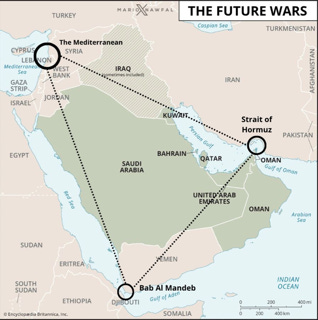
The impact of these policies can be seen not only in the current war on Iran and the vast support provided to Ukraine by the US and the EU to fight Russia, but in US policy towards Venezuela, Cuba, and Iraq. Cuba is under a complete US embargo–Venezuela does not have control over her funds from the sale of oil and gas, which have been placed in an account under the control of the US Secretary of State Marco Rubio– See this astonishing article: “How Marco Rubio is Running Venezuela From Afar”–Iraqi funds are in the custody of the Federal Reserve Bank of New York, giving the US the leverage to select who runs Iraq and, recently, to force Iraq to distance herself from Iran and to invest in a new pipeline to avoid the Strait of Hormuz.
U.S. extraterritorial claims to Greenland, Canada, Cuba, and the Panama Canal also express the strategic aim of US foreign policy. In the past 24 months, the U.S. has directly attacked or materially supported bombings in Ecuador, Somalia, Haiti, Nigeria, Yemen, Venezuela, Syria, Iran, Iraq, and the Caribbean–including a full blockade of Cuba. Meanwhile, the Gaza genocide and the Israeli invasion of Lebanon continues unabated with full US support.
This is even though the US public continues to vote for peace and an end to these foreign wars. The fact that US public opinion has little impact of US foreign policy shows why net approvals of “U.S. leadership” are at a record low (-15 percent) while most Americans (59 percent) reported in April 2026 that “America’s best days have passed.”
Meanwhile, the proxy war on Russia is also at a boil. The US supports Ukraine by providing intelligence and guidance instructions for drone attacks on Russian energy facilities and grain exports. According to Glenn Diesen; “Moscow considers itself to be fighting a defensive war against a NATO determined to use Ukrainians to destroy Russia. …Sadly, our freedom of speech is in free fall, and our populations have been indoctrinated to squeal ‘Russian propaganda’ whenever an argument deviates from NATO-approved narratives.”
According to Ian Pound there is no functional way to end the war in Ukraine. This is based on the observation that NATO and the EU have stolen the sovereignty of their members, refuse to talk to Russia and see no interest for their citizens in peace-making. He concludes: “Only a popular uprising against globalist leaders in Europe and their proxy in Ukraine” will change this reality.
As Yves Smith of Naked Capitalism recently pointed out situation in the Middle East (and elsewhere) continues to spiral out of control. Here’s Yves: “The world is moving into a major and potentially catastrophic change in our geopolitical and economic order. Yet normalcy bias reigns supreme. Too few are taking seriously the risk of a global depression due to the US refusing to make concessions to Iran and Iran continuing to choke in the traffic in the Strait of Hormuz to a close to zero level for a protracted period. And the global economy gets there faster if the US and Israel hits critical Iran infrastructure like energy production and Iran starts destroying Gulf State petrochemical assets or desalination plants.”
So long as the Wolfowitz doctrine of global domination continues to form strategic basis for US foreign policy, the following outcomes are possible; 1) Countries like Iran, Russia and China capitulate and, like Venezuela and Iraq, the US assumes control over their economies and resources; 2) A serious economic collapse or a catastrophic defeat renders the US unable to continue the policy of global domination; or 3) Countries refuse to be dominated and the US quest for global domination results in a global war. Obviously, something must be done to change the outcome.
The Global Cost of Militarism
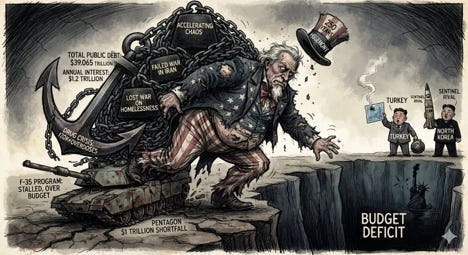
As the last Substack discussed the current NDAA for the US military requests $ 1.1 trillion for DOD operations in 2027. In addition, the DOD has requested an additional $65 billion for the US war on Iran, along with an additional $350 trillion for unspecified activities. The current DOD budget is $921 billion. The cost of militarism and war is a major reason why the US budget deficit is almost $40 trillion.
In 2025, NATO countries collectively spent approximately $1.63 trillion on defense. This figure reflects a significant increase in defense spending among member nations, with all allies exceeding the previous target of 2% of GDP. NATO budget is Eu 5.3 billion
The US and NATO countries have funded the Ukraine government and the Ukraine war — the US as of 12/31, $188 billion; NATO countries as of 12/24 EU 132 billion; Total 320 billion. An additional EU 90 billion was promised at the recent NATO meeting in Turkey for the rest of 2026 and for 2027
Meanwhile Russia spends $186 billion, and China spends $251 billion.
Excluding the US NATO Russia and China the rest of the world spends around $1.2 trillion
This is madness!!
Adendum:
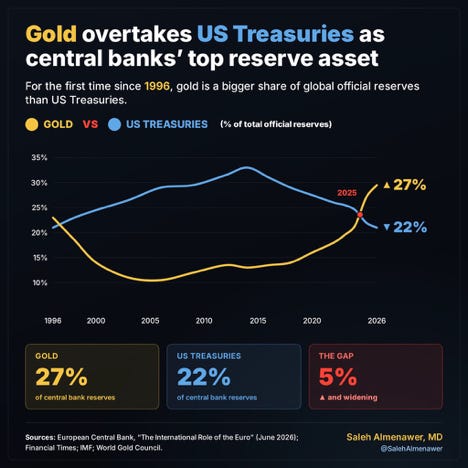
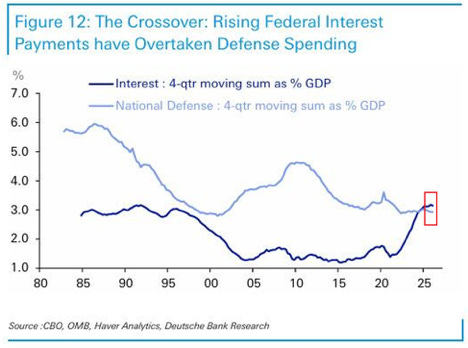
Here are a few charts for your consideration. I will publish another essays on the global economic situation.
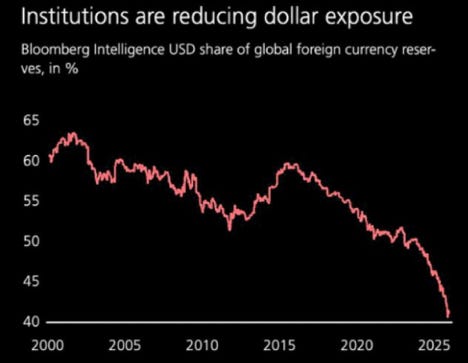
US Dollar share of global foreign currency reserves have fallen to its lowest level this century
\
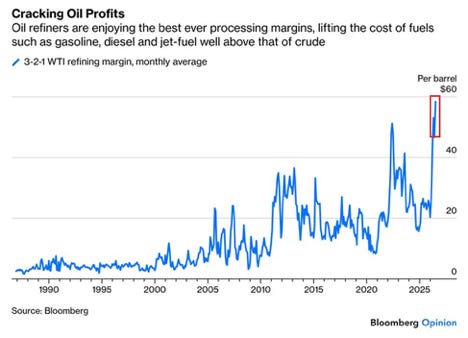
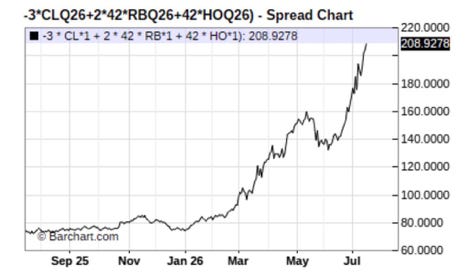
The crack spread
Inventories of refined products are very low compared to oil. With refineries in Persian Gulf and Russia down, 16% of world total, the shortage is in refined products.
\\