In Russian Business Daily, Defense Companies Admit Major Difficulties Due To Sanctions
Introduction and English translation of May 30th RBC article via Memri.
As Russia has tightened its hold over information channels to the point of virtually criminalizing criticism of the “special operation” in Ukraine, Russia’s business dailies sometimes succeed in providing unwelcome information to the authorities. Perhaps the authorities do not fear the select readership of these dailies, perhaps it assumes that the readership has access to sources of information. In any case RBC media has provided an article proving that the sanctions imposed on Russia are taking their toll on Russia’s defense industry. It turns out that even the quintessentially Russian Kalashnikov has foreign components. The absence of foreign components has caused extensive production delays, reliance on obsolete equipment, disruption of maintenance schedules and even layoffs.
The RBC report follows below:[1]
“Following the launch of Russia’s military special operation in Ukraine, the US and the European countries imposed a series of new sanctions against the Russian military industrial complex. Now defense industry complex plants are still assessing the risks, but it is already apparent that due to the new restrictions a number of contracts will be postponed. There are problems with the lack of marine diesel engines, import substitution of helicopter and aircraft engines, electronics, replacement of imported components installed in tank’s fire control systems, as well as aircraft repairs. Yet, defense industries claim that the state defense order will be fulfilled at the same level, as in the previous year.
“The industry doesn’t have the task of achieving a 100% level of import substitution for all products, as “Rostec” [corporation] and the Ministry of Industry and Trade emphasize. Reliance is being shifted to parallel imports. RBC has been taking with leading defense industry enterprises and experts to find out from them, how extensive are the problems caused by the new sanctions and what are the plans for resolving them.
“How Did The Authorities In Charge Of The Military-Industrial Complex React
“In early March, Deputy Prime Minister for the Defense Industry, Yury Borisov stated that ‘the full magnitude and depth of the current sanctions… was difficult to forecast.’ However, Borisov noted that in 2021 the state defense order was fulfilled by 98% and that ‘every opportunity for maintaining such indicators in the future’ exists.”

Yuri Borisov (Source: Rg.ru)
“At Rostec they explained to RBC that the corporation’s revenues are comprised of three elements: civilian goods, state defense orders and exports According to the corporation, the latter two accounted for about 55% of corporate revenues, while civilian products accounted for over 45%. ‘Naturally changes (considering today’s reality) are inevitable, the ratio will change. How exactly it will happen? We are now scrutinizing this issue. Approximately by the middle of the year the picture will become clear,’ stated Rostec. ‘Now the companies belonging to the state corporation adjust their plans on a number of projects, in consideration of the new inputs. Their deadlines have been objectively “shifted to the right” (that is, they were postponed to a later date),’ said the Rostec representative, without specifying what these projects are.
“Among the measures being taken, Rostec cited the following: development of new cooperation opportunities, fundamental changes in the suppliers, as well as intensification of import substitution programs in critical areas. For instance, regarding aviation, these concerns: propulsion systems (both for aircraft and helicopters), onboard systems and specialized software for production. Nevertheless, the task of producing absolutely everything [domestically] didn’t and doesn’t exist, the state corporation emphasized. “This is unreasonable, as there are alternative suppliers, there is also a mechanism of parallel import,” they summed up at Rostec.
“The Ministry of Industry and Trade also told RBC that no country in the world is able to completely abandon the use of foreign technologies and components. ‘Statements about 100% import substitution are populist ones,’ argued the ministry. Regarding the decisions to support of the industry, the ministry recalled that during the COVID-19 pandemic the department generated the necessary measures, some of which were perceived as redundant at the time. Thus some measures, brought to a state of readiness, weren’t implemented. ‘And now we are applying these “drafts”,” summarized the ministry, without specifying what tools they were referring to.
“What’s Going On In The Aircraft Industry
“A representative of the United Aircraft Corporation (UAC) stated in an interview to RBC that after the new sanctions were imposed ‘there is more work to be done.’ In the civilian segment [of the industry], the short term maintenance of the serviceability of the existing fleet of Sukhoi Superjet 100 aircraft is an important area of work for Russian manufacturers of planes, systems and components. The work is being performed with the airline companies and each [aircraft] operator has its own “road map” of joint actions. According to UAC, for the past period spare parts depots have been established including a pool of replacement engines. However, ‘there are of course sensitive positions’ regarding the Superjet 100 repairs, admitted the company.
“In early April, Yury Lapin, General Director of IrAero airlines, warned that due to the US and EU sanctions, airlines operating domestically-produced “Sukhoi Superjet 100” aircraft are unable to provide repairs and maintenance to assure the technical fitness of Russian-French SaM146 engines. Such a situation, according to Lapin, may lead to ‘a stoppage of [maintenance] on the fleet of Superjets in the short term perspective. Engine service problems were also reported by managers of three other airlines that fly Superjet planes. One of them noted that his airline will have to stop passenger flights on these planes as early as the fall of 2022, provided the engine tech support won’t improve.
“‘There are the two largest programs in civil aviation: manufacturing and exploitation of the short-haul Superjet 100 and of the medium-haul MS-21.’ Both programs presumed the utilization of a significant number of foreign-produced components, reminded Oleg Panteleev, Executive Director at the AviaPort industry agency. We are talking in particular about American-produced Pratt & Whitney engines for the MS-21 and Russian-French SaM146 engines for the Superjet 100 planes’, he specified. ‘The Americans stopped the supplies, in turn, the French side has also blocked the delivery of its component, i.e., of the generator module and other components. Therefore, it’s not possible to maintain production at the planned speed,’ elaborated the expert.
“‘Regarding combat aircraft, even if somewhere isolated foreign-produced components are being used, they belong to the category where their usage is allowed, because large warehouse inventories of them were created in advance, and they can be bought in the countries that don’t support sanctions’, noted Panteleev.
“At the end of March, the newspaper Kommersant reported that UAC had failed to receive the majority of the MS-21 engines from the American “Pratt & Whitney” company, due to which the commissioning and supply plan for this aircraft had to be reduced. Rostec plans to start deliveries of the MS-21 equipped with a home-produced PD-14 engine in 2024, but even these terms are considered way too optimistic in the industry, stressed the newspaper.
“Deputy Prime Minister, Borisov stated in mid-March that the Russian authorities at the background of sanctions were considering the prospects of increasing the serial production of IL-96 and Tu-214 passenger planes, which are currently produced in small batches for special customers. The UAC told RBC that they are already increasing the manufacturing of Tu-214 planes. ‘These planes will make it possible to support the air transport industry through a difficult period, stated the company.
“As for the helicopter-manufacturing programs, it’s necessary to replace imported engines for Ansat, Ka-62 and Ka-226 helicopters, Panteleev continues. ‘At the same time, there are more concerns about future maintenance and repair of Western-produced machines involved in the production of aircrafts. It’s necessary to purchase them in order to increase the production volume,’ concluded the expert.
“According to the Disclose investigative journalism portal, between 2014 and 2018, the French Thales group of companies equipped 60 twin-seat Su-30 multi-purpose fighters with the latest TACAN navigation systems. What’s more, similar TACAN systems were delivered to Russia for upgrading MiG-29 fighters, as well as special high-tech pilot helmets.
“Since 2014, Russian Air Force jets have been equipped with Sigma 95N navigation systems developed by the French Safran” company, which allow autonomous navigation without satellite signals. According to the Disclose website the target detection systems were supposed to be installed on Ka-52 helicopters.
“What Shipbuilders Say
Commenting on RBC’s question regarding the components, which are in short supply due to new restrictions, the United Shipbuilding Corporation (USC) stated that the volume of domestic production must be increased, first for all for marine diesel engines, for components of propulsion systems, for anchor-mooring equipment and ship systems (water circulation, waste water management, etc.).
“Russian shipbuilders today are going through enormous difficulties regarding the supply of engines for ships of all types: from boats to large warships, Ilya Kramnik Researcher at the Center for North American Studies of IMEMO Russian Academy of Sciences, and Navy expert, confirmed to RBC.
“For instance, multipurpose corvettes of ‘Project 20380′ equipped with guided missiles were initially fitted with engines made by the Kolomna plant. According to Kramnik, the practice of their usage demonstrated that the domestic diesels didn’t meet expectations. As the expert explained, there were complaints about engines’ reliability, power, and upgrade potential. It was decided to equip the improved corvettes of this type (project 20385) with German engines. However, due to the new restrictions the deal was derailed. Thus the fleet continues to use domestically-produced diesel engines, while for some projects the purchase is made in China, noted the expert.
“There are relatively few companies in the world that are capable of producing powerful modern diesel ship engines. And Russian companies aren’t among them, although Russia possess some competence in manufacturing diesel, stressed Kramnik. Regarding the propulsion systems and anchor-mooring equipment, traditionally the emphasis was put on imported components, and it remains unclear how promptly domestic developments can be introduced, summed up the expert.”
Ilya Kramnik (Source: Newprospect.ru)
“The USC has developed and is implementing import substitution plans for these types of equipment, as stipulated by the Shipbuilding Industry Development Strategy drawn up to 2035. It is planned to start serial production of cycloidal propellers for a series of river-sea vessels, in addition to domestic engines, whose [production] has been already mastered, and which are supplied en masse to such vessels. Besides, the Russian enterprises, which deal with engine production are upgrading them to the requirements of the register.
“The corporation has been working in this direction for some time, but now the magnitude of such work has grown considerably and at the USC they are sure that it aims to become a full-fledged business segment capable of generating proceeds. It will take about two years to work out tactical solutions. “From 2024 till early 2025, we expect to transform [our production] to be based entirely on Russian-produced piston machines and other systems that were traditionally bought from foreign countries,” explained the USC. ‘The situation demands, first of all, a tough stance of state customers with regard to meeting civil demand with Russian-produced ship equipment. This will provide the main support for shipbuilders, stressed the corporation.’
How Serious Are The Problems With Electronics?
“Deputy Prime Minister Borisov has repeatedly mentioned the ‘collapse of microelectronics’ in Russia and the need to restore this industry. In mid-May, he stressed again that the country is facing the task of acquiring technological independence.
“Ruselectronics holding told RBC that in the face of restrictions, the holding’s companies continue to fulfill contracts under state defense orders and produce civilian goods. In order to facilitate an uninterrupted work, the holding’s stocks of electronic components are being used, while cooperation chains are being reviewed
“‘In terms of exports, we record stable demand from foreign customers for a number of electronic components, particularly sealed magnetically controlled contacts. Thus, we expect export revenue in the first half of 2022 to remain at the level of 2021,’ Ruselectronics summed up.
“According to Kramnik, the company grossly underestimates the situation claiming that there are no problems. ‘There are big problems with microprocessor production, in particular in military, military- defensive and space areas. The equipment that we possess now allows for production of some things, but one has to be aware that such goods are already quite obsolete,’ explained the expert.
“When the issue concerns their introduction in modern arms systems with AI capability, for example, of real-time data transfer and support for tactical decision-making, it requires growing foundation capacities that are not always accessible via older solutions, stressed Kramnik. Especially when compact equipment is needed, added the expert. ‘If there’s some kind of ground facility, a building, it’s generally not that important whether to equip such a building with 100 or 500 kilograms of equipment, however, when it comes to a guided missile, the dimension and weight requirements increase dramatically. The product has to be light and small, which is difficult to achieve,’ explained Kramnik.
“There are also issues with modern optical and thermal imaging equipment, continued Kramnik. Russian plants enjoy their own matrices, but they usually cannot satisfy the demand and don’t meet the required characteristics, noted the expert. ‘Even enclosures, switches, and cables are imported. That is, we should start not with electronics, but with electrical engineering,’ concluded the expert.
“What Issues Is Russia’s Only Tank Manufacturer Facing?
“The press service of UralVagonZavod (UVZ) told RBC that the holding’s enterprises are operating steadily and are even increasing their production volume. The concern has been operating under sanctions since 2014, recalls the company’s representative. Import substitution doesn’t concern the holding’s products of both military and civilian use, stressed Uralvagonzavod.
“Meanwhile, at the end of March, as Kommersant reported referencing the plant’s press service, that “a small part” of the employees at the car assembly line were sent on short-term leave with 2/3 pay. The exact number of employees on leave wasn’t specified. However, the press service stressed that there are pending orders until the end of the year and with regard to a number of products -until the end of 2024.
“According to a statement of representative of the plant’s trade union, Alexander Ivanov made to URA.RU agency in early April, there are, actually no issues with the quantity of orders, however, there are problems with their fulfillment. Ivanov claimed that Uralvagonzavod is facing a shortage of components, because of the transition to import substitution. ‘The plant is searching for Russian suppliers; we are developing schemes of raw materials’ purchase from friendly states that haven’t joined the sanctions,’ said Ivanov. In addition, he claimed that the employees at the car assembly line are being laid off (with 2/3 of their pay intact) on a massive scale, rather than on a case-by-case basis, as the plant’s press office told Kommersant.
“On the whole, Uralvagonzavod fulfills the state defense order, but the components for the fire control systems (including those deployed at the Russian main battle tank T-90M) were purchased via Belarus from the French Thales company, recalled Colonel Victor Murakhovsky, the Editor-in-Chief of Arsenal of Fatherland. According to Murakhovsky, this concerns not the fire control system as a whole, but only its ‘night time module.’ It’s not yet known how critical this issue is and whether there is a potential for production of domestic substitutes, said the expert. The European online EU Observer’ magazine also reported that Russian T-72s are equipped with thermal imaging sight made by the French Thales company.
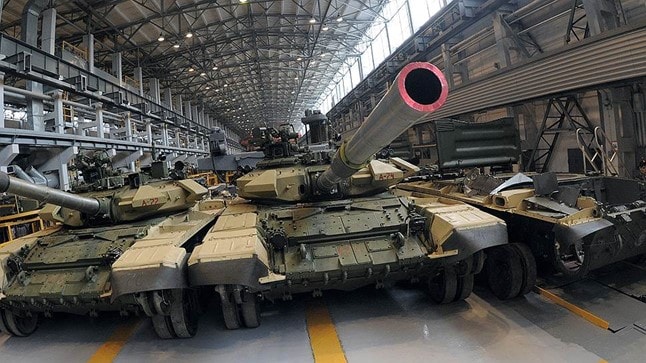
Tank assembly at Uralvagonzavod (Source: Kommersant.ru)
What is the Position of the Gunsmiths?
“On April 7, a meeting of the Board of Directors of the Union of Russian Armorers named after M.T. Kalashnikov was held. The meeting was chaired by Alan Lushnikov, a [major] shareholder of the Kalashnikov Concern. The meeting was dedicated to the issues of import substitution, simplification of export procedures for arms and cartridges, work on elimination of excessive administrative obstacles regarding the arms circulation [on the civilian market], as well as to state support measures of the [gunsmith] industry (according to the holding’s own statement).
“Vladimir Zhikharev, Executive Director at the Union of Russian Armorers, told RBC that the organization scrutinized the risks that may appear in connection with sanctions pressure on part of unfriendly states. He also concluded that some enterprises – that are part of Kalashnikov holding are at risk of not receiving many components, 70% of which (and sometimes more than 80%) were previously bought abroad. Also, there is the short-term issue of the repair and replacement of imported equipment.
“‘Many companies [of Kalashnikov holding] find themselves in a very difficult situation. The air guns production as well as that of cartridges of many civilian arms experience shortage [of materials and components?] Some companies of the holding have ceased production of certain types of civilian products,’ said Zhikharev. In addition, he stated that Kalashnikov holding may experience a twofold decrease in the export of civilian small arms due to the recent tightening of the sanctions regime.
“The Kalashnikov press service didn’t respond to RBC’s inquiry, the same is also true for RBC’s inquiries to ‘Russian Helicopters’ and ‘United Engine Corporation.’
[1] Rbc.ru, May 30, 2022.
Pepe Escobar: The Sanctioned Ones: How Iran-Russia are setting new rules

By Pepe Escobar, The Cradle, 5/31/22
The first Eurasia Economic Forum, held last week in Bishkek, Kyrgyzstan, should be regarded as a milestone in setting the parameters for the geoeconomic integration of the Eurasian heartland.
Sergei Glazyev, Russia’s Minister in Charge of Integration and Macroeconomics of the Eurasia Economic Union (EAEU), is coordinating the drive to design an alternative monetary-financial system – a de facto post-Bretton Woods III – in cooperation with China.
According to Glazyev, the forum “discussed the model of a new global settlement currency pegged to baskets of national currencies and commodities. The introduction of this currency instrument in Eurasia will entail the collapse of the dollar system and the final undermining of the US military and political power. It is necessary to start negotiations on signing an appropriate international treaty within the framework of the SCO.”
Glazyev described the initiative to upend the western global financial system in more detail during an exclusive interview with The Cradle in April.
It’s particularly relevant to understand how Glazyev interconnects the EAEU’s drive with the increasing geopolitical and geoeconomic role of the Shanghai Cooperation Organization (SCO), which unites at the same table key Eurasian powers: China, Russia, India, Pakistan, Kazakhstan and Iran.
That connects directly with Russian President Vladimir Putin, at the meeting of the Supreme Eurasian Economic Council, supporting the extension of a temporary free trade agreement between the EAEU and Iran, which is the newest (and only West Asian) full member of the SCO. Putin said this should go ahead despite the “confrontation by the collective West.”
The EAEU, inaugurated in 2015 with five full members – Russia, Kazakhstan, Kyrgyzstan, Belarus and Armenia – represents a market of 184 million people and a collective GDP of over $5 trillion. The next step with Iran will be to implement a full free trade agreement, possibly before the end of the year, according to Iranian deputy trade minister Alireza Peymanpak. Egypt, Indonesia and the UAE are also candidates to strike deals with the EAEU.
Iran, which has for over four decades now been forced to find creative solutions to bypass serial, imperial sanction packages, may have a conceptual lesson or two to teach Russia. Barter arrangements are gaining ground: Tehran is offering spare parts and gas turbines to Moscow’s power plants in exchange for much needed zinc, aluminum, lead and steel for its metal and mining industries, according to Iranian trade and industries minister Reza Fatemi Amin.
And more barter on a wide range of commodities is ahead, as discussed during a recent visit to Tehran by Russian Deputy Prime Minister Alexander Novak.
The other ‘RIC’
Slowly but surely, the new RIC (Russia-Iran-China) – as opposed to the old RIC in BRICS (Russia-India-China) – is attempting to integrate their financial systems. Iran is a matter of national security strategy for China, as an energy provider and essential partner of the Belt and Road Initiative (BRI) in West Asia.
Russia-China, though, is a much more complex matter. Extremely fearful of provoking US sanctions, Chinese banks are refraining – at least for the moment – to increase their deals with Russian banks, which brings us to the case of UnionPay:
The Chinese bank card provider – increasingly popular, especially across Asia – declined from partnering with Sberbank even before Russia’s largest bank was excluded by the EU and the US from the global bank messaging platform SWIFT. UnionPay also canceled plans with other Russian banks to issue UnionPay cards linked with the Russian Mir payment system, profiting from the exit of Visa and Mastercard from the Russian market.
This is still a careful balancing act for China. Earlier this year at the Boao Forum in Asia, President Xi Jinping was adamant in opposing the “wanton use of unilateral sanctions.” And over 80 percent of Chinese companies already established in Russia appeared to continue their business as usual.
Yet in practical terms, there are serious problems. The Bank of China and the Industrial and Commercial Bank of China (ICBC) have restricted financing for Russian commodities. Even the Asian Infrastructure Investment Bank (AIIB), absolutely essential for sustainable development projects, linked or not with BRI, decided to freeze all lending to Russia and Belarus in early March to “safeguard” its “financial integrity.”
On the financial front, cautious Chinese banks, with enormous western exposure, are always balancing the fact that nearly 80 percent of global cross-border transactions are still in dollars and euros, and only two percent in yuan. So the Russian market is not exactly a priority.
In parallel, the Russia-Iran front is quite lively. They are turbo-charging mutual settlements in their national currencies to “the highest possible level,” as highlighted by Deputy Prime Minister Alexander Novak: “We discussed together with central banks the spread and operation of the financial messaging system, as well as the connection of Mir and [Iranian] Shetab payment cards.”
As it stands, the Mir card is still not accepted in Iran, but that’s about to change – just as in Turkey, which this summer will start accepting Mir card payments from legions of Russian tourists. What this means in practice is that Russia and Iran will be connecting their banks to the System for Transfer of Financial Messages (SPFS), the Russian equivalent to SWIFT. The Chinese will obviously be examining how seamlessly the transition works.
Now compare all of the above with the prospect that soon there won’t be any SWIFT at all, as Mastercard CEO Michael Miebach let slip in Davos.
Miebach was participating in a panel on Central Bank Digital Currencies, discussing cross-border payments, when he suggested that SWIFT might soon be a thing of the past. No question about it: Moscow is eyeing crypto and digital currencies already, and Beijing is dead set on setting up the digital yuan to work around SWIFT and its linked CHIPS (Clearing House Interbank Payment System).
The Sanctioned Ones, now moving fast
The Russia-Iran front has been fast evolving since January this year, when Iranian President Ebrahim Raisi, on a visit to Moscow, handed a draft agreement to Putin on strategic cooperation for the next 20 years, building on “the very good experience of cooperation between Iran and Russia in Syria in combating terrorism,” and expanding to “economy, politics, culture, science, technology, defense, and military spheres, as well as security and space issues.”
Raisi also explicitly thanked Putin “for facilitating Tehran’s entry into the SCO.”
Iranian Oil Minister Javad Ouji went straight to the point in his meeting with Novak in Tehran last week: “Our countries are under strict sanctions, and we have the potential to neutralize them through the development of bilateral relations…We have created joint committees on banking, energy, transport, agriculture issues, as well as the issue of creation of nuclear power plants.”
And that brings us once again to the seemingly eternal soap opera of the Vienna-based Joint Comprehensive Plan of Action (JCPOA) talks, with Russian Deputy Foreign Minister Sergey Ryabkov now signaling the final draft “is at a high degree of readiness for adoption. There are some political problems, which are not related to the finalization of the text.”
Cutting through the proverbial fog of US swamp spin, Ryabkov stressed how “in terms of our interests, including in the context of peaceful nuclear cooperation with Iran, the text is quite satisfactory…there is nothing to ‘fine-tune’.” So when the Americans say that the deal is “out of reach,” Raybkov added, it means that they “broadcast the results of their internal discussions.”
The bottom line is that on the JCPOA, Tehran and Moscow are in sync: “We are what they call on edge, and it could happen very quickly if the political decision is made.”
Expanding on their synchronicity, Tehran even proposed to host negotiations between Moscow and Kiev over the Ukraine conflict – following the Turkish example. By now though, after Ankara’s failure, it is clear that Washington decision makers want no negotiation, but an endless war to the last Ukrainian.
Iranian Foreign Minister Hossein Amir-Abdollahian remains in sync with his counterpart Sergei Lavrov. At Davos, he said the Ukraine drama was caused by “the US and NATO’s provocative actions…they “provoked the Kremlin into this.” That’s essentially what Beijing has been discreetly implying.
All of the above shows some of the trials and tribulations of Eurasia integration, and the long and winding road to an EAEU-SCO new monetary system. But first things first: there’s got to be some action on the Mir-UnionPay front. When that news breaks, the die will be cast.
Gordon Hahn: Questions of Regime Stability in Wartime Russia
By Gordon Hahn, Russian and Eurasian Politics Blog, 5/30/22
The Russo-Ukrainian is bound to place political pressure on the Russian regime’s internal solidarity as well as state-societal solidarity but only over the long-term and only in conditions of failure in the war. Russian political culture highly values the country’s national political solidarity, and any decay in solidarity is likely to be a long-term prospect even in war time, given the extent to which Russian President Vladimir Putin has succeeded in restoring Russia’s traditional cultural and authoritarian-induced solidarity after the divisions incurred during the Soviet collapse and extending throughout the 1990s. There are three potential fissures along which Russian solidarity or unity can be undermined: (1) between hardliners and the Putinist balance between hardline siloviki and regime liberal economic and financial officials; (2) the defection of regime liberals from the regime; and (3) the rise of a societal opposition that rejects the war in Ukraine or its outcome and extends its dissent to the nature of the political.
The war was bound to consolidate Russian state and society around Putin for some period of time, likely of significant duration. Russian political and strategic culture is dominated by strains — comprising a security vigilance culture — that incline Russia towards hyper-vigilance against both domestic and foreign threats, especially those emanating from the West, as I tried to demonstrate in my most recent book, The Russian Dilemma. There are periods when Russian recessive strains of Westernization and liberalization temporarily predominate, such as under Tsar Alexander II, during the Romanov dynasty’s decay under Nicholas II, and during the Soviet demise and aftermath from 1987 to 2003. This security vigilance culture is not the product of Russian ‘paranoia’, though there is some of that; rather its is a product of centuries of political interference, military invasion, and other forms of unwanted Western intervention in Russia’s domestic affairs and against its national security interests. This is the perceptual-historical prism through which NATO expansion and Western meddling in Russian and Ukrainian politics produced Putin’s ‘special military operation,’ and it is the perceptual prism through which Russians will view the war for some time to come. NATO expansion and Western meddling in Russian and Ukrainian politics also brought a re-authoritarianization, which accompanies periods of the security vigilance culture’s ascendance. Putin strengthened that culture’s dominance by way of an effective authoritarian hegemony — not monopoly — over media, art, and science. The result is the return of Russia’s traditional but not always dominant security vigilance culture along the lines seen under Nicholas I and Alexander III, not the Soviet totalitarian hyper-vigilance culture. This culture rejects societal divisions and seeks to enforce national solidarity. Therefore, any rifts that could result from the present war –either through military failure or excessive costs for the economy — will have to be long in the making and occur within a context of deep crisis at the front or at home.
Read full post here.
Alexander Nepogodin: Modern Ukraine was built on an anti-Russia foundation, but a large part of the country refused to play along
By Alexander Nepogodin, RT, 5/31/22
Alexander Nepogodin is аn Odessa-born political journalist, and an expert on Russia and the former Soviet Union.
The conflict in Ukraine has many frontlines. The world is mostly focusing on the hostilities, but an even more serious conflict is unfolding inside the Ukrainian camp. This standoff between Ukrainians and Russians as two political nations has been developing since 2014, but it entered a new, decisive phase after Russia began its military offensive, three months ago.
Since the fall of the Soviet Union in 1991, three groups with strong identities have co-existed in Ukraine. A state which first came into being as recently as 1917, and had its current borders set by Joseph Stalin, the Georgian dictator who led the USSR until his death in 1953.
The first one, Ukrainian-speaking Ukrainians (or Galicians, named after the historical region of Galicia), mostly live in Ukraine’s western and central territories. Their ethnic narrative is very clear, they consider Russians to be their enemy, and their main icon is the World War Two Nazi-collaborator Stepan Bandera.
The Galician motto is something along the lines of “if you disagree with us, there is still time – pack your suitcase and catch the next train to Russia.” They are pushing the narrative that Ukraine as a nation doesn’t depend on Russia and the Russians. This is supported by their choice of national heroes. Hetman Ivan Mazepa sided with King of Sweden Charles XII during the Great Northern War between Russia and Sweden. Symon Petliura was the president of the Ukrainian People’s Republic during Ukraine’s sovereignty in 1918–1921. The aforementioned Bandera founded and led the Organization of Ukrainian Nationalists from the 1920s to the 1950s.
As for Russian-speaking Ukrainians living in central and southeastern parts of Ukraine, they never thought of Russians as strangers or enemies, before the propaganda which followed the 2014 Maidan coup in Kiev. And the third group living in Ukraine consists of ethnic Russians. They are connected with the Russian-speaking Ukrainians by language and the historical narrative – both of these groups believe they fought on the right side of history when they defended the Soviet Union from the Nazis during World War II.
West Ukrainians have a rather different view, but they also believe their past to be virtuous. They say their ancestors didn’t fight for the Third Reich, but rather for an independent Ukraine, even if they were part of the Ukrainian Insurgent Army (banned in Russia) which participated in the holocaust, helping to slaughter Jews.
In other words, these groups, especially the Ukrainian-speaking Ukrainians and the Russians, are separated by different views of history, different languages, and different political representation. Just think of the 2013-14 “Euromaidan” when the “pro-Western” and “pro-Ukrainian” forces overthrew Viktor Yanukovych, the supposedly “pro-Russian” president (despite his years of negotiations with the EU).
That conflict had been brewing in society for many years – just look at the names people from different regions called each other. “Ragul” (a derogatory word for a farmer, a village resident), “zapadenets” for people from western Ukraine, and “moskal,” “kommunyaka,” or “colorad” (because of the colors of St. George’s ribbon, which symbolizes Russia’s victory in the Great Patriotic War) for those living in southeastern regions. However, before 2014, the conflict of narratives was moderate, and the balance was upset after the policy of building a national state began to dominate.
In the middle have been the moderate group – Russian-speaking Ukrainians (or, to quote Mikhail Pogrebinsky, a political analyst living in Kiev – “Russian Ukrainians”). This group has always been placed between political Russians and radical Ukrainians, drawing some of its identity from both camps but also being somewhat unique. Their attitude towards Russia and Russian culture has been a key issue since the beginning of the conflict in 2014.
Everything was clear-cut with radical Ukrainians – they always considered Russians enemies and viewed Russia as an aggressor and existential threat. Moderate Ukrainians, on the other hand, didn’t feel animosity towards Russians and even agreed to call them a “brotherly nation.” The Russian and Ukrainian cultures were deeply intertwined in their reality, so it was hard for them to separate the two. The contact line in the Donbass in 2014 separated two armies, two political regimes, two world views, as well as people. Friends, neighbors and family members found themselves on different sides.
But the more difficult issue for the majority of moderate Ukrainians has been their political stance on Russia. The Russian-speaking Ukrainians didn’t hate Russia like radical Ukrainians; they were somewhat concerned with the “Russian world” concept as some civilizational community. When the concept was used to proclaim political unity between Russia and Ukraine in 2013-2014, the idea of such unity was compromised in the eyes of many Russian-speaking Ukrainians.
The problem, however, is that Ukrainian elites started to drift to the nationalist side long before the 2013-2014 crisis. This is also the main reason why Russia’s policy in Ukraine has failed: Russia had for too long ignored the fact that virtually the entire Ukrainian elite – political, economic and cultural – were keen to act on their own, dreaming of an independent Ukrainian political project.
Back in the early 1990s, right after the collapse of the Soviet Union, the Ukrainian establishment came up with two models for the country: the Galician (nationalist) model and the Eastern Ukrainian model. The latter anticipated the formation of a multiconfessional, multiethnic, multicultural state where a nation was perceived as a civil actor. By contrast, the radical approach was based on the ethnic principle of nation-building, which was most frequently espoused by Ukrainian-speaking Ukrainians from the western regions.
This concept is rooted in the idea of a monoethnic country – a “Ukraine for Ukrainians” as bearers of the Ukrainian language and culture. After 2014, those who espoused the Galician concept proved more active and influential in political processes, even though Volodymyr Zelensky was elected president in 2019 – a Russian-speaker from the Krivbass who seemed to subscribe to the Eastern Ukrainian concept. Until he took office and reality began to bite.
Initially, he tried to find a compromise with the Galician group, but after some time he became an integral part of it, not only continuing with the policy of Ukrainianization, but also proceeding to eliminate “pro-Russian” political forces entirely.
Without a doubt, the start of the special military operation has led many Russian-speaking Ukrainians to switch to the Galician concept and embrace Ukrainian nationalism, taking a radical stance towards Russia. There are quite a few examples when people from southeastern regions who had previously welcomed the reabsorption of Crimea by Russia reversed their position and took up arms – for example, by joining the ranks of the territorial defense. This was especially often the case with young people.
Those changes were brought about by a number of factors that had influenced the situation for many years: a growing aspiration to join the European Union political project; effective propaganda with restricted access to Russian TV and social networks; the Ukrainianization of education; military service in the Ukrainian Armed Forces and work in government agencies. In other words, those who lived in the southeastern regions of Ukraine, the so-called “post-Soviet people,” were subject to social engineering. Russia, in turn, couldn’t offer these people any alternative, except for permanent relocation to the neighboring country. Many of them did so – unable to tolerate the Ukrainianization of education and political persecution, they left their homeland forever.
Importantly, it was the radical shift in cultural and linguistic policy after Euromaidan and the attempt to build a nation-state that actually led to the outbreak of armed conflict in 2014. Ukraine made a fatal mistake when it abandoned the policy of moderate nationalization in favor of radicalism. Under the presidencies of Leonid Kravchuk and Leonid Kuchma, the country did pursue the nation-state model, but without upsetting the delicate balance of interests between all three groups.
With the loss of Crimea and the Donbass that followed Euromaidan in 2014, the status quo was finally upset, which led to a shift in the official historical memory, language policy, and relations with regional elites. The discussion of federalization and autonomization lost all legitimacy in political discourse, and politicians on both sides refused to recognize their opponents as a group with their own cultural and political rights. This was especially hard on representatives of the Russian-speaking southeast.
As for the language issue, recent years also saw an escalation in this stand-off. The total Ukrainianization of education began during the presidency of Petro Poroshenko and continued under Zelensky. Despite his earlier objections to this sort of policy.
For a third of the population, it felt like more than just the self-expression of political Ukrainians at the expense of Ukrainian Russians. It felt as though they were being demoted to second-class citizens.
The thing is that the status of the Russian language in Ukraine always remained a purely political and ideological issue rather than a practical one. Ukrainian society remained bilingual after the collapse of the Soviet Union, with people freely speaking both languages. Practically speaking, if the government wanted to achieve real equality for its citizens, it could have met all the linguistic needs of the Russian population without granting Russian the status of a regional language. Passing reasonable laws to preserve and protect it would have been enough.
The trajectory of Ukraine’s development reveals that further evolvement of the Ukrainian political nation, in the light of the current live confrontation with Russia, will be based on the political model of the nation state. It will not only be built on the estrangement of the Russian language and culture (including de-Russification and demolition of historical monuments commemorating Russian prominent figures) – it will inevitably lead to violence directed against unwelcome pro-Russian Ukrainians, many of whom have already been dubbed a “fifth column” – among them, the recently arrested journalist Yuri Tkachev and writer Yan Taksyur.
In a situation when Ukraine – the home country for the three groups of people we mentioned above, including those citizens whose national identity is still not fully fledged – refuses to represent and protect their interests, it’s hardly a surprise that they would seek representation and protection from other states, primarily Russia. So the sooner we acknowledge the fact that Ukraine will not be able to build a politically and ethnically united nation without resorting to violence, the sooner Russia will be able to set out to provide such living conditions in the territories it controls.
Although the present situation is very complicated, Russia will still have to work with the Ukrainian population. And a realistic perspective on the situation at hand implies a differentiated approach to each of the three population groups. However, the fact that the groups in question inhabit geographically defined parts of Ukraine makes this task much simpler.
One group mainly lives in the central and western parts of the country, while the others inhabit the southern and eastern regions. It is, in fact, something known as the “Subtelny line,” an imaginary split running through Ukraine and dividing it into different areas according to the ideology, beliefs and culture of the population.
Orest Subtelny was a Canadian historian of Ukrainian origin who published the results of an ethnolinguistic survey in the 1980s on the distribution of Russian and Ukrainian native speakers across the territory of the country. He concluded that there was a stable imaginary line dividing the country into two parts with different cultural, linguistic and, as it later transpired, ideological preferences. “Russian Ukraine” includes territories which have never been part of Ukraine, historically – the historical region north of the Black Sea, also known as Novorossiya, which was conquered from the Tatars and Turks under Catherine the Great; Sloboda Ukraine, or Slobozhanshchyna – a region that was part of the Russian state since 1503, the Donbass including some of the territories previously belonging to the Don Host Province (Oblast), and also Crimea. Interestingly, the results of all Ukrainian elections, opinion polls (e.g. on Ukraine’s accession to NATO) unmistakably reproduce the line Orest Subtelny drew on the map of Ukraine, confirming his idea of Ukrainian society being split into two camps.
About half of the “Russian Ukraine” is currently controlled by Russia’s armed forces and that’s where the military operations are mainly taking place now. As a result, Moscow is faced with a number of important tasks it has to accomplish in order to win the loyalty of the people living in the territories it controls. The top priorities here include revitalizing the region’s economy, filling the political vacuum (by establishing military-and-civilian administrations), helping the locals to get through the sowing season, opening the border with Russia for consumer goods, canceling debts owed by enterprises and individuals, granting benefits to small and medium-sized businesses (including tax relief), fast-tracking the procedure of Russian citizenship acquisition, restoring the destroyed infrastructure, and producing local mass media and social media content.
The main goal today is to fight for the hearts and minds of the Russian-speaking Ukrainians. In order to achieve success, Moscow will have to move the Russian identity into the foreground by boosting local patriotism, including in the areas it does not control. This won’t be too hard a task, as the people’s identity in the southeastern regions of Ukraine – the territories of historical Novorossiya – is basically the same it was 100 years ago, in many respects. And the differences that may be found are not that important in terms of deciding the future of the region.
What is much more important is that the history of Odessa, Kherson, Nikolaev and Melitopol is deeply rooted in Russian history and culture, because this is what plays an active part in molding the Russian national identity of the people living in Ukraine’s southeast, particularly the Russian-speaking Ukrainians. And Moscow can choose to use this trump card, especially given Kiev’s intolerance towards all those who think differently, political persecution and attempts to do away with the Russian language and culture. We just need to acknowledge that the process of self-determination of the Ukrainian nation is still ongoing, and to realize that the crucial battle for human minds is unfolding at this very moment.