By Pedro Gonzalez, IM1776.com, 5/27/22
In February 2021, by order of President Volodymyr Zelensky, Ukraine shut down three domestic television channels, accusing them of spreading Russian “propaganda.” Three months later, Zelenksky arrested Viktor Medvedchuk, who was at the time leading the second-biggest party in Ukraine’s national parliament, the pro-Russia and Eurosceptic Opposition Platform for Life (OPZZh).
Zelensky didn’t have trouble incinerating vaunted democratic norms well-before Russia crossed the Rubicon into Ukraine this year. So it was no surprise when he did it again amid the war in late March, invoking emergency powers under martial law to nationalize TV channels and ban 11 opposition parties, including OPZZh — all supposedly done in the name of combatting Russian misinformation and Russian sympathizers, even though OPZZh’s then-chairman, Yuriy Boyko, denounced the war and called for a ceasefire and the withdrawal of Russian troops from Ukraine. Zelensky, however, wouldn’t miss another opportunity to clip the wings of political opposition in his country, certainly not now that Western media rationalizes and glorifies his every move.
But the portrait of the Ukraine President as a democratic paragon whitewashes the real Zelensky and conceals a vast web of corruption and international skullduggery of which Ukraine is situated in the centre. Understanding the real Zelensky, requires seeing him as a creation of Ukrainian oligarch Ihor Kolomoisky. He is, in truth, a puppet of intrigue.
The Pandora Papers
It might be hard to believe now, but revelations from documents in the Pandora Papers — millions of files from offshore service providers leaked to the International Consortium of Investigative Journalists and shared with partners around the world — sent Zelensky reeling last year, threatening to end his political career. Though the actor-turned-politico campaigned as an anti-corruption reformer, the Pandora Papers showed him to be just as crooked as his predecessors.
Of more than 300 politicians and public officials, including several current and former national leaders, in more than 91 countries and territories to whom the documents were linked, Ukraine was home to more secret offshore holdings than any other, including Russia. The Organized Crime and Corruption Reporting Project (OCCRP), which contributed to the investigation, found that just before Zelensky was elected president, “he gifted his stake in a key offshore company, the British Virgin Islands-registered Maltex Multicapital Corp., to his business partner — soon to be his top presidential aide. And in spite of giving up his shares, the documents show that an arrangement was soon made that would allow the offshore to keep paying dividends to a company that now belongs to his wife.”
As it was with crackdowns on free speech and political opposition, Zelensky’s office attempted to justify the use of offshores by blaming the specter of Russian aggression. An adviser to Zelensky’s chief of staff said the offshores were necessary to “protect” the group’s incomes against the “aggressive actions” of the “corrupt” regime of former President Viktor Yanukovych, who was ousted in a US-backed color revolution in 2014. The expensive properties acquired by Zelensky associates in the center of London with the offshores, it seems, were but humble havens for persecuted Ukrainians.
It was true that Zelensky and his partners in a television production company, Kvartal 95, set up a network of offshore firms dating back to at least 2012. That was also the year the company began producing regular content for TV stations owned by Kolomoisky, Ukraine’s most flamboyant oligarch and Zelensky’s key backer.
The Raider
Kolomoisky is known to have intimidated guests by feeding a live shark he kept in a huge aquarium at his Dnipropetrovsk office, and has even reportedly ordered contract killings. If he did not exist, Richard Marcinko would likely have invented him as a villain in one of his Rogue Warrior novels.
Kolomoisky co-founded and was until 2016 the main owner of PrivatBank, Ukraine’s largest commercial bank, as well as PrivatBank Group, a global business coalition whose control extends across thousands of companies in virtually every industry from Ukraine, the European Union, Georgia, Russia, the United States and elsewhere. He denies having or needing influence over the President, but when the International Monetary Fund ended talks with Zelensky’s government after failing to reach a new lending agreement in 2019 (citing pervasive corruption) Kolomoisky, asked in an interview who would win if Zelensky was forced to choose between him and IMF loans, answered: “I would.” Ukrainian media has noted that Kolomoisky has not denied financing Zelensky’s campaign.
Kolomoisky built his enormous fortune atop PrivatBank primarily as a ‘raider’. In a story for Harper’s Magazine about Zelensky’s backer, Andrew Cockburn colored in the meaning of that term with the help of Matthew Rojansky, director of the Kennan Institute at the Woodrow Wilson Center for International Scholars. There are firms in Ukraine “registered with offices and business cards, firms [that specialize in] various dimensions of the corporate raiding process, which includes armed guys to do stuff, forging documents, bribing notaries, bribing judges,” said Rojansky to Cockburn. And according to Rojansky, Kolomoisky is “the most famous oligarch-raider, accused of having conducted a massive raiding campaign over the roughly ten years up to 2010.” At some point, he managed to end up on the United States’ visa ban list, prohibiting him from entering the country.
But the interests of the oligarch go well-beyond cutthroat business dealings, overlapping with Washington’s affairs in the region.
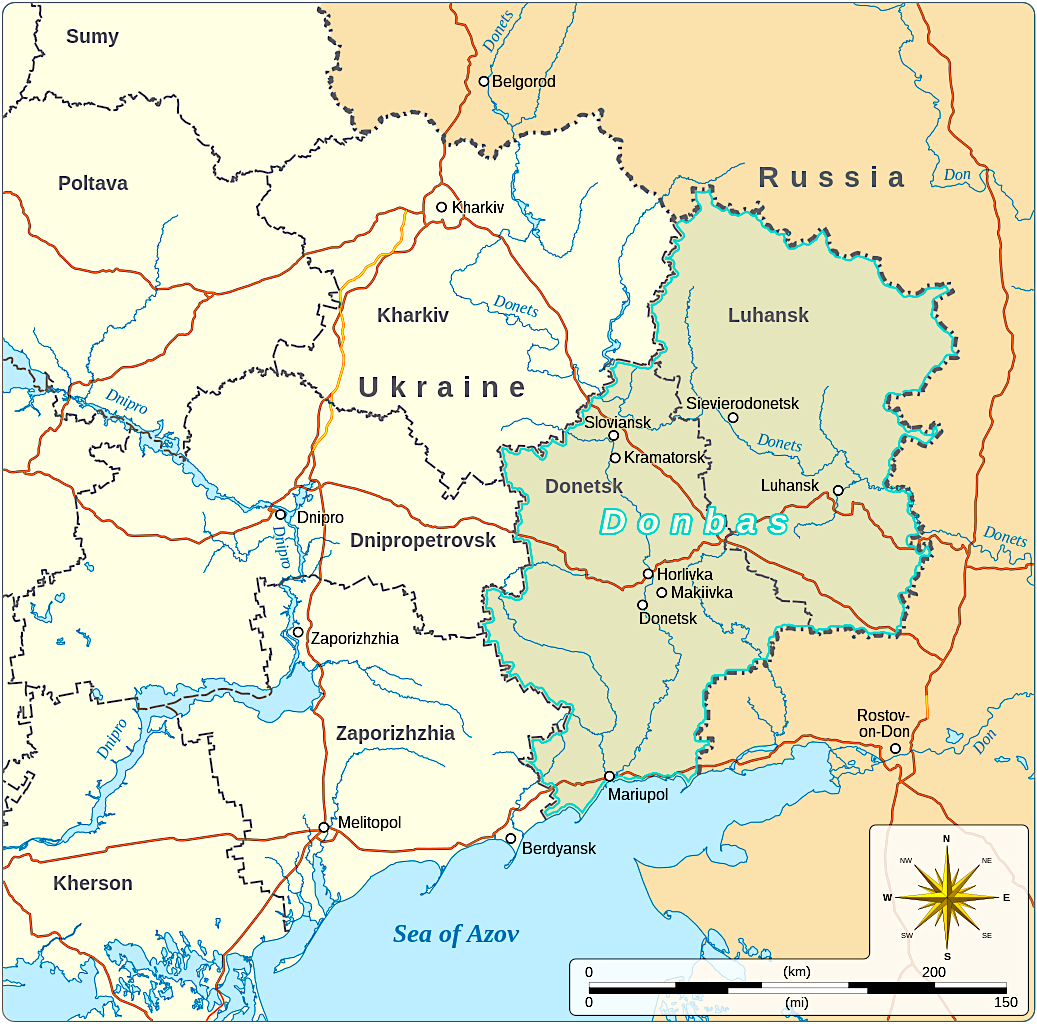
Between 2013 and 2014, the U.S. backed a color revolution in Ukraine that resulted in regime change. It also triggered a civil war between government forces and pro-Russian separatists in the eastern part of the country who declared independence from Kiev. Amid this crisis, acting President Oleksandr Turchynov appointed Kolomoisky governor of Dnipropetrovsk Oblast. He turned his workforce into a private army to combat the separatists. Yet even as Kolomoisky morphed into a warlord, he did not neglect his business empire.
Washington-Approved Oligarch
In 2014, the IMF approved emergency aid to Ukraine and injected billions into the National Bank of Ukraine — the country’s central bank — to support local commercial banks. Through a globe-spanning scheme involving PrivatBank accounts and PrivatBank Group companies and a corrupt Ukrainian court system, Kolomoisky looted billions in IMF aid. The con, as revealed in a series of court judgments, was outlined as follows by Cockburn:
Forty-two Ukrainian firms owned by fifty-four offshore entities registered in Caribbean, American, and Cypriot jurisdictions and linked to or affiliated with the Privat group of companies, took out loans from PrivatBank in Ukraine to the value of $1.8 billion. The firms then ordered goods from six foreign “supplier” companies, three of which were incorporated in the United Kingdom, two in the British Virgin Islands, one in the Caribbean statelet of St. Kitts & Nevis. Payment for the orders — $1.8 billion — was shortly afterwards prepaid into the vendors’ accounts, which were, coincidentally, in the Cyprus branch of PrivatBank. Once the money was sent, the Ukrainian importing companies arranged with PrivatBank Ukraine that their loans be guaranteed by the goods on order.
But the foreign suppliers invariably reported that they could not fulfill the order after all, thus breaking the contracts, but without any effort to return the money. Finally, the Ukrainian companies filed suit, always in the Dnipropetrovsk Economic Court, demanding that that foreign supplier return the prepayment and also that the guarantee to PrivatBank be cancelled. In forty-two out of forty-two such cases the court issued the identical judgment: the advance payment should be returned to the Ukrainian company, but the loan agreement should remain in force.
During this period, Kolomoisky kept his portfolio of activities diverse. Twenty fourteen was also the year when then-Vice President Joe Biden’s son, Hunter Biden, reportedly joined the board of Burisma, a Ukrainian energy company to which Kolomoisky has been connected with a controlling interest, according to the New York Post. Emails obtained by the Post revealed that Vadym Pozharskyi, a Kolomoisky protégé, communicated with Hunter in 2015 about a meeting between Pozharskyi and then-Vice President Biden. Further, bank records of Hunter (lawfully obtained according to D&A Investigations) show payments made to him by PrivatBank.
By 2015, Kolomoisky was onto his next controversy, the one that would ultimately lead to Zelensky’s rise.
In March of that year, Kolomoisky’s men physically seized control of Ukrnafta, the largest oil and gas producer in the country, and UkrTransNafta, which controls virtually all oil pipelines in Ukraine. This was Kolomoisky’s way of showing his disapproval of the government’s timid reform efforts, which posed a direct threat to then-President Petro Poroshenko’s power. Poroshenko thus turned to Washington for help — namely, then-Assistant Secretary of State for European and Eurasian Affairs Victoria Nuland and Geoffrey Pyatt, who was U.S. Ambassador to Ukraine at the time.
Nuland is an interventionist married to arch-neoconservative Robert Kagan. She’s been called “the architect of American influence in Ukraine,” was instrumental in regime change, and has served in every presidential administration except Trump’s since Bill Clinton’s days. People like Nuland are why presidents come and go, but interventionist foreign policy always remains.
With D.C.’s help, in exchange for him backing down, Poroshenko successfully removed Kolomisky from the visa ban list, among other things. Importantly, Pyatt and Nuland looked the other way on Kolomisky’s IMF scheme, even as Washington persecuted other oligarchs.
Meanwhile, at the same time that it ignored Kolomoisky’s corruption, the State Department attempted to extradite Ukrainian oligarch Dmitry Firtash for a bribery incident that allegedly took place in India. However, his real crime was holding ties to the government Nuland had a role in toppling as well as his association with deposed Ukrainian President Viktor Yanukovych. When Firtash appealed against his extradition, a European judge agreed and concluded that “America obviously saw Firtash as somebody who was threatening their economic interests.” Nevertheless, Washington has a long memory, and Firtash may end up standing trial in the U.S after all.
Even as he was removed from the U.S. banned list, Kolomoisky allegedly continued to embezzle and defraud PrivatBank of huge sums. Some of his schemes spilled over onto American soil.
According to the Justice Department, from approximately 2008 through 2016, Kolomoisky obtained fraudulent loans and lines of credit as part of a massive scheme totaling at least $5.5 billion, i.e. roughly equal to five percent of Ukraine’s gross domestic product at the time. In the U.S., millions of those dollars were allegedly laundered through commercial real estate purchases from Ohio to Kentucky and Texas. Furthermore, Zelensky’s benefactor allegedly purchased a dozen steel mills in small towns across America, leaving in his wake bankrupt factories, unpaid taxes, rotting buildings, and hundreds of steelworkers out of jobs.
By nationalizing PrivatBank in 2016, Ukraine effectively put the burden of a multi-billion dollar bailout on the shoulders of taxpayers.
The Servant of the People
Kolomoisky would have his revenge for what happened in his domain. The confrontation with Poroshenko, which was seen as humiliating for the oligarch, concluded in March 2015.
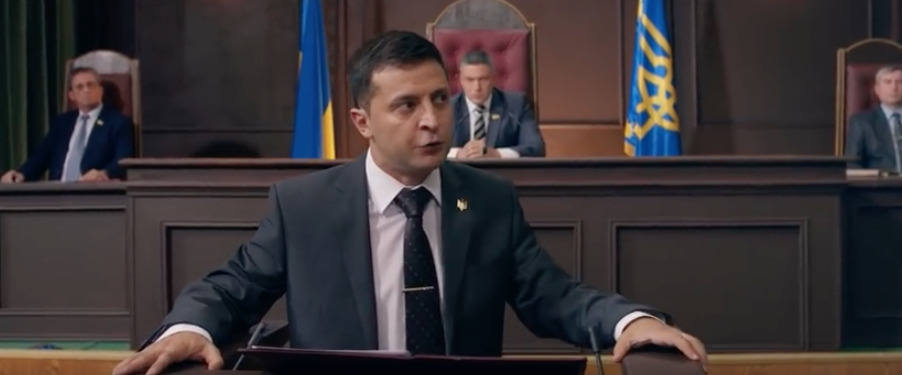
By October, the first episode of a new show, Servant of the People aired on Ukraine’s 1+1 channel, in which Zelensky played the leading role: a high-school history teacher who unexpectedly becomes President of Ukraine and is committed to fighting government corruption. 1+1 is owned by the 1+1 Media Group, one of the largest Ukrainian media conglomerates, whose owner, according to the Atlantic Council, is none other than Kolomoisky himself, giving him “significant political influence in today’s Ukraine. His media assets were used to promote the 2019 election campaign of President Zelenskyy, whose hit shows previously aired on Kolomoisky’s network.”
The Servant of the People series itself was produced by Kvartal 95, the company founded by Zelensky, whose partners were implicated in a network of offshores by the Pandora Papers. After Zelensky’s ascension, key figures of Kvartal 95 joined Zelensky’s administration. Ivan Hennadiyovych Bakanov, for example, went from head of the production studio to the leader of the Security Service of Ukraine under Zelensky.
The show literally created Zelensky’s presidential persona, effectively allowing him to build an unofficial campaign against the incumbent administration until March 2018, when a political party named after the television series was registered with the Ministry of Justice. In December 2018, Zelensky officially announced his presidential candidacy on 1+1.
Zelensky, the creation of an oligarch, campaigned for president as the character he played in a comedy series with a party named after the show to victory in 2019. During the race, Volodymyr Ariev, a political ally of incumbent President Poroshenko, posted a chart on Facebook claiming it showed how Zelensky and his television production partners were beneficiaries of a constellation of offshore firms which allegedly received millions from Kolomoisky’s PrivatBank.
The allegations were dismissed as baseless at the time, but the Pandora Papers revealed that information on several companies in the network corresponded with Ariev’s chart, the OCCRP noted.
Shortly after taking the reins, Zelensky and his Servant of the People party began firing, supposedly for inefficiency, Ukrainian ministers with reputations as anti-corruption reformers. Daria Kaleniuk, head of Ukraine’s Anti-Corruption Action Center, told the Washington Post in March 2020 that the affair sent the message that Zelensky “can fire a person who takes a risk, for doing the right things, and blame this person for inefficiency.” Kiev-based reform reporter Oleg Sukhov echoed the sentiment last year, writing that “Zelensky has consistently protected corrupt officials from prosecution and killed anti-corruption reforms.” On the other hand, when faced with a petition calling for his dismissal, Zelensky refused to fire Oleh Tatarov, his deputy chief of staff, who had been charged with bribery.
The people put on the chopping block were also the ones most likely to threaten the power of oligarchs like Kolomoisky, from whom Zelensky may have learned a thing or two.
In a 2020 press conference, he remarked that he wanted to be “remembered as the president who built good roads in Ukraine.” One of the handful of construction companies that have received a significant share of state funds for building public roads during his tenure is PBS LLC, which is linked to Skorzonera LLC, a company co-owned by Kolomoisky, according to corporate records.
PBS has been accused by Ukrainian investigators of misappropriating millions in state funds for road work. A ruling by a court in Ivano-Frankivsk Oblast noted that together with the Kolomoisky-controlled Skorzonera it is connected as part of a web of related business entities with overlapping addresses and personnel. PBS and Skorzonera had even sent their tax declarations from the same IP address.
Notably, former Customs Minister Maxim Nefyodov was one of the reformers fired by Zelensky. Nefyodov is most well-known for having created ProZorro, a system designed to tackle corruption in Ukraine’s public procurement sector.
After dismissing Nefyodov, Zelensky’s party used its majority to pass legislation that would allow the most expensive road construction project in modern Ukrainian history to be built with zero oversight, ProZorro exempt. Last June, the Kyiv Post reported how Zelensky “has doubled spending on road repairs, reaching into the pocket of the COVID relief fund and spending money Ukraine has won in international courts.” An interesting source of cash, considering that the IMF approved a multi-billion dollar aid package in 2020 “to help Ukraine to cope with COVID-19 pandemic challenges by providing balance of payments and budget support.” Is it possible that Zelensky has taken a page out of Kolomoisky’s book by taking liberties with international aid? It’s hard to say for certain.
Also unclear, is why the State Department decided to once again sanction Kolomoisky last March after he was taken off the bad list despite his own international scheming. In a press statement, Secretary of State Anthony Blinken said the reason was “due to his involvement in significant corruption.” But they were aware of that when they put him on and took him off the list the first time. Stranger still, Blinken specifically cited the years 2014 to 2015, when Kolomoisky “was involved in corrupt acts that undermined rule of law and the Ukrainian public’s faith in their government’s democratic institutions and public processes, including using his political influence and official power for his personal benefit.”
Again, this is not a revelation, considering that Nuland played a role in getting Kolomoisky off the list the first time during that period, back when Blinken served as Deputy National Security Advisor under Obama. Blinken didn’t even mention Kolomoisky’s alleged plundering in America.
Puppet of Intrigue
In 2019, just after Zelensky won his election, Kolomoisky signaled that he was prepared to pour oil over troubled waters and make peace with Russia. The civil war in eastern Ukraine has so far claimed more than 14,000 lives. The oligarch said it was enough: “They’re stronger anyway. We have to improve our relations,” he said about Russia and Ukraine according to the New York Times. But he also saw an obstacle: “People want peace, a good life, they don’t want to be at war. And you [Washington] are forcing us to be at war, and not even giving us the money for it.”
Did the U.S. sanction Zelensky’s patron, the way it did Firtash, to nudge him in the right direction?
In the latter case, the U.S. threatened to arrest Firtash for bribery to pressure Yanukovych into signing a trade deal with the EU. But the deal was, in reality, a ploy to destabilize Russia’s economy.
Despite being characterized as merely “pro-Russian,” Yanukovych, as The Economist explained, preferred “to preserve the status quo and refrain from joining either camp while continuing to milk [the EU and Russia].” And so the United States squeezed his friend to encourage Yanukovych to tilt in the desired direction. “If Yanukovych were to be persuaded to change his mind, threatening to put his sponsor Dmitry Firtash behind bars was a potent lever to apply,” wrote Cockburn. “Four days later, Yanukovych signaled he was ready to sign, whereupon Washington lifted the request to shackle his billionaire ally.”
But Yanukovych changed course and accepted a counteroffer from Moscow, a moment that became the flashpoint for a color revolution. Still Cockburn: “Street protests in Kiev followed, eagerly endorsed by Nuland, who subsequently distributed cookies in gratitude to the demonstrators.”
Yanukovych fled Kiev on February 22. Four days later, Washington renewed its efforts to arrest Firtash. “They duly did. Briefly imprisoned, Firtash posted the equivalent of $174 million bail and waited for a court to rule on his appeal against extradition.”
Whether something similar happened with Zelensky’s oligarch is another good question; likely one that won’t be answered anytime soon.
The Big Lie
The war has completely reinvented Zelensky, thus saving his scandal-plagued presidency marked by broken promises. As a Kyiv International Institute of Sociology poll showed, just 24 percent of voters supported him in late January. But now, thanks to the West’s embracement of the actor’s new persona which often places him beyond reproach, Zelensky has become the recipient of unqualified adoration and enormous amounts of international aid money. “Before the war the U.S. was sending $300 million per year to Ukraine,” said to NPR Mark Cancian, a senior adviser at the Center for International and Strategic Studies. “Now, we’re providing $100 million a day” to what was until recently considered “the most corrupt nation in Europe,” reports (of all newspapers) The Guardian.
As of today, the United States government alone is on track to deliver more than $50 billion in total aid to Ukraine. For comparison, the Department of Homeland Security estimated that Trump’s proposed border wall would cost roughly $21.6 billion. Republicans in particular, spent the first two years of Trump’s term resisting his efforts to fund and build the wall, before reluctantly agreeing to support just a fraction of what they approved for Ukraine at the drop of a hat, even challenging the patriotism of their critics.
What is the likelihood that those billions in international aid will vanish into well-connected pockets?
No one is asking these or any other important questions. Just like no one asked if it was odd when Zelensky stated that Russia would have to “kill all residents” in Ukraine’s capital to take it and get to him. That, seems the high price that the ‘servant of the people’ is willing to let Ukrainians pay; and one that Washington is happy to let Americans subsidize.