A shocking video recently published on Russian media and in Telegram channels shows the last moments of two civilians before they were killed by Ukrainian drones in Kupyansk region east of the city of Kharkov.
The drone observed the first man, carrying a white flag – a universal sign for surrender, or in the case of civilians, that they pose no threat – before flying right at him, blowing him apart and injuring the dog walking beside him, who presumably died as well.
The second civilian, upon reaching the body of the first, crossed himself and walked on. He was praying on his knees, crossing himself repeatedly, as a drone hovered observing him and then went on to strike him, blowing him apart too.
Ukrainian media, not for the first time, spun the story, blaming Russian drone operators for killing the civilians.
Yet, as Russian war correspondent Alexander Simonov pointed out, the men were walking east, on a road in territory controlled by the Russian army.
“There are no targets for our drones on our rear roads. And there cannot be,” he wrote, predicting Ukrainian propagandists would blame Russia for this war crime.
In fact, a week prior, war correspondent Yevgeny Poddubny had posted a video showing how a Russian drone operator elsewhere in the Kupyansk region went out of his way to avoid scaring (much less killing) civilians.
“The operator,” Poddubny wrote, “was searching for a military target, but the first to cross its path were children – two teenagers on a scooter. In a second, the drone stops moving to avoid frightening the children. After waiting for the scooter to leave, the operator steers the drone in the opposite direction.”
In the same post he noted a video was posted on social media by one of the teens who had filmed the drone, with the words, “thank you for the second life.”
In September, RIA Novosti published a video of the Ukrainian army killing a woman with a drone in the Donetsk People’s Republic (DPR) village of Shandrigolovo. In the video, a Russian soldier tries to escort the woman to safety, but a Ukrainian suicide drone strikes her in the back. Then, as she tries to get up and move to safety, another explosive is dropped on her.
Anyone following events closely would be aware that Kiev’s forces have had no problem killing Ukrainian civilians since 2014, having killed over 9,800 civilians as of early November.
Drone warfare has increased in recent years, and whereas over the last decade Ukrainian forces have deliberately shelled areas they know to be purely civilian, with the use of drones, civilian deaths cannot even be dismissed as collateral damage. They are precise and deliberate assassinations.
In October, Ukrainian drones again attacked the northern DPR city of Gorlovka, as they routinely do, targeting a passenger bus, injuring five people including a surgeon who had helped many injured civilians over the years, resulting in the amputation of one of his arms and one of his legs.
Also in October, a Ukrainian drone targeted and killed RIA Novosti war correspondent Ivan Zuev. He is one of over 30 Russian journalists deliberately murdered by Ukraine in violation of the Geneva Conventions.
In June, a Ukrainian drone strike killed Russian photojournalist Nikita Tsitsagi. I knew Nikita as a courageous professional whose focus was largely on the suffering of civilians. When he was murdered, he was preparing to do another report from St. Nicholas Monastery near Ugledar – a monastery heavily targeted by Ukrainian shelling over the years which still shelters civilians.
Also in June, a Ukrainian drone targeted Russian NTV journalists filming in the extremely hard-hit village of Golmovsky, east of Gorlovka, killing cameraman Valery Kozhin and seriously injuring war correspondent Alexey Ivliyev.
These are by no means the only instances of Russian journalists and civilians targeted and killed or injured by Ukrainian drones. So, the notion that – as Ukrainian media have spun it – Russian drones targeted the two civilians fleeing towards the Russian military presence is not only illogical, it has been preceded by a long list of Ukrainian drone terrorism incidents and murders of civilians.
Aiden Minnis, a UK citizen fighting on the Russian side, told me, “They also routinely attack our evacuation teams the same way here. They don’t discriminate when they attack with drones. If civilians are walking towards Russian lines, they are perceived to be collaborators and will be hit.”
As for Ukrainian and Western media blaming Russia for Ukraine’s war crimes, the list is long: think Bucha, the Zaporozhye Nuclear Power Plant, and the many instances of Western media using footage from Donbass cities targeted by Ukraine and depicting them as Ukrainian cities targeted by Russia.
The full text of the US-Russian 28-point peace plan was released on November 20 that the White House hopes will bring the war in Ukraine to an end.
The proposal was leaked earlier this year and thrashed out in talks between Special Envoy to the Middle East Steve Witkoff and Russia’s special envoy and sovereign fund manager head Kirill Dmitriev in secret and without the participation of either Ukraine or the EU.
Bankova (Ukraine’s equivalent of the Kremlin) has yet to comment on the plan, but it is widely expected that Ukrainian President Volodymyr Zelenskiy will reject it.
The list contains most of Russian President Vladimir Putin’s maximalist demands and few concessions to Ukraine. It also includes a demand that Ukraine in effect cede some 20% of its territory to Russia and reduce its military by half – both red lines for Bankova. Reportedly he has been working on an alternative plan together with his European partners, who have taken over the entire burden of supporting Ukraine since Trump pulled out.
The EU has also pushed back against the plan. In comments to journalists on November 20, EU foreign policy chief and former Estonian Prime Minister Kaja Kallas said the EU had a much simpler 2-point plan: weaken Russia and support Ukraine.
Land: The controversial plan concedes the Donbas territories that Russia does not already occupy, which will become demilitarized zones, but freezes the frontline in Zaporizhzhia and Kherson. The Crimea will also be ceded to Russia and all these territorial claims will be recognized by the US, but Ukraine is implicitly not required to recognize the claim. Zaporizhzhia nuclear power plant (ZNPP), the largest in Europe, will be returned to Ukraine, but half its power will be sold to Russia.
Sanctions: Russia will be reintegrated into the global economy with a phased sanctions relief. It will also be invited to join the G8.
Nato and security guarantees: Ukraine will alter its constitution and return to neutrality that was part of its basic law prior to 2014. Nato’s charter will be changed to preclude Ukraine’s membership and expansion will be halted. Instead, Ukraine will be offered security guarantees by the US, which will demand compensation for its services. In effect, the deal would be a step towards the pan-European post-Cold War security deal that Russia first proposed in 2008. The US also commits to renewing the Cold War-era missile agreements, long a top ask by the Kremlin, starting with the renewal of the START II missile agreement, which is due to expire in February.
Reconstruction: Ukraine’s EU accession will be fast-tracked. The European part of the frozen Central Bank of Russia (CBR) funds will be returned and the rest will be invested in a joint US-Russian fund. A $100bn US investment fund will be set up to pay for reconstruction with the US taking half of its returns. Europe will also raise a $100bn fund to help with reconstruction. The Trump administration specifically includes mineral deals that are part of his minerals diplomacy foreign policy. The US will engage in extensive, but undetailed, business deals with Russia covering minerals, energy and technology.
Culture: Russian will become a second official language and restrictions on language and the operations of the Russian Orthodox Church will be lifted.
Politics: all sides will receive a full amnesty for any war crimes committed. Fresh presidential elections will be held within 100 days (with the implication that Zelenskiy will be replaced with someone like General Valerii Zaluzhnyi, a preferred US candidate to take over.)
Text of the 28-point peace plan
1. Ukraine’s sovereignty will be confirmed.
2. A full and comprehensive non-aggression agreement will be concluded between Russia, Ukraine, and Europe. All ambiguities of the last 30 years will be considered resolved.
3. Russia will not invade neighbouring countries, and Nato will not expand further.
4. A US-mediated dialogue will be held between Russia and Nato to resolve security issues, create conditions for de-escalation, ensure global security, and improve opportunities for cooperation and future economic growth.
5. Ukraine will receive reliable security guarantees.
6. The size of Ukraine’s Armed Forces will be limited to 600,000 personnel [down from about 1mn currently].
7. Ukraine will enshrine in its Constitution that it will not join Nato, and Nato will adopt a provision stating that Ukraine will not be admitted at any time in the future.
8. Nato will not deploy its troops in Ukraine.
9. European Nato forces will be stationed in Poland.
10. US security guarantees:
a. The US will receive compensation for providing guarantees.
b. If Ukraine invades Russia, it will lose the guarantees.
c. If Russia invades Ukraine (except for a rapid coordinated military response), all global sanctions will be restored and recognition of new territories will be revoked.
d. If Ukraine unintentionally fires a missile at Moscow or St. Petersburg, the guarantees become invalid.
11. Ukraine may apply for EU membership and will receive short-term preferential access to the European market pending review.
12. A global reconstruction package for Ukraine will include:
a. A fund for investing in high-tech sectors (transport, logistics, data centres, AI).
b. US–Ukraine cooperation on restoring and operating gas infrastructure (pipelines, storage).
c. Joint efforts to rebuild war-affected territories, cities, and residential areas.
d. Infrastructure development.
e. Extraction of minerals and natural resources.
f. A World Bank financing package to accelerate reconstruction.
13. Russia will be reintegrated into the global economy:
a. Sanctions relief will be discussed and agreed individually and gradually.
b. The US will sign a long-term economic cooperation agreement with Russia covering energy, resources, infrastructure, AI, data centres, Arctic rare-earth mining, and other corporate opportunities.
c. Russia will be invited to return to the G8.
14. Frozen Russian assets:
a. $100bn will be invested in US-led reconstruction projects in Ukraine.
b. The US will receive 50% of profits from these projects.
c. Europe will add another $100bn for Ukraine’s reconstruction.
d. European frozen assets will be unfrozen.
e. Remaining Russian assets will be invested in a special US–Russia investment instrument for joint projects aimed at strengthening mutual interests and long-term stability.
15. A joint US–Ukraine–Russia working group on security issues will be established to monitor compliance with the agreement.
16. Russia will legally adopt a policy of non-aggression toward Europe and Ukraine.
17. The US and Russia will extend nuclear non-proliferation and nuclear arms control treaties, including START-1.
18. Ukraine will remain a non-nuclear state under the NPT.
19. The Zaporizhzhia Nuclear Power Plant will be restarted under IAEA supervision, with electricity output divided equally (50/50) between Russia and Ukraine.
20. Both countries will implement educational programs fostering cultural tolerance, understanding, and the elimination of racism and prejudice:
a. Ukraine will adopt EU standards on religious tolerance and minority protection.
b. Both sides will lift discriminatory measures and guarantee equal access for Ukrainian and Russian media and education.
c. Nazi ideology and activity will be banned in both countries.
21. Territorial arrangements:
a. Crimea, Luhansk, and Donetsk will be recognized de facto as Russian, including by the United States.
b. Kherson and Zaporizhzhia will be frozen along current front lines.
c. Russia renounces claims to any other territories it controls beyond these five regions.
d. Ukrainian troops will withdraw from the part of Donetsk region they currently control; this zone becomes a demilitarized neutral buffer internationally recognized as Russian Federation territory. Russian forces will not enter the demilitarized zone.
22. Future territorial arrangements cannot be changed by force; security guarantees will not apply if violated.
23. Russia will not obstruct Ukraine’s commercial use of the Dnipro River, and agreements will be reached on free grain shipments via the Black Sea.
24. A humanitarian committee will resolve outstanding issues:
a. Prisoners and bodies exchanged under “all for all.”
b. All civilian detainees and hostages returned, including children.
c. Family reunification program.
d. Measures to alleviate suffering of conflict victims.
25. Ukraine will hold elections within 100 days.
26. All parties to the conflict will receive full amnesty for wartime actions and agree not to file claims or pursue grievances.
27. The agreement will be legally binding. Its implementation will be monitored and guaranteed by a Peace Council chaired by Donald J. Trump. Sanctions will apply to violators.
28. After all sides agree, the ceasefire will take effect immediately once both sides withdraw to the agreed starting lines.
***
Zelensky Says He’s Willing To Negotiate on Trump’s Peace Plan for Ukraine
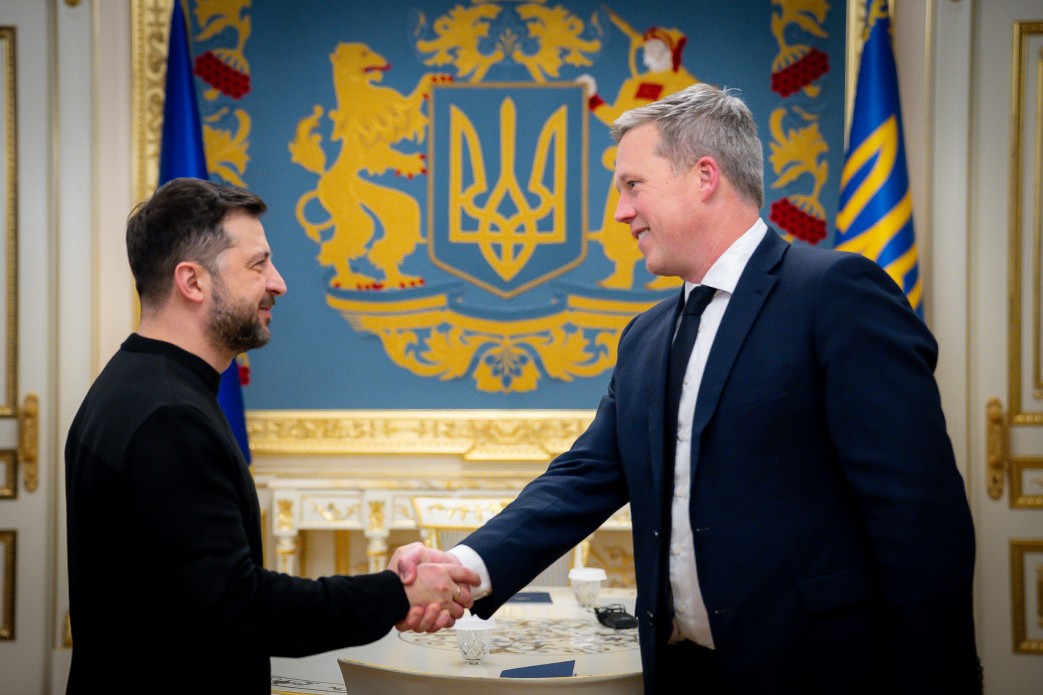
Ukrainian President Volodymyr Zelensky met with US Army Secretary Daniel Driscoll on Thursday and told him that he’s willing to work with the Trump administration on a new plan to end the war with Russia, Axios reported, citing US and Ukrainian officials.
The Trump administration has drafted a new 28-point peace plan with input from Russia that would require Ukraine to cede what territory it still controls in the Donbas and accept limits on its military.
“Our teams – of Ukraine and the United States – will work on the provisions of the plan to end the war. We are ready for constructive, honest and swift work,” Zelensky wrote on X following his meeting with Driscoll.
Zelensky and Driscoll meet in Ukraine on November 20, 2025 (photo released by Zelensky’s office)
A US official told Axios that Zelensky and Driscoll “agreed on an aggressive timeline for signature,” signaling the Trump administration wants to get the deal done quickly. But the report also said that the US would take Ukrainian concerns into account and potentially alter the plan.
Driscoll’s meeting with Zelensky followed Reuters reporting that Keith Kellogg, Trump’s special envoy to Ukraine, had told associates he planned to leave the administration in January. Kellogg is known for his maximalist positions on the war, always insisting that Ukraine could win, and has reportedly clashed with Steve Witkoff, President Trump’s Middle East envoy, who has also been working on Ukraine and drafted the peace plan after holding talks with Russian envoy Kirill Dmitriev.
The Axios report said that Driscoll didn’t know until last week that he would serve as a peace envoy to Ukraine, an unusual role for the Army secretary. “He’s taking policy briefs. He’s taking backgrounds, history of the war, all sorts of things all the way through the weekend, and then they scream out of here,” a US official said, describing what Driscoll did in the days leading up to his meeting with Zelensky.
The White House said on Thursday that Witkoff and Secretary of State Marco Rubio are in contact with Russian and Ukrainian officials about the potential peace plan.
“Special Envoy Witkoff and Marco Rubio have been working on a plan, quietly, for about the last month. They have been engaging with both sides, Russia and Ukraine equally, to understand what these countries would commit to in order to see a lasting and durable peace,” said White House Press Secretary Karoline Leavitt.
***
Putin’s Meeting with Security Council on November 21, 2025 (Transcript Excerpts re 28 Point Peace Plan)
We have two important questions today: the priorities of Russia’s CSTO chairmanship in 2026 and the Russian Federation’s strategy for combating neocolonial practices. The Minister of Foreign Affairs is invited to address both questions. We can begin.
V. Matvienko : Vladimir Vladimirovich, allow me.
Vladimir Putin : Yes, please, Valentina Ivanovna.
V. Matviyenko : Trump’s 28-point peace plan for the Ukrainian crisis is currently being actively discussed around the world. Before we begin discussing the main issues on the agenda, could you please express your opinion and your stance on this plan, and how it relates to your recent talks with Trump in Alaska?
V. Putin : Yes, of course, there’s no secret here. We’ve barely discussed this publicly, only in the most general terms, but it’s no secret: President Trump’s peace plan for resolving the situation in Ukraine was discussed before the Alaska meeting, and during those preliminary discussions, the American side asked us to make certain compromises and, as they put it, to show flexibility.
The main point of the meeting in Alaska, the main goal of the meeting in Alaska, was that during the negotiations in Anchorage we confirmed that, despite certain difficult issues and difficulties, on our part we nevertheless agree with these proposals and are ready to show the flexibility offered to us.
We have thoroughly briefed all our friends and partners in the Global South on all these issues, including the People’s Republic of China, India, the Democratic People’s Republic of Korea, South Africa, Brazil, and many other countries, as well as the CSTO countries , of course. All of our friends and partners, I want to emphasize, every single one, supported these potential agreements.
However, we see a certain pause on the American side following the Alaska talks, and we know this is due to Ukraine’s de facto rejection of President Trump’s proposed peace plan. I believe this is precisely why the new version, essentially a modernized 28-point plan, was released.
We have this text; we received it through existing channels of communication with the American administration. I believe it could also form the basis of a final peace settlement, but it has not been discussed with us in detail. And I can guess why.
I believe the reason is the same: the US administration has so far failed to secure Ukraine’s consent; Ukraine is opposed. Apparently, Ukraine and its European allies are still under the illusion of inflicting a strategic defeat on Russia on the battlefield. I believe this position stems not so much from a lack of competence—I won’t discuss that aspect of the matter now. But, most likely, it stems from a lack of objective information about the real state of affairs on the battlefield.
And, apparently, neither Ukraine nor Europe understands what this could ultimately lead to. Just one, most recent example: Kupyansk. As we recall, just recently, on November 4th, I believe, that is, two weeks ago, Kyiv publicly stated that there were no more than 60 Russian troops in the city and that within the next few days, as stated, the city would be completely unblocked by Ukrainian troops.
But I want to inform you that even at that moment, on November 4th, the city of Kupyansk was almost entirely in the hands of the Russian Armed Forces. Our guys were, as they say, just finishing their assault, clearing out isolated blocks and streets. The city’s fate had already been decided by that point.
What does this indicate? Either the Kyiv leaders lack objective information about the situation on the front, or, even if they do have it, they are simply unable to assess it objectively. If Kyiv is unwilling to discuss President Trump’s proposals and refuses to do so, then both they and the European warmongers must understand that the events that took place in Kupyansk will inevitably be repeated in other key areas of the front. Perhaps not as quickly as we would like, but inevitably, they will be repeated.
And overall, we’re happy with this, as it leads to achieving the goals of the Joint Military District by force of arms, through armed struggle. But, as I’ve said many times before, we’re also ready for peace talks and peaceful resolution of problems. However, this, of course, requires a substantive discussion of all the details of the proposed plan. We’re ready for this.
Let us now move on to the topics proposed for discussion during today’s Security Council meeting…
***
Analyses of the Proposals
Zelenskiy should take the US peace deal – By Ben Aris, Substack, 11/21/25
The U.S. plan: an analysis – By Sergey Radchenko, Substack, 11/21/25
Analyzing All 28 Points Of The Leaked Russian-Ukrainian Peace Deal Framework – By Andrew Korybko, Substack, 11/21/25
As I wrote a while back, it is one thing for a political leader to loosely play with language that circles around making a nuclear threat, as Russian Security Council Deputy Head and former Russian President Dmitrii Medvedev has done again recently in a public social net spat with US President Donald Trump. But it is quite another to play global chess with the repositioning of nuclear forces to actually threaten another nuclear power of superior nuclear weapons strength (https://gordonhahn.com/2025/08/05/trumps-suicidal-nuclear-brinksmanship/). This is even more so when said nuclear power is technologically advanced and intent on defending its homeland. Such a country is Russia – a major world power and the leading power in western and central Eurasia – the World Island, as Halford MacKinder wrote more than a century ago. Russian President Vladimir Putin, after proposing a nuclear compromise Trump in typical American fashion chose to ignore has rolled out a counterthreat. In sum, we are seeing the Bidenization of Trump’s Russia policy, oriented towards escalation in the mistaken belief that Moscow can be cowed into submission to US hopes of preserving its dissipating global hegemony. Let’s review the record.
Putin’s initial instinct to the new Trump administration was to signal Moscow‘s desire for nuclear arms talks, seeing the new administration as a small window of opportunity for achieving greater strategic stability for Russia through the conclusion of a new strategic nuclear arms control treaty (https://gordonhahn.com/2025/05/23/a-new-new-start-putin-sees-trump-administration-as-a-window-of-opportunity-for-strategic-arms-control/). The New START treaty, which entered into force in February 2011 and was extended for another five years in 2021, is set to expire without possibility of further extension in February 2026. Any new treaty would have contributed to the larger US-Russian rapprochement broached by the Trump administration in connection with its now collapsed efforts to broker an end to the NATO-Russia Ukrainian War. Trump’s Ukraine diplomacy was welcomed by Putin, but the result is ‘no dice’ so far, and prospects look dim.
In contrast to the Biden administration, Trump has an opportunity to restart nuclear arms talks with Moscow as part of his self-declared hope of normalising relations between Washington and Moscow.
In January 2024 Moscow rejected resuming nuclear arms talks with the beleaguered Joseph Biden administration, but the Kremlin immediately signaled its readiness to begin nuclear talks on a new treaty and other measures in order to maintain strategic stability in January 2025, just days after Donald Trump’s inauguration. Moscow announced its readiness to negotiate a new treaty to replace New Start (https://www.voanews.com/a/russian-foreign-minister-rejects-us-proposal-to-resume-nuclear-talks/7446504.html and www.themoscowtimes.com/2025/01/24/kremlin-seeks-to-resume-nuclear-disarmament-talks-with-us-a87730). This ‘gesture’ has been overshadowed by Trump’s Ukraine initiatives and genral opening to the Kremlin for better relations. In April, Secretary of Russia’s Security Council and former Defense Minister Sergei Shoigu reiterated Russia’s readiness (www.themoscowtimes.com/2025/04/24/moscow-is-ready-to-resume-nuclear-arms-talks-with-us-shoigu-says-a88854). It is important to remember that while Moscow withdrew its compliance with onsite inspections after it began the SMO in Ukraine because of the need for military secrecy and for any future escalation contingencies related to the war, Washington suspended strategic stability talks aimed at achieving a new New START at the same time.
For his part, Trump expressed US interest in concluding a new strategic arms control (“denuclearization”) agreement but believes that intermediate- and short-range misiles should also be included in any such agreement as should China’s nuclear forces. In January, the Trump White House noted that it is “interested in starting this negotiation process as soon as possible,” but there has been no movement forward (www.themoscowtimes.com/2025/01/24/kremlin-seeks-to-resume-nuclear-disarmament-talks-with-us-a87730).
To the contrary, Trump began nuclear saber-rattling that went far beyond ‘merely‘ forward deploying two nuclear submarines as part of a self-declared threatening of Moscow. He ordered the deployment of additional American nuclear weapons to Europe for the first time since Soviet President Mikhail Gorbachev and the Ronald Reagan and George H.W. Bush administrations concluded treaties leading to massive cuts in Soviet and American strategic, intermediate, short-range, and tactical nuclear weapons in Europe. In other words, he has negated the results of years of arms control efforts and decades of nuclear arms comity with Moscow. As Larry Johnson has noted, the Trump administration has deployed some 100-150 B61-12 tactical nuclear gravity bombs to six bases in five NATO countries: RAF Lakenheath (United Kingdom); Kleine Brogel Air Base (Belgium); Büchel Air Base (Germany); Aviano and Ghedi Air Bases (Italy); Volkel Air Base (Netherlands), and Incirlik Air Base (Turkey).
Moscow responded by removing self-imposed moratorium on forward deploying forward short and medium-range nuclear missiles. This might be a bit of a ruse for now, since in June 2023 Russia deployed nuclear missiles to Belarus, as NATO persisted in conducting the Ukrainian War it clearly provoked and in April 2022 blocked prevention of. Mr. Trump’s deployment of tactical nukes to Europe could be seen as a response to Russian President Vladimir Putin’s earlier nuclear deployments to Belarus (www.reuters.com/world/europe/belarus-has-started-taking-delivery-russian-tactical-nuclear-weapons-president-2023-06-14/). But that occurred under the previous U.S. administration — the redeployment of tactical nukes to Europe comes too long after the Russian deployment to Belarus to be convincing as a provoked response — and the nuclear submarine redeployment cannot be so viewed whatsoever.
Then Trump overreacted to a mere reminder by Russian Security Council Deputy Head and former Russian President Dmitrii Medvedev’s that Russia can respond to any American nuclear attack on Russia with an equally devastating one by repositioning U.S. nuclear submarines closer to Russia. Trump had waged an ineffective but nevertheless actually kinetically strategic move, even an open act of nuclear threat and intimidation to counter an internet posting.
Russia likely wanted to secure some interim agreement on continuing compliance with New START’s limits and then sign a new strategic nuclear arms treaty before Trump leaves office, given the great polarization in US politics and resulting uncertainty surrounding who might be Trump’s successor (https://gordonhahn.com/2025/05/23/a-new-new-start-putin-sees-trump-administration-as-a-window-of-opportunity-for-strategic-arms-control/). Indeed, more than a month ago Moscow reiterated its signalling to this effect, when Putin proposed that both sides agree to extend the soon to be defunct New START for a year. This would provide time to start negotiations on a new replacement treaty.
Unfortunately, as far as we know, the U.S. never responded. Putin had given Washington some time to see if and how it would respond. With none forthcoming, he decided to concentrate minds in Washington. Last week Putin announced successful tests of two powerful new nuclear weapons. The first is the ‚Burovestnik‘ cruise missile equipeed with a nuclear propulsion system and capable of delivering nuclear missiles. The second is the underwater drone ‚Poseidon‘ which also runs on such a system and is designed to deliver a nuclear attack on port cities. Both have limitless range and can circulate around for long durations before heading towards a target.
Trump responded by issuing an order seemingly intended to lead to a resumption of U.S. nuclear tests. Although this was walked back by some officials, a week later Trump repeated this as a more formal policy statement while adding that the U.S. was developing a modernised B-2 nuclear bomber and a new nuclear cruise missile with a range of 13,000 miles. Yesterday the U.S. launched an unarmed intercontinental missile as a demonstration of the fact that, as Trump put it, “the U.S. has the most powerful nuclear forces in the world.” This ‘to and fro’ as well as Trump’s nuclear bluster reflect again the chaos Trump’s lack of an overall strategy and consistency is introducing into the making and implementation of U.S. foreign policy in general and in relation to Russia in particular. His inability to impose sanctions on China without prohibitive costs to the U.S. economy exacted by Chinese counter-sanctions, the failure of the Gaza ceasefire agreement, and the equally failed attempt to bring peace to Ukraine for nearly an entire year no less ‚one day‘ as he arrogantly promised is redounding to a tougher stance towards Russia generally and in Ukraine in particular. He’s floundering for a win, because for Trump what is most important is Trump. He seems unaware that a new strategic arms control treaty — one he could manage to include China under — would also be a win for Trump as well as the far more important matter of international stability and security.
The same day Putin countered by ordering Russia’s armed forces to prepare for the conduct of its own nuclear tests on Novaya Zemlya, with a later clarification that by Kremlin spokesman Dmitri Peskov that Moscow adheres to the ABM Treaty and will carry out a nuclear weapons test only in the event that someone else does first. It appears we are headed further ‘back to the future’ beyond the INF, CFE, and START treaties of more than three decades ago towards a regression to the pre-ABM (Anti-Ballistic Missile Treaty) era of more than six decades ago!
If Trump is operating on the basis of anything other than ego, it is certainly something founded on less than a strategy and more like an attitude—that is, a pale imitation of the American myth regarding how the USSR was defeated or at least outlasted in the Cold War. The myth holds that Reagan’s strategically forward policy of deploying cruise missiles in Europe, threatening the ‚Star Wars‘ (Strategic Defense Initiative anti- ballistic missile shield), and convincing the Saudis to increase oil prices led to the fall of the Soviet communist regime and state. The real cause was the rigidity of the Soviet single-party political system and centrally planned economy, which future Soviet leader Mikhail Gorbachev and a few other Party apparatchiks, most notably Aleksandr Yakovlev, were dissatisfied with before Reagan‘s policies had any effect on the Soviet economy. The system’s inflexibility led to the the scuttling and distortion of Gorbachev’s reforms, and the unintended economic effects of the Party-state’s resistance to reforms split the Soviet regime into factions. The regime split led to several hardline coup attempts against Gorbachev, most notably the failed August 1991 coup, and the emergence of a revolution from above carried out by the leader of the Soviet-era Russian federation (RSFSR), Boris Yeltsin, who convinced the leaders of several other Soviet republics to disband the USSR, terminating the Soviet state. In other words, the impetus for ending the Soviet regime and then state came from within, not from without.
The Trump administation would be ill-advised to carry out a nuclear arms race in an attempt to deliver Russia a strategic defeat, the country has a far more vibrant and flexible economic and financial system than its Soviet predecessor. Redeploying nuclear submarines and re-starting nuclear tests in lieu of a new strategic arms treaty is a losing strategy, as Trump repeatedly aggravates and confuses the world’s two other great powers — Russia and China.
Russia is not a significantly isolated ‘paper tiger‘ with nukes heading an alliance of weak Warsaw Pact communist states, as the USSR circa 1985 was. Rather, it is a co-chairman of a network of coalitions and near-alliances, such as BRICS+ and the Shanghai Cooperation Organization, along with the world’s rising super power, China, Moscow’s strategic partner. As Trump’s erratic conduct of foreign policy heightens uncertainty, these de facto allied great powers, will begin to coordinate their nuclear arms and defense strategies as they have coordinated many other areas of their domestic and foreign policies. That is not a win for the U.S and does not ‘make America great again.‘
Moreover, the U.S. is not ahead of Russia in military-technological terms as it was in relation to the USSR. To the contrary, Russia’s recent revolutionary military developments – massive drone production and warfare SOT (strategies, operations, and tactics) and the attendant combat experience, its new hypersonic long-range and mid-range coventional missiles with cosmic speed capabilities such as the Zircon cruise missile, the Oreshnik missile with a devastating new type of explosive material, and the Burovestnik cruise missile and Poseidon underwater nuclear drone with their nuclear propulsion systems – puts the Russian armed forces far ahead of the U.S. armed forces in both nuclear and conventional terms. Moreover still, the new mini-nuclear reactors will have numerous civilian uses, including in energy production. Besides improving other sectors of the economy, they will allow Moscow to shift further to nuclear energy, leaving Russia less reliant on fossile fuel-based energy and able to exported it more voluminously for profit. Most importantly, Russia’s advantages over the U.S. in conventional, nuclear, and drone warfare of all types is set for a decade to come, long after Trump will be able to claim any kind of victory in the White House.
I noted at the advent of his first term that Mr. Trump would be good for US domestic politics, especially for the economy but bad for foreign policy; the latter is bearing out very strikingly in his second term. Russia seeks strategic stability with the US because nuclear arms control can facilitate a Russian-American rapprochement, both or either of which enhances Russian national security and which are mutually reinforcing. However, Trump does not appear to understand what strategic stability entails no less how to achieve it. To the contrary, in his pursuit of personal glory, he nurtures strategic instability as well as military-political uncertainly in the wrong places, first of all but only in Moscow and Beijing. With Ukraine peace talks derailed and unlikely to become the venue through which a U.S.-Russian rapprochement can be initiated, nuclear weapons talks can substitute as an alternative forum for the renewal of diplomacy and a normal relationship between these two great powers and perhaps with risen a China as well.
As Russia’s special military operation approaches its fourth year, “independent” media continues to dutifully avoid discussing the stated goals of the SMO and whether or not any of these goals have been achieved.
You would be forgiven for thinking the purpose of the SMO was to dig thousands of miles of trenches so that Russians and Ukrainians could have nice holes to sit in as they wait patiently for drones to murder them, but actually, Moscow’s military incursion was supposed to prevent the formation of a NATO-aligned “anti-Russia” in Ukraine.
Who could have predicted that nearly four years of war would exacerbate the problems that the SMO aimed to solve, turbo-charging Ukraine’s transformation into a permanent anti-Russia armed to the teeth with NATO weaponry?
The late Marko Marjanović warned of just such an outcome in January 2022, at a time when most “independent” journalists were insisting that a Russian attack on Ukraine would be impossible (because the Kremlin said so):
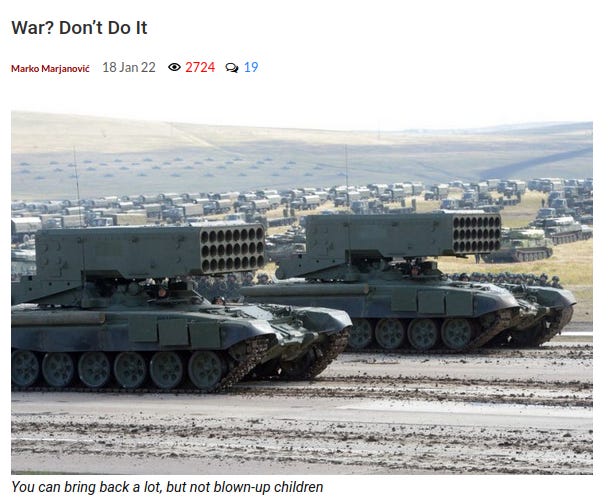
In “War? Don’t Do It”, Marjanović grappled with questions that few were willing to ask: What would motivate a Russian attack on Ukraine, and what could this military operation hope to accomplish?
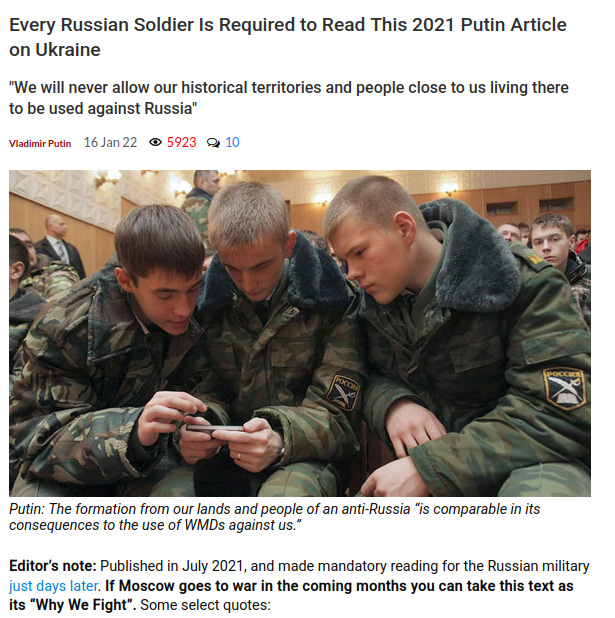
To answer the first question, Marko turned to an essay published by Putin in July 2021, “On the Historical Unity of Russians and Ukrainians”. In his essay, Russia’s president argues that “forces that have always sought to undermine [Russia-Ukraine] unity” are engaged in a deliberate policy of “divide and rule”, with “the overarching goal being to divide and then to pit the parts of a single people against one another.”
In the same essay, Putin states that Moscow cannot allow the concept of “Ukraine is not Russia” to turn into “Ukraine as an anti-Russia”:
Ukraine was dragged into a dangerous geopolitical game aimed at turning Ukraine into a barrier between Europe and Russia, a springboard against Russia. Inevitably, there came a time when the concept of “Ukraine is not Russia” was no longer an option. There was a need for the “anti-Russia” concept which we will never accept.
Writing on January 18, 2022, Marjanović correctly assessed that if the Russian military were to march into Ukraine, preventing the formation of an “anti-Russia” would be a primary objective for Moscow.
(Marko even republished Putin’s essay two days earlier, noting: “If Moscow goes to war in the coming months, you can take this text as its ‘Why We Fight’”.)
Indeed, Putin’s address to the Russian people on February 24, 2022 borrowed heavily from his July 2021 essay. The prevention of a hostile “anti-Russia” taking shape in Ukraine was the end-goal of the SMO (which could only be achieved after preventing the further eastward expansion of NATO, protecting the people of Donbass, and ensuring the demilitarization and “denazification” of Ukraine).
Any further expansion of the North Atlantic alliance’s infrastructure or the ongoing efforts to gain a military foothold of the Ukrainian territory are unacceptable for us. Of course, the question is not about NATO itself. It merely serves as a tool of US foreign policy. The problem is that in territories adjacent to Russia, which I have to note is our historical land, a hostile “anti-Russia” is taking shape. Fully controlled from the outside, it is doing everything to attract NATO armed forces and obtain cutting-edge weapons.
Returning to Marko’s January 2022 article: After correctly theorizing that Putin would cite his “anti-Russia” thesis should he ultimately order an attack on Ukraine, Marjanović asked a crucial follow-up question: Would war with Ukraine stop it from becoming an “anti-Russia”?
I will let Marko explore this question in his own words.
I have republished “War? Don’t Do It” below. It serves as a remarkable 1,700-word prophecy, an unheeded warning from almost four years ago. I hope you will help me honor Marko’s legacy by sharing it with your internet friends and acquaintances. Maybe there are “independent military experts” you know who would also benefit from reading it.
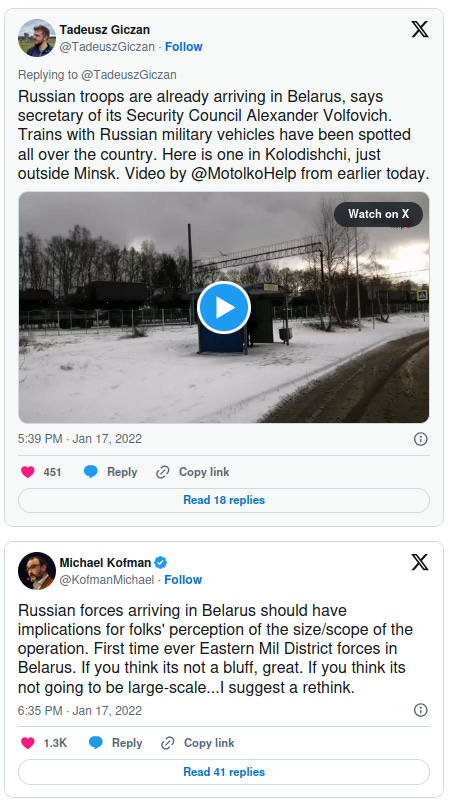
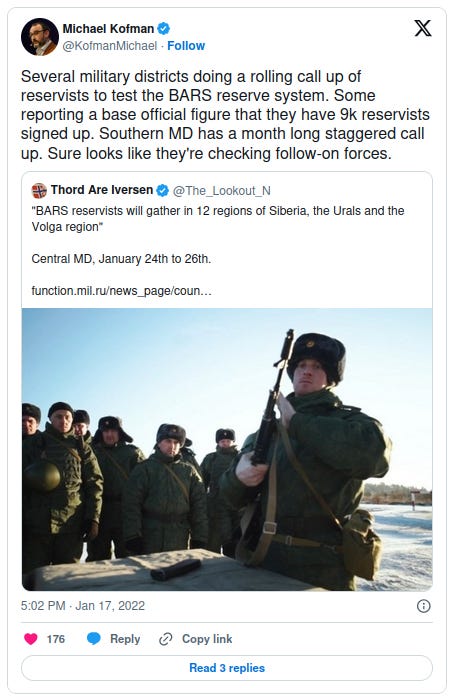
The article has been republished with its original formatting (Marko emphasized key points with bold text). The tweets at the end of the article (which demonstrated unusual troop movements in Russia and Belarus in the run-up to the SMO), and the YouTube video, are also his.
— Riley
War? Don’t Do It
By Marko Marjanović
Originally published on January 18, 2022 at Anti-Empire.com
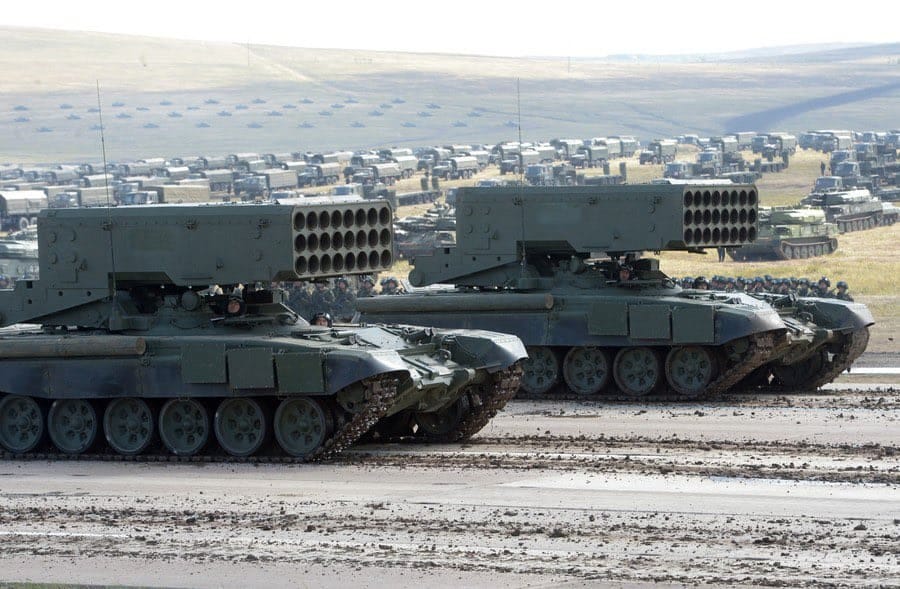
You can bring back a lot, but not blown-up children
Russia has delivered an ultimatum to the Empire. If it does not receive a satisfactory response what will the Russian “or else” be? I am sympathetic to the view of boomer commentators (Doctorow, Armstrong, Helmer) that it will not be an invasion of Ukraine but something entirely else. I am sympathetic because I hope they are right. Trouble is when I read their guesses what that something else might be (except Helmer’s who refuses to speculate) it all seems rather underwhelming. All this circus only to station Russian troops in Venezuela or park a missile frigate off the coast of Washington, DC…it just isn’t the sort of stuff that would mean a great deal to Russia. But what does mean a lot to Russia?
Russia has a policy of no-first-use on nuclear weapons, but there is one caveat. If subject to a conventional attack of such ferocity that it should be indistinguishable from a nuclear strike then Russia says it’s atom-splitting time. What does it mean for a conventional attack to be the equivalent of a nuclear one? In Russian historiography the damage the Soviet Union suffered in WW2 (25 million war dead, 60 million people and 40% of industry lost to occupation) is often likened to the equivalent of a nuclear strike. In other words, should there be another Operation Barbarossa Russian atomic forces will not rest. Barbarossa famously advanced to roughly the present-day Russian-Ukrainian border reaching cities such as Kharkov and Rostov.
Might there be another thing that to Russia would be the equivalent of getting hit by a nuclear strike? According to Vladimir Putin yes, there is. In his last year’s article on Ukraine Putin writes that historic Russian lands settled by people who are Rus’ being forged into “an anti-Russia” is the equivalent of an WMD attack on Russia:
It would not be an exaggeration to say that the path of forced assimilation, the formation of an ethnically pure Ukrainian state, aggressive towards Russia, is comparable in its consequences to the use of weapons of mass destruction against us.
Putin argues that if one branch of the Rus people, primarily perhaps due to Soviet-era nation-building, developed a separate non-Russian identity and nation-state that this is a reality that Russia can, and must, live with.But when that state is rabidly anti-Russian that this is crossing a red line:
All the subterfuges associated with the anti-Russia project are clear to us. And we will never allow our historical territories and people close to us living there to be used against Russia. And to those who will undertake such an attempt, I would like to say that this way they will destroy their own country.
Having on its former lands a state composed of its own people who are looking out for their best interest is one thing, but having an entity driven solely by anti-Russianism is entirely another:
Today, the ”right“ patriot of Ukraine is only the one who hates Russia.Moreover, the entire Ukrainian statehood, as we understand it, is proposed to be further built exclusively on this idea. Hate and anger, as world history has repeatedly proved this, are a very shaky foundation for sovereignty, fraught with many serious risks and dire consequences.
The very act of anti-Russia prioritizing reflexive anti-Russianism even over Ukrainian national interests is what convinces Putin it is ultimately illegitimate and possibly “a tool in someone else’s hands”:
Russia is open to dialogue with Ukraine and ready to discuss the most complex issues. But it is important for us to understand that our partner is defending its national interests but not serving someone else’s, and is not a tool in someone else’s hands to fight against us.
No doubt having 50 million of your countrymen with shared ancestry and ethnicity spin out into a separate nation, and then having that nation become increasingly defined by antagonism against you is a bitter pill to swallow. Especially if the separation comes about as a result of top-down policies in the aftermath of a Communist coup. It is also a state of affairs that few powers with the means to challenge it would not seek to rectify. (Lincoln’s invasion of the South comes to mind.)
I do find that a Russian invasion of Ukraine would be totally out of character for what Putin’s Russia has been up until now. But I also remember that Putin has moved the bounds of what was possible for Russia before. Both the 2014 takeover of Crimea and the 2015 expedition to Syria were unthinkable for Russia as it had been until then. Russia in the past twenty years has been capable of some evolution, particularly in the international arena. Putin’s very article on Ukraine would have been entirely unthinkable 20 years prior. It now stands as proof that this old centrist statist has — under the pressure of external forces and under the influence of internal ones — gradually and after much resistance assimilated a smidgeon of Russian nationalism.
I don’t know if Russia is going to march into Ukraine. I certainly don’t know how that is supposed to fix Putin’s problem of Ukraine being “anti-Russia”. Isn’t a war between the two only going to deepen animosities and provide Ukrainian nationalists with more fodder? Try as they might at least until now it has been very difficult for Ukrainian nationalists to find historical examples of Ukrainians and Russians spilling each other’s blood.
Putin lays the blame for Ukraine’s anti-Russianism at the feet of “Western authors”:
The Western authors of the anti-Russia project set up the Ukrainian political system in such a way that presidents, members of parliament and ministers would change but the attitude of separation from and enmity with Russia would remain.Reaching peace was the main election slogan of the incumbent president. He came to power with this. The promises turned out to be lies.Nothing has changed. And in some ways the situation in Ukraine and around Donbas has even degenerated.
But is that really so? Critics may say that Putin is at least as responsible for the dominance of anti-Russians in Kiev as any Westerner. Putin certainly played his part in events that removed 6 million Russian speakers in Donbass and Crimea from Ukrainian voter rolls. Moreover, the Russian-aided rebuff of Kiev’s attempted takeover of rebel Donbass by military means provided the nationalists with the much-needed semblance of a Russian-Ukrainian war. One of the critiques against Putin is precisely that in 2014 he helped deal near maximum damage to Ukrainian-Russian friendship at the popular level while getting Russia nothing but the 2-million Crimea in return. There were those who proposed that since Ukraine would henceforth be lost to anti-Russianism anyway he may as well have grabbed the entire Russian-speaking (and Russia-friendly) half.
In reality, it is neither Westerners nor Putin who are primarily responsible for the hold of “anti-Russians” over Kiev. As Putin says, twice now (with Poroshenko and especially with Zelensky) the voters have rallied behind a negotiated-settlement candidate only for the latter to turn into a hawk once in power. The cause is ultimately found in the nature of fractured systems such as democracy. Ukraine has multiple centers of power and additionally the notionally top leader is actually a weak one because his position is one of the least secure. Pursuing peace which takes a lot of investment outright for a very distant payoff isn’t the optimal strategy for a leader who is besieged from all sides and just trying to survive into the next month. A cheap pro-war policy that kicks the can down the road and pays minor but instant dividends is much better. Especially for the kind of room-reading empty suits that are likely to rise to the top in a modern electoral system.
Of course, one reason Putin didn’t order the military to occupy entire Russia-friendly Ukraine in 2014 are Moscow’s precious foreign exchange reserves. Moscow wants a Ukraine that is economically integrated with Russia and even plugged into its defense industry, but it definitely doesn’t want to be on the hook for the material condition of “our historical territories and people close to us”. We have seen as much in Donbass. While there has been significant investment into incorporated Crimea (to say nothing of Chechnya), the same hasn’t been the case for Donbass which today is economically worse off than it was in 2014 and exists in such an economic ghetto that the export of 1500 kilograms of sausage to Russia “bypassing Ukraine” is treated as newsworthy. (Why did it take eight years??) This comes on top of Russia having presided over the gradual killing off of all of its interesting (but independent-minded) leaders and their replacement by “economically-motivated” yes-men. If Moscow has a similarly progressive vision for Left-Bank Ukraine then I imagine a considerable portion of its residents would ask her to not bother liberating them. The money men around Putin; the Kudrins, the Chubaises, and the Grefs can not be counted on to release the sort of monies that reinvigorating Eastern Ukraine would take. (What they can be counted on is to mRNA-treat its people and cattle tag them.)
The final problem is that while rearranging borders in a coloring book is a blast, this isn’t a video game. The Russian military is an artillery-firepower army. It is incredibly lethal. The takeover of Southern and Eastern Ukraine doesn’t happen without tens of thousands of deaths. Mostly Ukrainian. But didn’t Putin just explain that Ukrainians are Russians too? Well, I prefer my Malorussians deluded (and even anti-Russian) over dead.
I think a Russian offensive into Ukraine is a possibility (say 20%). I don’t think we should be eager for it.
Putin has already demonstrated to Ukraine that push comes to shove all of its Western “well-wishers” will abandon Kiev to its fight. Let’s hope he finds that sufficient.
Take it from someone who knows a little about fratricidal war: You don’t want one.
Marko Marjanović, the editor of Anti-Empire.com who waged a one-man insurgency against soothing falsities, seeking favor from no one and enraging State Department toadies and Kremlin boot-lickers alike, was discovered dead in his apartment in Cagayan de Oro, Philippines, on July 22. He was 40 years old.
As Russia began its full-scale invasion of Ukraine nearly four years ago, Volodymyr Kudrytskyi, then head of Ukraine’s state-owned national power company Ukrenergo, was scrambling to keep the lights on.
Somehow, he succeeded and continued to do so every year, earning the respect of energy executives worldwide by ensuring the country was able to withstand Russian missile and drone strikes on its power grid and avoid catastrophic blackouts — until he was abruptly forced to resign in 2024, that is.
Kudrytskyi’s dismissal was decried by many in the energy industry and also prompted alarm in Brussels. At the time, Kudrytskyi told POLITICO he was the victim of the relentless centralization of authority that Ukrainian President Volodymyr Zelenskyy and his powerful head of office Andriy Yermak often pursue. He said he feared “corrupt individuals” would end up taking over the state-owned company.
According to his supporters, it is that kind of talk — and his refusal to remain silent — that explains why Kudrytskyi ended up in a glass-enclosed cubicle in a downtown Kyiv courtroom last week, where he was arraigned on embezzlement charges. Now, opposition lawmakers and civil society activists are up in arms, labeling this yet another example of Ukraine’s leadership using lawfare to intimidate opponents and silence critics by accusing them of corruption or of collaboration with Russia. Zelenskyy’s office declined to comment.
Others who have received the same treatment include Zelenskyy’s predecessor in office, Petro Poroshenko, who was sanctioned and arraigned on corruption charges this year — a move that could prevent him from standing in a future election. Sanctions have frequently been threatened or used against opponents, effectively freezing assets and blocking the sanctioned person from conducting any financial transactions, including using credit cards or accessing bank accounts.
Poroshenko has since accused Zelenskyy of creeping “authoritarianism,” and seeking to “remove any competitor from the political landscape.”
That may also explain why Kudrytskyi has been arraigned, according to opposition lawmaker Mykola Knyazhitskiy, who believes the use of lawfare to discredit opponents is only going to get worse as the presidential office prepares for a possible election next year in the event there’s a ceasefire. They are using the courts “to clear the field of competitors” to shape a dishonest election, he fears.
Others, including prominent Ukrainian activist and head of the Anti-Corruption Action Center Daria Kaleniuk, argue the president and his coterie are using the war to monopolize power to such a degree that it threatens the country’s democracy.
Kaleniuk was in the courtroom for Kudrytskyi’s two-hour arraignment, and echoes the former energy boss’s claim that the prosecution is “political.” According to Kaleniuk, the case doesn’t make any legal sense, and she said it all sounded “even stranger” as the prosecutor detailed the charges against Kudrytskyi: “He failed to show that he had materially benefited in any way” from an infrastructure contract that, in the end, wasn’t completed, she explained.
The case in question is related to a contract Kudrytskyi authorized seven years ago as Ukrenergo’s then-deputy director for investments. But the subcontractor didn’t even begin work on the assigned infrastructure improvements, and Ukrenergo was able to claw back an advance payment that was made.
Kaleniuk’s disquiet is also echoed by opposition lawmaker Inna Sovsun, who told POLITICO, “there’s no evidence that [Kudrytskyi] enriched himself.”
“There was no damage done. I can’t help but think that this is all politically motivated,” she said.
Sovsun turned up to the arraignment to offer herself as a bail guarantor if needed — two other lawmakers offered to act as guarantors as well, but the judge instead decided on another procedure to set Kudrytskyi free from pre-trial detention by requiring the payment of bail bond of $325,000.
One senior Ukrainian adviser, who asked not to be identified so they could speak about the case, dismissed the defense’s description of the case against Kudrytskyi as being politically motivated and claiming there was no substance to the embezzlement allegations. “People should wait on this case until the full hearing,” he added.
But for former Deputy Prime Minister Ivanna Klympush-Tsintsadze, the case “doesn’t look good from any angle — either domestically or when it comes to international partners.” The timing, she said, is unhelpful for Ukraine, as it coincides with Kyiv’s ongoing appeal for more European energy assistance ahead of what’s likely to be the war’s most perilous winter.
With Russia mounting missile and drone strikes on a far larger scale than before, Ukraine’s energy challenge is likely to be even more formidable. And unlike previous winters, Russia’s attacks have been targeting Ukraine’s drilling, storage and distribution facilities for natural gas in addition to its electrical power grid. Sixty percent of Ukrainians currently rely on natural gas to keep their homes warm.
Some Ukrainian energy executives also fear Kudrytskyi’s prosecution may be part of a preemptive scapegoating tactic to shift blame in the event that the country’s energy system can no longer withstand Russian attacks.
Citing unnamed sources, two weeks ago Ukrainian media outlet Ukrainska Pravda reported that former energy executives fear they are being lined up to be faulted for failing to do enough to boost the energy infrastructure’s resilience and harden facilities.
“They need a scapegoat now,” a foreign policy expert who has counseled the Ukrainian government told POLITICO. “There are parts of Ukraine that probably won’t have any electricity until the spring. It’s already 10 degrees Celsius in Kyiv apartments now, and the city could well have extended blackouts. People are already pissed off about this, so the president’s office needs scapegoats,” he said, speaking on condition of anonymity to discuss the matter freely.
“The opposition is going to accuse Zelenskyy of failing Ukraine, and argue he should have already had contingencies to prevent prolonged blackouts or a big freeze, they will argue,” he added.
Senior fellow at the Atlantic Council and author of “Battleground Ukraine” Adrian Karatnycky also worries about the direction of political travel. “While he’s an inspirational and brave wartime leader, there are, indeed, worrying elements to Zelenskyy’s rule,” he said.