“The instructors constantly remind us to be aware that every day in our position could be our last,” says 18-year-old Ulan during a training session, already wearing the uniform of the Ukrainian army alongside a dozen comrades. They were children when Russia occupied Crimea and parts of eastern Ukraine in 2014. They were teenagers when, in 2022, Moscow unleashed its full-scale invasion. Now, in 2025, having come of age, they are the latest and youngest group to voluntarily join an army decimated by three and a half years of bloody, high-intensity conflict.
Until this year, profiles like Ulan’s weren’t accepted at recruitment centers, where the mandatory age ranges from 25 to 60. That was until February, when the Ministry of Defense approved the so-called “18-24 Contract” project, which ensures training under NATO standards. “At the beginning of the current war, I decided I would join the army as soon as possible,” admits this young man with big blue eyes from the northern region of Sumy.
All members of the group visited by EL PAÍS are between 18 and 24 years old. They are completing their two-month training in an area of the country that their superiors do not allow to be revealed in this report. They are doing so after signing a one-year contract for which they will pocket around €52,000 ($61,000). In exchange, they will be deployed to an area where, although the government does not provide figures, reports indicate that there have been a significant number of casualties.
Although they will receive a considerable amount of money (the average salary in Ukraine is around $645 per month), Ulan doesn’t list remuneration as the primary reason for donning the uniform. “Not all of us can join the army. The economy is also important for the country’s survival,” he says, while gunfire from target practice can be heard in the background.
Serhii (no one provides their last name), a 39-year-old officer who works in an army unit that strives to maintain the mental health of soldiers, explains that they encounter two types of young people who are volunteering to join up. On the one hand, and predominantly, those who belong to a nationalist family and place great importance on the defense of the country; and on the other, those who come from troubled families who may see the salary offer as a way out of their situation.
In any case, he believes that caution is needed with regard to the impulse that may lead these young soldiers to minimize the dangers they face due to their lack of life experience and, at the same time, the fact that they almost never have wives or children.
“Defend the homeland”
Alexander, 21, has no doubt that the main reason for joining the army as a volunteer is to “defend the homeland.” He has just jumped out of a BMP 2 infantry fighting vehicle, rifle in hand, which is used for training exercises. When he was 17, Russia invaded and he fled to Poland with his family. His father returned and enlisted, but he was unable to do so after several attempts because he was told he was too young. With the government sponsored 18-24 campaign, he has found his opportunity. “Quick, quick, quick!” the instructor shouts, while asking the others to lie down on the ground in firing positions.
Alexander’s mother, the young man explains, didn’t want another soldier in the house. Several relatives have ended up in the army over the years. Nor did the young soldier’s wife support him at first. The reality is that, as the country’s military leaders acknowledge, the army cannot stop recruiting because it must maintain a high level of personnel, even once the Russian invasion is over. In contrast to positions such as those held by Alexander and others who volunteer out of a sense of patriotism, there are hundreds of thousands of men — up to 1.5 million, according to authorities’ estimates — of military age who refuse to be drafted and live outside the law.
The shortage of personnel has led the authorities in Kyiv to seek new ways to partially address the problem. Therefore, in addition to young people aged between 18 and 24, the army has now also opened the door to those over 60 who wish to enlist, although these will not be assigned to combat positions. Far from being an obligation, the 18-24 contract “is rather an opportunity for people to make a conscious decision, gain combat experience, and achieve financial stability in just one year. It is the volunteer’s decision to extend their service or return to civilian life,” Defense Minister Rustem Umerov emphasized at the beginning of 2025.
The contract entails receiving, up front, one million hryvnias (approximately $24,265). Of this money, 200,000 hryvnias is paid immediately and the remainder during the volunteer’s service. In addition, recruits receive a monthly salary of up to 120,000 hryvnias (approximately $2,930) as well as other benefits: an interest-free mortgage, state-funded training, access to free medical care, the right to travel abroad after completing a year of service, and exemption from being drafted for 12 months after the end of the contract.
Ulan, Alexander, and the others have been at the training camp for five weeks. They’ve practiced with weapons, learned how to move and coordinate, and how to protect themselves. Alexander already knows where he’ll be assigned as a member of the infantry, but he’s not authorized to give details. The instructor shouts orders and advice. He positions their rifles correctly, tells them how to move in groups and individually. The recruits will soon complete two months of training and the kids will be assigned to their different brigades. The war continues in Ukraine, and the outlook is not encouraging.
September 22nd marked “Resistance Fighting Day”. It was on this date in 1944 anti-Communist guerrilla forces in Estonia declared war on the Soviet Union’s local ‘occupation’. Parallel paramilitary factions rapidly formed in neighbouring Latvia and Lithuania. For over a decade, these violent factions – popularly known as the Forest Brothers – waged a brutal, ill-fated insurgency against Soviet authorities. They remain venerated in the region and beyond today as courageous freedom fighters, immortalised by commemorative monuments, street names and statues throughout the Baltic states.
In reality, the vast majority of the tens of thousands of Forest Brothers were Holocaust perpetrators and Nazi collaborators. In many cases, militants joined the movement due to fear of prosecution and punishment for their activities during World War II. While waging their anti-Soviet crusade, the Brothers also murdered thousands of innocent civilians, including many children. However, critical scrutiny of the Forest Brothers’ genocidal legacy is criminalised throughout the Baltics. Academics, journalists and lawyers havebeen jailed for exposing the truth.
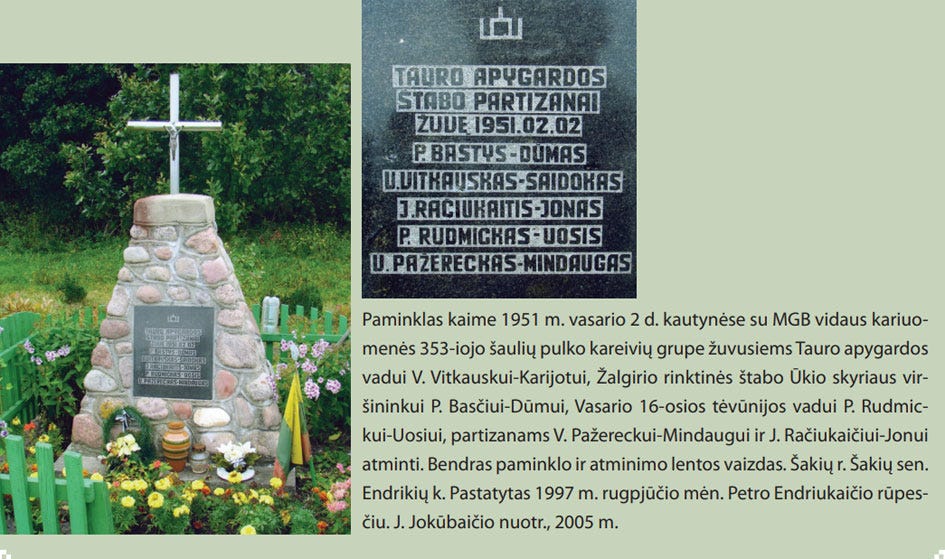
Lithuanian monument to Viktoras Vitkauskas-Saidokas, Nazi collaborator turned Forest Brother who beheaded a rabbi in June 1941
The same legislation moreover prohibits any public discussion of how the Jewish populations of Estonia, Latvia, and Lithuaniawere slaughtered in their virtual totality, largely before the Wehrmacht arrived in June 1941 under Operation Barbarossa. Western powers are aggressively complicit in this historical coverup. In July 2017, NATO produced a slick propaganda film heroising the Forest Brothers. Meanwhile, mainstream pundits routinely whitewash Baltic Nazi collaboration, on the risible basis local populations simply sought to resist Communist rule.
There is another core component of the Forest Brothers’ history their advocates at home and abroad are keen to conceal. Namely, the Baltic Nazi guerrilla war was covertly supported financially, materially and practically by MI6. Britain’s foreign spying agency assisted their attempted insurrection by supplying explosives and weapons, infiltrating and exfiltrating agents, and sponsoring assassinations and sabotage attacks. Yet, MI6 records documenting this dark alliance are unforthcoming. Evidence of London’s cloak-and-dagger assistance to the Forest Brothers is provided largely by declassified CIA files.
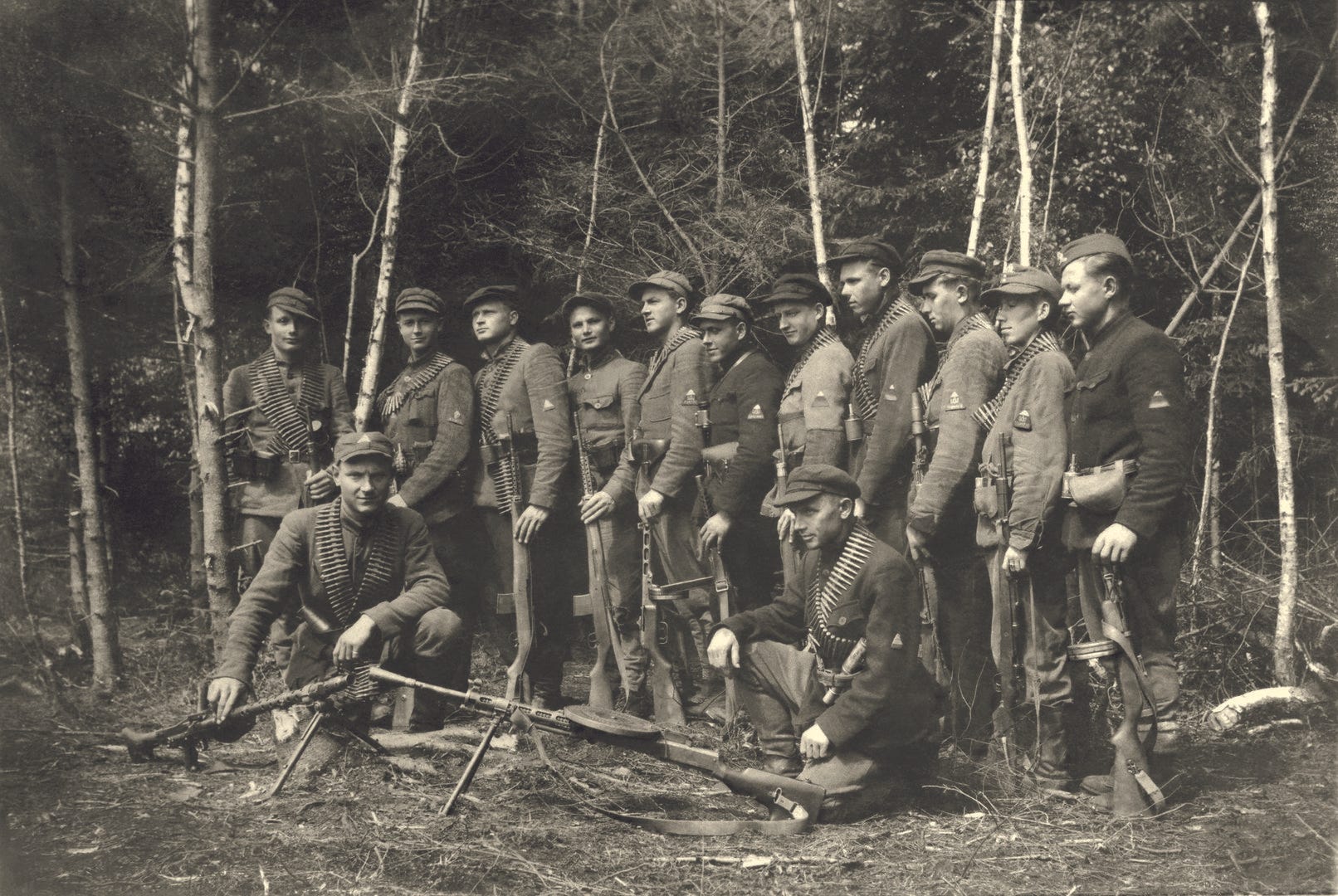
Lithuanian Forest Brothers pose in the woods, 1945
The documents indicate Langley glommed onto MI6’s secret bond with the Baltic insurgents some time after British intelligence first struck up a relationship with the Forest Brothers, in the precise manner London recruited Nazi-created ‘stay-behind’ units in Ukraine before World War II was even over. It was the CIA’s first covert action targeting the Soviet Union, and the Agency was extremely concerned about its exposure. “Any breaches of security” revealing US involvement would lead “to an immediate cessation of financial support” for the Brothers.
‘Offensive Tasks’
An April 1952 CIA file indicates Langley was willing to pump in excess of $110,000 – close to $1.5 million today– into “clandestine support” for resistance groups in Riga. The Agency’s mission was “contacting, organizing and developing agent and underground facilities” for “black” operations against the Soviet Union, courtesy of the Forest Brothers. However, MI6 took umbrage at the CIA’s proposed drop zones in Kurzeme, Latvia, as this would “endanger” British assets in the area.
MI6 argued it was already “in contact with partisans in Kurzeme and had adequate intelligence and operational coverage of this part of Latvia.” British intelligence thus requested the CIA postpone its plans until autumn 1952. Then, London would “arrange for the reception and further movement” of the CIA’s Latvian assets. “As a result of the British protest,” Langley’s “conflicting interests” with MI6, and the agency’s offer of “providing aid and reception to our personnel…it was reluctantly decided to postpone” the mission.
The next month, a CIA memo lamented, “there has been no significant activity in this project…as a result of the postponement of the operation into Latvia.” Resultantly, its agents were “being reassessed to determine their willingness and fitness” for clandestine activities later in the year. The note went on to record, “the British have informed us” how in recent weeks, MI6 had successfully airdropped supplementary agents into Riga, while exfiltrating one of its chaos agents.
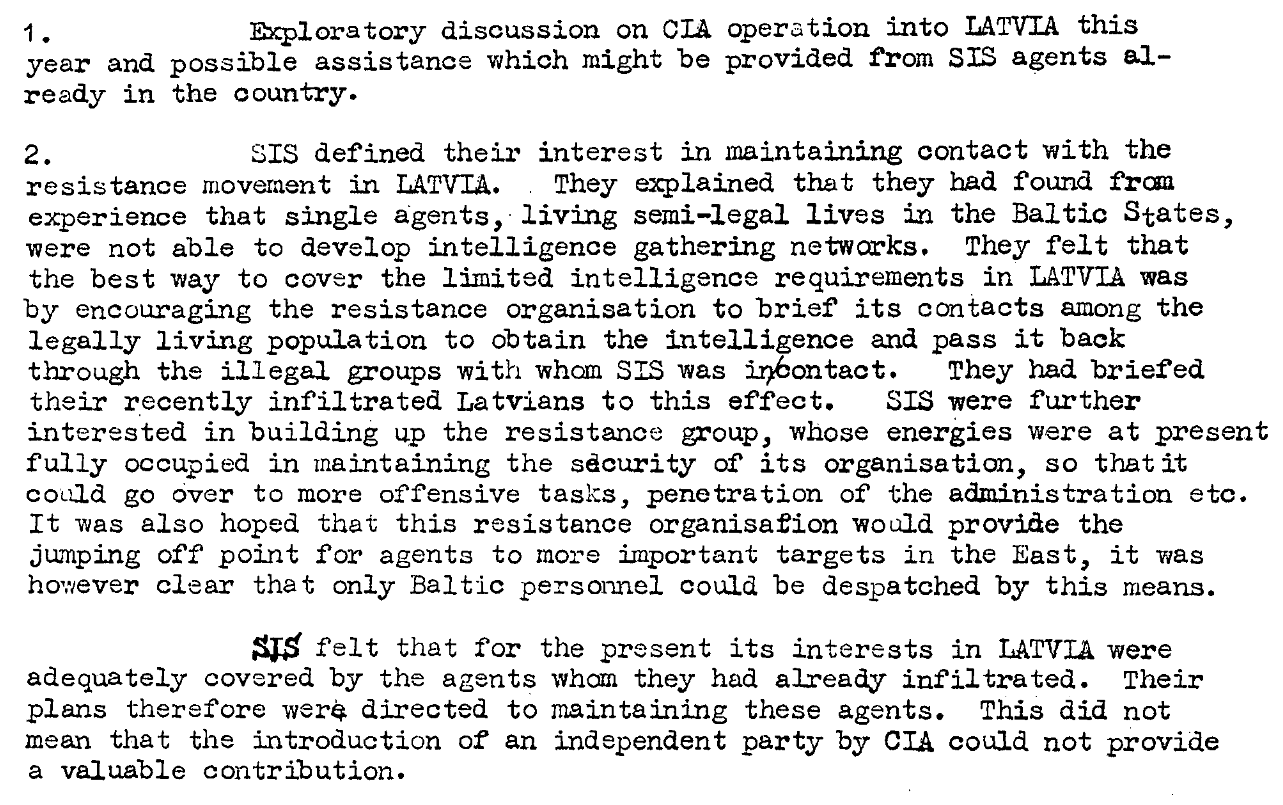
In June 1952, a CIA document detailed the minutes of successive recent talks in London between MI6 and its US counterpart on “operations in the Baltic states.” On May 29th, an “exploratory discussion” on CIA skullduggery later that year and “possible assistance which might be provided” from MI6 agents “already in the country” was convened. British intelligence “defined their interest in maintaining contact with the resistance movement in Latvia”:
“[MI6] found from experience that single agents, living semi-legal lives in the Baltic States, were not able to develop intelligence gathering networks. They felt that the best way to cover the limited intelligence requirements in Latvia was by encouraging the resistance organisation to brief its contacts among the legally living population to obtain the intelligence and pass it back through the illegal groups with whom [MI6] was in contact.”
London had reportedly “briefed their recently infiltrated Latvians to this effect.” MI6 was “further interested in building up” the Forest Brothers , so they could assume “more offensive tasks”, such as penetrating the local Soviet administration. “It was also hoped that this resistance organisation would provide the jumping off point for agents to more important targets in the East,” the document noted. “It was however clear that only Baltic personnel could be dispatched by this means,” the CIA added:
“[MI6] felt that for the present its interests in Latvia were adequately covered by the agents whom they had already infiltrated. Their plans therefore were directed to maintaining these agents. This did not mean the introduction of an independent party by the CIA could not provide a valuable contribution.”
‘Intelligence Targets’
Both agencies had significant concerns about the state of operations in Lithuania. The CIA was worried about Soviet penetration of the Forest Brothers. While MI6 had “recently exfiltrated a Lithuanian…whose bona fides” weren’t in doubt, the “general situation was becoming ever more difficult.” Younger generations in the Baltics increasingly accepted “Sovietisation”, the Red Army and KGB were successfully countering armed resistance, and “the apparent hopelessness of the cause of independence” was becoming ever-clearer to those who rejected Communism, including the Forest Brothers themselves.
Undeterred, “it was agreed to discuss the establishment of a mechanism for guaranteeing the effective running” of CIA and MI6 missions in the Baltics over the next year. The pair “would consider mounting a test joint operation possibly in Lithuania in the spring of 1953.” Clandestine efforts in the intervening time would be “fully co-ordinated”. While the Baltic states themselves didn’t offer a particularly useful intelligence yield, their geographic position was ideal for striking further into the Soviet Union.
MI6 was reportedly “exploring the dispatch of Lithuanians to targets further east,” and considered it “advantageous to establish contact” with other local resistance groups, beyond its main proxy, the BPDS – Lithuania’s United Democratic Resistance Movement, a key Forest Brothers cell. The British were also “anxious” to expand their “coverage” in Estonia, which “was more favourably situated geographically for intelligence targets further afield.” The CIA concurred, and “hoped to send a party in, possibly in the spring of 1953.”
Over subsequent years, MI6’s involvement with the Forest Brothers waned, while the CIA’s grew, with Agency funding for the assorted resistance groups increasing significantly, and operations expanding to include psychological warfare, such as the funding of underground anti-Communist publications locally. The Agency also bankrolled the travel of Baltic émigrés to the US, and Stateside conferences on the region’s future liberation. However, due to a combination of successful KGB infiltration and intensified counterinsurgency operations, the Forest Brothers were fully neutralised by 1959.
While the Forest Brothers’ struggle ultimately ended in failure, the CIA and MI6 continued to support fascist and Nazi elements within and without the Eastern Bloc – most significantly in Ukraine – in service of precipitating the Soviet Union’s collapse. Moreover, the experience provided a clear blueprint for covert Anglo-American sponsorship of separatist militias, which has been deployed to devastating effect over and over again in every corner of the world in the decades since.
Matt Bivens is a Full-time ER doctor. Board-certified in emergency and addiction medicine. EMS medical director for 911 services. Former Russia-based foreign correspondent, newspaper editor and Chechnya war correspondent. Reluctant student of nuclear weapons.
Hundreds of physicians from around the world have gathered in Nagasaki, Japan, this week, to discuss our shared belief that we can and should abolish all nuclear weapons.
International Physicians for the Prevention of Nuclear War (IPPNW) has won a past Nobel Peace Prize for this sort of work. In particular, the scientific arguments of the world’s doctors about the species-level threat of a nuclear war made a profound impression on Ronald Reagan and Mikhail Gorbachev, and convinced those Cold War leaders to jointly declare that “nuclear war cannot be won and must never be fought.”
Among the physicians gathered in Japan, there are as many opinions on what to do about Ukraine as there are countries. The opinions here are my own.
Many eyes here are on the situation in Ukraine, where, after nearly four years of war, we continue to flirt with the unthinkable: a blundering escalation into the use of nuclear weapons.
This week, the Wall Street Journal is reporting that the U.S. will help Ukraine strike deep inside Russia with long-range missiles. President Donald Trump also just told a gathering of top U.S. generals and admirals that this summer he ordered two nuclear-armed submarines “over to the coast of Russia, just to be careful.” The Trump White House is even considering arming Ukraine with Tomahawk cruise missiles (which in theory can carry nuclear weapons).
It all sounds like the opposite of progress. Not so long ago, President Trump claimed that he could end the war quickly, as long as Ukraine recognized the war was over and agreed to let go of its long-lost territory. He now has changed his mind, and says he believes Ukraine could win it all back.
“Why not?” he said in one of his legendarily grammar-torturing social media posts:
“Russia has been fighting aimlessly for three and a half years a War that should have taken a Real Military Power less than a week to win … [Ukraine] has Great Spirit, and only getting better … In any event, I wish both Countries well. We will continue to supply weapons to NATO for NATO to do what they want with them. Good luck to all!”
So much of this is bizarre, not least Trump’s suggestion that NATO is something separate and autonomous from the U.S. security state.
But the president is clearly frustrated. Probably he thought the Russians launched the war because they wanted land, and were only complaining about NATO as a cover story. Actually it’s the other way around: the Russians wanted NATO out, and occupied land as a means to that end.
Trump could move forward with a peace process, but to succeed, he’d have to face down a rage-filled U.S. national security establishment. Remember how all of Washington pilloried President Joe Biden over the chaotic U.S. withdrawal from Afghanistan? Trump knows he would face at least as much bipartisan fury if he were to announce that Ukraine will never join NATO.
Yet such an announcement is exactly what peace will require. As the Russian government has made plain for years, and has reiterated in its officially published memoranda, all sides must agree that Ukraine will forever be a militarily neutral state. This is clearly non-negotiable for the Kremlin.
Russia will thus continue to fight the war until this goal is accomplished, or until so much of Ukraine gets annexed that it matters little what any rump remainder state does.
Rather than accept peace on these terms — renouncing NATO expansion to Ukraine — our collective leaders have decided we’ll have more war. Is NATO expansion worth so much death and destruction? Is it worth continuing to risk a blunder into all-out nuclear war?
‘No One Was Threatening Anyone!’
NATO, the North Atlantic Treaty Organization, is a 76-year-old, U.S.-led military alliance. For the first 42 years of its existence, its job was to coordinate a shared American-European defense of the borders of Western Europe against any possible attack by the Soviet Union. But that job disappeared overnight, after the Soviet Union broke happily apart into more than a dozen new states, from Ukraine to Uzbekistan.
Many assumed the NATO alliance would thus be honorably retired. But it still had value to U.S. defense contractors: NATO is their marketing department to the world. Whenever a new nation “joins NATO”, it receives a pledge that the U.S. military will fight and die to protect it from any attack. The new nation returns that pledge, but more importantly, it also promises to spend 2% of its economy on its military forces — and 20% of that on buying (mostly American) weapons and equipment. This is NATO’s completely arbitrary “2/20 goal”, and it’s worth hundreds of billions to arms dealers.
Ever since its justification for existence abruptly disappeared 34 years ago, NATO has been busily growing. From 12 initial members after World War II, it has ballooned to 32 today. NATO expansions are treaty commitments between nations, which means each must be approved by the U.S. Congress. It’s unclear why ordinary Americans would want to voluntarily agree to fight and die defending far-off places like Bulgaria or Slovenia. But this has been floated past Congress each time on a sea of defense contractor cash.
Front page of The New York Times, March 29, 1998.
Back in the 1990s and early 2000s, each round of NATO expansion was met by dismay among top foreign affairs experts. William Perry, Bill Clinton’s Defense Secretary, wrote in his memoirs about regretting he did not resign in protest over NATO expansion. George Kennan — probably the most famous U.S. foreign policy expert, and the architect of the Cold War strategy towards the Soviet Union called “containment” — was livid about the drive to expand NATO. He told us 27 years ago (!) that this “tragic mistake” would revive the Cold War.
“There was no reason for this whatsoever,” he fumed. “No one was threatening anybody else.”
“I was particularly bothered by the references to Russia as a country dying to attack Western Europe,” Kennan told The New York Times back then, speaking of the defense contractor-oiled Senate hearings. “Don’t people understand? Our differences in the Cold War were with the Soviet Communist regime. And now we are turning our backs on the very people who mounted the greatest bloodless revolution in history to remove that Soviet regime. … It shows so little understanding of Russian history and Soviet history. Of course, there is going to be a bad reaction from Russia [to NATO expansion], and then [the NATO expanders] will say that ‘we always told you that is how the Russians are’ — but this is just wrong.”
Ukraine was a major prize in this game. The Ukrainians themselves initially wanted to become a non-aligned state — a neutral and hopefully prosperous gateway nation between East and West. In July 1990, when Ukraine declared its independence, they pledged for themselves a coveted neutrality:
“[Ukraine] solemnly declares its intention of becoming a permanently neutral state that does not participate in military blocs and adheres to three nuclear-free principles: to neither accept, produce nor purchase any nuclear weapons.”
But that was decades ago, and U.S. defense contractors continued to play a long lobbying game. American leaders over the years would regularly announce that Ukraine had every right to join NATO, someday, if it wanted. Russian leaders grew ever more bluntly sullen in opposing this. And all waited for the crisis to declare itself — especially NATO, which apparently exists to manage the crises created by NATO.
Double, Triple, Quadruple Trouble
We have more than 20 years of American, French and German diplomatic cables in which the diplomats of the west all warned us not to expand NATO into Ukraine. Doing so, wrote the U.S. Ambassador to Russia, would cross “the brightest of all red lines for the Russian elite (not just Putin).”
Ambassador William Burns made clear in his cable (17 years ago) that this wasn’t just Russian bullying or whining, but a legitimate strategic concern. As Burns recounted, Russian leaders recognized that Ukraine itself was angrily divided over whether to join NATO — remember, they had pledged themselves to military neutrality in their very Declaration of Independence! The Russian elite worried that forcing the question of NATO could cause a civil war there, which would be a major headache for the Kremlin:
From “Nyet Means Nyet: Russia’s NATO Enlargement Redlines”, a 2008 State Department cable from Burns — then a diplomat, later Biden’s CIA chief.
Yet we did force the NATO question, and the collapse of Ukraine’s government and a civil war did follow, exactly as our diplomats had warned. Moscow seized Crimea and armed Ukraine’s pro-Russian east, while the Washington foreign policy establishment backed Kyiv and Ukraine’s west.
Amid all the uproar of 2015, President Barack Obama raised a lone voice of reason. Although he came under enormous pressure from across the D.C. national security spectrum, Obama refused to pour in weapons.
“[Obama] has told aides and visitors that arming the Ukrainians would encourage the notion that they could actually defeat the far more powerful Russians, and so it would potentially draw a more forceful response from Moscow,” reportedThe New York Times.
The paper noted that the President was virtually alone in Washington with this opinion, but a rare person on Obama’s team who agreed was Deputy Secretary of State Antony Blinken. Years later, after he’d been promoted to Secretary of State, Blinken would always say ‘yes’ to more war. But a decade ago, under Obama’s influence, he was smarter:
“Russia is right next door,” Blinken said in a speech 10 years ago. “Anything we did as [NATO] countries in terms of military support for Ukraine is likely to be matched and then doubled and tripled and quadrupled by Russia.”
The New York Times described the idea Russia would double-triple-quadruple down on violence as the argument that “seems to most closely channel the president’s, according to people familiar with the internal debate.”
Obama (and Blinken) had grasped a crucial reality: We in America just don’t care as much about Ukraine as Russia does. That means any military escalation we attempt there will be matched by Russia — and then doubled, tripled, quadrupled, or possibly even escalated to the point of tactical nuclear weapons use. Ukraine won’t win, but it will get destroyed.
If only Obama had stood firm on such logical and moral high ground. Sadly, while he avoided providing weapons, Obama instead signed off on a massive CIA buildup inside Ukraine. We have only learned about this recently, especially as recounted last year in a major (and clearly CIA-blessed) New York Times report, “The Spy War.”
During the 10 years (!) before the Russians finally invaded in 2022, the CIA had constructed listening posts at “12 secret locations along the Russian border.” One such “listening post” visited by The Times was a massive underground bunker that, well before the war, was staffed by more than 800 Ukrainian agents. The CIA also trained an “elite Ukrainian commando force,” Unit 2245, which engaged in so much anti-Russian violent mayhem — “staging assassinations and other lethal operations” — that it left the Obama administration “infuriated.”
“The Obama White House was livid,” says The Times article about a 2016 raid into Crimea by Unit 2245, a sneak attack that left several Russian soldiers dead. The CIA-trained commandos had dressed in Russian military uniforms and crossed the Black Sea at night in inflatable speed boats; Putin had denounced it as a terrorist attack, and Vice President Biden afterwards got the job of calling Ukraine’s president to yell at him about it.
But the CIA continued to build up its spy networks, which included infiltrating Ukrainians deep into Russia as sleeper agents:
“The [CIA] program was called Operation Goldfish,” The Times reported, “which derived from a joke about a Russian-speaking goldfish who offers two Estonians wishes in exchange for its freedom. The punchline was that one of the Estonians bashed the fish’s head with a rock, explaining that anything speaking Russian could not be trusted.”
“Anything” speaking Russian should have its head bashed in with a rock?
By 2021, The Times reported, “as Putin was weighing whether to launch his full-scale invasion,” a top Russian spy service chief told him that “the CIA, together with Britain’s MI6, were controlling Ukraine and turning it into a beachhead for operations against Moscow.”
This all sounds like stuff that would provoke any nation to invade its neighbor, doesn’t it? If Mexico had 12 enormous bunkers along the Rio Grande filled with hundreds of Chinese-trained black ops guys, who believed Texas had been wrongly stolen from them, and who occasionally slipped across the river in rubber boats to slit the throats of U.S. border guards, and whose official motto involved using a rock to bash in the head of every English-speaker — would Washington tolerate any of that?
A final note on Operation Goldfish, which is apparently on-going: In revealing it last year, The Times asserted that:
“Now these intelligence networks are more important than ever, as Russia is on the offensive and Ukraine is more dependent on sabotage and long-range missile strikes that require spies far behind enemy lines. And they are increasingly at risk: If Republicans in Congress end military funding to Kyiv, the CIA may have to scale back.”
The Times followed up this year with a second, even richer report detailing how U.S. soldiers and CIA agents under Biden “received the green light to enable pinpoint strikes deep inside Russia itself.” An unnamed “European intelligence chief” is quoted as observing of these American officials: “They are part of the kill chain now.”
CIA-trained spies are in Russia now, sleeper agents who emerge to direct some of the many drone strokes inflicted on cities and infrastructure. With Trump’s recent blessing, they will be ready to help guide whatever new American missiles Ukraine may soon be launching. What do we think this does for Russian civil society? It must surely be helping to drive Russia deeper and deeper into authoritarianism.
We’ve seen thousands of ordinary Russians arrested and many receive long prison sentences simply for speaking out against the war. This suppression of dissent is commented on smugly in the West, as if it provided more evidence of Russian savagery. But imagine if American airports, apartment buildings, oil refineries and other infrastructure were being attacked by drones, month after month — even as China bragged publicly about having secret “Operation Goldfish” sleeper agents spread throughout our country to guide the drones to their targets. How well do you think the American government and people would respect civil liberties under such pressure?
Offered a Chance to Avoid the War, We Declined
Obama may have opted for discreet CIA shenanigans and tried to avoid full military violence, but of course Trump’s team opened the weapons spigot.
The first Trump Administration signed off on hundreds of millions of dollars in weapons for Kyiv that Obama had blocked. (It was only when the White House reportedly had paused those shipments — even as Trump asked Ukrainian President Volodymyr Zelensky to look into Hunter Biden’s sketchy job at the Burisma oil company — that Congress erupted in rage and sought Trump’s 2019 impeachment.)
Biden, of course, took over from Trump in 2020. The Kremlin found itself facing one of America’s loudest champions of expanding NATO — a man up to his elbows in family corruption in Ukraine and also deeply involved in the Obama-era 2014 coup d’etat and the ensuing massive expansion of CIA presence there.
But with Trump out of power, at least the hysterical Russiagate hoax might blow over? Maybe U.S.-Russia relations could normalize? The Kremlin sought a new understanding with Biden.
By fall of 2021 — months before the Russian military invasion — Russia gave Washington a proposed draft treaty for a post-NATO security system for Europe. That offer also came with an ultimatum: Leave Ukraine alone, or we will go into it militarily, and kick you and your CIA-backed allies out.
The assertion I just made — that the Russians were provoked into the invasion by our efforts to make Ukraine a NATO client state — has often been dismissed as “Russian propaganda.” For years, anyone who’d say this could be smeared as “Putin’s puppet”, a “useful idiot,” etc.
Thankfully, NATO Secretary General Jens Stoltenberg long ago made this utterly explicit:
“President Putin declared in the autumn of 2021, and actually sent a draft treaty that they wanted NATO to sign, to promise no more NATO enlargement,” Stoltenberg told a joint committee meeting of the European Parliament in September 2023. “That was what he sent us. And [that] was a pre-condition for not invad[ing] Ukraine. Of course we didn’t sign that. … [Putin] went to war to prevent NATO, more NATO, close to his borders.”
So, let’s think about this for a second:
In the weeks before the Russians invaded in February 2022, the Kremlin told President Biden that war could be avoided — and all President Biden had to do was open up a dialog, about Russian unease with NATO encirclement, and entertain proposals for a different international security system. Apparently, our reply was to refuse. We told the Russians we thought they were bluffing, and warned them to expect heavy economic consequences if they did invade.
Offered an Early Peace Deal, We Declined
The Russians invaded. But they were indeed still sort of bluffing. They were also clearly spooked by the loud international condemnation and the early supply of NATO-grade weaponry to help Ukraine resist. The war was barely two weeks old and not going well when the Kremlin spokesman, Dmitri Peskov, said Russia would cease military operations “in a moment,” if only Ukraine would declare neutrality — note the consistency of war aims — and also grant autonomy to the eastern regions of Luhansk and Donetsk (of note, Russia was pointedly not annexing those regions — not then). Ukraine’s new President Zelensky also said then he was open to ditching NATO and agreeing to a peace.
Moscow and Kyiv reached for conciliation after just two weeks of war? We ignored that in our media — you never heard about it — and we certainly did not enable or support that. Instead, behind the scenes we undermined it.
By just 21 days into the war, Kyiv and Moscow already had a working draft of a peace treaty, and in just a few weeks more, there was a signed-and-agreed deal. It, too, was scuttled — at American insistence. This has been testified to now by many participants and insiders, including top Ukrainian officials involved, U.S. foreign policy scholars, former German chancellor Gerhard Schroder, and former Israeli prime minister Neftali Bennet, to name but a few. (The New York Times has published draft documents of some of those peace agreements.)
What Now?
Ukraine has been wrecked. Millions of Ukrainians have fled the country. Polls show most of them now desperately want to trade lost lands for a quick peace.
This entire catastrophe could have been avoided by keeping NATO and the CIA out in the first place, or, failing that, simply by humoring the Russians in autumn of 2021 and talking to them about their proposed post-NATO security treaty. The war could have been stopped “in a moment” on day 12, if President Biden had replied to the Kremlin spokesman’s offer — which, by the way, was a much better deal than Ukraine will ever get today. It also could have been wound up 30 days or so after it started if we hadn’t interfered when Moscow and Kyiv reached tentative deals in Istanbul.
And it could be wound up today. But that would involve someone standing up to the U.S. national security state and renouncing any plan to include Ukraine in NATO.
Why don’t we have a more vigorous debate about this in the West? Perhaps because if we start to ask even a few questions, it might quickly come apparent how NATO is a source of problems, not solutions — and how much better all of our lives could be without any NATO at all. For some in D.C., that’s a scary conversation indeed.
Russian President Vladimir Putin demanded Ukraine hand over full control of the eastern Donetsk region as a condition for ending the war, during a 2-hour call with his U.S. counterpart Donald Trump on Oct. 16,according to two senior officials cited by Michael Birnbaum of the Washington Post.1 Birnbaum also reported that Putin indicated willingness to abandon claims on portions of Kherson and Zaporizhzhia in exchange for Donetsk, a small concession compared to earlier demands, which some White House officials viewed as progress. Trump did not publicly comment on Putin’s demand, but in a high-tension meeting with Volodymyr Zelensky on Oct. 17, the U.S. leader urged his Ukrainian counterpart to accept Putin’s terms, reportedly warning him that Putin had vowed to “destroy” Ukraine if Zelensky did not agree to his terms, according to Christopher Miller, Max Seddon, Henry Foy, and Amy Mackinnon of the Financial Times. At one point Trump—who was “cursing all the time” tossed aside maps of the front line Zelensky—who refuses to yield more territory without fight—brought to the meeting. Asked after the meeting whether was concerned that Putin was stringing him along, Trump said he was not concerned, according to AP and WP’s Birnbaum. “I’ve been played all my life by the best of them, and I came out really well,” he said, adding it was “all right” if it took a little time. “But I think that I’m pretty good at this stuff,” he added. Trump’s acknowledgement of being played indicates that he has clearly arrived at a more realistic assessment of Putin who had repeatedly heaped praise on Trump and Trump’s views.
If Trump’s recent repeated claims that he is considering supplying Tomahawk cruise missiles to Zelenskyy were meant to reignite Putin’s interest in substantive discussions of a Russian-Ukrainian peace deal, then he can congratulate himself. The Russian leader not only scrambled to talk to his U.S. counterpart one day before the latter was to host Zelenskyy on Oct. 17, but he also agreed to a U.S.-Russian summit to be hosted by Viktor Orban in two weeks. As for Zelenskyy’s hopes to convince Trump to permit supplies of these U.S.-made long-range cruise missiles during their meeting, they appeared to be all but dead in the water even before the bilateral. Trump appeared noncommittal about providing Tomahawks on Oct. 16, according to the Kyiv Independent. Trump then reaffirmed his recent cooling toward the idea of supplying these cruise missiles to Kyiv when hosting Zelenskyy on Oct. 17. “Tomahawks are very dangerous weapons,” Trump said. “Hopefully, we will be able to end the war without thinking about Tomahawks,” he said, according to FT. Meanwhile, George Beebeof Responsible Statecraft has warned that supplying Tomahawks to Ukraine risks repeating failed pressure tactics and ignores Russia’s fundamental security concerns, making compromise less likely. In contrast, The Wall Street Journal editorial board argues that sending Tomahawks would deter Russian aggression and show American resolve. Marc Thiessen of the Washington Post also supports sending Tomahawks to impose crushing costs on Russia, asserting it would push Putin to negotiate and that fears of escalation are overblown. Meanwhile, Sam Skove in Foreign Policy contends that Ukraine’s most pressing battlefield need is more drones, not long-range Tomahawk missiles.
In his latest essay Thomas Graham explains why, in his view, containment is inadequate to the current Russian challenge. The structural conditions that underpinned containment’s success no longer exist: the world is no longer bipolar, Russia no longer lies at the center of U.S. policy, and the U.S. model is no longer obviously superior to the alternatives, Graham explains. Graham argues that the United States should seek to harness Russian power and ambition to U.S. purpose rather than to defeat Russia. To attain these goals, Graham proposes a policy of “competitive coexistence,” grounded in “five principles,” including that the U.S. “must accept Russia as it is,” “accept that Russia has legitimate national interests,” “recognize that Russian weakness can prove as dangerous as Russian strength,” “harness Russian power and ambition… to American purposes,” and “engage third parties… where Russia and the United States are not the dominant powers.”
The deployment of Russian nuclear weapons to Belarus demonstrates both change and continuity in Russian thinking on escalation management,Gabriela Iveliz Rosa-Hernandez, Decker Eveleth, and Paul Schwartz argue in their CNA report. They find that joint military exercises, force deployments, and readiness demonstrations, which have been carried out as part of this deployment, are consistent with Russia’s pre-2022 war doctrine. At the same time, the authors highlight a key departure: placing nuclear weapons in Belarus marks a “marked departure” from Russia’s pre-war posture as it had long opposed NATO nuclear sharing, and now treats “attacks on Belarus [as] attacks on Russia itself. “They argue this forward deployment “alters the balance in Eastern Europe”—giving Russia “very little reaction time if [these weapons] are launched preemptively,” and increasing the likelihood of escalatory responses and NSNW demonstrations in future crises. Rosa-Hernandez, Eveleth, and Schwartz conclude that “Russia is embracing new forms of escalation management not seen since the Cold War,” and that “US and NATO strategists… should immediately take the implications… into consideration” and closely monitor evolving Russian doctrine.
A Polish judge ordered the release of Volodymyr Zhuravlev, a 45-year-old Ukrainian accused of involvement in the Sept. 2022 Nord Stream sabotage, arguing that Ukraine was justified to order the sabotage the pipeline, Karolina Jeznach and Bojan Pancevski reported in Wall Street Journal. Judge Dariusz Lubowski ruled that the evidence presented by German authorities was insufficient. He said the attack on the pipeline was a legitimate operation considering that it was undertaken in wartime as Ukraine sought to defend itself against Russia. “The act of blowing up [the Nord Stream pipeline] is an act of sabotage, but not during the times of war and if it is the property of an aggressor,” Judge Lubowski said, according to WSJ. Polish Prime Minister Donald Tusk did not disagree with the judge on whether the destruction of Nord Stream 2 was justified. Tusk was quoted by WSJ as saying that “The problem with North Stream 2 is not that it was blown up. The problem is that it was built.” German prosecutors maintain the attack was criminal, alleging Zhuravlev, a deep-sea diver, helped plant explosives. A German investigator called the ruling “shameful.” Another suspect’s extradition from Italy was delayed after procedural errors.
Support for mainstream political parties in Europe is crumbling against a rising tide of nationalism as voters increasingly want their governments to prioritize domestic issues.
This might not be enough to end the war in Ukraine, which will cost Europe $50 billion it can ill afford in 2026. But we may be witnessing the beginning of the end of the uniparty in Europe.
On October 6, France lost a fourth prime minister in little over a year with the unexpected resignation of Sebastien Lecornu.
The country’s problem is not new. With national debt at 114% of GDP a succession of prime ministers have fallen at the altar of trying to impose deeply unpopular budgetary cuts. One way out, which at the moment seems unlikely, is for President Macron to resign before his term expires in 2027. But polls suggest that the National Rally of Marine le Pen would stand a good chance of winning should fresh presidential elections be held.
The National Rally has seen a stunning surge in popularity over the past year — garnering 31.5% of parliamentary votes in 2024 — by focussing on local economic concerns and tapping into dissatisfaction with traditional political parties.
And there’s the rub. This pro-war internationalism of the mainstream in Europe is crumbling in the face of rising nationalism, in which citizens want their governments to focus on domestic issues, not foreign adventurism. As it stands, France will need to double its yearly defense spending to €100 billion by 2030 if it is to stay on course to hit the 5% of GDP target. It simply doesn’t have the money and any government that tries to obtain it through taxes or cuts will fall.
We are seeing the same in Britain. Given burgeoning government debt, bond yields in the UK are now consistently the highest among G7 nations. Britain seems unlikely to face a debt crisis as some fear. But as in France, the nationalist Reform Party in Britain is turning the political tide. It is now surging ahead of the incumbent Labour Party in opinion polls, with 35% share of the vote, from the eight main parties.
Mid-term elections are seldom a reliable bell-weather of electoral success. And yet, when it came to office in July 2024, the Labour Party amassed a seemingly unassailable majority of 152 seats in Parliament. Just 15 months later, it now looks beatable.
There is an increasingly widespread view that Keir Starmer’s government is not performing well on the issues that matter, on the economy, the cost of living and immigration. Yet Labour continues to pump $6 billion each year into the war effort in Ukraine and has committed, gradually, to hit 5% of GDP in defense spending by 2035. The latter would increase government spending by $80 billion per year, money which manifestly the country cannot afford without increasing taxes or cutting services to ordinary people. This continued fiscal pressure will simply funnel more votes to the Reform Party, increasing the chance that it comes to power in 2029.
While Germany does not face as severe a debt crunch as either Britain or France, it is deindustrializing in the face of high energy prices accelerated by the war in Ukraine and decisions to cut off Russian energy supplies. There, the nationalist Alternative für Deutschland is also on the rise and some fear it could compete for victory at the next Federal election in 2029.
In Czechia, the populist Andrej Babis is trying to form a coalition having won parliamentary elections with 35% of the vote. Among other things, he has vowed to scrap the Czech ammunition initiative which has supplied Ukraine with 3.5 million artillery shells since 2022 and criticized the previous centrist government for giving “Czech mothers nothing and Ukrainians everything.” That country appears to be shifting gradually towards the position of Slovakia and Hungary that want to bring the war in Ukraine to an end.
All across Europe, the mainstream appears to be falling out of favor. Part of the reason for that is a sense that all the traditional parties form a so-called uniparty in which the needs of big business and internationalism come before the needs of ordinary people. Liberals deride this notion, yet the concept appears to be gaining traction with ordinary people who increasingly want their governments to tackle issues that matter to them and to their children.
It is precisely this wave of disenfranchisement that swept Donald Trump to power in 2016 and 2024.
This shifting political arithmetic in Europe will ultimately seal the fate of the war in Ukraine, although not necessarily in the short term.
With no signs that the major powers in Europe want to get behind a negotiated end to the war, Ukraine is already signalling that it will need an additional $49 billion in Western financial support in 2026 to balance the books. With, at best, a fraction of that coming from the United States under President Trump, that leaves Europe largely on the hook for a cost that European governments can ill afford, either economically or politically.
That will weigh ever heavily on the shoulders of the mainstream across the continent who try to justify the cost of an unwinnable war to increasingly sceptical voters. France will not likely be in a position to double its financial contributions to Ukraine at a time it is trying to force through €44 billion in spending cuts. Britain is unlikely to increase its funding having already been forced to backtrack on attempts to cut welfare benefits over the past year. Where will the money come from?
The European Commission has so far been unable to extend a $140 billion credit facility to Ukraine backed by frozen Russian assets in Belgium that would allow that country in theory to continue fighting through 2027. Belgium, which houses Euroclear where the monies are held, has long opposed this move and the French, already in strife politically, are also sceptical.
Nevertheless, if Macron clings to power, and with Starmer and German Chancellor Frederich Merz relatively safe in their roles for at least another three years, it’s likely the major European powers will continue to back a continuance of war, despite its unaffordable cost, and will search for ways to make the finances work. This will have continued heartbreaking consequences for Ukraine itself.
But, it also seems obvious that the traditional parties in France, Germany and Britain will bear a painful political cost. Macron and Merz both recently decried the assault on European democracy, with the German chancellor claiming “our liberal way of life is under attack, from both outside and within.”
But that is not the point. Democracy functions specifically to evict governments who aren’t delivering what their voters want. What we are starting to witness in Europe today is a natural and inevitable shift from internationalism to nationalism. Europe is simply coming to the party a few years after the United States.