Ukraine hits warehouse of top online marketplace
The Bell, 7/20/26
Ukraine’s long-range drones hit warehouses used by Wildberries, Russia’s answer to Amazon, in attacks over the weekend. The online marketplace handles 10% of the country’s entire retail trade. Kyiv said the facilities were trading in sanctioned goods and supplying the Russian army. The attacks could be an attempt to bring the consequences of the war to regular Russians, who cannot imagine life without Wildberries.
On Saturday night, Ukrainian drones attacked two of the company’s biggest warehouses in Central Russia — one in Elektrostal in the Moscow region, the other in Kotovsk in the Tambov region. According to official statements, eight people were killed and a further 80 injured. Footage of the fire in Elektrostal suggests that nothing at all remains of the warehouse after it burned for more than a day. The Kotovsk facility is likely a total loss as well.
***
Hitting the Wildberries warehouse is a lot more painful than it looks
By Ben Aris, Intellinews, 7/20/26
The tit-for-tat missile war escalated at the weekend after Ukraine hit the largest distribution centre belonging to Wildberries, the “Amazon of Russia.” The Kremlin hit back the next day with a massive drone and missile barrage.
The war has entered a new and brutally destructive phase with both sides adopting a “punishment strategy” – both are deliberately targeting civilian infrastructure and assets with the intention of just making people’s lives hell.
Zelenskiy was careful to say that Wildberries sells things like drone parts and both Wildberries, and its Ukrainian equivalent Nova Poshta, are used by regular people to send their men at the front care packages and supplies.
Zelenskiy claims the military supply component makes the Wildberries’ warehouse a legitimate military target, but we all know what is going on here: the AFU just wants to bring the war into the homes of regular Russians, who have been largely insulated from the effects until now. Pictures coming out of Moscow over the weekend show a huge black cloud over the city leading people to quip that it looks like Mordor.
But destroying the Wildberries’ warehouse is actually a lot more painful than it first appears. Wildberries became not only the largest e-commerce site in Russia, but the largest retail outlet of any kind in 2019 when it overtook Sportsmaster, the previous leader. The destruction of its stockpile is not just going to make shopping harder, it has also destroyed the livelihoods of thousands of SMEs that have already been struggling due to the sharp economic slowdown this year.
People (and the sanctions) focus on Russia’s oil wealth, but as I detailed in a piece way back in 2004, Russia is a “Soviet Sandwich” – there is a top piece of tasty and nutritious bread that is the oil and gas sector, but there is also a bottom piece equally appealing that is the retail sector. The middle was made up of greasy, grislily, and unhealthy pink processed and unreformed Soviet industrial sausage meat. There is a reason why half of all Russia’s imports over the last three decades has been machinery.
People forget how vast Russia’s consumer market is: 150mn gadget- and fashion-hungry punters. That is half as big again as Germany, the second most populous country in Europe. Pre-war retail turnover was approaching half a trillion dollars – about one third of GDP. This is why companies like Auchan and Raiffeisen Bank International (RBI) refuse to leave the Russian market – when I was at the EIU companies told me that not only was Russia their biggest market in terms of headcount, but also their most profitable, because the barriers to entry were so high, that pushed up the profit margins.
The upshot is amongst my Russian friends from the 1990s, anyone that had any good idea for any product or service, quickly became a millionaire, simply because the market is vast.
Light manufacturing Which brings us to Wildberries and why it is so successful. The second unusual factor that plays into this equation is not only is the consumer market vast, but so is the country. To get your goods to punters you have to send them over huge distances – literally halfway across the planet if a Moscow widget-maker sells something to a customer in Vladivostok.
Companies like Wildberries, and its rival Ozon (see my 2019 interview with the boss here), stepped into the breach here and have set up marketplaces which have become the basis of a flourishing micro-economy. But crucially they also set up the logistics distribution network. As Ozon CEO Alexander Shulgin told me: “Someone that makes nice chairs used to only be able to sell them to people in his town or city. What we do is open up the whole country to these craftsmen.” The way it works is you make your wooden stylish chair and drop it off at the local distribution centre (or they come and pick it up) but once it goes online and is sold, Wildberries or Ozon take over and will send it anywhere in the country, as well as taking care of billing and collection. Suddenly a small shop in Ryazan has access to 150mn people.
This is Germany’s Mittelstand with knobs on. The German version is thousands of small firms that make things like specialist high precision engineering goods or machines that they sell to bigger companies. The Russian version is much broader and is largely B2C rather than Germany’s B2B.
In other words, we are talking about jobs for regular people. The online marketplaces make it even easier to invent yourself as an entrepreneur in Russia than in Germany, and a very successful one at that if you have a good product.
This process has also been fuelled in a fundamental change in the cost of production. A great example and early success story was Obuv Rossii, a Siberian shoe shop, catering to the middle classes. The CEO, Anton Titov, told me that he used to have his shoes made in China, but after a decade of growth, Chinese wages grew at the same time as the ruble devalued to the point where it became cheaper to make things in Russia. China stopped being the world’s factory, as Chinese President Xi Jinping switched from an export-led economic model to a consumption-led one. This led to an explosion of light-weight manufacturing investment that was catalysed by online market places which appeared at exactly the right time to solve the very serious marketing and distribution problems overnight. In many ways Russia’s online sector has leapfrogged western retail which still relies on bricks and mortar chains on the high street.
Russia is physically so big, and the cities so spread out, that the physical distribution and shop networks make a lot less sense as they are so much more expensive. The heart of the online marketplace revolution is that a handful of leading companies have basically concentrated Russia’s entire logistics into a few centrally controlled systems that cover the whole range of products to make it as efficient as possible and have the economies of scale. The same is true to Ukraine’s Nova Poshta, probably the best company in the country.
Russia skipped over the light manufacturing stage in 1991. Usually, emerging markets get their first shot in the arm after the transition by attracting light manufacturing foreign direct investment (FDI) because wages are so low. But in Russia’s case the so-called Dutch disease of a heavily overvalued currency, thanks to oil and gas exports, meant that the cost of labour was too high, adding to the pain of the Yeltsin-era chaos. When I arrived in Moscow in 1993, despite the fact the economy had collapsed about a year earlier, the city was insanely expensive.
Belatedly, the light manufacturing boom finally took off nearly 20 years after the collapse of central planning. The tasty bottom layer of bread in the Soviet sandwich is also part of the reason the Russian economy has been so robust in the last few years as it can’t be sanctioned. VAT is the biggest contributor to budget revues (40%), far more than oil & gas (25%). How do you sanction retail sales that happen entirely inside the Russian economy and rely on no imports? That’s the whole point of local light manufacturing: it only uses Russian inputs to keep things cheap.
And there is the rub. Not only did Ukraine blow up a retail distribution hub so it will be harder to get your groceries this week in Moscow, but it also blew up the stock of thousands of small entrepreneur businesses. This has wrecked not just their jobs, but many of these small businesses have sunk life savings into funding their production in an effort to grow. I have seen reports of one woman that had invested $25,000 into her children’s clothes production and all her capital was tied up in inventory – all stored in the Wildberries’ Elektrostal logistics centre. She will have to go back to scratch and start all over again, carrying some heavy debt.
That is why Zelenskiy’s decision to hit the warehouse is so painful. He has chosen a target that is in many ways more painful for the economy than blowing up the oil terminals at Primorsk and Ust-Luga last month, not because it will hurt the budget, but because it will hurt a big source of employment for regular people. It was a lot more painful than it first appears as it hit a part of economy that was flourishing.
It was only one warehouse, but that is the main feature of the escalating missile war: both sides are now hitting warehouses, supermarket, delivery trucks and transport hubs. For example, Russia has started to systematically target Ukraine’s petrol stations. There are hundreds of these, but Russia is producing millions of drones. It will slowly wear Ukraine’s ability to put fuel in cars in the same way that Ukraine has already caused a fuel crisis by targeting Russian oil refineries. Soon just getting your shopping could become hard too. And currently the plan is to continue the war for two more years.
***
Russian Strikes Pound Ukrainian Cities After Ukrainian Drone Attacks Killed Eight in Russia
By Dave DeCamp, Antiwar.com, 7/19/26
Russian missiles and drones targeted multiple Ukrainian cities on Sunday, killing at least six people, in strikes that came a day after a Ukrainian drone barrage killed eight people in Russia.
Russia’s Defense Ministry said that its forces intercepted 379 Ukrainian drones over multiple Russian regions on Saturday. Local officials said that seven people were killed and 25 were wounded by an attack that hit a logistics center belonging to Wildberries, a Russian online retailer, in the Tambov Oblast. One other person was killed, and 61 were wounded by various attacks in the Moscow Oblast.
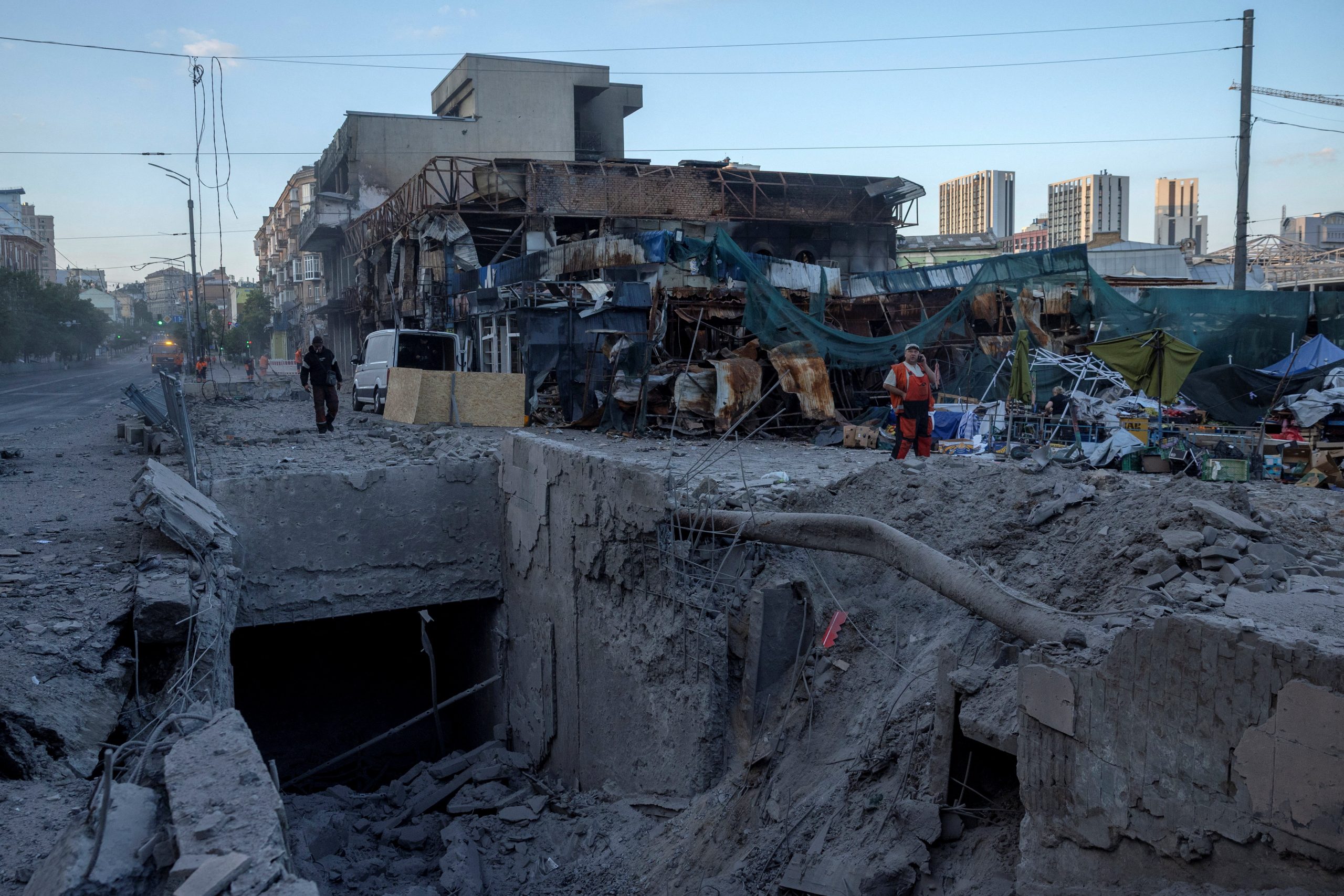
Russian officials vowed there would be a response, and according to the Ukrainian Air Force, Russia’s armed forces fired 41 missiles and 125 drones into Ukraine overnight into Sunday. Local officials reported three killed in a Russian attack that hit a postal facility near Kharkiv, and three other people were killed by separate attacks in Kyiv, Sumy, and Kherson.
Russia’s Defense Ministry claimed attacks on military targets, facilities that produce military equipment, and energy infrastructure, though photos show apartment buildings were also damaged in the Russian barrage. The Russian ministry also said its forces targeted Ukrainian ports and “vessels used in the interests of the Ukrainian army,” and Ukrainian officials reported five people were killed by a Russian strike on a cargo ship in the Black Sea.
Ukrainian forces also launched drones into Russia again on Sunday, with the Russian Defense Ministry claiming its forces downed over 160 Ukrainian drones over the Black Sea and multiple Russian regions. Ukraine’s drone attacks are known to be supported by US intelligence, meaning they always risk an escalation between Moscow and NATO.