By Sylvia Demarest, Substack, 8/22/26
Introduction
The US has spent the last fifty years weaponizing the US financial system and the US dollar by imposing sanctions on many countries, corporations and individuals. In most cases, these sanctions were planned with and agreed to by US allies. The US and the EU have also jointly engaged in seizures of government and individual assets. Sanctions and asset seizures raise a serious question, are global assets, including the assets of foreign countries, safe in the US and the western financial system? Moreover, under international law, to be legal, sanctions require UN approval. Most US sanctions have not been approved by the UN.
One recent example of unilateral sanctions is the seizure Russian central bank assets and the imposition of severe economic sanctions on Russia in early 2022. The US, UK and EU imposed the “shock and awe” sanctions before Russia launched the Special Military Operation and invaded Ukraine. The trigger for the sanctions was Russia’s recognition of the Donbass republics along with entering a mutual defense pact with the republics that required Russia to intervene when the republics were attacked by Ukraine. The fact that the sanctions were so massive and were announced in coordination with the EU and the UK meant they had been planned and agreed to well in advance. These sanctions, which included banning Russia banks from using the SWIFT international clearing system, were supposed to weaken Russia economically and force President Putin from office. The sanctions failed. The main impact has been to force Russia and her allies to develop alternative structures.
Since Trump’s Inauguration the US has gone out of its way to tariff, harass, and insult a growing number of the countries of the world, including US allies. Trump has placed tariffs on countries, then taken them off, then threatened tariffs again. Trump has demanded that countries follow US dictates, demanded they invest billions in the US, denigrated their leaders and tried to undermine their governments.
US allies and other countries must be wondering what the possible benefit there could be to being a US ally, especially when Trump insinuates the US may not help them if they get into trouble.
Although the US has weaponized the dollar and the US financial system, we still expect foreigners to not only go along with US policy, and with US sanctions, but to also to stash their savings in the dollar, and the US stock and bond markets. It raises the question; does the US still know how to play the geo-strategic game?
Now the US is demanding that the entire world isolate and refuse to do any business with Iran or face US sanctions.
US Sanctions on Iran
US sanctions on Iran go all the way back to the hostage crisis of 1979. Over the years, the US and her allies have frequently added new sanction on Iran. In many ways, Iran is the most sanctioned country in the world. Now the US wants to place more sanctions on Iran which will include sanctioning any country or entity that does business with Iran. This time, US allies have not been consulted nor have they agreed to abide by these new sanctions.
Here’s Secretary of the US Treasury Scott Bessent: “Oil markets are misinterpreting what this economic pressure means. This is going to be the greatest coordinated economic isolation in the history of the world. We’re going to our allies and saying, you are either with us or against us. If you insist on doing business with Iran, transferring money, buying their oil, or doing seaborne ship transfers, the US Treasury and US gov’t will put their full might and force toward enforcing against you.”
The key bit: “We’re going to our allies.” This means, US allies have not yet agreed. What Bessent is implying is that he and Trump will have to get “allies” to agree. These are the same “allies” that have had tariffs imposed on them and have refused to supply navy ships to assist the US in opening the Strait of Hormuz.
Iran sells 80% of her oil to China. China is now expected to refuse to do any business with Iran. Here’s China’s reaction: China announces it does not accept U.S. sanctions against Iran. Here’s Philip Pilkington: “They’re (China?) ready for a big fight over secondary sanctions.” In fact, China has made it illegal for any Chinese entity to obey unilateral sanctions that are illegal under international law.
China’s Ministry of Foreign Affairs says baseless unilateral sanctions on Iran will only lead to further escalation: “China opposes unilateral sanctions that lack basis in international law and UN Security Council mandate. Military force and pressure tactics will only lead to escalation that serves no one’s interests. We call on parties to act responsibly and solve disputes through dialogue and negotiation.”
As this Substack has discussed, China has a virtual monopoly on rare earths and many other inputs that are essential for weapons and many essential products. Moreover, the US has made it clear that the intent is to weaken China and bring China under US economic and political control. How can the US expect China to fall into line and go along with sanctioning Iran?
Daniel Drumbrill nailed the US dilemma on X: “This is genuinely hilarious, and peak on-brand American tone-deafness.”
“The United States is now asking China, the same China it has spent years trying to economically isolate, sanction, and technologically contain, to help it economically isolate & sanction one of China’s own partners: Iran.”
“US Treasury Secretary Scott Bessent is telling Beijing to “get with the programme” and join Washington’s “most crushing economic operation” against Iran. “You are either with us or against us.” China is Iran’s largest oil customer. And yet America expects Beijing to help crush Tehran’s economy.”
“This is the same America that put Huawei on the Entity List, expanded the Foreign Direct Product Rule to strangle its supply chain, pressured allies to ban it from 5G, restricted advanced chips and manufacturing equipment, targeted DJI and Chinese drones, and placed hundreds of Chinese companies under export controls, all while talking about maintaining technological superiority and reducing economic dependence on China. That’s the kind of “with us” they were hoping China would continue playing along with.”
“After years of trying to isolate China, they now want China’s help isolating China’s ally.”
“The lack of self-awareness is almost impressive.”
“Still, it’s deeply satisfying to finally see meaningful pushback against the economic tools that have long been used to pressure, constrain, and punish countries around the world.”
The Strait of Hormuz
Martin Armstrong’s recent essay: “The Strait of Hormuz is Repricing the Entire World Economy” discusses the dilemma the US faces in dealing with the consequences of the illegal war on Iran–the impact of the closing of the Strait of Hormuz on prices and inflation. Here’s Armstrong:
“The politicians continue to speak about the Strait of Hormuz as though this were merely a regional dispute between Iran and its neighbors. That is complete nonsense. The strait is one of the most important arteries in the global economy, carrying roughly one-fifth of the world’s oil and gas shipments. Brent crude has moved above $91, but the headline price of oil is only the beginning. The real economic damage appears in shipping rates, insurance premiums, refinery margins, diesel prices, electricity costs, and ultimately government borrowing. War does not remain confined to the battlefield. It enters every household through inflation.”
“Washington claims the strait is open while Iran insists it remains closed. Both statements are political propaganda because it is the shipowners, insurers, and commodity traders who determine whether a waterway is commercially open. A tanker can theoretically pass through Hormuz, but that means nothing if the insurance premium becomes prohibitive or the crew refuses to accept the risk. Most politicians have never operated a business and do not understand that commerce depends upon confidence—not government declarations. Once confidence collapses, trade will retreat regardless of how many officials stand before cameras insisting that everything remains under control.”
“The more serious warning is coming from refined products, particularly diesel. Politicians obsess over crude because that is the price quoted every evening on television. Yet modern civilization runs on diesel. Trucks transport food and consumer goods, farmers operate machinery, construction companies run heavy equipment, and emergency generators protect hospitals and critical infrastructure. When diesel rises, the cost of virtually everything rises with it.”
Diesel is now above $5.00 a gallon in most places. Moreover, US diesel prices are currently sitting at just below $190 per barrel. That’s higher than all but three days in March-April and trending toward the all-time highs of 2022. All with crude prices much lower and the crack doing much of the work.
The Proxy War on Russia is also not going well–the impact on wheat exports and food prices
Simplicius goes through the reasons why the proxy war on Russia is failing and what Zelensky’s probable reaction will be: “The closer Ukraine comes to battlefield defeat, the more it will redirect all of its available resources to targeting Russian civilian infrastructure in order to spur some kind of popular uprising of discontent against Putin.”
“The problem for Ukraine is, this creates an accelerating feedback loop of self-defeat: the more resources Ukraine pours into hitting militarily insignificant targets, the more Russia’s actual military might remain unaffected by Ukrainian combat power, which means the faster Ukraine’s collapse will accelerate on the real front. In essence, Ukraine is vesting its entire strategy into a war against Russia’s civilian sentiment, which is as risky a move as it was for the US in Iran, wherein strikes against civil infrastructure turned even the diehard anti-clerical contingent against the US and enshrined their support of the Iranian leadership.”
One serious impact of the proxy war on Russia is on the export of wheat by both Ukraine and Russia, two of the largest wheat exporters globally. This unfortunate war will have a huge impact on future food prices if the export of wheat continues to be blocked. Here’s one reaction: “It’s worse for the #wheat market than Hormuz was for crude.” Capacity in the region cut from about 3.3mn tons a month to about 250,000 tons at Russia’s only remaining operational facility at the Black Sea port of Tuapse.
The three-year high reached in wheat futures in July could soon be surpassed as the war continues to block wheat exports.
One Other Potential Impact: The US Stock Market
“According to the Advisor Perspectives composite of four major U.S. stock-market valuation measures, the market ended July 2026 at roughly 176% above its long-term geometric mean. This means that stocks are not merely expensive, it means that stock valuations are historically extreme. The composite includes: Crestmont P/E, Cyclically Adjusted P/E, Q Ratio, S&P Composite relative to its long-term regression trend. Individually, each measure has limitations. Taken together, however, they tell a powerful story.”
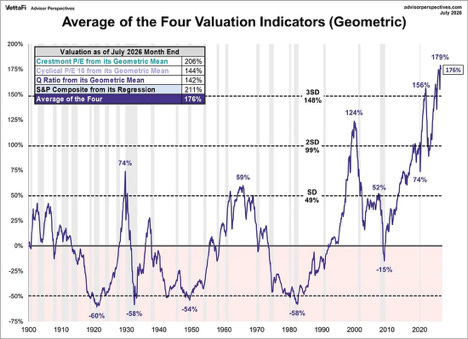
As this Substack has pointed out, the U.S. stock market is trading at valuation levels that exceed those seen around several of the most famous speculative peaks in modern financial history. This includes: the late 1920s; the late 1960s; the technology bubble of 2000; the post-pandemic speculative surge. Yet this creates a conundrum. Extreme valuations do not mean that valuations cannot get more extreme and while risk may be high, there is no way to know if or when the market might fall or how such a market decline might progress.
Right now, global money flows continue to support US stock prices, but this could change. As they say, the US is still “the cleanest dirt shirt”. The US stock and bond markets not only depend on global money flows but also hold the savings of not only millions of Americans, but the rest of the world.
Conclusion
We live in interesting, complex, and very dangerous times.
“When plunder becomes a way of life for a group of men living together in society, they create for themselves in the course of time a legal system that authorizes it and a moral code that glorifies it.” Frédéric Bastiat’s “The Law”, 1850.