By Marta Havryshko, Substack, 9/17/26
President Zelensky has made The Jerusalem Post’s list of the 50 Most Influential Jews of 2026. The paper introduces him as “The Jewish president who became the face of Ukraine’s resistance.”
The newspaper notes that Putin has “repeatedly framed Zelensky as a disgrace to Jewish people and has called his government a ‘Nazi regime.’” It then immediately sets about dismantling those attacks by invoking Zelensky’s family history: his grandfather fought the Nazis in the Red Army, while numerous relatives were murdered in the Holocaust.
“Zelensky’s paternal grandfather was the only member of his immediate family who survived the Holocaust,” The Jerusalem Post emphasizes.
Yet in portraying Zelensky as a “good leader, and just so happens to be Jewish,” and praising his “impressive political agenda, pushing the country to join the EU, fighting corruption, and seeing the country through a nearly five-year invasion,” The Jerusalem Post somehow neglects to tell its readers that Zelensky has become the face not only of Ukrainian resistance to Russian aggression, but also of Ukraine’s neo-Nazis.
The Azov Commander
When Zelensky came to power in 2019, his relationship with Azov was fraught. Azov commanders, including Andriy Biletsky, publicly declared that they would not obey his orders to withdraw troops in the Donbas under the terms of a ceasefire with Russia. Some even threatened him openly. Biletsky said he would never accept a decoration from Zelensky’s hands.
A few years later, the picture could hardly be more different.
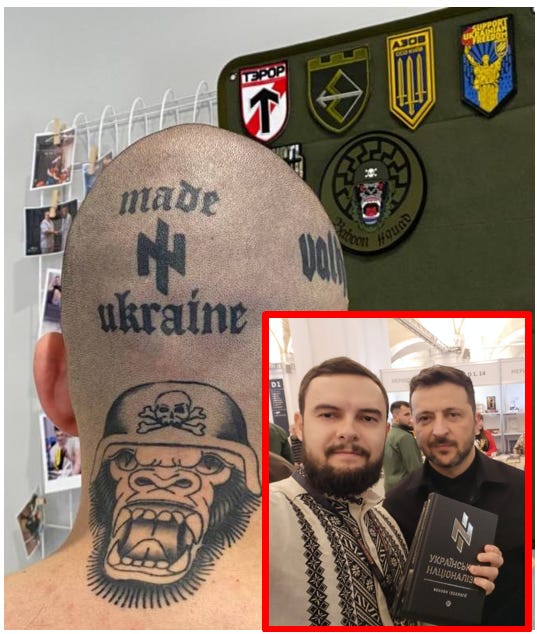
Biletsky accepted the title of Hero of Ukraine from Zelensky, along with a string of other high state honors, and became commander of the Third Army Corps, which today numbers roughly 50,000 personnel. Another Azov celebrity, Denys Prokopenko, likewise rose to command a corps and became a Hero of Ukraine.
Azov, founded by neo-Nazis and fanatics and numbering barely 1,000 fighters in 2022, now has two army corps regarded as elite formations. While Azov has gone to considerable lengths to rebrand, the Third Assault Brigade, formed from the Azov milieu, absorbed some of its most radical elements.
Command positions there have been held, for example, by Russian neo-Nazi Artem “Uragan” Krasnolutsky, who annually celebrates Adolf Hitler’s birthday; Aleksei “Kolovrat” Kozhemyakin, who has Hitler and swastika tattoos on his chest and fled Russia after facing prosecution for racist and antisemitic crimes; and Sasha “Martyn” Martynenko, whose body is covered in swastikas, an SS motto, and antisemitic tattoos.
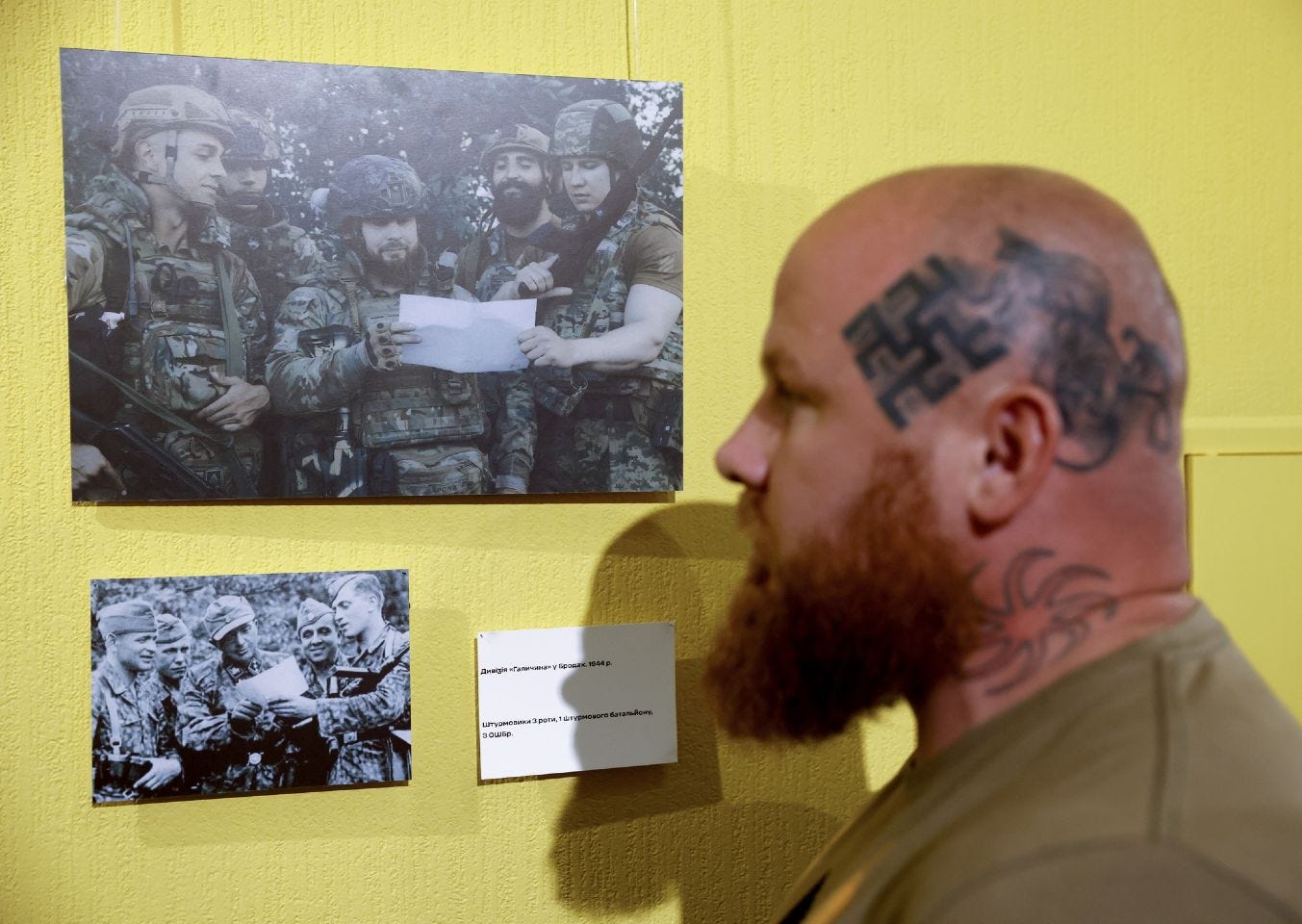
Aleksei “Kolovrat” Kozhemyakin, the commander of the 1st assault battalion of the 3rd Assault Brigade (Azov), is visiting the opening of the photo exhibition of his brigade at the Kyiv History Museum on 27 Sept. 2023.
The Third Assault Brigade’s ideological foundations draw on the integral nationalism of the Organization of Ukrainian Nationalists (OUN)—an ideology whose historical trajectory included collaboration with Nazi Germany during the Holocaust, mass ethnic cleansing of Poles, and collective terror against Ukrainians deemed politically or nationally “wrong,” with entire families among its victims.
On top of this, some senior figures associated with the Third Assault Brigade, such as Dmytro Kukharchuk, openly voice anti-Muslim, racist, homophobic, and misogynistic views.
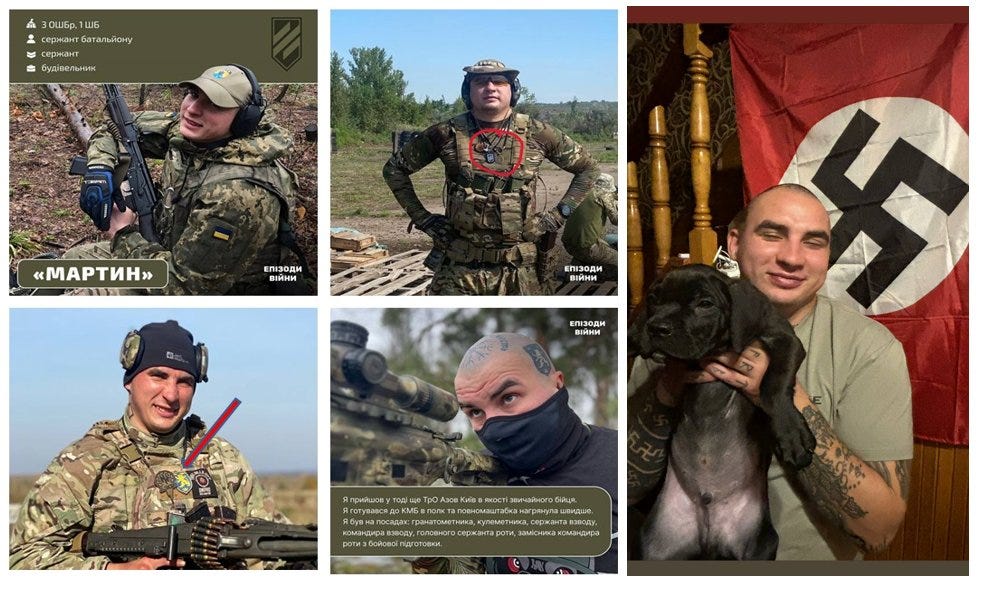
Sasha “Martyn” Martynenko, an officer of the Azov-rooted Third Assault Brigade.
Zelensky’s Jewishness poses no obstacle whatsoever to the Azov formations. Why should it? Zelensky has presided over their expansion and their growing influence—everything they need to accumulate military and, potentially, political power in a country at war. His government now relies on precisely this radical wing: a milieu that brands virtually any peace negotiations “capitulation” because it has every incentive to preserve the status quo—a permanent war in which its power, prestige, and influence continue to grow.
Commander of Foreign Neo-Nazis
It is precisely under the presidency of Zelensky—Ukraine’s Supreme Commander-in-Chief—that, for the first time in the country’s post-independence military history, entire formations of foreign neo-Nazis and far-right militants have emerged: the Russian Volunteer Corps, the German Volunteer Corps, and the Belarusian Volunteer Corps.
Neo-Nazis from France, Spain, and elsewhere have also fought in Revansh, under the command of Ukraine’s military intelligence. They have come to Ukraine to acquire combat experience, build transnational networks, and prepare for the racial war they envision in their respective countries.
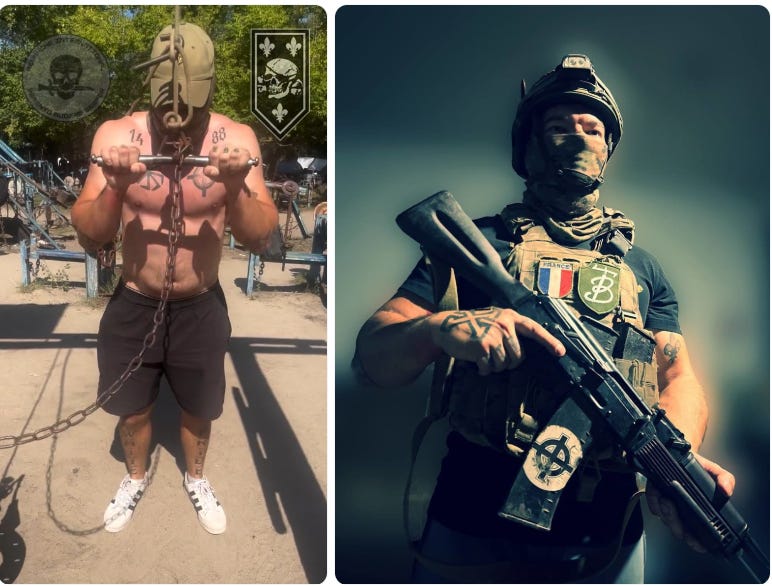
Gwendal Delange (aka “Kenneth”), a neo-Nazi from France, is fighting in Ukraine under Military Intelligence. He initially served in Azov, later collaborated with the 3rd Assault Brigade, and now serves with Revanche International, led by HUR.
For all their antisemitic and white-supremacist politics, Zelensky’s Jewishness appears to trouble them remarkably little. Why would it? Ukraine offers them something infinitely more valuable than ideological consistency: extraordinary opportunities to strengthen their extremist nationalist movements, gain battlefield experience, forge international connections, and acquire military credentials.
Ukraine also freely hosts concerts by so-called National Socialist Black Metal bands such as M8l8th (Hitler’s Hammer), drawing crowds of more than a thousand people. Why? The band’s frontman, Alexey Levkin, is a deputy commander of the Russian Volunteer Corps.
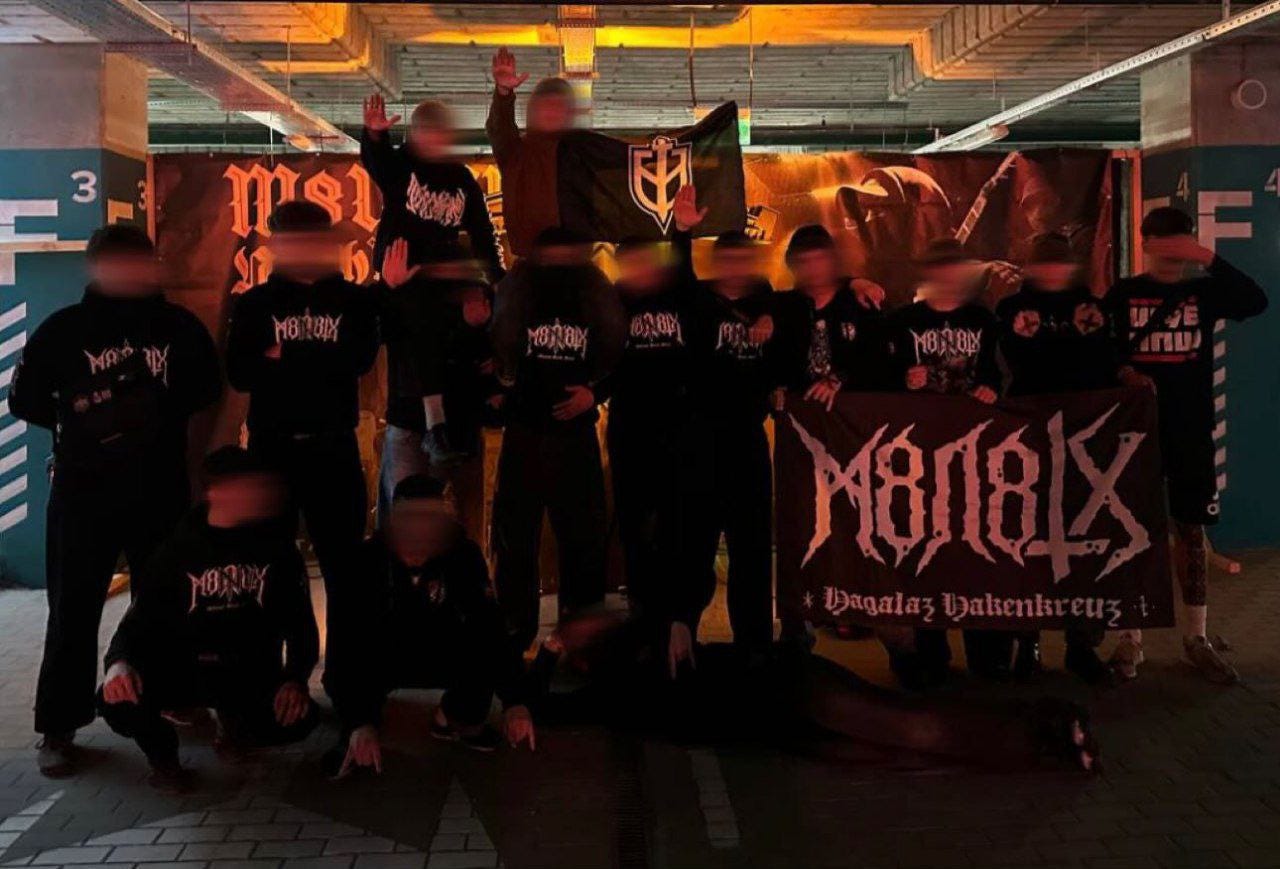
Yule Night II in Kyiv on Dec. 25, 2025.
These concerts are not merely places where young people can throw Nazi salutes and sing about the white race with impunity. They are networking hubs for the far right.
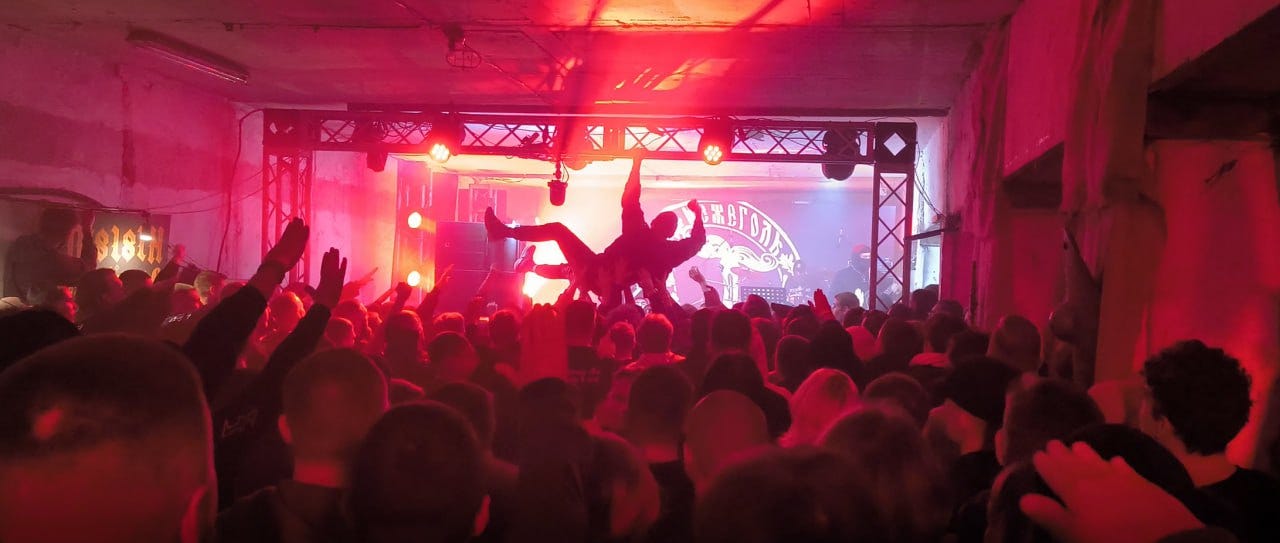
Yule Night II in Kyiv on Dec. 26, 2024.
The contrast with contemporary Russia is striking. There, such concerts are relatively small, driven underground, and frequently subjected to police raids. In wartime Ukraine, meanwhile, they can be openly advertised and staged on a large scale, with prominent commanders from far-right military formations in attendance.
Under Zelensky, Ukraine has also become an ideological laboratory for Europe’s far right. Neo-Nazi and neo-fascist conferences can take place openly in the country. One example is Nation Europa held in Lviv in August 2024, to which Italy’s CasaPound, Germany’s Der III. Weg, and other European far-right movements were invited.
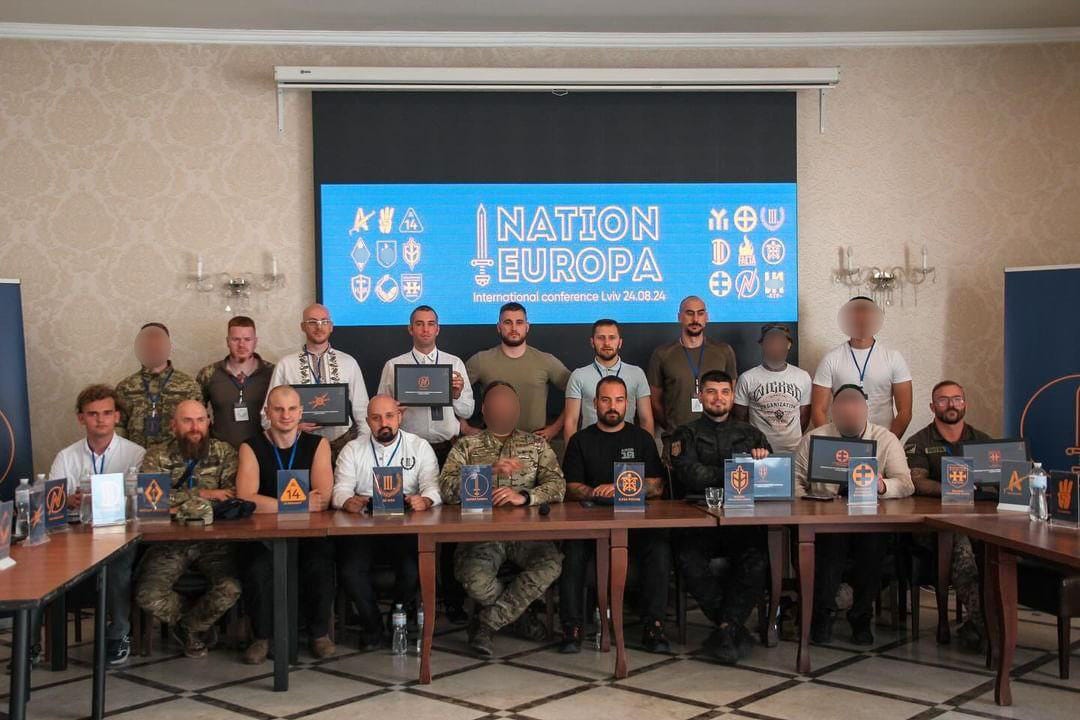
And here an obvious question arises: in a country at war, where the security services wield enormous powers and where public events operate under wartime restrictions, how could a gathering of this kind take place without at least the knowledge and permission of the relevant authorities?
It is difficult to imagine that it could.
Such gatherings also offer an obvious recruitment opportunity. With Ukraine facing an acute shortage of manpower and a deepening mobilization crisis, foreign far-right networks constitute a ready-made pool of ideologically motivated men with an appetite for combat.
The paradox could hardly be more grotesque: a Jewish president celebrated abroad as the living refutation of Putin’s “Nazi” propaganda presides over a wartime state in which foreign neo-Nazis can acquire combat experience, build international networks, hold conferences, stage concerts, and embed themselves in military formations.
For them, Zelensky’s Jewish ancestry is not the problem. Ukraine is the opportunity.
Betraying His Grandfather’s Legacy
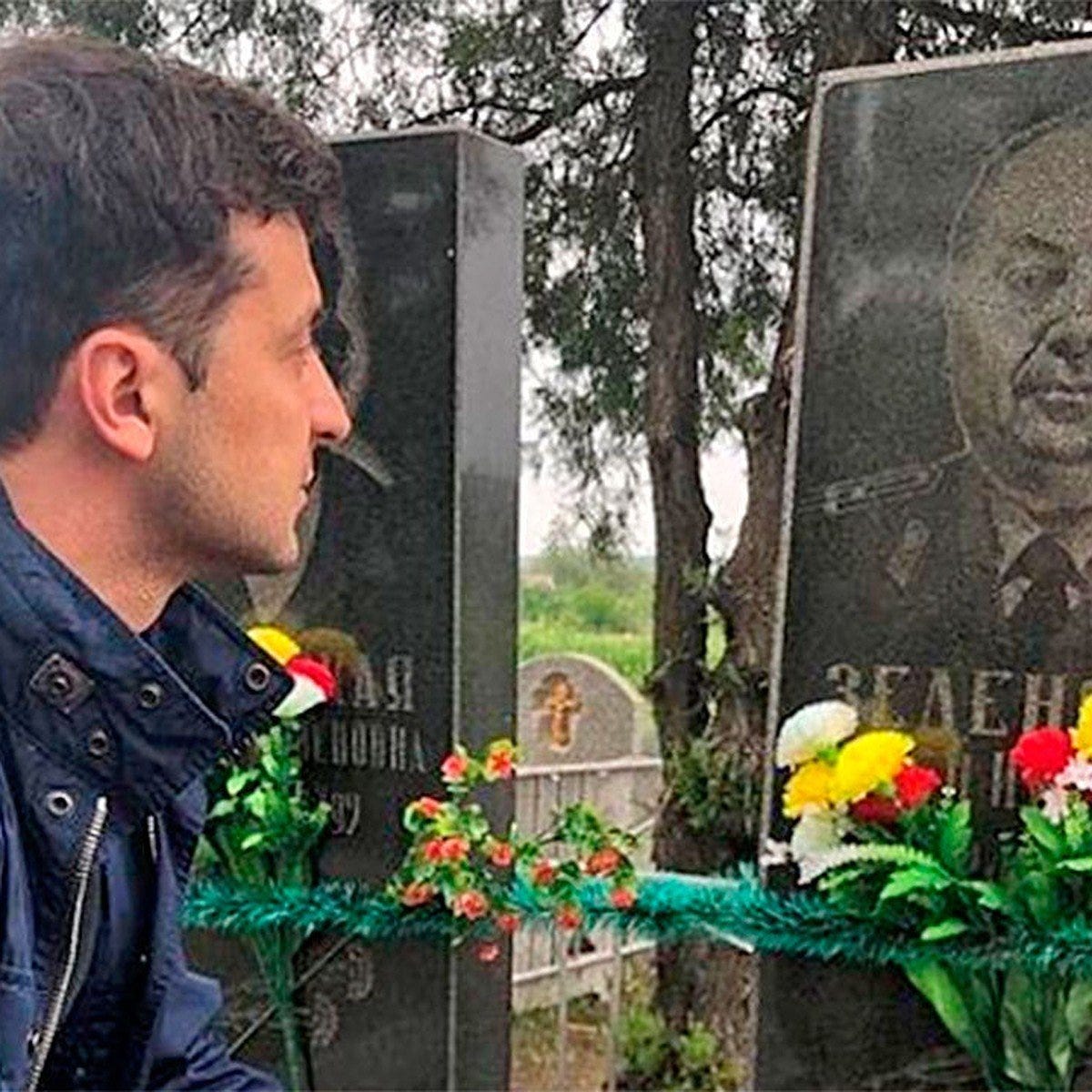
The Jerusalem Post’s invocation of Zelensky’s grandfather, who fought the Nazis in the ranks of the Red Army, is particularly ironic.
Because Zelensky has betrayed his grandfather’s memory.
How? By kneeling recently at the graves of Nazi collaborators—the very political milieu whose members participated in the persecution and murder of Jews like Zelensky’s own relatives and neighbors during the Second World War.
It was under Zelensky, a Jewish president, that the remains of Nazi collaborator Andriy Melnyk were brought back to Ukraine for the first time in the country’s history. The state conducted his reburial with honors, and Zelensky attended. Men subordinate to Melnyk’s nationalist movement served in police formations under the Nazi occupation of Ukraine. They guarded ghettos, hunted down Jews in hiding, escorted Jews to execution sites, and participated in killings.
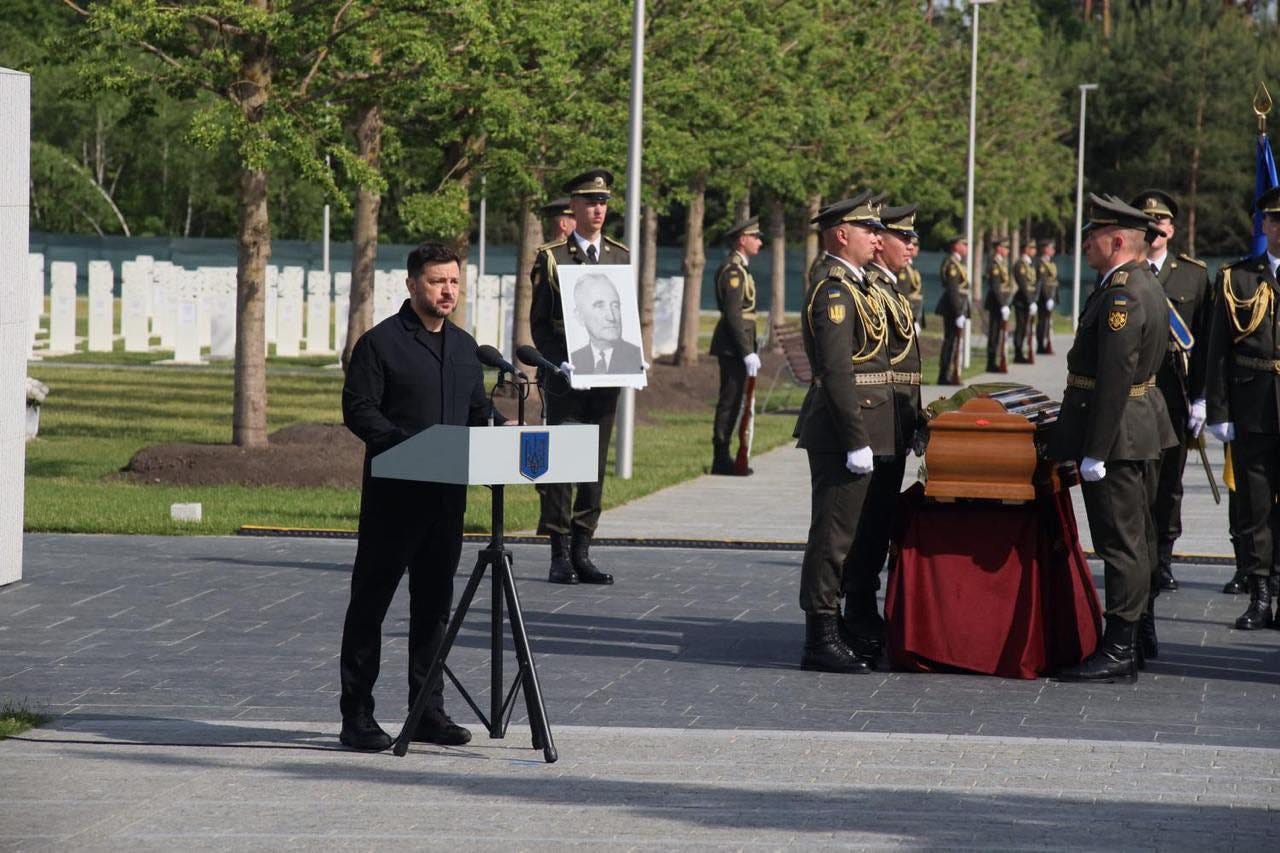
Could some of those victims have been Zelensky’s own relatives? And now he honors Melnyk, their political leader?
Under Zelensky, Kyiv also held, for the first time (2021), a march honoring the Waffen-SS Division “Galicia,” formed in 1943 to fight as part of Nazi Germany’s war effort. Members of formations connected to the division were implicated in wartime atrocities, while the division later fought in Slovakia and Yugoslavia on the German side.
Today, within the Third Army Corps commanded by Andriy Biletsky, the Waffen-SS Galicia Division is commemorated as a heroic military tradition and does not commemorate 8 May – Day of Victory over Nazism. This, too, represents something extraordinary: under a Jewish Supreme Commander-in-Chief, a formation of the Ukrainian military openly celebrates the legacy of a Waffen-SS division – Nazi collaborators.
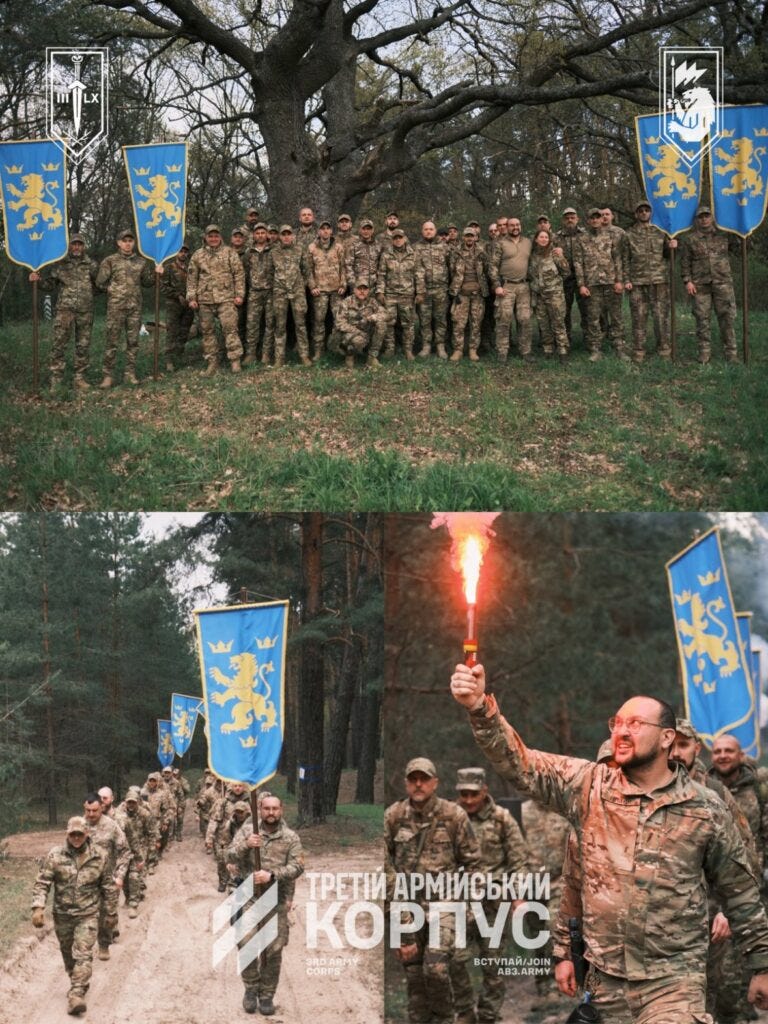
The Third Assault Brigade also produced an exhibition devoted to the Waffen-SS Galicia Division. It was unveiled with considerable fanfare at the Museum of Kyiv and was later shown in Lithuania and Estonia with support from Ukraine’s Ministry of Culture.
Again: under Zelensky.
A Jewish president.
What we are witnessing, then, is not merely an argument over historical memory. Under Zelensky, the meaning of the Second World War itself is being rewritten in Ukraine, while figures and formations associated with Nazi collaboration are being rehabilitated and incorporated into a new national heroic canon.
So why did The Jerusalem Post omit these profoundly uncomfortable facts while celebrating Zelensky as a leader?
Why have so many media outlets stopped asking Zelensky uncomfortable questions about neo-Nazis and far-right extremists whose military and institutional power has expanded under his presidency—and whose transnational networks could pose dangers far beyond Ukraine?
And how exactly does any of this square with the endlessly repeated mantra of “freedom and democracy” that Ukraine, under Zelensky, is supposedly defending?
At what point do we finally start asking uncomfortable questions of the “Jewish face of Ukrainian resistance”?
*If you find these posts valuable, please consider supporting my work with a subscription or a small donation. Your support helps me keep researching, writing, and sharing new ideas. Thank you!