A guest essay from friend-of-Racket and former “Moscow Times” editor Matt Bivens, who writes at The 100 Days.
A big noise was heard in the dark forest, and a roar echoed. All the animals ran to the boyar, the Bear. Large animals came. Small ones came. Captain wolf came, showing his sharp wicked teeth, and greedy eyes.
Then came the beaver, that visiting merchant. He, the beaver with the fat tail. The noble weasel arrived. Little princess-squirrel arrived. Came the church clerk-fox, that treasurer. Then the filthy peasant-rabbit, poor rabbit, grey rabbit. The hedgehog-tax collector came, all huddled up, how he bristles …
All to the bear then bowed, and the bear told his story, crying: Judge how I have been wronged! I had an old shoe, of woven basket, torn, for many years it lay unused. Gray geese flew over it one day, they took it and tore it to shreds, then scattered the pieces in the open field.
How am I to endure this bitter wrong? Who will comfort my brave heart? Aren’t we going to declare a war on birds?
And they went to war, and went to war, and bravely led the army. That’s fighting there in the distance!
— from Rimsky-Korsakov’s Opera “The Tsar of Saltan”, playing this fall in St. Petersburg’s Mariinsky Theater
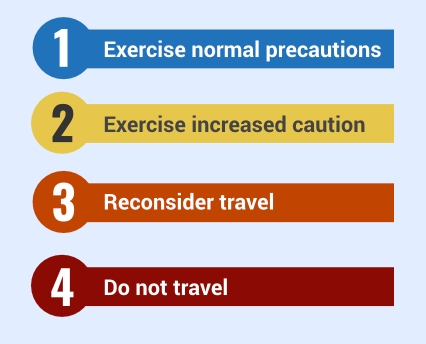
MOSCOW — The U.S. State Department said not to come here. They have a Level 4 warning against Russia travel, which is the fastest they can hyperventilate.
The warning cites free-floating peril associated with the war in not-so-distant Ukraine, “the risk of harassment or wrongful detention,” and the American government’s “limited ability to help” if you get in trouble. It concludes in bold-face:
Do not travel to Russia for any reason.
Seventeen grim-sounding bullet points follow. If you do go to Russia, State says, you should, among other things:
Prepare a will …
Discuss a plan with loved ones regarding care and custody of children, pets … funeral wishes, etc.
Leave DNA samples with your medical provider …
Make funeral arrangements!
I seriously doubt a primary care doctor would know what to do with my “pre-travel DNA samples.”
State Department’s travel advisory scale.
‘Do not travel to Russia for any reason.’
But Americans are traveling here every day. There are no direct flights anymore, and international sanctions have closed European and American airspace to Russian airlines. But Turkish Air among others has stepped up eagerly, and Istanbul Airport is humming with activity.
We had many reasons to travel to Russia. We needed to reconnect with friends and loved ones, and tend to various family matters. My older daughter wanted her fiancé to meet her Ukrainian-Russian grandparents, and to see the places she remembered fondly from her kindergarten days, when I worked in Russia as a journalist (before I came to my senses and went to medical school).
As a card-carrying member of International Physicians for the Prevention of Nuclear War, I also wanted to meet with like-minded international physicians, to discuss, yes — nuclear war, the prevention of. And I wanted to take Russia’s temperature. It’s a place I know well but hadn’t visited for some years.
There were downsides to such a trip. One was leaving coastal Massachusetts at my favorite time of year. (Sailboat season!) Another was anxiety among family and friends, who have a media-nurtured fear of all things Russian. When I telephoned my father about our planned trip, I could hear my mother in the background call out, “Don’t get captured!”
Don’t get captured? Did we need to worry about that?
Amnesty International does say more than 20,000 ordinary Russians have been arrested and fined, and many dozens at least have received long prison terms for voicing anti-war criticism. We were just tourists visiting family, not anti-government activists. But there are no guarantees: Two years ago, a young woman from Los Angeles — a ballerina from Siberia, with American-Russian dual citizenship (just like my wife and daughters) — went for a visit home to Russia, and at passport control was interrogated about her views. Her phone was searched, and she was charged with treason (!) over a Venmo donation of $51.80 to a New York-based charity raising money for Ukraine. She was convicted, and sentenced to 12 (!) years. (She was released in April as part of a prisoner swap.)
Then there were the drone attacks. All summer, there were multiple Ukrainian-sponsored drone attacks on St. Petersburg’s Pulkovo Airport — the same airport we’d fly in and out of. One day after I left in September, Pulkovo was shut down for a full day by another large drone attack. My wife followed a few weeks later — the same day Russia shot down 46 drones headed for Moscow alone.
The only difference between these drones and terrorist car bombs are that the drones fly, and are apparently guided to target by sleeper agents of Operation Goldfish, who were trained by the CIA and spread throughout Russia.
(As an aside: imagine if American airports, residential buildings and other infrastructure were attacked by flying car bombs, month after month — even as, say, Iran bragged publicly about having secret “Operation Goldfish” sleeper agents spread through our country to guide the bombs to their targets. Would our government also start locking people up over $51 Venmo donations to the wrong people?)
This was all context for our planned trip, and it gave us pause. But by late summer, the geopolitics, which had been awful for years, looked cautiously promising. Vladimir Putin and Donald Trump had just met cordially in Alaska. It seemed a window for safe and hassle-free travel.
Since we were introducing the fiancé to Russia — and also don’t know what the future holds — we decided to treat ourselves to the full tourist experience. We would attend the Rimsky-Korsakoff Opera mentioned above, a meandering collection of Alexander Pushkin’s fairytales that revolves around the imaginary city of Tmutarakan. We’d go mushroom hunting in the woods outside of St. Petersburg, indulge in a full-day Russian banya (steam sauna) complete with the traditional massage-by-whackings-with-oak branches, ride the elegant overnight sleeping car train to Moscow, explore the Tretyakov and Hermitage museums, and have feast after feast — in fancy Russian restaurants, in Georgian restaurants, and best of all at home with the in-laws, where everyone oohed and aahed and took photos of the home-cooked Ukrainian fare, from borshch to blini.
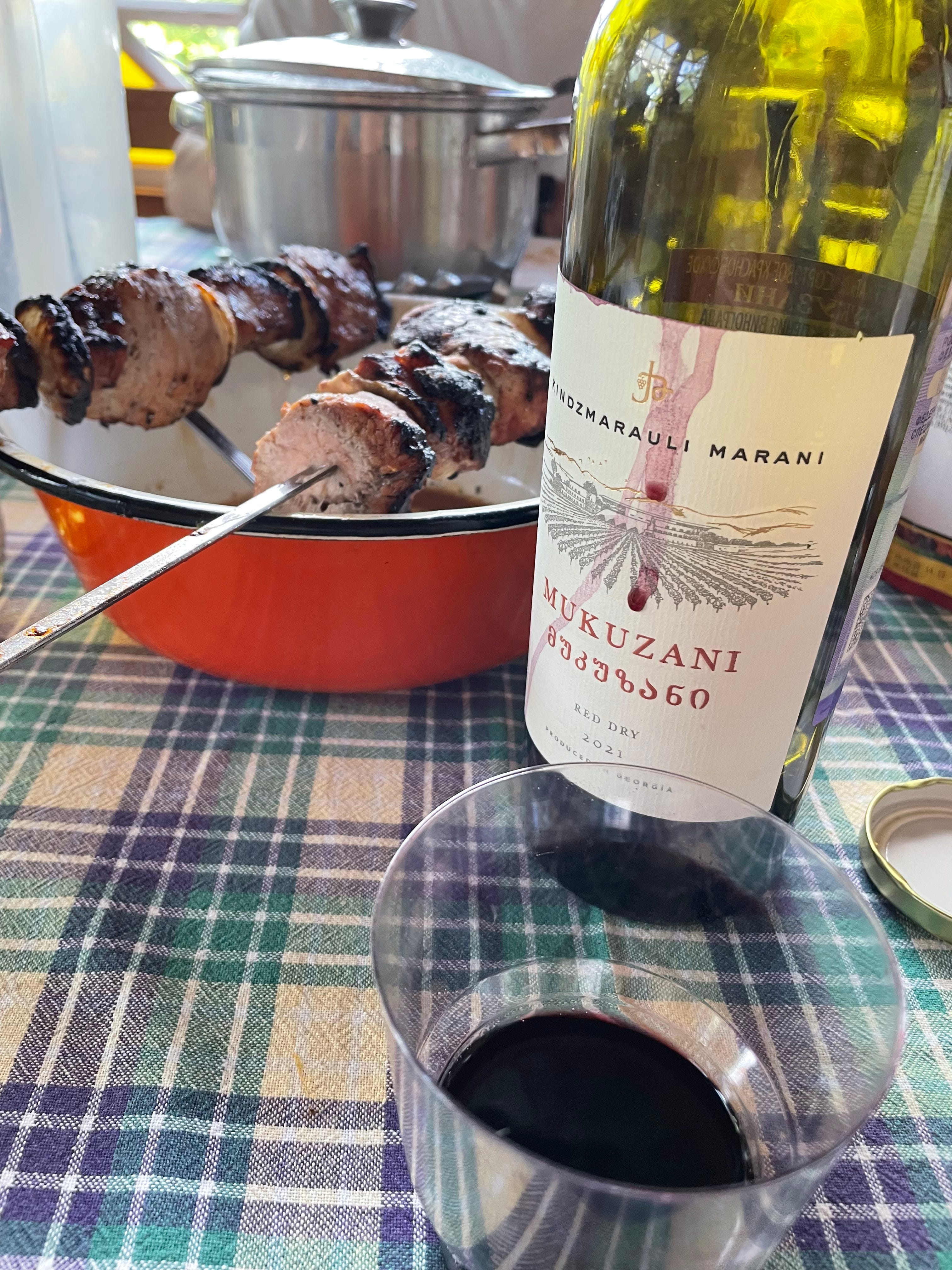
Shashlyk (a.k.a. shish kebob) and Georgian wine at my in-laws’ dacha (country house). Photo by Matt Bivens.
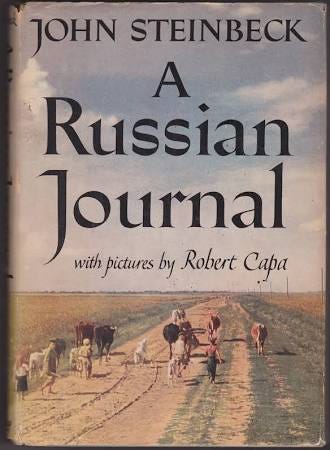
Spoiler alert, it was a wonderful trip, and no one was “captured.” I won’t bore you with most of it. Instead, I hope to reacquaint you with ordinary Russian people at this moment in time. As I pondered this idea, I remembered a 1949 classic by the novelist John Steinbeck, “A Russian Journal.” I occasionally thought of this slim book as we took our Red Square selfies, or struggled to talk politics over dinners with friends. Then, on the last day of our trip, with a pleasant jolt of recognition, I saw my own long-lost copy on my father-in-law’s bookshelf.
I took it down, and read Steinbeck’s opening account of how he and his photographer colleague Robert Capa conceived their collaboration in the late 1940s, while sitting in a New York hotel bar drinking absinthe-and-crème de menthe cocktails, and complaining about the sad state of international affairs:
Willy, the bartender, who is always sympathetic, suggested a Suissesse, a drink which Willy makes better than anybody else in the world. We were depressed, not so much by the news but by the handling of it. …
Willy set the two pale green Suissesses in front of us and we began to discuss what there was left in the world that an honest and liberal man could do. In the papers every day there were thousands of words about Russia … by people who had not been there, and whose sources were not above reproach. And it occurred to us that there were some things that nobody wrote about Russia, and they were the things that interested us most of all. What do the people wear there? What do they serve at dinner? Do they have parties? What food is there? How do they make love, and how do they die? What do they talk about?
Good questions then and today.
For anyone skeptical about a non-hostile examination of Russia amidst the carnage of Ukraine: Steinbeck the author, Willy the bartender, and many others were open to such an inquiry in 1949 — when the Soviet Union was ruled by Josef Stalin (!), had just taken over Czechoslovakia in a surprise coup, had blockaded West Berlin, and had detonated its first atomic bomb; while the Chinese Communist Party had just driven the nationalists out to Taiwan, and Senator Joseph McCarthy’s Red Scare and the U.S. war in Korea were just a year away.
For anyone still indignant, and angrily aware that far more than 1 million young men on all sides have been killed or maimed in a war Russia alone chose to launch; or, for that matter, that Russia’s recent drone attacks on the Ukrainian power grid have imposed nationwide blackouts; I can only say that I deplore the suffering everywhere — we have family on all sides of the conflict — and the war could end tomorrow if Lockheed Martin and RTX (Raytheon) America stopped fueling it and negotiated a NATO-free Ukrainian future.
Poland’s prime minister Donald Tusk just couldn’t resist an opportunity to bait the Germans and rub it in just how humiliated they are now. And not once but twice: First, when one of the Ukrainians suspected of executing the September 2022 terrorist attack on the Nord Stream pipelines – the “world’s largest offshore pipeline system” and as vital a piece of German infrastructure as has ever been built – was recently arrested in Poland, Tusk could have simply kept quiet.
But where would have been the fun of that? Instead, the Polish prime minister made a point of holding an aggressive press conference and also using X to tell Berlin to, in essence, go and jump in the Baltic.
Tusk declared that extraditing the Ukrainian state terror suspect is not in Poland’s national “interest,” and that, anyhow, the real scandal about Nord Stream is not that it was blown up but that it was built. In other words: Dear Germans, we do not give a damn about your property, rights, or judicial procedures; on the contrary we expect you to feel ashamed for ever having dared construct a perfectly legal and useful pipeline that we in Warsaw didn’t like. And dare not notice, by the way, that we had a direct commercial interest in the Baltic Pipe competition that – oh coincidence! – went online just when Nord Stream exploded.
Then, a few days later, the Polish leader felt the need to add insult to insult: After a Polish court had obediently – and illegally (so much for that famous rule of law in EU-Nato-land) – denied the German extradition request, Tusk just had to gloat, letting his X followers know that “the case is closed.” Obviously, Tusk is a raving nationalist – under that cheap, career-facilitating EU varnish – and he also has an interest in impressing the Polish public with his tough talk. Yet the real issue is, of course, that he – rightly – perceives no cost to this behavior: Berlin will take it.
And that despite the fact that what wasn’t said but implied, at least for anyone not yet fully zombified by the West’s mainstream “cognitive warfare,” was, of course, even worse: Poland won’t extradite a suspected Ukrainian terrorist because that terrorist did what Warsaw considered the right and profitable thing to do and, thus, helped his group of seven do.
Then, a few days later, the head of Poland’s spooks Slawomir Cenckiewicz felt the itch to make things even clearer: He told the Financial Times that from the Polish point of view going after the Nord Stream bombers “doesn’t make sense, not only in terms of the interests of Poland but also the whole [Nato] alliance.” Oops. Slawomir, we get it: as a likely accomplice you are personally affected in this case. But are you really sure you had permission to not only basically admit Poland was in on the terror job against the German “allies” but other NATO members, too?
But let’s be fair and acknowledge Warsaw’s discomfort. Indeed, as the Ukrainian criminals who blew up a vital part of Germany’s infrastructure were very likely also working for and with Poland, handing one of them over to the German victims of the worst eco-terror attack in European history would be a trifle harsh and ungrateful as well as really inconvenient, too: What if the rudely discarded deep-sea tool from Ukraine were to start spilling the beans – or, perhaps, pirogi – once he faces German interrogators? Plea deal anyone?
Tusk and Cenckiewicz’s weird, panicky announcements, let’s be precise, are not only so needlessly offensive toward the Germans – EU fellow members and NATO allies, no less – that they could have been produced by the infamous Kiev School of anti-diplomacy itself. The Polish prime minister and his master spook also displayed a truly brutish legal nihilism, because, under the pertinent European Union agreement, Poland does not, actually, even have a formal right to refuse an extradition by citing national “interest” (or NATO interest – whatever that is supposed to be – for that matter).
Maybe it should have, the sovereignists among us might say, but that’s not how the EU rolls and that is not what the agreement says that Poland has an obligation to follow. According to the 2002 “Council Framework Decision on the European Arrest Warrant and the Surrender Procedures between Member States,” refusing an extradition request is only permitted “when there are reasons to believe […] that the said arrest warrant has been issued for the purpose of prosecuting or punishing a person on the grounds of his or her sex, race, religion, ethnic origin, nationality, language, political opinions or sexual orientation, or that that person’s position may be prejudiced for any of these reasons.” In short, it’s all about the rights of the suspect, which Germany is certainly not threatening here. And there is not a word about national interest.
It may seem ironic that Tusk also once served as President of the European Council and is, in general, an EU creature through and through. But then again, trampling on EU laws – and others, too – is, of course, the true hallmark of the “elite” Eurocrat. It’s called the Von der Leyen Stay-Out-of-Jail Privilege.
Meanwhile, a high Italian court has also refused to extradite yet another suspected Ukrainian terror Nord Stream suspect. Italy, too, is a humble NATO foot soldier and obedient US vassal, of course. And Ukrainian officials and media are preparing a fresh defense line to fall back on when the Baltic sludge will really hit the fan: After years of brazenly, shamelessly lying in our faces Kiev-style and pretending they had nothing to do with the terror attack, they are currently explaining that it wasn’t a crime at all but a “legitimate” act of war. Oh, really now? Even by that very belated, inconsistent, and embarrassingly transparent “logic,” war against whom, if we Germans may ask: Your constant bankroller and NATO member Germany?
And what has Berlin had to say? Very little, as in, really, nothing. Oddly enough, the German establishment – the same that claims to want to play a “leadership role” in Europe, again – left it to the Foreign Minister of Hungary to articulate a common-sense response. Taking to X, Peter Szijjarto confronted Tusk him with the absurdity and recklessness of his own words: “According to” Donald Tusk, “blowing up a gas pipeline is acceptable. That’s shocking as it makes you wonder what else could be blown up and still be considered forgivable or even praiseworthy. One thing is clear: we don’t want a Europe where prime ministers defend terrorists.” The Hungarians, of course, know a thing or two about both sensitive pipelines and Ukrainian subterfuge and lawlessness among “allies.” But, unlike Berlin, Budapest won’t take it all lying down.
What are Germans to think about their own government that can’t find such words? Just words! Not even to speak about the sanctions that the Polish government actually deserves. The more so as Tusk publicly slapping Berlin in the face is not an exception but merely yet another instance of long-standing Polish policy. For those who have forgotten, after the Nord Stream terror attack, we were first told by our Western establishment politicians, “experts,” and media that Russia was to blame. That that idea made no sense at all didn’t matter. Sort of as with the current Great Drone Scare.
Then, finally, that big, fat, and very, offensively obvious lie was replaced by a smaller, slightly less idiotic one: Ukraine did it, and Ukraine alone. That Ukraine did it is probably still true, although recent revelations in Denmark have put the US front and center again. But, in any case, Ukraine alone? Definite, industrial-strength, offensively obvious BS.
And that’s what brings us back to Poland (and not only, of course). By the summer of last year, Polish attempts to obstruct the German investigation of the Nord Stream attacks became so obvious that even the Western mainstream press noticed. The Wall Street Journal reported that the “Nord Stream revelations” were igniting disputes between Berlin and Warsaw.
After all, not only were German prosecutors finally homing in on the obvious – though not the sole – perpetrators from Ukraine, they also had to face the fact that the terrorists had used Poland “as a logistical base.” And some German officials were still patriotic enough to dare think and even say – though under cover of anonymity – the obvious: Poland was deliberately stalling their investigation, first, for instance, by absurdly claiming that the Ukrainian terrorists had been mere innocent tourists, then by refusing to hand over evidence and letting – more realistically, helping – a suspect escape (the same one they are now not extraditing, as it happens).
Polish officials, meanwhile, openly told their German counterparts that, in their view, those who had detonated Nord Stream deserved not prosecution but medals. Then as well, Tusk, too, had nothing better to do than add insult to injury, as German investigators put it, publicly ordering the Germans to “apologize” – for the temerity of building pipelines, obviously – and “keep quiet.”
Here’s the Polish deal the Germans got: I, Warsaw, help the Ukrainians, who also fleece your taxpayers, blow up your pipelines and promote your deindustrialization, and you, Berlin, in return, shut up and apologize to me. As a bonus I regularly slap you in the face in public. Fair? And, insane as it is, up until now, the German answer has been: “Jawohl! And can I have some more, please?”
Berlin emerges in this story as a deliberately helpless victim of both a massive terror attack by Ukraine – an ultra-corrupt state it is still insisting on shoveling cash into and for which it risking a (direct) war with Russia – and its so-called “allies,” including probably not only Poland but also the US and perhaps Britain and Norway as well.
We often hear that the US and its vassals provoked the Ukraine War to inflict a crippling defeat on Russia and turn it into a helpless object of American geopolitics. That is all true. The irony is that Germany is the country they actually ended up crippling the most. And with Germany’s consent, from Olaf Scholz’s hapless grin to Friedrich Merz’s thunderous silence.
For the US, devastating Germany is, of course, plan B: Plan A, defeating Russia, has not worked, but as one dogma of US strategy in Eurasia is to never allow deep cooperation between Berlin and Moscow, taking down Germany will also do for Washington. Poor Germany: “Friends” like these, and yet, its “leaders” can’t stop looking for enemies in Moscow.
Over the past year, Russian analysts have effectively become Trumpologists. Every statement from the US president, often several a day, is dissected and debated in real time. Since Donald Trump’s remarks frequently contradict one another, following his train of thought can feel like a virtual roller coaster ride – dizzying, unpredictable – yet impossible to ignore.
But one should not get carried away by the spectacle. Trump’s tactics are straightforward. He can be abrasive and threatening one moment, charming and conciliatory the next. At times he presents himself as “one of us,” at others as “one of them.” The real question is whether there is a coherent strategy behind this chaos. Nine months into his second term, there is enough evidence to draw some cautious conclusions.
First, Trump’s ultimate goal is personal glory. He wants to go down as the greatest president in US history – the man who restored America’s dominance and reshaped global politics. His strategic vision begins and ends with his own legacy.
Second, he is determined to suppress America’s economic rivals. In this, his policies are blunt but consistent: tariffs, trade wars, and the repatriation of production to US soil. For Trump, global competition is not about mutual gain but national survival.
Third, and most relevant for Russia, Trump wants to be seen as a global peacemaker. But in his vocabulary, “peace” really means truce. He is not interested in complex negotiations or long-term settlements. His aim is to get all sides into one room, stage a handshake, declare victory, and move on. Once the cameras are gone, the details, and the responsibility, are left to others. Should conflict resume, Trump can say he brought peace; it was others who spoiled it.
This formula does not work with Russia. Moscow has tried to explain to the US president the real origins of the Ukrainian crisis – and that Russia’s conditions for peace are not “maximalist” demands but the minimum basis for a lasting settlement. Trump, however, is uninterested in history or nuance. His focus is always the immediate result, the headline moment. After eight months of dialogue, progress remains intermittent at best.
There are also external limits to Trump’s freedom of action. For all his bluster, he is neither “the king of America” nor “the emperor of the West.” He cannot ignore Washington’s entrenched anti-Russian consensus, shared by Democrats and many in his own Republican Party. Nor can he completely disregard US allies in Europe, however little he may respect them. Despite his self-image as a political maverick, Trump is still constrained by the machinery of the American establishment.
Even so, the “special diplomatic operation” – Moscow’s direct dialogue with the Trump administration – has served its purpose. It has demonstrated to Russia’s partners that Moscow is genuinely committed to a fair and durable peace. It has shown Russia’s soldiers and citizens that their leadership continues to pursue the declared objectives of the Ukraine military operation. And it has clarified for the Kremlin the limits of Trump’s real power.
The talks may have slowed, but communication continues along two channels – Lavrov-Rubio and Dmitriev-Witkoff. Yet diplomacy, as ever, is not a substitute for strength. Its purpose is to consolidate what has been achieved on the battlefield. A diplomatic operation can assist, but it cannot replace, a military one.
This article was first published in Kommersant, and was translated and edited by the RT team:
(Full disclosure: I wrote some op-eds for RT in 2021. – Natylie)
Margarita Simonyan, the editor of RT
On June 7, 2005, Margarita Simonyan, an intelligent, articulate Russian journalist who had previously worked in the Kremlin press pool reporting for Rossiya, a leading Russian state television network, announced the creation of Russia Today. “It will be a perspective on the world from Russia,” she said. “Many foreigners are surprised to see that Russia is different from what they see in media reports. We will try to present a more balanced picture.”
Simonyan was 25 years old at the time.
RT went live on December 10, 2005, and the journalistic world has never been the same.
Russia Today, operating on a shoe-string budget of just $30 million (by way of comparison, CNN, a major American media outlet, had an operating budget of $2.5 billion in 2005) struggled to make a dent in the international news market.
Russia Today’s big break came in August 2008, during the short-lived Russian-Georgian War. Georgia and its Western allies painted the conflict as a flagrant example of modern-day Russian imperial ambition. Russia told a different story—that it was Georgia who was the aggressor, and that Russia was simply acting in accordance with its treaty obligations to defend South Ossetia from outside aggression.
Russia had brokered a ceasefire and negotiated an agreement in 1992 known as the “Sochi Agreement.” The agreement, which brought an end to fighting between Georgian and South Ossetian forces that had been raging since 1991, established a cease-fire between both the Georgian and South Ossetian forces, and defined a zone of conflict around the South Ossetian capital of Tskhinvali which would be monitored by a Joint Control Commission and a peacekeeping body, the Joint Peacekeeping Forces group (JPKF), which operated under Russian command.
The Georgian Army, on August 7, 2008, launched a military incursion into South Ossetia which occupied Tskhinvali and saw Georgia troops fire on the Russian peacekeeping force, killing and wounding scores of Russian soldiers.
The next day, on August 8, 2008, Russia responded with a massive military incursion of its own, driving the Georgian troops out of South Ossetia and subsequently advancing deep into Georgia, threatening the capital city of Tbilisi, before agreeing to a ceasefire brokered by the European Union.
At the time, both the Russian government and the European Union found that the Georgian military the fighting, a finding seconded by the Georgian government in April 2025, when Prime Minister Irakli Kobakhidze declared that “9former Georgian President Mikhail) Saakashvili started the war at the urging of external forces, on orders from the US State Department. The timeline of events is reflected, among other places, in a Council of Europe resolution and the Tagliavini Report, which state that on 7 August 2008, the regime at the time opened artillery fire on Tskhinvali, and the following day Russian troops entered Georgia.”
Julia Ioffe is a Russian-born émigré who moved to the United States at age seven in 1990, graduated with a Bachelor of Arts degree in History, specializing in Soviet History, from Princeton University in 2005, and later worked for two years in Russia as the as the Moscow correspondent for Foreign Policy and The New Yorker, where she developed a reputation as a “Putinologist”—someone who seeks to understand Russia today by deconstructing its leader and his policies. She has described the Russian-Georgia War as “Russia Today’s crucible” observing that, in the first days of the conflict, “when information was patchy and unreliable, RT became exactly what it set out to be: a source of information for the West about what the Russian position actually was.”
The numbers reflected this new reality: viewership of Russia Today topped out at just short of 15 million, and RT broadcasts on YouTube exceeded the one million mark (it should be noted that CNN had the same sort of “break” during the 1991 Gulf War, where the concept of a 24-hour news channel was shown to be attractive to a broader audience. CNN’s viewership during the Gulf War approached 10 million viewers.) According to Ioffe, the Russian-Georgian War was, from the perspective of RT, “the event that best showcased its abilities as a news organization, and that made it a recognizable brand in the West.”
For a “Putinologist” like Ioffe, Russia Today’s transition into the mainstream was baffling. “Russia Today,” she noted, “was conceived as a soft-power tool to improve Russia’s image abroad, to counter anti-Russian bias the Kremlin saw in the Western media.” But, Ioffe, lamented, “Often it seemed that Russia Today was just a way to stick it to the US from behind the façade of legitimate newsgathering.”
Ioffe cites the example of Alyona Minkovski, a Russian-born US citizen who hosted the “The Alyona Show”, a popular part of the RT line up from 2010-2012. When Fox News host Glenn Beck attacked RT for commenting on American political stories (in this case, a story about the New Black Panther Party), Minkovski fired back: “I get to ask all the questions the American people want answered about their own country because I care about this country and I don’t work for a corporate-owned media organization.”
The diminutive American RT host saved her best for last: “Fox…you hate Americans. Glenn Beck, you hate Americans. Because you lie to them, you try to warp their minds. You tell them that we’re becoming some socialist country…you’re not on the side of America. And the fact that my channel [RT] is more honest with the American people is something you should be ashamed of.”
Later, after he left Fox News, Beck himself admitted that his time at Fox News had been divisive for America. “I made an awful lot of mistakes,” he said in an interview with Megyn Kelly. “I think I played a role, unfortunately, in helping tear the country apart.”
Of course, neither Julia Ioffe or any of the other “Putinologists” could admit that Alyona Minkovski and RT had a point. But the reality is that the anti-Russian elite who dominated the American intellectual and media scene didn’t matter—the American public did. And, as Alyosha Minkovski told CSPAN’s Brian Lamb in a 2011 interview, RT was “on cable in almost every single or every major city in the US. I know that we’re on cable in New York, in D.C., in Chicago, Los Angeles, San Francisco and I believe maybe North or South Carolina. Something, like, 20 to 22 million households now within the US can access RT on cable. Around the world, we’re on satellite. You can always watch us online. The Alyona Show has its own You Tube channel. You can go to the RT.com website and we livestream everything.”
In many ways, RT’s success (Russia Today officially changed its name to RT in 2009 “so as not to scare the audience,” Simonyan quipped) was its undoing. In 2012, a junior CIA analyst named Michael van Landingham, while working at the Open-Source Center, or OSC, authored a study entitled “Kremlin’s TV Seeks to Influence Politics, Fuel Discontent in US.” The “Kremlin TV” referenced was none other than RT.
The OSC was created in 2005 when the Director of National Intelligence transferred the CIA’s Foreign Broadcast Information Service (FBIS) to the Office of the Director for National Intelligence, renaming it the Open-Source Center. The mission remained the same—to collect information available from the Internet, databases, press, radio, television, video, geospatial data, photos and commercial imagery, and to train intelligence analysts to make better use of this information.
In his report, Mr. van Landinghan observed that “RT America TV, a Kremlin-financed channel operated from within the United States, has substantially expanded its repertoire of programming that highlights criticism of alleged US shortcomings in democracy and civil liberties. The rapid expansion of RT’s operations and budget and recent candid statements by RT’s leadership point to the channel’s importance to the Kremlin as a messaging tool and indicate a Kremlin directed campaign to undermine faith in the US Government and fuel political protest. The Kremlin has committed significant resources to expanding the channel’s reach, particularly its social media footprint. A reliable UK report states that RT recently was the most-watched foreign news channel in the UK. RT America has positioned itself as a domestic US channel and has deliberately sought to obscure any legal ties to the Russian Government.”
When asked by Brian Lamb about who owns RT, Alyona Minkovski answered without hesitation, “RT is publicly funded. So its funded by the Russian government.”
And RT has published its budget for the public to see ($400 million in 2014).
So much for obscurity.
Moreover, the idea that a state-funded media is anathema to a free press is somewhat mooted by the existence of the Broadcasting Board of Governors (BBG), an independent federal agency of the United States government that oversees civilian US international media (USIM), including the Voice of America (VOA), Radio Free Europe/Radio Liberty (RFE/RL), the Office of Cuba Broadcasting, Radio Free Asia (RFA), and the Middle East Broadcasting Networks. The BBG oversees 61 language services, 50 overseas news bureaus, 3,500 employees, and 1,500 stringers among the five media entities. In 2015, it had an annual budget of $751 million
According to the BBG, these networks are founded on the belief that it is in the interest of the United States to communicate directly with the people of the world and for the people of the world to have access to accurate information about local, regional, and global events, including in the United States. International audiences turn to VOA and the other BBG-supported media, the BBG asserts, because they count on their accuracy and reliability. If the BBG were to engage in propaganda, the BBG states, “our audiences would simply tune us out and we would not be able to accomplish our mission.”
In 2015 RT was the number one TV news network on YouTube, with nearly 3 billion views; more than half of that number belonging to the main RT YouTube channel. RT’s total monthly online audience reportedly exceeded 32 million unique users, and RT was the world leader among non-English speaking international TV news channels, and ahead Al Jazeera, Deutsche Welle and Voice of America in terms of worldwide audience. RT also outperformed all other foreign broadcaster in the US market, with Nielsen research reporting that 2.8 million people in seven major US urban areas watch RT weekly, greater than the audience of Euronews, Deutsche Welle, NHK or France 24.
The world was listening and had apparently cast its vote: RT was a world leader in terms of viewership and influence.
RT’s success, however, wasn’t because the BBG had failed at its job, but rather because US mainstream media had failed at its job—informing the American public. There was a notable decline in the professionalism of American mainstream journalists which, when combined with a discernable reduction in media literacy and political polarization amongst the American people, led to a collective inability to understand the policy implications of the promises being made by politicians and their allies in the mainstream media. RT’s strength was exploiting the credibility gap created because of the collective incompetence of the US mainstream media and the American consumer at large, providing credible information that resonated with an audience that had grown increasingly skeptical and jaundiced.
Rather than admit that they were the problem, the American political class instead collaborated with their US mainstream media partners to shift the blame of an increasingly dysfunctional American society away from where it belongs—their own shoulders—and instead onto those of RT.
This issue came to a head in 2016, when the FBI and CIA, working hand in glove with the Democratic Party and the Obama administration, manufactured out of whole cloth allegations of Russian collusion with the campaign of Donald Trump during the 2016 election. The myths that sprang up about RT’s role in pushing for a Trump victory were as numerous as they were unfounded. But it didn’t matter—perception creates its own reality, and the repeated claims by respected senior members of the FBI and CIA made before the US Congress—and echoed by an unquestioning mainstream media—that Russian President Vladimir Putin had supported, aided and abetted the candidacy of Domald Trump became the gospel truth to those in search for a new Russian enemy.
James Comey, the former Director of the FBI, in testimony before the US Congress, noted that “[T]he Kremlin is waging an international disinformation campaign through the RT propaganda network which traffics in anti-American conspiracy theories that rivaled the extravagant untruths of Soviet era.”
But Comey’s assertion runs afoul of the conclusion reached by the CIA’s Peter Clement, who served as the Deputy Director of the Eurasia and Russian Mission Center during the period covered by the 2016 Presidential race, “A lot of our internal domestic problems are in fact of our own doing,” Clement declared, “I think the Russians have been very good at exploiting this. The polarization was already there. I don’t think this was generated by the Russians.”
“Exploiting”, however, has a multiplicity of meanings and definitions.
All RT was doing was reporting the truths about the 2016 national election.
The only “exploitation” taking place was filling the informational vacuum created by the failure of American mainstream journalism to do its job.
In January 2017 the Director of National Intelligence published what is known as an “Intelligence Community Assessment”, or ICA, about alleged Russian interference in the 1016 Presidential election. Appended to this declassified report was Michael van Landingham’s 2012 assessment of RT. Following the publication of that report, the Department of Justice determined that RT America comply with registration requirements under the Foreign Agent Registration Act (FARA).
While the Russian government maintained (accurately, as it turns out) that it played no role in influencing the 2016 US Presidential election, the fact is that RT was simply doing what any responsible media outlet would do—report the news. RT’s editor in chief, Margarita Simonyan, decried the Department of Justice’s decision, but noted that it would comply with the demand in order to avoid further legal action by the US government.
“Between a criminal case and registration, we chose the latter. We congratulate American freedom of speech and all those who still believe in it,” Simonyan noted on her Twitter account.
The US State Department at the time stated that registration as a foreign agent was a mere formality that would not affect the broadcaster’s operation in the US. And yet immediately after the State Department made this statement, the US Congress stripped RT of its credentials, citing its FARA registration as the reason.
Once again it was left to RT to articulate the importance of free speech in America, and the danger of having the notion of a free press trampled on by the US government.
“To all the self-righteous defenders of ‘freedom of speech’”, Simonyan said after the Congressional decision was announced, “who oh-so-ardently proclaimed that FARA registration places no restrictions whatsoever on RT’s journalistic work in the US: Withdrawal of Congressional credentials speaks much louder than empty platitudes. And to borrow from Orwell, all ‘foreign agents’ are equal, but looks like only RT is denied congressional accreditation on the basis of FARA status, while the likes of NHK and China Daily carry-on business as usual, and US officials continue to claim that the forced FARA registration for RT America’s operating company isn’t at all discriminatory.”
In late 2019 I was contacted by an editor with RT’s online English language web service, RT.com, about writing content for their web page. At that time, I was already being published on a regular basis by The Washington Spectator, The Huffington Post, TruthDig, The American Conservative, and Consortium News. I would not be an employee of RT, but rather a contributor who would be compensated for each article. The agreed upon level of compensation was on par with the media outlets which already published me.
My very first article, “‘Russian aggression’ is just a pretext for US politicians to further bloat 2020 defense budget, while Moscow won’t even care”, was published on December 23, 2019. “By including provisions to stop Russian pipelines and target Russia’s actions in Syria,” I wrote, “the new US defense budget demonstrates Washington’s overreach, but likely does nothing to rein in Vladimir Putin.”
It turned out that my analysis here, and in my other articles published on RT, withstood the test of time.
I will note that the RT editorial “touch” was the lightest of any outlet I’ve ever been published it. I was the originator of most of my ideas, although on occasion RT would ask me to write about some breaking news (literally the conversation would go something like this: “Trump is speaking today on defense spending. Would you be able to write something about this?”).
The notion that I parted with any notion of journalistic or ethical integrity by having articles I wrote published in RT is absurd.
And yet, in September 2020 the Journal of Communications published an article, “Anything that causes chaos: The organizational behavior of Russia Today (RT)”, authored by Mona Elswah and Philip Howard. Ms. Elswah was a graduate of Oxford University’s Internet Institute, where she received her PhD. During that time, she served as a research associate of her PhD supervisor, Philip Howard. Howard specialized in what is known as “computational propaganda” and has made a career out of writing and researching about the nexus between democracy and technology on behalf of his underwriters, who include George Soros’ Open Society, the German Marshall Project, and the National Endowment for Democracy, who’s affiliated agency, the National Democratic Institute, awarded him the “Democracy Prize” in 2019 (former US Secretary of State Madaleine Albright made the presentation.)
Curiously, the Elswah-Howard paper opted from the start to avoid discussing the content presented by RT but rather zeroed in on RT’s “organizational behavior”, which was defined as “an applied behavioral science that investigates the impact individuals, groups, and structure have on behavior within a certain organization.”
Elswah-Howard, in their paper, sought to “advance the theory about the organizational behavior within the newsroom and news production” to explain “why some sources of political news and information produce the content they do.”
After declaring that RT was founded on a legacy of Soviet-era media practices where central authority dictated journalistic outcomes, the authors note that the best description of RT is a “neo-Soviet” model called “neo-authoritarian” in which media outlets “have limited autonomy and where private ownership is, to some extent, tolerated.”
Are you confused? I am.
“Although it might be tempting to compare RT’s organizational behavior with other media outlets,” the authors wrote, “this study focusses only on RT.”
The author’s then decried RT’s practice of having its employees sign non-disclosure agreements, something every major US mainstream media organization does as standard practice.
But we’re just talking about RT here.
Don’t get distracted.
“RT’s organizational behavior,” the authors later conceded, “may share some practices with other news organizations.”
But RT was different. “Journalists at RT,” the authors observed, “continue to be subject to Soviet-style socialization and self-censoring.”
The main “tactic” used by RT in this regard was “socialization”.
“Socialization at RT,” the authors wrote, “depends largely or earning the loyalty of the journalists” by “”integrating the attitudes, habits and state of mind into the employees which should then lead them to reach decisions in favor of the organization.”
In short, RT treated its employees with respect and paid them well.
RT’s editorial control was exerted by publishing a “style guide” on “terms journalists should use to refer to regimes, countries and political groups.”
I regularly write for Energy Intelligence, a major on-line publication.
Energy Intelligence has a style guide that I must adhere to.
It doesn’t make them controlling—just professional.
The authors of the study on RT’s organizational behavior state that they “were able to obtain a copy of the guide that is being handed to newly hired journalists to help them understand the production process. This document,” the authors concede, “does not provide any political editorial directives but, rather, provides a professional guide for journalists who are just starting their career at RT.”
The authors, unable to document their theories about RT’s controlling practices, then cite unnamed sources who speculate that journalists at RT “were being told about the editorial policies of the channel through internal talks with the editors, rather than through a formal, written style guide. The journalistic socialization at RT”, the authors conclude, “is mostly pursued during casual day-to-day directives.”
Back to the conclusions reached by the author’s regarding RT’s “socialization” of its journalist. “RT’s social controls do not focus upon coercion and fear,” they concluded, “but rather the benefits of working for RT,” noting that “non-Russian journalists often joined and stayed with RT for career progression.”
The goal of the paper was to denigrate RT, and the author’s spent a great deal of time trying to do just that. But at the end of the day, the only fact-based assertions they could make was that RT operated as a legitimate journalistic organization, and that it was a great place to work.
This reality escaped the United States Department of Justice, however. The theory that RT was an organ of Russian state propaganda or, worse, an active participant in a broader campaign designed to sow chaos and confusion amongst an American audience in order to manipulate it to achieve electoral outcomes preferred by the Russian government, underpinned every judgement made by the Department of Justice.
In 2024, the Department of Justice weaponized this theory, launching a frontal assault on RT and people affiliated with RT. My home was raided by the FBI, as was the home of an RT producer who used to book my appearances on RT news programs. RT was declared a “foreign mission”, which precluded any operations on US soil.
I’ve written about my experiences in this regard, and how I view them as a frontal assault on free speech and a free press in the United States.
I have previously wrote about by extensive experience working as a journalist with CNN, NBC News, and Fox News. When it came to issues of national security importance, the news rooms of all three organizations, I wrote,” were literally subordinated to the US government, taking their talking points directly from either the White House, the State Department, or the Pentagon.
In short, these news organizations did not produce news, but rather American propaganda which was designed to deceive the broader American audience about critical issues of war and peace.
The news organizations I observed firsthand were more representative of a state-controlled media than a free press.
I also noted that, “if called upon to compare and contrast, based upon my own personal experiences, the level of journalistic integrity between these US media outlets and RT, RT wins hands-down.”
I stand by this assessment.
When I received the invitation to attend RT’s 20th Anniversary celebration, every fiber of my body screamed at me to turn it down.
I had just had my passport returned to me this past summer, and had already made a visit to Russia that proceeded with no interference from the US government (my passport had been seized on June 3, 2024, as I was preparing to board a flight to Saint Petersburg, where I was scheduled to appear of two panels hosted by RT.)
The FBI had just begun returning to me items they had seized during their raid on my home in August 2024.
The safe choice would have been to simply decline the invitation without comment.
But RT is a legitimate media organization whose voice provides essential information and perspective to an American audience being denied just that by US mainstream media outlets.
Free speech and a free press go hand in hand.
And for America to truly be a land where free speech and a free press exist in more than just theory, the RT must be able to practice its particular brand of journalism free from restriction or stigma.
As President Trump and President Putin navigate the troubled waters of current US-Russian relations toward a destination marked by normalcy and mutual respect, one can only hope that the restoration of RT as a news organization untainted by the unjust and inaccurate label of “foreign mission” or “foreign agent” will be part of whatever arrangements are made in this regard.
But perceptions create their own reality, and as long as people act as if RT is somehow leprous when it comes to the practice of journalism, then change will be slow, if at all.
If I turned down RT’s invitation, then I would be reinforcing the impression that RT was somehow tainted and not worthy of being treated as the legitimate journalistic organization that it, in fact, is.
In this regard, I had no choice but to accept as a matter of principle.
But allow me to conclude with something even more important.
Forget politics.
Let’s talk about people.
The producers, editors and journalists at RT with whom I have had the pleasure of working with over the course of the past six years have been some of the most decent human beings imaginable—genuinely good people who care deeply about others not from any professional mandate, but rather because they are, in their hearts, fundamentally decent human beings.
It is an honor and privilege to know them and count them as friends and colleagues.
And I will be proudly standing side by side with these amazing people later today as we collectively celebrate the anniversary of an organization that has, literally, changed the world we live in.
The International Monetary Fund (IMF) has lowered its forecast for Russia’s economic growth in 2025 to just 0.6%, marking the second-steepest downgrade among major economies, even as it raised its global outlook, the organisation reported on October 14.
At the same time, the IMF left its growth projections for Ukraine unchanged, despite escalating Russian attacks on energy infrastructure and a widening budget shortfall.
The revised Russian projection represents a 0.3 percentage-point cut from the IMF’s July estimate of 0.9%, and a significant drop from the 1.5% growth forecast published in April. The downgrade follows a period of stronger-than-expected growth in 2024, when Russia’s economy expanded by 4.3%, fuelled largely by elevated wartime spending.
Despite the downward revision, the IMF maintained its longer-term forecasts for Russia, projecting GDP growth of 1% in 2026 and 1.1% by 2030. These figures suggest a prolonged period of subdued expansion, in stark contrast to official Russian estimates.
Russia’s Economic Development Ministry has projected GDP growth of 1% in 2025 and 1.3% in 2026, anticipating a gradual acceleration to between 2.5% and 2.8% later in the decade. Meanwhile, the Central Bank of Russia forecasts economic growth of 1–2% in 2025 and as much as 2.5% by 2028.
Alongside the growth downgrade, the IMF also warned of rising inflationary pressures. It now expects Russia’s inflation rate to reach 9% in 2025 — more than double the global average forecast of 4.2% — before moderating to 5.2% in 2026. Inflation in Russia stood at 8.2% as of early September, according to the Central Bank.
Globally, the IMF raised its 2025 growth forecast to 3.2%, up from 3% in its July update. The 2026 global outlook remains unchanged at 3.1%.
The IMF’s latest World Economic Outlook highlights a widening gap between Russia’s near-term prospects and those of the broader global economy, as structural constraints and high inflation weigh on the country’s post-war recovery.
Ukraine growth flat in 2025
The IMF forecast Ukraine’s GDP growth of 2% in 2025 and 4.5% in 2026, unchanged from its April 2025 projections. The figures signal a pause in downward revisions, though they remain lower than the Fund’s October 2024 forecasts of 2.5% and 5.3%, respectively.
Ukraine is currently negotiating a new four-year loan programme with the IMF and seeking additional international support to fill an estimated $65bn budget gap for the 2026–2029 period. The country continues to rely almost entirely on external financing for non-defence spending, with domestic revenues directed primarily toward the war effort, which accounts for roughly half of the national budget.
While Ukraine’s economy has shown signs of resilience — rebounding by 5.5% in 2023 and 2.9% in 2024 following a severe wartime contraction — output remains more than 20% below 2021 levels, according to data from the Kyiv-based Centre for Economic Strategy.
The contraction in 2022, when GDP fell 28.8%, reflected the initial shock of Russia’s full-scale invasion, which led to the occupation of around one-fifth of Ukrainian territory and triggered the displacement of nearly 6mn people.
The IMF’s unchanged forecasts come as Ukraine faces growing uncertainty over the pace and reliability of international funding. Russian strikes on critical infrastructure have intensified in recent months, raising further concerns over energy security and the continuity of industrial activity during the winter heating season.
Ukraine’s longer-term recovery remains dependent on sustained financial assistance and the stabilisation of security conditions, both of which are subject to increasing geopolitical risk.