By Kautilya The Contemplator, Substack, 8/5/26
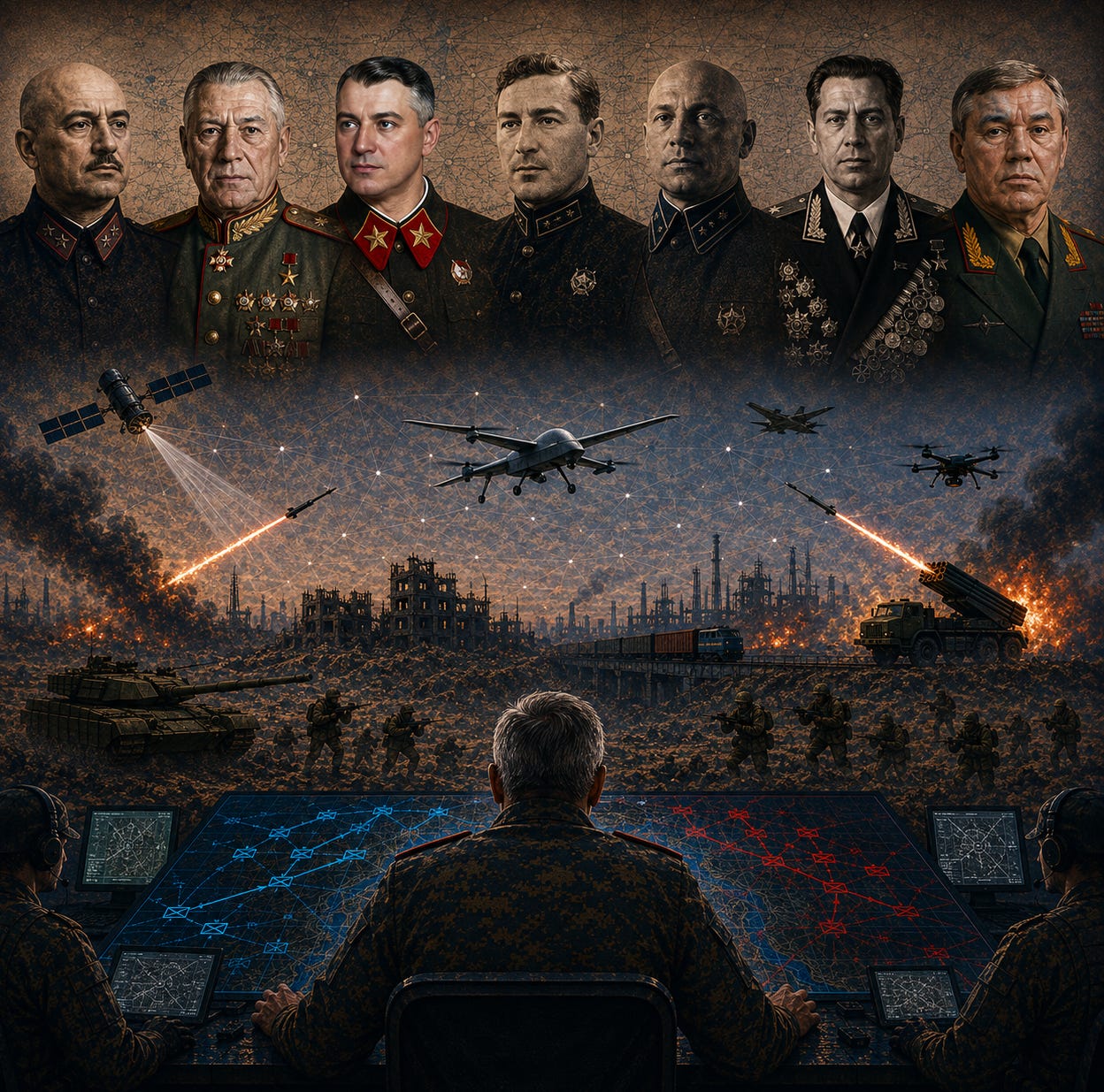
After over four-and-a-half years of war, one question dominates commentary on Ukraine: Why is Russia advancing so slowly across the battlefield? Prior to the fall of Pokrovsk and Konstantynivka, the Washington-based Center for Strategic and International Studies (CSIS) reported that Russian forces were advancing seventy and fifty meters per day, respectively.1 Compared to the great offensives of the Second World War, this pace of progress is unimpressive, reinforcing a common narrative across the social media landscape that Russia’s campaign is strategically ineffective.
Such conclusions, however, assume that time is a key factor for success on the battlefield. Every village captured becomes a scorecard, while every month without a dramatic breakthrough is interpreted as evidence of failure. Moreover, observers forget that Russia is operating in the most heavily fortified, mined, surveilled and drone-saturated battlefield in the world today. Over a decade, NATO has helped Ukraine construct layered defensive fortifications while enabling Kiev to access Western intelligence, financing, military training and sophisticated weaponry. Russia is thus fighting to defeat a mobilized state whose military effort is sustained by the industrial, financial and intelligence resources of a much larger NATO coalition. As such, the question is not why this task is slow but why anyone should expect it to be fast.
This raises an even more fundamental question. Is the assessment of success the same for the Russian General Staff as it is for the external observer? While this essay does not claim be privy to the classified operational plans of the Russian military leadership, it does claim that there is a recognizable thread that runs through the writings of seven prominent Russian military thinkers in modern history – Aleksandr Svechin, Boris Shaposhnikov, Mikhail Tukhachevsky, Vladimir Triandafillov, Georgii Isserson, Nikolai Ogarkov and ultimately General Valery Gerasimov.
Across a century of profound change, these thinkers have focused on understanding the character of war, organizing the state accordingly, destroying the enemy’s operational system, sustaining offensive momentum and adapting military methods to technological change. Viewed through this intellectual tradition, territorial speed is only one variable in the General Staff’s calculations. Russian operational thought sheds light on several factors that might constrain Russian commanders from accelerating the campaign. These relate primarily to concerns around incurring higher casualties, exposing larger formations to destruction and risking exhausting the army before achieving the political objectives of this campaign.
Part I: Understanding the Character of the War
Aleksandr Svechin: Strategy Determines Operational Tempo
All military campaigns start with a deceptively simple question: How do individual battles produce strategic victory? For Aleksandr Svechin, known as the “Soviet Clausewitz” and for pioneering the concept of “operational art”, the answer lay in recognizing an intermediate level of warfare between tactics and strategy. Winning battles alone did not guarantee victory. Modern wars were won by linking tactical successes together through a sequence of operations designed to achieve political objectives.
Svechin explains in his foundational 1926 work Strategiya (Strategy):
«Боевые действия являются не чем-то самодовлеющим, а лишь основным материалом, из которого слагается операция… Нормально этот путь к конечной цели распадается на ряд операций… Мы называем операцией такой акт войны, в течение которого усилия войск без всяких перерывов направляются… к достижению определенной промежуточной цели.»2
“Combat actions are not something self-sufficient, but only the basic material from which an operation is formed… Normally, the path to the final objective is divided into a series of operations… We call an operation such an act of war during which the efforts of the troops are directed continuously toward the achievement of a particular intermediate objective.”
This formed the foundation of Soviet Operational Art. Tactical engagements were valuable insofar as they supported the operational design. Operations in turn were significant only as long as political objectives were being pursued. Towns like Bakhmut or Avdiivka are not captured because of their intrinsic value, but because of the role they play within an operational campaign.
Svechin’s second enduring insight was that strategy must distinguish between wars seeking rapid annihilation (сокрушениe) and those requiring the progressive attrition of the enemy (измор). These were not moral preferences but strategic responses to different military conditions. As he explains:
«…грань между сокрушением и измором нужно искать не вне, а внутри вооруженного фронта.»3
The boundary between annihilation and attrition must be sought not outside, but within the armed front itself.
This distinction provides a useful perspective for assessing Ukraine. Instead of determining why Russia has not undertaken sweeping offensives for a breakthrough, Svechin would want to first determine whether the conditions for such a breakthrough exist. If they do not, the next question is whether successive operations have progressively weakened Ukraine’s ability to sustain organized resistance.
Boris Shaposhnikov: Mobilization Takes Time
While Svechin emphasized strategy, politics and the uncertainty of war, Boris Shaposhnikov focused on the General Staff and preparing the state for modern war. A Marshal of the Soviet Union, Shaposhnikov defined the General Staff as the institution responsible for coordinating the entire war. This included everything from national mobilization to industry and transportation. His landmark 3-volume work Mozg Armii (The Brain of the Army) remains a foundational text in Russian military education including the General Staff Academy of the Armed Forces. The book’s central insight is that the military system must be designed around the character of the conflict it is actually fighting:
«Характер будущей войны определяет и характер самой мобилизации».4
“The character of the future war determines the character of mobilization itself.”
This principle offers one explanation for Russia’s conduct after February 2022. What began as a limited coercive operation aimed to bring Ukraine to the negotiating table became a prolonged industrial war against a mobilized Ukrainian state supported by the full resources of NATO. Shaposhnikov may have advised that such a change would require not just tactical adaptation but the gradual reconstruction of the military system itself. This would entail generating formations, expanding industrial production, replacing equipment and sustaining repeated campaigns.
He explicitly connected a strategy of attrition with the progressive mobilization of forces not initially committed:
«Стратегия измора вызвала к жизни постепенность мобилизации, приведение в боевую готовность не использованных в начале войны сил и средств».
“The strategy of attrition brought forth the gradual character of mobilization – the bringing to combat readiness of forces and means not employed at the beginning of the war.”
President Vladimir Putin’s partial mobilization announcement of September 21, 2022, illustrates this principle. Following Ukraine’s counteroffensive that recaptured 12,000 square kilometers of territory under Russian control, Moscow realized that further mobilization was required to increase combat power. At the same time, committing additional manpower would not result in a rapid advance. The 300,000 reservists who were called-up had to be trained, equipped, organized and integrated into new and existing formations before they could generate operational effect.
Part II: The Search for Operational Depth
While Svechin and Shaposhnikov focused primarily on the relationship between strategy, mobilization and the state, Tukhachevsky, Triandafillov and Isserson further explored the operational level of war. Their thinking focused on answering how modern armies could restore operational maneuver against increasingly resilient and deep defensive formations. This was a common question that was left unresolved since the First World War.
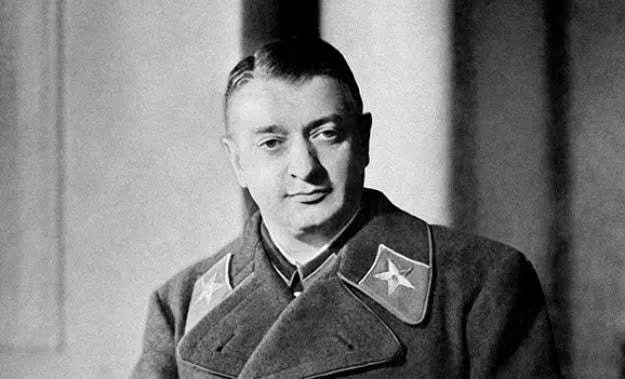
Mikhail Tukhachevsky: Operational Disintegration Matters More than Territorial Speed
Tukhachevsky was a Marshal of the Soviet Union and one of the country’s foremost military reformers. Referred to as the “Red Napoleon,” he helped develop the conceptual foundations of “Glubokiy Boy” (Deep Battle) in the 1930s.
Tukhachevsky argued that modern armies fought as integrated systems sustained by logistics, manpower, communications, command structures and artillery that extended far beyond the front trenches. According to him:
«Как по фронту, так и в глубину боевой порядок должен быть поражаем атакой соединенных сил артиллерии и пехоты, а также и прочих родов войск по отдельным, наиболее важным, расчленениям его, при нейтрализации всех прочих.»5
“Both along the front and in depth, the enemy’s battle formation must be struck by the combined attack of artillery and infantry, as well as the other arms, against its individual and most important components, while the remainder are neutralized.”
If the adversary managed to preserve its resources to restore the front, then success at the tactical level would achieve little. Victory depended on disrupting the entire military system rather than just destroying frontline units. The decisive condition was operational disintegration.
From this perspective, Russia appears more focused on degrading Ukraine’s command, drone-support networks and logistics rather than occupying towns. Simultaneously, Ukraine also reveals the limits of Deep Battle. The constant presence of drones, minefields and long-range weapons systems makes it significantly harder to convert local tactical penetrations into wider operational collapse. While the technology has evolved, the operational objective remains consistent.
Vladimir Triandafillov: Sustaining Successive Echelons Limits Tempo
If Tukhachevsky provided the vision of Deep Battle, Vladimir Triandafillov explained how it could be achieved. In The Nature of the Operations of Modern Armies (1929), he argued that modern industrial armies could no longer be destroyed in one decisive battle:
«Если поставленная перед армией задача имеет не местное значение, а преследует решительную цель… должно быть предусмотрено значительное проникновение в глубину расположения противника, немедленное нанесение вслед за первым ударом второго, третьего и последующих, с тем чтобы довести противника до полного поражения.»6
“If the task assigned to the army is not merely local but seeks a decisive objective, then it must provide for a significant penetration into the enemy’s depth, followed immediately by a second, third, and subsequent blows, in order to bring the enemy to complete defeat.”
This insight formed the basis of the Soviet concept of successive echelons. Instead of committing all forces at once, the first echelon would penetrate the tactical defenses, following which succeeding echelons would penetrate the breach created and destroy the enemy’s logistics and command posts before it could restore the front again. Thus, victory emerged from sustaining offensive momentum through successive waves of combat power.
For Triandafillov, however, this was fundamentally a problem of logistics and force generation. Operational tempo depended upon sufficient troop density, reserves, engineering support, transportation and ammunition to sustain each echelon as the offensive advanced.
In Ukraine’s drone-saturated environment, where minefields, constant surveillance and precision munitions reveal each force concentration, the challenge of supporting successive echelons has become far more difficult than achieving the initial breakthrough. As such, deep operations must proceed gradually since logistics and follow-on forces determine the pace of advance.
Georgii Isserson: Campaigns Are Continuous, Not Isolated Operations
Isserson, another prolific writer on military strategy and a contemporary of Tukhachevsky and Triandafillov, further expanded the operational concepts in their works. He argued that modern war should no longer be understood as a succession of separate operations. In The Evolution of Operational Art (1937), he wrote:
«Современная операция не представляет собой единовременного оперативного усилия на одном участке. Она складывается из ряда непрерывных оперативных усилий, сливающихся в одно общее целое. Ряд последовательных операций составляет современную операцию.»7
“A modern operation does not constitute a single operational effort in one sector. It consists of a series of uninterrupted operational efforts merging into one unified whole. A series of successive operations constitutes the modern operation.”
Isserson provides another compelling answer as to why Russia’s campaign should be assessed by whether successive operations cumulatively degrade Ukraine’s ability for organized resistance rather than by the speed of territorial advances. The objective is to link a continuous series of operations that gradually attrit the enemy’s ability to wage war until it can no longer regenerate combat power.
Part III: Technology Changes But Operational Art Endures
Nikolai Ogarkov: The Reconnaissance-Strike Complex Changes How Operational Depth is Perceived
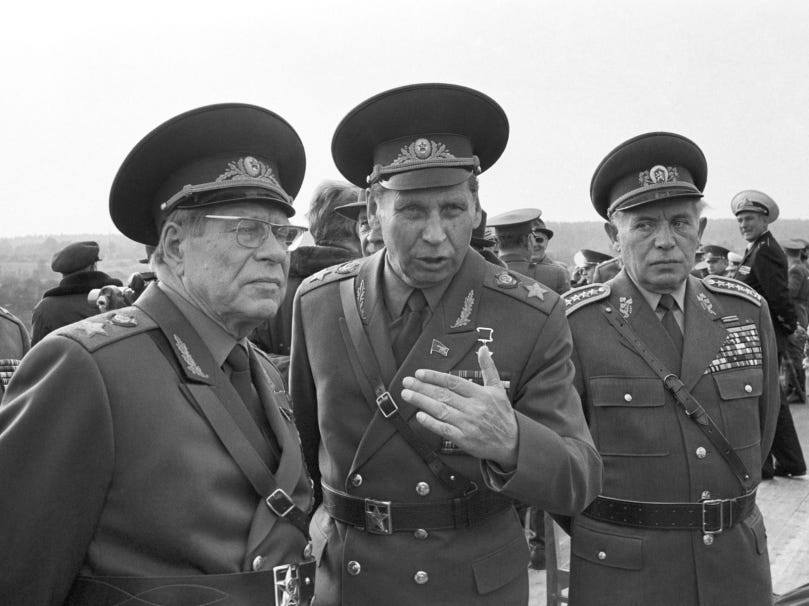
Marshal Nikolai Ogarkov, Chief of the Soviet General Staff during 1977-1984, became the leading proponent of the transformation of conventional warfare through the domains of information, precision strike and automated command systems that would eventually become known as the Revolution in Military Affairs (RMA). Based on the operational theory developed by Tukhachevsky, Triandafillov and Isserson, he contended that improvements in reconnaissance, communications and precision weaponry would radically alter how operational depth was achieved. The future army would no longer depend mainly on mechanized forces to breach the enemy’s rear, but would employ its operational depth to strike at all levels of the enemy’s operational system through what would become known as the reconnaissance-strike complex (RSC).
Ogarkov’s vision laid the intellectual foundation for the Russian military’s transformation after 2008. The reforms first launched by the former Minister of Defense Anatoly Serdyukov and subsequently by Sergey Shoigu and General Gerasimov, trace their origins to Ogarkov. These reforms focus on flattened command structures, high-readiness combined-arms formations, strategic joint commands, reconnaissance-strike loops, integrated service operations and non-nuclear strategic deterrence.
Ukraine represents the realization of that vision. Information now moves faster than armies. Targets are detected in seconds and strike cycles have been compressed from hours to minutes. Firepower can reach deep into the enemy’s operational rear without first physically occupying it. Operational depth is increasingly generated through reconnaissance, precision munitions and electronic warfare than by mechanized penetration alone.
Valery Gerasimov: Operational Art Meets the Transparent Battlefield
If Ogarkov foresaw the reconnaissance-strike battlefield, then General Valery Gerasimov is the first Russian Chief of the General Staff to conduct a large-scale conventional war on it. While his writings do not depart from the principles of Soviet operational art, they are modified to adapt to a time where surveillance, unmanned systems, electronic warfare and precision strikes dominate.
In fact, Gerasimov faces the problem of no longer gaining operational depth but sustaining the combat capabilities required to use it. Any concentration of forces and logistics is vulnerable to satellite surveillance followed by drone strikes. Command post operations need to be kept mobile and maneuver coordinated with electronic warfare to defeat the enemy’s reconnaissance-strike capabilities.
This provides one answer to the central question of the essay. The comparatively slow pace of Russian operations need not be interpreted as a lack of maneuver. In an open battlefield, the tempo of operation increasingly depends on the survivability of forces to seize temporary windows of opportunity to maneuver. Commanders thus face a dilemma between retaining their combat capability and accelerating territory capture.
All of this does not mean Russian operational theory has been flawlessly executed. It explains why commanders would prefer to preserve combat power instead of accelerating the advance across the frontlines at the risk of higher casualties. The analysis also does not rule out competing explanations around command problems, logistics issues or political constraints facing the Russian military. What matters is that the discussion on operational art provides another framework to assess the conduct of Russian operations.
The history of Russian military thought thus suggests that battlefield speed has never been an end in itself. From Svechin to Gerasimov, it is the gradual degrading of the war-fighting system of the enemy that has been consistently sought in order to achieve political objectives. If this intellectual tradition is genuinely considered, the key question is not why Russia advances at such a slow pace, but whether the tempo of its operations is consistent with the strategic logic that has shaped Russian operational art for more than a century.
Kautilya The Contemplator is a reader-supported publication. To receive new posts and support my work, please consider becoming a free or paid subscriber. I will always be grateful for your support.