By Kautilya The Contemplator, Substack, 10/6/26
I was recently speaking with a former college professor whom I have known for almost thirty years. A scholar of Russian history, politics and international relations, he also lived the history that he would later teach. He grew up in the Soviet Union, graduated from the prestigious Moscow State Institute of International Relations (MGIMO) in the early 1970s and became a Soviet diplomat. Following the dissolution of the USSR, he moved to the United States.
Our conversation gravitated toward a dimension of the conflict in Ukraine that strategic commentators rarely touch upon. For my professor, as well as many Ukrainians and Russians of his generation who grew up in the Soviet Union, footage of damaged power stations, factories, mines and bridges carry a grief that most battlefield maps cannot explain. Infrastructure like the Azovstal Iron and Steel Works, the Dnipro Hydroelectric Station, power transmission networks, numerous bridges and railway structures are all iconic Soviet industrial feats that have been largely blown up or bombed. These structures belonged to the landscape of their lives. They were symbols where they studied and travelled, where their parents and grandparents worked and invested their lives in the belief that they were building the future. While the conflict today has divided political judgments profoundly, the sense of loss nonetheless crosses boundaries that now divide.
The destruction in Ukraine cannot be measured only in terms of endangered civilian lives, loss of energy provision, food and other production. It is also the destruction of an accumulated inheritance. It is the dismantling of the physical foundations of a society that generations once expected their children to inhabit. Understanding this loss requires a history that goes far beyond the conventional narrative in the West that Russia is the inexplicable aggressor and Western countries are disinterested spectators. Western decisions about NATO expansion, overt support to extremist and anti-Russian groups, the policies of the current Zelensky regime and the strategic use of Ukraine as a proxy against Russia firmly belong in the explanation of this confrontation.
Ukraine’s significance was never only confined to its location on a map or as a “geopolitical pivot” as former national security adviser Zbignew Brzezinski called it in his book The Grand Chessboard: American Primacy and its Geostrategic Imperatives.1 It also was about what people had built there together and what later became its industrial and human inheritance.
The Industrial Heart of a Revolutionary State
Ukraine played perhaps the central role in the Soviet economic project. Not only was it well-endowed in mineral resources like coal and iron ore but also brought together agricultural production, industrial experience and access to major transport routes. Its development did not begin during Stalin’s industrialization programs during the 1920s and 1930s. The Donbas and the southern metallurgical districts already possessed substantial industry before the 1917 Bolshevik Revolution. Soviet leaders inherited this resource base, restored it after war and expanded it dramatically.
In his December 1921 report to the Ninth All-Russia Congress of Soviets, Vladimir Lenin described the Donbas Basin as “the main center of our large-scale industry.”2 Without fuel and functioning factories, the young Bolshevik state would be unable to sustain production and establish the economic relationship between workers and peasants on which its survival depended. The region was important not only because of its coal seams. It’s miners, railway and metalworkers already formed an organized proletariat and would provide the production capacity base of the new state.
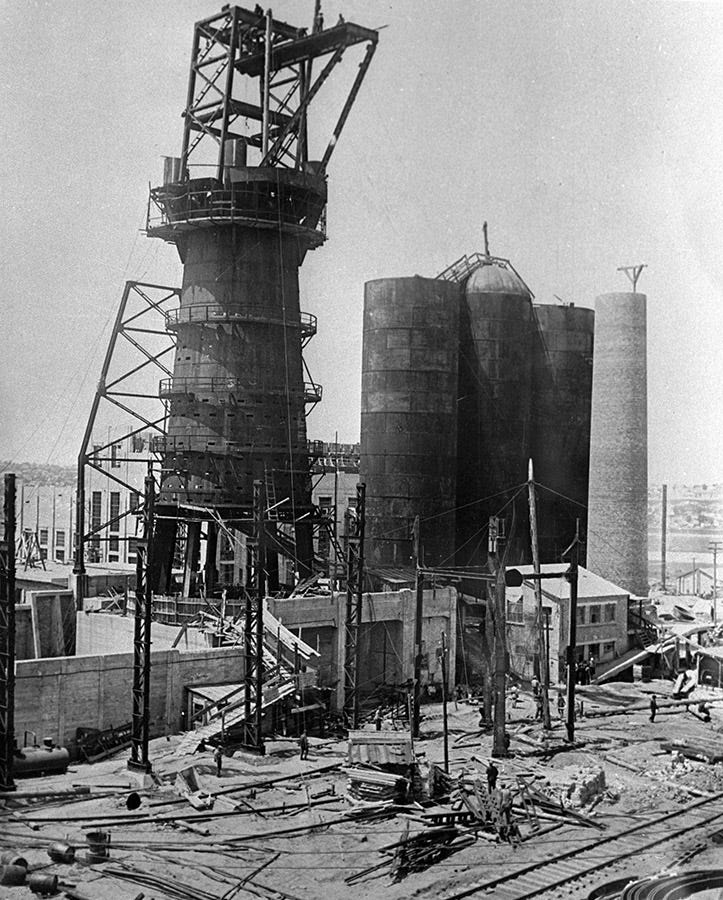
This ambition was taken even further. During the First Five-Year Plan (1928-1932), around 400 of roughly 1,500 new industrial plants (~27 percent) built across the Soviet Union were located in Ukraine.3 During the second, around 1,000 of 4,500 (~22 percent) were also there. This was an all-union undertaking and brought together labor, planners and engineers from all across the USSR. Ukraine would demonstrate that socialism could transform an economy and society.
The Dnipro Hydroelectric Station: The Future Becomes Visible
Few projects expressed the ambition of industrial development as the DniproHES, that began operating in 1932. The National Museum of the Holodomor in Kiev documents construction workers living in barracks and dugouts surrounding the emerging industrial complex.4 The museum’s oral-history collection describes how employment could provide a small ration and a chance of survival for people escaping hunger in the countryside. Construction was both punishing work but many considered it a refuge. Food and accommodation were inadequate. Liudmyla Yehorchenko, a seven-year old in 1932, whose parents worked at the complex, recollects watching frequent funeral processions passing her street.
Its construction also reveals a history obscured by today’s geopolitical divisions. American engineer Hugh L. Cooper advised on the design and construction of the dam. General Electric provided five generators. Another four were manufactured at the Electrosila plant in Leningrad to GE specifications. GE specialists also participated in the project.5 They did not, however, build the entire station. Soviet construction combined domestic labor and engineering with imported American expertise and equipment.
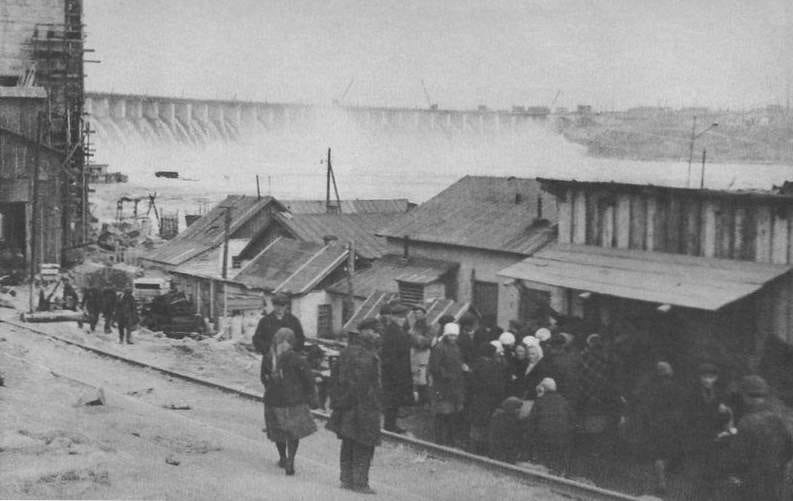
American support did not just entail the delivery of machinery. American engineers worked closely with Soviet labor and became a part of the daily life of this emerging Soviet industrial landscape. Their living conditions, however, were different from those of their Soviet counterparts. They lived near the construction site in a residential area comprising comfortable stone and brick cottages, a sharp contrast to the barracks and dugouts occupied by Soviet workers.
DinproHES supplied metallurgical, chemical and machine-building enterprises. It enabled productive activity far down the industrial chain as entire factories were created that sustained communities. It became a potent emblem of historical change in the early 1930s and the realization of a political promise that was visible in concrete and machinery.
The dam suffered significant damage in August 1941 when retreating Soviet NKVD units blew it up using twenty tons of explosives to slow the German advance. In Fall 1943, retreating German forces blasted the dam in order to slow the Soviet advance. The dam was rebuilt and modernized in 1950. In March 2024 it was struck by missiles and was put out of action.
A World Beyond the Factories
My professor’s recollections of Soviet Ukraine went far beyond its industrial landscape. He remembered it as a place where the achievements of modernization met the advantages of geography. The soil was fertile, fruits and vegetables were plentiful, the climate was more forgiving than in other parts of the USSR and there was easy access to the Black Sea. Odessa and Mykolaev belonged to this remembered world alongside the factories. Crimea occupied a special place. It was a southern destination of warmth and seaside holidays, something like a Florida on the Black Sea. This does not mean that every Ukrainian household enjoyed a higher standard of living relative to other regions of the USSR. However, it captures the importance of food, climate, landscape, recreation and the way people experienced their lives.
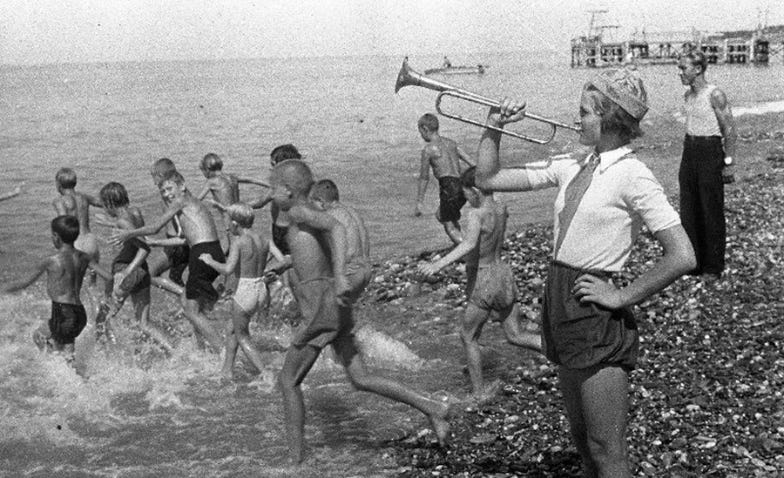
This is why the destruction of familiar places has brought so much grief to people who otherwise have diverging political opinions. Underneath these memories was my professor’s conviction that this calamitous conflict could have been avoided. His remembrance gives that argument a human dimension. The consequences of Western policy and its relentless pursuit of conflict with Russia is being borne by people whose homes, livelihoods and inherited world occupy the territory that is being used as a proxy to fight this war.
Shared Memory and the Limits of Restraint
The timing of Russia’s escalation in Ukraine since 2022 deserves attention. There were limited attacks on Ukrainian infrastructure such as railway facilities and the Zatoka bridge in the spring of 2022. The sustained campaign against Ukraine’s electricity system started in the autumn of 2022. Attacks against power generation facilities has dramatically increased over the past several months. The recent attacks on major Kiev bridges also belong to an expanding pattern rather than marking the first Russian strikes on bridges.
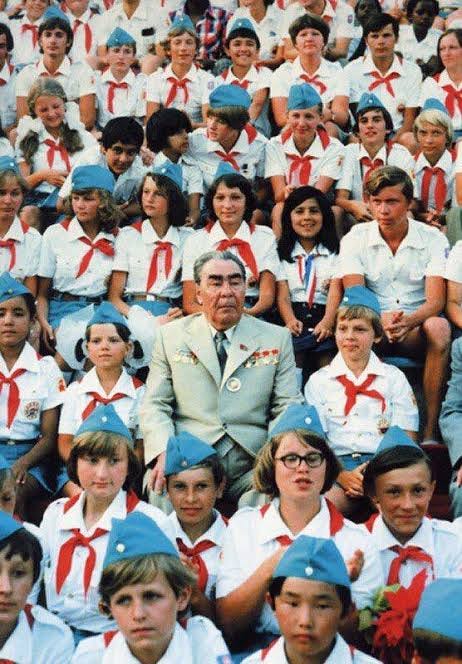
Could shared Soviet memory have contributed to earlier limits? The possibility merits consideration. Putin’s political outlook places significant weight on the historical relationship between Russia and Ukraine. In his July 2021 essay on their relationship, he described the division between the two nations as a common tragedy and emphasized the economic advantages he believed continued cooperation could have preserved.6 Irrespective of how contested his interpretation of that history is, it nonetheless shows that this shared Soviet memory occupies some place in his political imagination. Putin himself has presented some limits as deliberate. In April 2024, he said Russia had held back certain energy attacks during winter for humanitarian reasons.
There is also an irony to all of this. Infrastructure that may have been understood as a shared inheritance and thus considered worth preserving, increasingly becomes the medium through which Russia is ratcheting up the pressure on Kiev. The longer the confrontation continues, military considerations increasingly replace expectations of a future relationship.
What Future Generations Must Inherit
My professor’s memories return us to the question of what will remain for those who must live together after the fighting ends? Reconstruction needs security, productive livelihoods and the confidence that what is rebuilt will endure. Children should be able to inherit their families’ memories without inheriting an obligation to continue their conflicts. The generations who built Ukraine’s industrial world suffered immense hardship because they believed that future generations would live better. Honoring that labor means preserving the possibility of such a future.
Reconciliation will take several generations and will require more than just repairing bridges or rebuilding power stations. It will require acknowledging suffering, reconnecting divided families and allowing people to mourn without demanding that their grief conform to an official narrative. A shared past cannot compel forgiveness, but it can serve as a starting point for recognizing humanity across the divide.
Kautilya The Contemplator is a reader-supported publication. To receive new posts and support my work, please consider becoming a free or paid subscriber. I will always be grateful for your support.
1 Zbigniew Brzezinski, “The Grand Chessboard: American Primacy and Its Geostrategic Imperatives”, New York, Basic Books, 1997), p46.
2 V. I. Lenin, “The Home and Foreign Policy of the Republic: Report of the All-Russia Central Executive Committee and the Council of People’s Commissars,” December 23, 1921, in Collected Works, 2nd English ed., trans. George Hanna, vol. 33 (Moscow: Progress Publishers, 1965), 141–81, reproduced in “Ninth All-Russia Congress of Soviets,” Marxists Internet Archive
3 Internet Encyclopedia of Ukraine, s.v. “Five-year plan,” Canadian Institute of Ukrainian Studies, accessed October 6, 2026.
4 National Museum of the Holodomor-Genocide, “Zaporizhzhia during the Holodomor-Genocide,” May 21, 2025.
5 General Electric, “Инженеры GE помогли осуществить самый знаковый проект СССР 1930х—строительство Гидроэлектростанции ДнепроГЭС” [GE Engineers Helped Implement the USSR’s Most Iconic Project of the 1930s—the Construction of DneproGES], GE News.
6 Vladimir Putin, “On the Historical Unity of Russians and Ukrainians,” July 12, 2021, President of Russia, http://en.kremlin.ru/events/president/news/66181