Below is the US State Dept. press briefing following the bilateral meeting in Geneva between the US and Russia. The main takeaways are 1) US proposed possibility of agreement regarding limits on placement of missiles in Europe similar to INF Treaty between US and Russia (this would be consistent with Russia’s report of Putin’s phone call with Biden on December 7, 2021 in which it was asserted by Putin’s adviser Yuri Ushakov that “Biden made it clear that the US does not intend to deploy offensive strike weapons in Ukraine.”,** 2) US reiterated its position that agreement to not expand NATO membership further is a “non-starter,” and 3) further discussions are expected later this week between the two countries regarding moving forward with more bilateral diplomacy.
**Shoutout to Ray McGovern for discussing this in a recent interview with Regis Tremblay and an article.
Members of the Defense Department also were present at the talks between Deputy Secretary of State Wendy Sherman and Deputy Foreign Minister Sergei Ryabkov which lasted for about 8 hours. The Pentagon also held a shorter press briefing that partially addressed the bilateral meeting and related issues.
Below is the press briefing by Deputy Foreign Minister Ryabkov and Russia’s permanent representative to the UN office Gennady Gatilov. The discussions were described as “difficult” and “detailed.” It was explained that Russia will have a better understanding of progress on their concerns after the NATO-Russia Council meeting to be held in Brussels on January 12th and the meeting between Russia and the OSCE on the 13th. “The key issues are still pending and we do not see that there is understanding from the American side of how imperative these matters need to be resolved in the key that will make us happy.”
With respect to US’s position that agreement to not expand NATO any further is a non-starter: “It goes to show they underestimate the seriousness of the matter and that’s bad.” Ryabkov later made the following comment regarding Ukraine and Georgia in NATO in response to a reporter’s question: “We are fed up with loose talk, half-promises, misinterpretations. We need ironclad, waterproof, bulletproof, legally binding guarantees – not assurances – guarantees with all the words ‘shall’, ‘must’….It’s a matter of Russia’s national security.”
Note: press briefing starts at around the 15 minute mark
An American Russia expert recently observed that diplomacy is not a reward for good behavior. Rather diplomacy is a necessary activity required for averting war. Skilled diplomacy requires one to understand the perceived interests of the other side and what shapes those perceptions. This helps both sides to arrive at a mutually agreeable resolution that takes into account the most serious concerns of each. The Biden administration would be wise to give a fair hearing to the security concerns of the world’s other nuclear superpower at the upcoming meeting with Russia on January 10th in order to avert unnecessary escalation in Eastern Europe.
As Putin gets further into what could be his final term as president, he has decided to try to get a meaningful resolution to one of his top priorities: ensuring Russia’s national security. If he can successfully resolve this issue, he may feel freer to open up the purse strings and invest more in his other top priority: raising Russia’s living standards, which have fallen behind as a result of the austerity that has been imposed as the Russian government has focused on macroeconomic stability to make the economy “sanction-proof.”
He has started by offering a proposed draft agreement between Russia and the US and one between Russia and NATO that guarantee no further eastward expansion of NATO and no stationing of US/NATO troops in Ukraine or intermediate- and short-range missiles in Europe.
While it may seem like Russia is making extreme demands and offering no concessions of its own in return, one must keep a few points in mind. First, at the beginning of negotiations, parties will typically start with maximalist positions with the idea that they will be whittled down during talks to something they can live with. Second, Russia has genuine security concerns that many Americans are not aware of because most media has made little attempt to explain Russia’s perspective with regard to its disagreements with the US-led west.
Lacking some of the natural barriers that Americans take for granted, Russia has a history of invasions from the West, including Germany twice in the 20th century – having come through the Polish/Ukrainian corridor. Hitler’s invasion in WWII resulted in around 27 million dead Soviets and destruction of a third of the country. These perceived security interests are driven by historical experience and therefore represent a Russian view, not simply a Putin view.
With this heavy history, Mikhail Gorbachev was hesitant to allow a reunified Germany during 1990 negotiations with western leaders. Declassified government documents reveal that in order to secure Gorbachev’s agreement, he was promised verbally more than once by US Secretary of State James Baker and other western officials that NATO would not move “one inch eastward.”
After the mutually negotiated end of the Cold War and subsequent dissolution of the Warsaw Pact, NATO had lost its reason for existence and had to resort to finding other justifications for remaining in business. This project was assisted by political ideologues , such as Zbig Brzezinski and Neoconservatives, as well as intense defense contractor lobbying which helped spur NATO expansion rather than a re-negotiation of a European security architecture that would ensure the security of all parties. From Russia’s perspective, it made sense to ask: if the Cold War had ended, Russia had voluntarily given up its empire and was no longer an enemy, then why was NATO being expanded with Russia excluded from these new security arrangements?
Not only has the US overseen several rounds of NATO expansion since 1999, it has unilaterally withdrawn from several important treaties governing arms control. The first is the ABM Treaty, the abrogation of which Russia viewed as a threat to its nuclear retaliatory capability. There is also the INF Treaty, the dissolution of which will now allow the US to potentially station intermediate range missiles in Europe, representing another perceived danger to Russia’s security interests.
Then there was the US-supported coup that removed the corrupt but democratically elected leader of Ukraine in 2014, which sparked deeper dissension in a country that has political and cultural divisions that go back centuries. The cold hard reality is that Ukraine has more strategic and historical significance to Russia than it could ever have to the US thousands of miles away. Russia also has the advantage of proximity in the event of a military conflict. The US should seriously reconsider the wisdom of paying lip service to Ukraine’s military defense for any such scenario. Ukraine is the poorest country in Europe and also one of the most corrupt. Ukraine would provide no benefit to NATO as a member and it’s safe to say that neither Americans nor most Europeans would be willing to die for it. Ukraine would be best served if it were militarily neutral and allowed to negotiate economically beneficial relations with both Russia and the West, with the most extreme political elements in the country discouraged from their most reckless inclinations.
It’s time for the US to get beyond its post-Cold War triumphalist mentality and pursue practical diplomacy with Russia. Insisting that all countries have the right to decide what military alliances they join without regard to the larger real world context is a nonstarter. Everyone knows the US would never take this attitude if Russia and China decided to lure Canada or Mexico into joining a military alliance with them.
The Russia of 2022 is not the Russia of the 1990’s. In order to get something, the US-led west will now have to give something. That means a willingness to seriously address Russia’s security concerns. It remains to be seen if the US is capable of the shift in mindset needed to rise to the occasion.
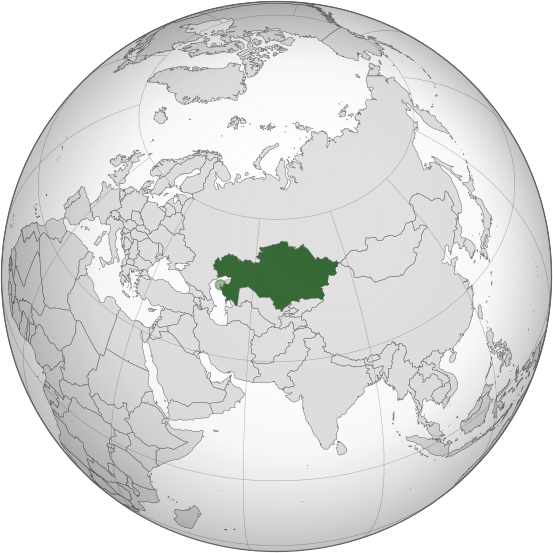
Land controlled by the Republic of Kazakhstan shown in dark green. bySsolbergj + own work, Aquarius.geomar.deThe map has been created with the Generic
Below are excerpts from two articles about the recent unrest in Kazakhstan. The second is by Pepe Escobar and explains that it is , at least partly, being driven by outsiders as some sort of attempt at a color revolution. The first article, a comprehensive one by Dmitry Plotnikov and published by RT, takes a more nuanced view of the situation. – Natylie
Nationalists are on the rise’: How protests in Kazakhstan turned violent & why Russia feels it can’t stay silent
What’s behind the current violent unrest in Kazakhstan and why is political stability in this huge former Soviet republic of such great importance to Russia?
Events in Kazakhstan are unfolding at breakneck speed, with the situation changing on an hourly basis. Initially, it seemed that protests against soaring energy prices would not turn into anything more serious. Since then, however, the country has asked for help from the Collective Security Treaty Organization (CSTO), a Russia-led military bloc, and its soldiers have engaged in fierce street battles with armed marauders.
Kazakhstan has always been viewed as one of the most stable post-Soviet countries, with the transition of power from its first president to his successor, managed by the local elites, initially seen as smooth and efficient. However, today the country is perhaps facing its toughest challenge since it became independent 30 years ago. RT has analyzed the reasons behind the unrest in Kazakhstan.
Footage of protests in Kazakhstan has spread all over the world. Demonstrators are forcing their way into public buildings, driving away military vehicles, and disarming soldiers. They have set on fire the mayor’s office in Almaty, the country’s largest city and second capital, which has now turned into the epicenter of the protest movement.
The unrest, however, appears to be mostly spontaneous and uncontrolled. It seems there are no leaders to organize the crowds, nor has any political party spearheaded the protest movement yet. The government simply does not know who to negotiate with, while the demonstrators are gaining control of many of Kazakhstan’s public buildings, as well as storming and destroying the offices of the Nur Otan ruling political party and national television channels.
The protests started on January 2 in western Kazakhstan when the price of fuel went up. Liquefied Natural Gas (LNG) is used by most local citizens as car fuel instead of gasoline. The government refused to continue subsidizing its price and made it clear that, from then on, the cost of LNG will be controlled solely by the market. And it doubled immediately – from 60 to 120 tenge per liter (from $0.14 to $0.28). The government believes that this step will “allow for the obtaining a balanced gas price based on demand and supply” as well as “attracting investment” for new production capacities. The authorities claim that the old model resulted in gas producers being constantly at a loss – the business was unprofitable for them.
Protests flared up in the town of Zhanaozen and quickly spread to the west and north of the country. Demonstrators blocked traffic in the central parts of Kazakhstan and demanded that LNG prices be brought down to previous levels. Many also wanted to face those public officials, residing in Nur-Sultan, who were responsible for the gas price surge. In the beginning, the protests were mostly peaceful, there were no clashes with the police. However, the situation changed and 69 people were detained by law enforcement on January 2 and 3.
The protests went on and Kazakh President Kassym-Jomart Tokayev instructed his government to address the matter of soaring gas prices. Soon the state press service revealed that an investigation had been launched against owners of Kazakhstani gas stations, aimed at identifying price-fixing cartels, and the government promised to “introduce a set of measures in order to regulate the price of gas.” They also said that some of the local owners had decided to reduce the gas price from 120 to 85-90 tenge (about $0.21) per liter, as required by a social responsibility edict for businesses.
But this was not enough to calm the protesting crowds, who resorted to even more radical actions. On the evening of January 4, violent clashes with law enforcement officers started in many Kazakh towns, which lasted throughout the night. Policemen used batons, tear gas and rubber bullets against protesters, who responded by setting official cars and specialized vehicles ablaze.
In an attempt to soothe the demonstrators, President Tokayev agreed to comply with one of their demands and dismissed the government. Later, there were rumors that early parliamentary elections would be held. However, this second concession again failed to appease the street movement. This may be explained by the make-up of the new government, which did not significantly differ from the previous one. Alihan Smaiylov was appointed head of the new government. In the previous cabinet, he held the post of first deputy prime minister.
It was as if all the concessions only angered the crowds even more. On January 5, they went on to attack and set fire to administrative buildings. At the same time, the police were often reluctant in trying to disperse the demonstrators. Some of them were even seen changing sides.
These protests are drastically different from any previous demonstrations Kazakhstan has seen. The mass movement of 2019, which marked the power transition from longtime leader Nursultan Nazarbayev to Tokayev, were dispersed very quickly and in a violent manner – unlike what we see happening in the country today. A casual onlooker can get the impression that the situation in Kazakhstan grew so tense and exploded in a matter of days, and the government is partly paralyzed.
The head of Moscow’s Eurasian Analytical Club, Nikita Mendkovich, believes the reasons behind these mass protests include not only the country’s difficult economic situation, but also the government’s attempts at flirting with nationalists.
“Over the past year or two, we have seen government attempts at flirting with nationalists and pro-Western groups by introducing anti-Russian measures. By this, the ruling elite antagonized Kazakhstan’s Russian-speaking population, which supports Russia and constitutes the majority in Kazakhstan. As a result, the ruling party lost over one million votes at the parliamentary elections in January 2021. But the nationalist opposition interpreted this as a sign of the ruling regime’s weakness and strived to finish it off,” the analyst said.
As he pointed out, at the moment, the Democratic Choice of Kazakhstan (DVK) and Oyan, Qazaqstan (OQ), which are pro-Western opposition groups, are actively trying to head the protests and use them to promote their own agenda. According to Mendkovich, this is exactly why the government’s willingness to comply with the protesters’ economic demands failed to put an end to the unrest, but, on the contrary, seems to have further radicalized the demonstrators and motivated them to put forward purely political demands.
Roman Yuneman, a Russian political figure who spent the first 18 years of his life in Kazakhstan, agrees with Mendkovich that local nationalists are the basis of the protest movement. “It’s not the liberals, or hipsters, who are protesting – it’s the nationalists and patriots. That’s why you can see so many of them holding the national flag, and some are even singing Kazakhstan’s anthem,” he said. Yuneman points out that today’s protests have the largest scale in the history of independent Kazakhstan.
So is that much fear and loathing all about gas? Not really.
Kazakhstan was rocked into chaos virtually overnight, in principle, because of the doubling of prices for liquefied gas, which reached the (Russian) equivalent of 20 rubles per liter (compare it to an average of 30 rubles in Russia itself).
That was the spark for nationwide protests spanning every latitude from top business hub Almaty to the Caspian Sea ports of Aktau and Atyrau and even the capital Nur-Sultan, formerly Astana.
The central government was forced to roll back the gas price to the equivalent of 8 rubles a liter. Yet that only prompted the next stage of the protests, demanding lower food prices, an end of the vaccination campaign, a lower retirement age for mothers with many children and – last but not least – regime change, complete with its own slogan: Shal, ket! (“Down with the old man.”)
The “old man” is none other than national leader Nursultan Nazarbayev, 81, who even as he stepped down from the presidency after 29 years in power, in 2019, for all practical purposes remains the Kazakh gray eminence as head of the Security Council and the arbiter of domestic and foreign policy.
The prospect of yet another color revolution inevitably comes to mind: perhaps Turquoise-Yellow – reflecting the colors of the Kazakh national flag. Especially because right on cue, sharp observers found out that the usual suspects – the American embassy – was already “warning” about mass protests as early as in December 16, 2021.
Maidan in Almaty? Oh yeah. But it’s complicated.
Almaty in chaos
For the outside world, it’s hard to understand why a major energy exporting power such as Kazakhstan needs to increase gas prices for its own population.
The reason is – what else – unbridled neoliberalism and the proverbial free market shenanigans. Since 2019 liquefied gas is electronically traded in Kazakhstan. So keeping price caps – a decades-long custom – soon became impossible, as producers were constantly faced with selling their product below cost as consumption skyrocketed.
Everybody in Kazakhstan was expecting a price hike, as much as everybody in Kazakhstan uses liquefied gas, especially in their converted cars. And everybody in Kazakhstan has a car, as I was told, ruefully, during my last visit to Almaty, in late 2019, when I was trying in vain to find a taxi to head downtown.
It’s quite telling that the protests started in the city of Zhanaozen, smack into the oil/gas hub of Mangystau. And it’s also telling that Unrest Central immediately turned to car-addicted Almaty, the nation’s real business hub, and not the isolated, government infrastructure-heavy capital in the middle of the steppes.
At first President Kassym-Jomart Tokayev seemed to have been caught in a deer facing the headlights situation. He promised the return of price caps, installed a state of emergency/curfew both in Almaty and Mangystau (then nationwide) while accepting the current government’s resignation en masse and appointing a faceless Deputy Prime Minister, Alikhan Smailov, as interim PM until the formation of a new cabinet.
Yet that could not possibly contain the unrest. In lightning fast succession, we had the storming of the Almaty Akimat (mayor’s office); protesters shooting at the Army; a Nazarbayev monument demolished in Taldykorgan; his former residence in Almaty taken over; Kazakhtelecom disconnecting the whole country from the internet; several members of the National Guard – armored vehicles included – joining the protesters in Aktau; ATMs gone dead.
And then Almaty, plunged into complete chaos, was virtually seized by the protesters, including its international airport, which on Wednesday morning was under extra security, and in the evening had become occupied territory.
Kazakh airspace, meanwhile, had to contend with an extended traffic jam of private jets leaving to Moscow and Western Europe. Even though the Kremlin noted that Nur-Sultan had not asked for any Russian help, a “special delegation” was soon flying out of Moscow. Kremlin spokesman Dmitry Peskov cautiously stressed, “we are convinced that our Kazakh friends can independently solve their internal problems”, adding, “it is important that no one interferes from the outside.”
Geostrategy talks
How could it all derail so fast?
Up to now, the succession game in Kazakhstan had been seen mostly as a hit across Northern Eurasia. Local honchos, oligarchs and the comprador elites all kept their fiefdoms and sources of income. And yet, off the record, I was told in Nur-Sultan in late 2019 there would be serious problems ahead when some regional clans would come to collect – as in confronting “the old man” Nazarbayev and the system he put in place.
Tokayev did issue the proverbial call “not to succumb to internal and external provocations” – which makes sense – yet also assured that the government “will not fall”. Well, it was already falling, even after an emergency meeting trying to address the tangled web of socioeconomic problems with a promise that all “legitimate demands” by the protesters will be met.
This did not play out as a classic regime change scenario – at least initially. The configuration was of a fluid, amorphous state of chaos, as the – fragile – Kazakh institutions of power were simply incapable of comprehending the wider social malaise. A competent political opposition is non-existent: there’s no political exchange. Civil society has no channels to express itself.
So yes: there’s a riot goin’ on – to quote American rhythm’n blues. And everyone is a loser. What is still not exactly clear is which conflicting clans are flaming the protests – and what is their agenda in case they’d have a shot at power. After all, no “spontaneous” protests can pop up simultaneously all over this vast nation virtually overnight.
Kazakhstan was the last republic to leave the collapsing USSR over three decades ago, in December 1991. Under Nazarbayev, it immediately engaged in a self-described “multi-vector” foreign policy. Up to now, Nur-Sultan was skillfully positioning itself as a prime diplomatic mediator – from discussions on the Iranian nuclear program as early as 2013 to the war in/on Syria from 2016. The target: to solidify itself as the quintessential bridge between Europe and Asia.
The Chinese-driven New Silk Roads, or BRI, were officially launched by Xi Jinping at Nazarbayev University in September 2013. That happened to swiftly dovetail with the Kazakh concept of Eurasian economic integration, crafted after Nazarbayev’s own government spending project, Nurly Zhol (“Bright Path”), designed to turbo-charge the economy after the 2008-9 financial crisis.
In September 2015, in Beijing, Nazarbayev aligned Nurly Zhol with BRI, de facto propelling Kazakhstan to the heart of the new Eurasian integration order. Geostrategically, the largest landlocked nation on the planet became the prime interplay territory of the Chinese and Russian visions, BRI and the Eurasia Economic Union (EAEU).
A diversionary tactic
For Russia, Kazakhstan is even more strategic than for China. Nur-Sultan signed the CSTO treaty in 2003. It’s a key member of the EAEU. Both nations have massive military-technical ties and conduct strategic space cooperation in Baikonur. Russian has the status of an official language, spoken by 51% of the republic’s citizens.
At least 3.5 million Russians live in Kazakhstan. It’s still early to speculate about a possible “revolution” tinged with national liberation colors were the old system to eventually collapse. And even if that happened, Moscow will never lose all of its considerable political influence.
So the immediate problem is to assure Kazakhstan’s stability. The protests must be dispersed. There will be plenty of economic concessions. Permanent destabilizing chaos simply cannot be tolerated – and Moscow knows it by heart. Another – rolling – Maidan is out of the question.
The Belarus equation has shown how a strong hand can operate miracles. Still, the CSTO agreements do not cover assistance in case of internal political crises – and Tokayev did not seem to be inclined to make such a request.
Until he did. He called for the CSTO to intervene to restore order. There will be a military enforced curfew. And Nur-Sultan may even confiscate the assets of US and UK companies which are allegedly sponsoring the protests.
This is how Nikol Pashinyan, chairman of the CSTO Collective Security Council and Prime Minister of Armenia, framed it: Tokayev invoked a “threat to national security” and the “sovereignty” of Kazakhstan, “caused, inter alia, by outside interference.” So the CSTO “decided to send peacekeeping forces” to normalize the situation, “for a limited period of time”.
The usual destabilizing suspects are well known. They may not have the reach, the political influence, and the necessary amount of Trojan horses to keep Kazakhstan on fire indefinitely.
At least the Trojan horses themselves are being very explicit. They want an immediate release of all political prisoners; regime change; a provisional government of “reputable” citizens; and – what else – “withdrawal of all alliances with Russia.”
And then it all gets down to the level of ridiculous farce, as the EU starts calling on Kazakh authorities to “respect the right to peaceful protests.” As in allowing total anarchy, robbery, looting, hundreds of vehicles destroyed, attacks with assault rifles, ATMs and even the Duty Free at Almaty airport completely plundered.
This analysis (in Russian) covers some key points, mentioning, “the internet is full of pre-arranged propaganda posters and memos to the rebels” and the fact that “the authorities are not cleaning up the mess, as Lukashenko did in Belarus.”
Slogans so far seem to originate from plenty of sources – extolling everything from a “western path” to Kazakhstan to polygamy and Sharia law: “There is no single goal yet, it has not been identified. The result will come later. It is usually the same. The elimination of sovereignty, external management and, finally, as a rule, the formation of an anti-Russian political party.”
Putin, Lukashenko and Tokayev spent a long time over the phone, at the initiative of Lukashenko. The leaders of all CSTO members are in close contact. A master game plan – as in a massive “anti-terrorist operation” – has already been hatched. Gen. Gerasimov will personally supervise it.
Now compare it to what I learned from two different, high-ranking intel sources.
The first source was explicit: the whole Kazakh adventure is being sponsored by MI6 to create a new Maidan right before the Russia/US-NATO talks in Geneva and Brussels next week, to prevent any kind of agreement. Significantly, the “rebels” maintained their national coordination even after the internet was disconnected.
The second source is more nuanced: the usual suspects are trying to force Russia to back down against the collective West by creating a major distraction in their Eastern front, as part of a rolling strategy of chaos all along Russia’s borders. That may be a clever diversionary tactic, but Russian military intel is watching. Closely. And for the sake of the usual suspects, this better may not be interpreted – ominously – was a war provocation.
Note: I don’t agree with Macgregor that Russia will invade Ukraine. If the US/NATO do not provide Russia with security agreements it can live with, there are other ways Russia can militarily pressure the US, NATO and Ukraine as has been discussed by Gilbert Doctorow and Patrick Armstrong. Only if Kiev attacks Donbas will Russia engage its military there. But I think the rest of what Macgregor has to say is well worth listening to. – Natylie
Douglas Macgregor, a retired US Army Colonel and former Pentagon senior advisor, analyzes the US-Russia standoff in Ukraine; the aftermath of the US withdrawal from Afghanistan; Trump’s failure to act on 2016 campaign anti-interventionist rhetoric, only to surround himself with neocons; and the ongoing, overlooked US military occupation of Syria after the decade-long CIA dirty war.
“The Military Industrial Congressional Complex,” Macgregor says, “seems to be more powerful than anyone who occupies the office of the presidency.”