There are moments in history when you can almost hear the hinge creak and Tuesday’s news that Russia and China have finally signed a binding agreement on the Power of Siberia 2 (a 50 billion cubic metre pipeline through Mongolia carrying Arctic gas eastward) is one of them.
Unlike the existing line out of Irkutsk, which feeds off reserves to the north of Mongolia, this new artery will carry the Yamal fields, the same gas that helped keep Germany’s factories humming for half a century. What once fuelled Western Europe’s rise will now stoke Beijing’s ambitions as a scheme long stalled by Chinese wariness suddenly becomes reality. Maybe Beijing has finally decided to heed its own ancient proverb: distant water cannot quench a nearby thirst.
Putin, closing out his China trip on Wednesday, underlined the point. Gas through Power of Siberia 2, he said, will be sold at market rates, with no “friendship discounts” for Beijing, whatever the Western press insists. Of course, “market rates” in Beijing’s lexicon are a different animal and the Chinese will try to drive them down toward their own domestic benchmarks.
It’s hard to exaggerate how much the map tilts with this shift, because for decades Russian gas was the bedrock of Germany’s might as an exporter and the hidden muscle that gave Western Europe its edge. For example, this fuel ran at an average of €13–22 per megawatt hour in the last “normal years” of 2018 and 2019. By contrast, in the first half of this year, the same benchmark was €41. Brussels can roar about values and thunder on about sanctions till its lungs give out, but numbers don’t bend to rhetoric.
Nevertheless, the sceptics have a point because fifty billion cubic metres is a sliver beside the 150-odd bcm Gazprom used to pump west each year. China won’t fill the EU’s shoes overnight, but the real shift here is in leverage. Western Europe has lost not just the gas but its standing as Moscow’s anchor customer and that mantle now slips easily to Beijing; on terms Berlin would have killed for. It’s another old proverb brought to life: hoist a rock in rage, only to let it fall on your own foot.
None of this means the deal is a bonanza for Russia because, in an ideal world, its companies would have sold to both east and west, playing them off to drive up returns. The EU’s decision to tear up that balance means Moscow forfeits income; but it loses far less than Western Europe does. For Russia, Power of Siberia 2 offers stability: a guaranteed outlet, even if the prices end up being close to Chinese domestic levels. For Western Europe, the outcome is instability: with higher bills, weaker security of supply, and vulnerability to every winter storm or accident that might close an LNG port in Texas or Qatar.
Even with the advent of Power of Siberia 2, Russia will sell in total about 106 bcm a year to China; still a long way shy of the 150–160 bcm Western Europe once bought. While European countries always paid premium prices, China drives harder bargains so the new project simply won’t bring the profits the old westward flows once did.
Bloomberg put it plainly on Wednesday: the pipeline “will turn the global LNG market upside down” and imperil Washington’s dreams of global energy dominance. If Chinese demand winds up being met by fixed Russian volumes, that will mean up to 40 million tonnes of LNG Beijing will no longer require; half of last year’s imports, although that remains a projection. It is hard to overstate the significance for US exporters, who had counted on China as their growth market.
Of course, the timing’s no accident here given Trump has swung around tariffs like a golf club while Xi has answered in kind, slapping levies on American LNG. And while the White House fumes, Beijing openly takes delivery of its first cargo from Russia’s sanctioned Arctic LNG-2; a move as brazen as it is calculated. China realises that betting on tankers through the Strait of Hormuz is gambling on a choke point the US Navy could close at any moment. And if there’s a fight over Taiwan, that artery will get cut, which leaves only one supplier able to promise steady lifeblood: Russia, with its pipelines over land and its immense reserves.
That truth has finally outweighed Beijing’s old nerves about leaning too heavily on Moscow, and leaving itself vulnerable to any political changes in the Kremlin. Something obviously altered the calculation, maybe it was Brussels’ latest lectures or perhaps Trump’s renewed threats but either way, EU leverage has drained away, and China walks off with a hell of a deal.
And here’s the bitterest irony: a project that started with Willy Brandt in the 1960s (Ostpolitik, the dream of tying East and West together by trade) now lies dead in the ditch. What’s left now is a cut-down continent, severed from the eastern pipe that kept its factories competitive, run by leaders who’d rather wave their fists than accept the facts staring them in the face. Moscow, by contrast, has read the weather and understands that when the wind shifts, you’re better off erecting windmills rather than stacking up sandbags.
And when you look at the frontline players today it can only make you wonder how a region which has produced some of humanity’s greatest ended up with this lightweight bunch of leaders. Von der Leyen, Macron and Merz talk like knights on a crusade but as most of Western Europe’s economies struggle, all they’ve achieved is spiralling costs and a half-continent shackled to LNG at twice the price
While Beijing quietly inks its contracts, Brussels keeps itself busy with morality plays. And nobody’s bills get lighter for all the posturing. Like an old man yelling at a cloud, to borrow a famous Simpsons’ line.
The EU has managed to pull off one of the greatest self-owns you could ever imagine. It’s tossed away the thing that carried its post-war prosperity; the quiet certainty that tomorrow’s power would be there, steady and affordable, same as today’s. That assurance has now crossed to Beijing and it’ll be only when the lights stutter, or bills climb higher, that Western Europeans feel the weight of what their leaders cast overboard in zeal.
All my investigations are free to read, thanks to the enormous generosity of my readers. Independent journalism nonetheless requires investment, so if you value this article or any others, please consider sharing, or even becoming a paid subscriber. Your support is always gratefully received, and will never be forgotten. To buy me a coffee or two, please click this link.
August 1st marked the 50th anniversary of the Helsinki Accords’ inking. The event’s golden jubilee passed without much in the way of mainstream comment, or recognition. Yet, the date was absolutely seismic, its destructive consequences reverberating today throughout Europe and beyond. The Accords not only signed the death warrants of the Soviet Union, Warsaw Pact, and Yugoslavia years later, but created a new global dynamic, in which “human rights” – specifically, a Western-centric and -enforced conception thereof – became a redoubtable weapon in the Empire’s arsenal.
The Accords were formally concerned with concretising détente between the US and Soviet Union. Under their terms, in return for recognition of the latter’s political influence over Central and Eastern Europe, Moscow and its Warsaw Pact satellites agreed to uphold a definition of “human rights” concerned exclusively with political freedoms, such as freedom of assembly, expression, information, and movement. Protections universally enjoyed by the Eastern Bloc’s inhabitants – such as free education, employment, housing and more – were wholly absent from this taxonomy.
Helmut Schmidt, Erich Honecker, and Gerald Ford sign the Helsinki Accords
There was another catch. The Accords led to the creation of several Western organisations charged with monitoring the Eastern Bloc’s adherence to their terms – including Helsinki Watch, forerunner of Human Rights Watch. Subsequently, these entities frequently visited the region and forged intimate bonds with local political dissident factions, assisting them in their anti-government agitation. There was no question of representatives from the Soviet Union, Warsaw Pact, or Yugoslavia being invited to assess “human rights” compliance at home or abroad by the US and its vassals.
As legal scholar Samuel Moyn has extensively documented, the Accords played a pivotal role in decisively shifting mainstream rights discourse away from any and all economic or social considerations. More gravely, per Moyn, “the idea of human rights” was converted “into a warrant for shaming state oppressors.” Resultantly, Western imperialist brutality against purported foreign rights abusers – including sanctions, destabilisation campaigns, coups, and outright military intervention – could be justified, frequently assisted by the ostensibly neutral findings of “human rights” defenders such as Amnesty International, and HRW.
Almost instantly after the Helsinki Accords were signed, a welter of organisations sprouted throughout the Eastern Bloc to document purported violations by authorities. Their findings were then fed – often surreptitiously – to overseas embassies and rights groups, for international amplification. This contributed significantly to both internal and external pressure on the Soviet Union, Warsaw Pact, and Yugoslavia. Mainstream accounts assert the conception of these dissident groups was entirely spontaneous and organic, in turn compelling Western support for their pioneering efforts.
US lawmaker Dante Fascell has claimed the “demands” of “intrepid” Soviet citizens “made us respond.” However, there are unambiguous indications meddling in the Eastern Bloc was hardwired into Helsinki before inception. In late June 1975, on the eve of US President Gerald Ford signing the Accords, exiled Soviet dissident Alexander Solzhenitsyn addressed senior politicians in Washington, DC. He appeared at the express invitation of hardcore anti-Communist George Meany, chief of the CIA-connected American Federation of Labor and Congress of Industrial Organizations (AFL-CIO). Solzhenitsyn declared:
“We, the dissidents of the USSR don’t have any tanks, we don’t have any weapons, we have no organization. We don’t have anything…You are the allies of our liberation movement in the Communist countries…Communist leaders say, ‘Don’t interfere in our internal affairs’…But I tell you: interfere more and more. Interfere as much as you can. We beg you to come and interfere.”
‘Political Aberration’
In 1980, mass strikes in Gdansk, Poland spread throughout the country, leading to the founding of Solidarity, an independent trade union and social movement. Key among its demands was the Soviet-supported Polish government distribute 50,000 copies of Helsinki’s “human rights” protocols to the wider public. Solidarity founder-and-chief Lech Walesa subsequently referred to the Accords as a “turning point”, enabling and encouraging the union’s nationwide disruption, and growth into a serious political force. Within just a year, Solidarity’s membership exceeded over 10 million.
Lech Walesa addresses Polish workers in Gdansk, August 1980
The movement’s inexorable rise sent shockwaves throughout the Warsaw Pact. It was the first time an independent mass organisation had formed in a Soviet-aligned state, and others would soon follow. Undisclosed at the time, and largely unknown today, Solidarity’s activities were bankrolled to the tune of millions by the US government. The same was true of most prominent Eastern Bloc dissident groups, such as Czechoslovakia’s Charter 77. In many cases, these factions not only ousted their rulers by the decade’s end, but formed governments thereafter.
Washington’s financing for these efforts became codified in a secret September 1982 National Security Directive. It stated “the primary long-term US goal in Eastern Europe” was “to loosen the Soviet hold over the region and thereby facilitate its eventual reintegration into the European community of nations.” This was to be achieved by; “encouraging more liberal trends in the region…reinforcing the pro-Western orientation of their peoples…lessening their economic and political dependence on the USSR…facilitating their association with the free nations of Western Europe.”
In August 1989, mere days after Solidarity took power in Poland, marking the first post-World War II formation of a non-Communist government in the Eastern Bloc, a remarkable op-ed appeared in the Washington Post. Senior AFL-CIO figure Adrian Karatnycky wrote about his “unrestrained joy and admiration” over Solidarity’s “stunning” success in purging Soviet influence in the country throughout the 1980s. The movement was the “centerpiece” of a wider US “strategy”, he revealed, having been funded and supported by Washington with the utmost “discretion and secrecy.”
Vast sums funnelled to Solidarity via AFL-CIO and CIA front the National Endowment for Democracy “underwrote shipments of scores of printing presses, dozens of computers, hundreds of mimeograph machines, thousands of gallons of printer’s ink, hundreds of thousands of stencils, video cameras and radio broadcasting equipment.” The wellspring promoted Solidarity’s activities locally and internationally. In Poland itself, 400 “underground periodicals” – including comic books featuring “Communism as the red dragon” and Lech Walesa “as the heroic knight” – were published, read by tens of thousands of people.
Karatnycky boasted of how the Empire was intimately “drawn into the daily drama of Poland’s struggle” over the past decade, and “much of the story of that struggle and our role in it will have to be told another day.” Still, the results were extraordinary. Writers for Warsaw’s NED-funded “clandestine press” had suddenly been transformed into “editors and reporters for Poland’s new independent newspapers.” Former “radio pirates” and Solidarity activists previously “hounded” by Communist authorities were now elected lawmakers.
Signing off, Karatnycky hailed how Poland proved to be a “successful laboratory in democracy-building,” warning “democratic change” in Warsaw could not be a “a political aberration” or “lone example” in the region. Karatnycky looked ahead to further neighbourhood insurrection, noting AFL-CIO was engaged in outreach with trade unions elsewhere in the Eastern Bloc, including the Soviet Union itself. So it was, one by one, every Warsaw Pact government collapsed in the final months of 1989, often in enigmatic circumstances.
‘Shock Therapy’
The “revolutions” of 1989 remain venerated in the mainstream today, hailed as examples of successful, largely bloodless transitions from dictatorship to democracy. They have also served as a template and justification for US imperialism of every variety in the name of “human rights” in all corners of the globe since. Yet, for many at the forefront of Western-funded, Helsinki Accords-inspired Warsaw Pact dissident groups, there was an extremely bitter twist in the tale of Communism’s collapse across Central and Eastern Europe.
In 1981, Czechoslovak playwright and Charter 77 spokesperson Zdena Tominová conducted a tour of the West. In a speech in Dublin, Ireland, she spoke of how she’d witnessed first-hand how her country’s population had benefited enormously from Communism. Tominová made clear she sought to fully maintain all its public-wide economic and social benefits, while purely adopting Western-style political freedoms. Given she’d risked imprisonment to oppose her government with foreign help so publicly, her statements shocked audiences.
“All of a sudden, I was not underprivileged and could do everything,” she sentimentally recalled of the eradication of Czechoslovakia’s class system. “I think that, if this world has a future, it is as a socialist society…a society where nobody has priorities just because he happens to come from a rich family,” Tominová declared. She moreover reiterated her vision and mission was global in nature – “the world of social justice for all people has to come about.” But this was not to be.
Czechoslovakia’s late 1989 ‘Velvet Revolution’
Instead, newly ‘liberated’ ex-Eastern Bloc countries suffered deeply ravaging transitions to capitalism via “shock therapy”, eradicating much citizens held dear about the systems under which they’d previously lived. Thrust into a wholly new world, hitherto unknown homelessness, hunger, inequality, unemployment and other societal ills became commonplace, rather than prevented by basic state guarantee. After all, as decreed by the Helsinki Accords, such phenomena didn’t constitute egregious “human rights” breaches, but instead an unavoidable product of the very political “freedom” they had aggressively promoted.
Russian President Vladimir Putin has concluded his four-day visit to China. Ahead of his departure on Wednesday, he held a major Q&A session, speaking to the media on a broad range of topics, including bilateral ties with Beijing, the potential settlement of the Ukraine conflict, international security architecture.
Here are the key takeaways from the press conference:
‘Very useful’ visit
The visit, which was the longest foreign trip for the Russian leader since 2014, combined multiple high-profile events and informal meetings with different leaders. Putin said the format had proven to be “very useful,” not only “good for meeting at the negotiating table but, more importantly, for holding many informal discussions on any issue of mutual interest in an informal and friendly atmosphere.”
“So, when we planned my visit, we did it so as to avoid moving a long distance many times. I would like to remind you that the schedule included the SCO summit, a trilateral Russia-Mongolia-China meeting, and a visit to the People’s Republic of China proper,” Putin told reporters.
Power of Siberia 2 pipeline
China and Russia have reached an agreement on the Power of Siberia 2 pipeline, concluding years of talks on the major project, Putin said. The resulting deal on the 50 billion cubic meter per year pipeline has left everyone “satisfied” and “pleased,” according to the Russian president.
“This is not charity – we’re talking about mutually beneficial agreements based on market principles,” he stressed.
End of Ukraine conflict in sight?
The potential settlement of the enduring conflict between Russia and Ukraine might have drawn closer thanks to the position of the US, Putin said. President Donald Trump and his administration appear to have a “genuine desire to find the solution,” he noted.
“I think there is a certain light at the end of the tunnel. Let’s see how the situation develops. If not, then we will have to achieve all the goals set before us by force,” the Russian president said.
West shifting responsibility for Ukraine conflict
Asked about recent hostile remarks by German Chancellor Friedrich Merz, who called the Russian president a “war criminal,” Putin said it was merely a part of the strategy to shift western responsibility for the Ukraine conflict.
“I think that [Merz’s remark] was an unsuccessful attempt to absolve himself, maybe not himself personally, but his country and the collective West… of the responsibility for the tragedy that is currently unfolding in Ukraine,” Putin stated, adding that the Western European nations have been pushing the situation towards an armed conflict for a decade by “completely ignoring Russia’s security interests.”
Putin ready to meet Zelensky
The Russian president reiterated his readiness to meet Ukraine’s Vladimir Zelensky. However, he once again underlined Moscow’s concern that Zelensky lacks legitimacy and questioned whether meeting him would actually be “meaningful.”
“It’s a path to nowhere, to just meet, let’s put it carefully, the de-facto head of the [Ukrainian] administration. It’s possible, I’ve never refused to if such a meeting is well-prepared and would lead to some potential positive results,” Putin said. “If Zelensky is ready, he can come to Moscow, and such a meeting will take place.”
On security guarantees
Putin dismissed rumors of discussions about “security guarantees” for Ukraine in exchange for ceding territories it claims as its own. The territorial issue was never the priority for Moscow, the Russian leader said. The special military operation has been a fight for “human rights, for the right of the people who live in these territories to speak their native tongue and live according to their culture and traditions,” the president stressed.
“Security guarantees are natural, I often talk about this. We proceed from the fact that any country should have these guarantees and a security system, and Ukraine is no exception. But this is not connected with any exchanges, especially with territorial exchanges,” Putin explained.
Judicial Watch today [August 28th] announced lawsuits filed against the Department of Justice, the FBI, and the Office of the Director of National Intelligence (ODNI), for failure to respond to Freedom of Information Act requests in the case of longtime Donald Trump adviser Michael Caputo. For those who think Russiagate as ancient history, welcome to its second chapter, about Biden-era surveillance:
Judicial Watch submitted the requests in response to information that Caputo’s email was the subject of a secret search warrant of his Google email account in September 2023, three weeks after he began working for the Trump 2024 presidential campaign…
“The evidence shows that the Biden FBI and Justice Department were spying on the Trump campaign. Caputo used his emails to help devise strategy for the Trump campaign, and the Biden gang was rooting through it all!” said Judicial Watch President Tom Fitton. “The lawsuits show that the lawfare and spying against Trump was only paused. These records can’t be released soon enough.”
Earlier this summer, after FBI Director Kash Patel and Director of National Intelligence Tulsi Gabbard began releasingdocuments exposing the original Russiagate probe as the product of manipulated intelligence and alleging a “treasonous conspiracy,” critics dismissed the matter as old news. Russiagate never ended for some, however.
Not only did Patel, Deputy Chief of Staff Dan Scavino, and Regulatory Czar Jeff Clark all receive notices informing them of email monitoring from the last election cycle, but at least one longtime Trump aide is still under investigation by the administration he worked to elect.
A notice from Google in March told Caputo he’d been monitored by the FBI since September, 2023, weeks after he agreed to take on “Weaponization of Government” issues for the 2024 Trump campaign. In addition to Patel, Scavino, Clark, and himself, Caputo describes six other colleagues in a similar position. “If I know if there are ten, there are fifty,” says the garrulous Buffalo native with a radio voice. “The one thing I’m sure of is, I don’t know everything.”
Caputo hopes his lawsuit and efforts to get his case closed will jog something loose, from enforcement agencies he still doesn’t trust. “I think Kash and Dan and Tulsi have really big fish to fry,” Caputo says, “But the reason I’m bringing it up now is because my family has had enough. I want them to leave my family alone.”
The devout Catholic who nearly died of cancer during the scandal speaks of the original investigators as a spiritual horror. “These people,” he says, “are demons.”
The nightmare began on March 20, 2017. Caputo was in Moscow of all places, on a trip for his consulting business, staying at the Metropol hotel made famous by Master and Margarita author Mikhail Bulgakov. In the evening, a well-known American reporter called his cell.
“She said, ‘Michael, what the hell is this?’” Caputo recalls. “I said, ‘What do you mean?’ She said, ‘You just got name-checked in a House Intelligence Committee hearing by James Comey for being too close to Russia.’ I asked if she was kidding. She said, ‘I’m not kidding, where are you?’ I said, ‘Why do you need to know?’”
Caputo knew his life was about to be turned upside down. The Trump-Russia controversy was white-hot then. Four intelligence agencies concluded Russia meddled with the 2016 election to help Donald Trump. From there, the heads of anyone with even fleeting ties to Russia began rolling. National Security Adviser Michael Flynn was forced to resign after reported contact with Russian ambassador Sergei Kislyak. Attorney General Jeff Sessions had to recuse himself from Russia matters. And Caputo didn’t know it, but Comey that day just announced the existence of an FBI investigation into Trump’s “links” to Russia in hearings led by California congressman and Russia-hunter-in-chief, Adam Schiff.
Walking outside, Caputo found himself at the foot the Kremlin, a stone’s throw from the Metropol, staring at its red brick. He thought of his family and felt ill. “I lean over with both my hands on the wall, and I vomited all over the wall,” he recalls. “I’m thinking, ‘Oh God, oh God.’ I was retching for two or three minutes.” He got up, tried to clear his head, and ducked into a nearby Western bar to clean himself up. Before he could get to a bathroom, he saw a man at the bar staring at him. “I look at him, and he points at the bar TV. My face is on the TV.”
The critical exchange in Congress involved an exchange between California Congresswoman Jackie Speier and Comey.
“All right, let’s move on to someone else in that web,” the Bay Area’s Speier said. “His name is Michael Caputo. He’s a PR professional, conservative radio talk show host. In 1994, he moved to Russia… In 2000 he worked with Gazprom-Media to improve [President Vladimir] Putin’s image in the United States.” She paused. “Do you know anything about Gazprom, Director?”
“I don’t,” the head of America’s top counterintelligence agency said about the world’s largest natural gas company, and Russia’s largest company. Completing the ignorance loop, Speier incorrectly explained, “Well, it’s an oil company,” then went on.
“What possible reason would the Trump campaign have for hiring Putin’s image consultant? No thoughts on that, Director?”
About Caputo as “Putin’s image consultant”: in Caputo’s defense, Putin at the turn of the century wasn’t a full-blown villain in the American diplomatic community.Ex-Ambassador to Russia and leading Russiagate finger-wagger Michael McFaul at the time lauded Putin as a “bright counter” to the gloomy international picture. Future Canadian Deputy Prime Minister Chrystia Freeland called him a “kindler, gentler sort of Kremlin chief,” welcoming his “quick pat” to her “third-trimester belly.” Even Bill Clinton declared Putin a “man we can do business with.” Only the dwindling independent Russian press absolutely recoiled from him.
Like me, Caputo worked in Russia through the nineties and early 2000s. When we met, he was working on “democratization” projects in the Yeltsin years with USAID-funded organizations like the International Foundation for Electoral Systems, along with groups like the International Republican Institute (IRI), helping launch a Russian version of the “Rock the Vote” campaign.
He was also part of an expensive group U.S. effort to get Yeltsin re-elected, one eventually memorialized in headlines like “Yanks to the Rescue!” in Time and in Hollywood movies like the Jeff Goldblum/Lieb Schrieber vehicle Spinning Boris. “I was part of the original meddling team,” Caputo laughs. He recalls that meetings on that subject were also often attended both by high-level Democrats who’d later become leading Russiagate torch-bearers, and a translator named Konstantin Kilimnik. A 2020 Senate Intelligence Report would later allege that working with Kilimnik was “what collusion looks like.”
Caputo’s life went downhill quickly after that night in Moscow. He and friend Roger Stone would co-earn their own chapter in the report of Special Counsel Robert Mueller, under the heading, “Other Potential Campaign Interest in Russian Hacked Materials.” History unfolded differently, but the header should have read, “FBI Informants Offering Russian Aid to Trump Figures Without Success.”
In May, 2016, months before the official opening of the Trump-Russia investigation, a mysterious stranger named Henry Greenberg approached a partner in his business, Zeppelin Communications, in May of 2016, asking if they would do PR for his restaurant. It turned out he didn’t want PR for his restaurant at all ( it was never built, according to a Miami Herald article), just an introduction to Caputo’s friend Roger Stone. “Henry Greenberg” was really Henry Oknyansky, a.k.a. Gennady Arzhanik, a.k.a. Gennady Vorovtsov, a career criminal who by his own admission was also an informant for both the FBI and the Department of Homeland Security:
“Henry Greenberg” explains his service to the FBI and DHS
A satirist couldn’t have invented this footnote character to the Mueller report. In 1993, while still in Russia, Greenberg-Oknyansky-Vorovstov posed as Gennady Arzhanik, the son of a Soviet war hero, Admiral Vasily Arzhanik. Using this identity, he induced a company called FinInTorg to fork over about $2.7 million for a shipment of canned goods. The moment money was transferred, he swiped it, then fled to America. In a 2002 article, Russia’s Kommersant Daily described him as having been “a fugitive from national and international justice for more than six years,” suspected in the theft of “over $50 million.”
This is the person who asked Caputo to introduce him to Roger Stone, in order to pitch a deal: information about Hillary Clinton laundering money, for $2 million. Stone asked how much money Hillary allegedly laundered. “Hundreds of thousands,” answered Greenberg/Oknyansky. “That isn’t much money,” laughed Stone. Greenberg reportedly said it wasn’t Stone’s money he wanted, but Trump’s. Mueller wrote that Stone “refused the offer, stating that Trump would not pay for opposition research.” The Special Counsel wasn’t impressed with the episode, saying it “did not identify evidence of a connection between the outreach… and Russian interference efforts.”
Mueller left out the detail about Greenberg’s history as a federal informant. Sort-of Russians with vague government or party ties offering dirt on Clinton to Trumpworld figures would be a consistent theme in the scandal. Registered FBI informant Felix Sater suggested that Trump attorney Michael Cohen push for a hotel deal in Moscow. Donald Trump, Jr.’s meeting with Russian lawyer named Natalia Veselnitskaya in search of information on Clinton was “at long last, the smoking gun,” according to the Los Angeles Times, but even NBC’s Ken Dilanian was later forced to consider the episode in a “new light” after it emerged that the information Veselnitskaya offered came from the P.R. firm Clinton hired, Fusion-GPS.
Stefan Halper, another FBI asset, nudged Trumpworld figures like Carter Page with provocative suggestions, like one to seek Russian funding: “I imagine you could probably find funds” and “you could do alright there” and my favorite, “Nobody needs to know exactly where it’s from”:
FBI informant Stefan Halper (CHS) pushes Carter Page (“Crossfire Dragon”) to seek Russian funding
George Papadopoulos, sold in the papers like the New York Times as the Patient Zero of Russiagate, had an experience similar to Caputo’s. He was approached out of the blue by a mysterious Maltese professor named Josef Mifsud, who made extravagant claims about access to Russian information. Papadopoulos ended up a national villain just for mentioning the story to an Australian diplomat, who quickly fed the story to American authorities, after which the FBI’s “Crossfiure Hurricane” probe was officially announced on July 31, 2016. Like Caputo, Papadopoulos is convinced he was set up, and that only the release of records about American cooperation with foreign governments like our main “Five Eyes” partners (the UK, Australia, New Zealand, and Canada) will clarify who Mifsud was and why he was approached.
“I’m not mad that this has not been revealed yet, because I believe it will be,” Papadopoulos says now. “Recent trips by Gabbard and Patel to the UKand Australia signal that there is momentum towards this transparency.” Sources have told me the Trump administration is indeed making inquiries to some of those countries about older communications involving Russiagate.
When the story of Caputo’s interaction with Greenberg became public, the question the press should have been asking is how and why an FBI informant was trying to sell Trump aides information in May of 2016, or why another FBI informant in Halper was “ingratiating himself” to Page at a London symposium on July 12th, when the FBI investigation didn’t begin until July 31st, ostensibly because of Papadopoulos. Instead, Papadopoulos became a New York Times cover subject, and Caputo and Stone were denounced for failing to mention Greenberg when the House Intelligence Committee asked if he’d been approached by any Russians during the campaign.
California Congressman Eric Swalwell zeroed in on this testimony, telling Yahoo! reporter Michael Isikoff that Caputo and Stone “lied through their teeth,” to “protect the fact that they were willing and eager to take a meeting with Russians” — Russians, plural — “who were offering dirt.” He added Stone was “communicating with individuals associated with the Russian hacks.” There was never evidence that Greenberg had real restaurant plans, let alone connections to Russian intelligence. Asked this week which “individuals” were “associated with Russian hacks” and how he knew that, Swalwell didn’t reply.
In 2019 Caputo — whose wife is Ukrainian — produced a documentary called, “The Ukraine Hoax.” The film, which Caputo insists was a low-budget affair funded via his attorney with “no Russian money for obvious reasons,” was made with a few key points in mind. Though it criticized the Trump impeachment over a call to Ukrainian President Volodymyr Zelensky as baseless, its main message was historical. “I made a movie about how we’re going to go to war and we better watch out,” he says.
The film also dug into the Hunter Biden-Burisma story, with one scene even showing Caputo standing in front of Burisma’s offices. It aired on One America News (OAN) a day after Joe Biden’s inauguration, on January 21, 2021, and is still up on Rumble:
Caputo in front of Burisma
Caputo’s plan was to have the movie run, do a publicity tour, then publish a book. “Covid hit and the plan was scrapped,” says Caputo. The book was eventually published, but in March, 2020, Caputo joined Trump’s government, working for the Department of Health and Human Services as a spokesperson at the outset of the pandemic. Within six months he was diagnosed with head and neck cancer. “Russiagate almost killed me,” he said. “It was 100% stress.”
Caputo stepped away from government. Government didn’t return the favor. On March 16, 2021, a few months into Biden’s presidency, the Director of National Intelligence released a National Intelligence Council report that identified “The Ukraine Hoax” as a product of the Russian Secret Services, by way of Ukrainian parliamentary member Andrei Derkach and the selfsame Kilimnik, with whom Caputo says he never got along, even when they were co-workers at the International Republican Institute in the nineties. “He wouldn’t buy me a drink in a bar in the nineties,” Caputo says. The key passage reads:
Derkach, Kilimnik, and their associates sought to use prominent US persons and media conduits to launder their narratives to US officials and audiences… They also made contact with established US media figures and helped produce a documentary that aired on a US television network in late January 2020.
The next day, March 17, 2021, Radio Free Europe/Radio Liberty identified Caputo as the subject of the report. Neither the NIC nor any of the media treatments explained what the basis was for connecting Caputo’s film and Derkach, Kilimnik, or Russia.
Two years later, considerably thinner but recovered, Caputo decided to re-unite with Trump and join his second re-election campaign. Asked what he’d like to work on, Caputo didn’t hesitate. Stung by the 2016 experience, he sent a memo on August 4th, 2023, headed, “SUBJECT: DIRECTING WEAPONIZATION REFORM.” He wrote to the campaign leadership:
This memorandum outlines a campaign strategy to develop and execute federal government reform policy, focused on transformation of the Department of Justice (DOJ), the Federal Bureau of Investigation (FBI), the Department of Health and Human Services (HHS), and more.
Five weeks later, on August 21, 2023, the U.S. Attorney’s office in the District of Columbia issued a classified subpoena to Google, demanding access to Caputo’s emails, subscriber information, billing and finacial information (including Google wallet), VOIP calls, data transfer volumes, and other records. He didn’t find out about this until March 18, 2025. In another preposterous plot-twist, he was by that time himself an advisor to the new U.S. Attorney of the District of Columbia, Ed Martin.
“I actually was notified that this was an investigation initiated by the US attorney in the District of Columbia while sitting in the office of the US Attorney for the District of Columbia,” he recalls.
The classification on Caputo’s subpoena tolled, so like Patel, Scavino, and Clark, Caputo received a notice from the company informing him his data had been collected.
Across the years, a huge range of people connected to Russiagate received similar notices. Congressional investigators on both sides of the scandal were monitored in leak investigations, from Senate staff looking into Russiagate’s origins like former Judiciary Committee Counsel Jason Foster to members of Congress like Swalwell and Adam Schiff, who were pushing the probe in the opposite direction. Mueller targets like Rick Gates, too, received Google notices post-factum, and figures like Page and Paul Manafort were monitored under FISA.
Even Tucker Carlson appeared victim to the not-uncommon Russiagate cocktail of “incidental” FISA collection and media leaks, when Axios in 2021reported he was “talking to U.S.-based Kremlin intermediaries about setting up an interview with Vladimir Putin.” The amusing source: “People familiar with the conversations.” A later story by Charlie Savage of the New York Times hypothesized that the NSA “may have incidentally” captured his conversations without “intentionally targeting him as part of any nefarious plot.” Savage didn’t hypothesize about the intentionality or nefariousness of the leak.
“It was definitely part of Russiagate,” Carlson says. “The NSA read my texts and leaked the details to the New York Times. Ultimately they admitted it, but no one was ever punished. I rarely think about it, but it infuriates me every time I do.”
Since Russiagate started it’s become common to learn that intelligence agencies were either intentionally or incidentally collecting information even on politicians. A December, 2021 Inspector General’s report quietly disclosed in a footnote that a U.S. Congressman was the subject of “overly broad” and “non-compliant” FISA searches (it turned out to be Illinois Republican Darin LaHood). Current Director of National Intelligence Tulsi Gabbard was physically monitored by Air Marshals under the TSA’s Quiet Skies program. The New York Times even just reported that the leak case involving John Bolton involved communications captured by a Five Eyes ally in the Biden years. Who isn’t under surveillance now?
Caputo’s notice read, saying, “Hello, Google received and responded to a legal process issued by the Federal Bureau of Investigation”:
In conjunction with news about other Google notices, he lost it. “Come on,” he says. “The future Director of the FBI? Dan Scavino, the one of the President’s best friends, and the member of the campaign? Me, a member of the campaign, and they popped me weeks after I send a memo on how to pursue a Weaponization of Government policy? That’s a huge mop-up operation.”
Caputo turned to Judicial Watch, which filed FOIA requests to the DOJ, FBI, and ODNI, asking for records of his case. All were ignored, prompting the lawsuits filed today. He worries that elements of the FBI and other agencies who brought the original cases are still in place, using spy tools far too easy to access, with too little oversight. The only thing that would even begin to justify any of this would be evidence of Russian money backing his movie, but Caputo is steadfast on that score. “It’s been four and a half years by now,” he says. “You think they’d have found some kind of Oleg.”
Fifty years after Watergate, the idea of spying on aides to presidential candidates, Congressional staff, journalists, even candidates and presidents no longer shocks much of the country. Can that pattern be reversed?
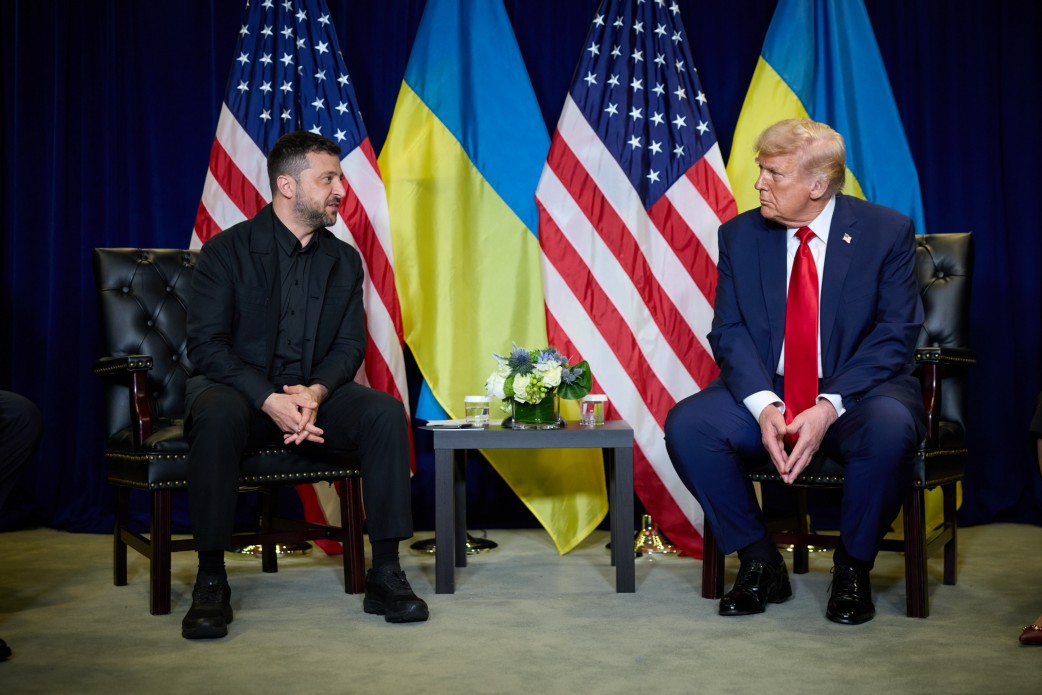
Trump made a very interesting comment during a press conference yesterday (8/26/25) which entirely summarizes the West’s misguided approach to Russia:
Trump is asked on his opinion regarding Lavrov’s statement that Russia could not sign a deal with an illegitimate leader like Zelensky. Trump responds by saying such statements are irrelevant because “everyone is just posturing”, and “it’s all bullshit”.
Trump could not be more wrong that a civilizational state like Russia is merely “posturing” about its existential interests, and understanding this key divergence is essential for grasping the far larger implications of the ideological rift between West and East.
It also explains why observers have been tearing their hair out trying to comprehend why Russia’s consistently clear elucidations of its demands always seemingly fall on deaf ears. Russia issues the exact bullet point reduction of its demands, and the very next day Trump’s various reps and envoys muddle things by claiming they aren’t sure what Russia wants, or that a meeting is needed to further iron things out.
Trump demystifies things by explaining that these weren’t misunderstandings or a US inability to properly listen to Russia’s demands—even worse, these were outright US dismissals of Russian concerns all along. In Trump’s decadent, reality-TV-inspired world view, every global conflict is just another daytime soap opera production you can throw enough money at, ‘rizz’ up its hosts, and things fall into place.
He cannot seem to grasp the existential implications for the parties involved, a theme I recently alluded to:
The world’s a stage for silver-spooned Donnie, and its ‘inconvenient’ conflicts mere sideshows to be quickly dispensed with for the prize of accolades. That is what being uncultured gets you—the inability to understand rooted histories, barring the odd toss-off like “these people have been fighting for thousands of years” that Riviera Don occasionally rattles off about Gaza in pale imitation of erudition.
This is likely the real reason for Putin’s infamously pedantic exegesis on Russian history for Tucker Carlson, to signal to Western audiences that the conflict has much deeper roots and implications than their leaders are willing to admit.
Another implication of Trump’s crude dismissal of Russian legal objections has to do with the same so-called ‘Rules Based Order’ so often pedestaled as the sacred geometry on which the entire Western system rests. Trump callously pulls at the threads of this Order’s very seams by ignoring clearly legitimate concerns about one of the party’s legal standings, again signifying to the world that the ordurous odor coming from this Order is one of fickle arbitrariness and hypocrisy.
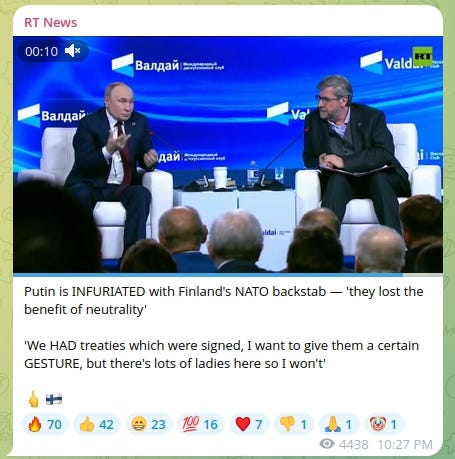
On the occasion of shedding light on this ideological divide between Russia and the West, it is interesting that Putin had just recently again shared his views on the origins of the West’s demonization of Russia. Many have debated this for years, citing Russia’s fraternal involvement with both US and UK in previous centuries and often attributing the ‘fall’ to the pre-WWI, Milner’s Roundtable and Mackinder’s “Heartland” years.
But Putin, for his part, traces the lineage of this schismatic hatred much farther back, to the days of Ivan IV, when he believes Papal representatives sought to convince Russia to shed its Orthodoxy, to no avail. After Ivan IV’s rebukes, Putin says the first inklings of the now-notorious “otherness” began to be applied to Russia, with Ivan deemed to be a mad tyrant and branded ‘the Terrible’.
So, how did we get from Trump’s casual table rants to plumbing historical myths? The underlying continuity can be explained simply: the West does not understand Russia, and does not care to understand it. This comes from an ingrained superiority complex and exceptionalism dating back centuries.
Rhetorical question: How can you resolve a conflict between two parties whose deepest cultural, spiritual, and geopolitical epistemologies you shroud in deliberate obfuscation?….