YouTube link here.
Judge Napolitano Interviews Col. Lawrence Wilkerson : Does The Deep State Control Trump?
YouTube link here.
YouTube link here.
Financial Times, 7/15/25
…The conversation with Zelenskyy on July 4 was precipitated by Trump’s call with Putin a day earlier, which the US president described as “bad”.
Two people familiar with the conversation between Trump and Zelenskyy said the US president had asked his Ukrainian counterpart whether he could hit military targets deep inside Russia if he provided weapons capable of doing so.
“Volodymyr, can you hit Moscow? . . . Can you hit St Petersburg too?” Trump asked on the call, according to the people.
They said Zelenskyy replied: “Absolutely. We can if you give us the weapons.”
Trump signalled his backing for the idea, describing the strategy as intended to “make them [Russians] feel the pain” and force the Kremlin to the negotiating table, according to the two people briefed on the call….
Here is Aaron Mate’s analysis of this report:
According to new reports in the Financial Times and Washington Post, Trump has asked Ukrainian President Volodymyr Zelensky about pressuring Russia by launching strikes deep enough to hit Moscow (The FT account goes further, claiming that Trump “encouraged” those strikes). “We can if you give us the weapons,” Zelensky reportedly told Trump about hitting Moscow. A Western official says that the conversation reflected an intent to give Ukraine long-range missiles capable of “bringing the war to Muscovites.”
These anonymously sourced accounts amount to more hot air. The Trump administration continues to reject Zelensky’s request for powerful Tomahawk missiles, as Biden did as well. That leaves Ukraine with its dwindling arsenal of ATACMs, which were once billed as a “game-changer” only to fall well short. Ukraine briefly ran out of ATACMs earlier this year and has only acquired fewer than 20 replacements since. In April, former Biden National Security Adviser Jake Sullivan admitted that the US gave Ukraine so many of the long-range missiles that it came to a point where “we basically have no more to give.” Moreover, he added, “the idea that they made a major difference operationally in the war has not been borne out by the evidence.”
***
How Trump’s 50-day deadline threat against Putin will backfire
By Jennifer Kavanagh, Responsible Statecraft, 7/15/25
In the first six months of his second term, President Donald Trump has demonstrated his love for three things: deals, tariffs, and ultimatums.
He got to combine these passions during his Oval Office meeting with NATO Secretary General Mark Rutte on Monday. Only moments after the two leaders announced a new plan to get military aid to Ukraine, Trump issued an ominous 50-day deadline for Russian President Vladimir Putin to agree to a ceasefire. “We’re going to be doing secondary tariffs if we don’t have a deal within 50 days,” Trump told the assembled reporters.
The threat is unlikely to change Putin’s calculus, however, or bring the conflict to a near-term conclusion. Instead, Trump’s deadline is likely to make his own life more difficult, limiting his future flexibility, putting the settlement he craves farther out of reach, and forcing him to take steps that harm rather than advance U.S. interests.
Trump’s intention to impose “secondary tariffs” on Russia if Putin does not meet his deadline was not well-explained in his press conference with Rutte. Nor was it immediately clear if the planned punishment for Putin’s continued intransigence would include tariffs on Russian trade with the United States or “secondary sanctions” on Russia’s trading partners — or some combination of the two.
Whatever the details, however, looming economic consequences are unlikely to intimidate Putin or convince him to accept an early ceasefire. For starters, if Trump is indeed talking about tariffs on Russian trade with the United States, then his threat is an empty one. The United States imported only about $3 billion in goods from Russia in 2024, meaning that U.S. tariffs will impose little, if any, new costs on Moscow.
If Trump was instead warning that he would impose secondary sanctions or economic penalties on countries like China, the European Union, and India which purchase Russian oil and other goods, then the potential consequences for Russia are higher — if Trump follows through. A U.S. decision to impose economic penalties on Russia’s trading partners would place at risk the income Moscow relies on to finance its war machine, but it would also create political and economic complications for Washington that undermine the credibility of Trump’s threat and its effectiveness as a tool of coercion.
Not only would such a policy disrupt and set back ongoing U.S. negotiations with important U.S. trade partners and put pressure on the U.S. economy, but in the case of India and Europe, it would force Trump to impose painful economic punishments on crucial security partners. Because of these concerns, the United States has historically enforced secondary sanctions only sporadically and selectively, often targeting adversaries but not allies. The same would likely be true in this case.
Moreover, there is no guarantee that even secondary sanctions would cut off Russian revenues, as Moscow has become skilled as using black market transfers and its “shadow fleet” to circumvent U.S. and European economic pressure.
Most importantly, Putin and the Russian economy have shown tremendous resilience to the economic weapons that the United States and its allies have unleashed so far, and there is no reason to expect this time to be different. In fact, the Russian stock market rose almost three percent after Trump’s announcement, suggesting Russian investors share this assessment. As a result, Putin is unlikely to be fearful of Trump’s economic intimidation or sensitive to even the moderate costs additional U.S. economic warfare might impose.
If Trump’s ability to force Putin to the table using economic sticks is limited, then his military leverage is even smaller. Putin has a clear advantage on the battlefield, and the new aid arrangement in which Europe will buy U.S. weapons to send to Ukraine is unlikely to change this.
What weapons Europe can send quickly — purchased from the United States or taken from their own stocks — will be small in number and limited in type. After over three years of war, neither the United States nor Europe have deep reserves of munitions or other kinds of weapons to provide. More weapons can be purchased off production lines, but they won’t arrive for some time and so won’t do anything to help Ukraine’s soldiers in the near-term.
Moreover, defensive weapons like Patriot systems and interceptors — the focus of much fanfare during today’s big announcement — will help protect Ukrainian civilians but do little to reinforce Ukraine’s already strained front lines.
Putin’s continued strikes on Ukrainian cities and decision to press forward with a summer offensive are evidence of his confidence in Russia’s ability to persist militarily for the foreseeable future. It is unlikely the meager military aid package announced on Monday will change his mind on this score.
Ultimately, Trump’s newest deadline, like those that he has issued before, is unlikely to factor into Putin’s decision-making or to change the trajectory of the war. Putin has staked far too much on the outcome of the conflict in Ukraine to stop fighting before achieving his basic objectives or to settle for an unsatisfactory deal in response to an artificial and U.S.-imposed deadline while he still has the military advantage.
In this way, Russia is like any other wartime combatant, unwilling to sue for peace until it is clear that there are no more benefits to be gained from continued fighting.
Rather than bringing peace closer by forcing Putin the negotiating table, Trump’s threats may make near-term resolution less likely, both by hardening Putin’s resolve and by placing at risk newly opened channels of communication between the United States and Russia. The ultimatum also compromises Trump’s effectiveness as a mediator and constrains the flexibility he will need to successfully broker a deal between Russia and Ukraine.
When 50 days is up and Putin has not agreed to a ceasefire Trump will have an unenviable choice to make: demonstrate fecklessness by backing down or take economic actions that will inflict harm on the United States, alienate close partners, and almost certainly push a near-term end to the war beyond his grasp.
There is one glimmer of hope that Trump and others hoping for peace can hang on to, however. Fifty days is a long time, and will arrive in the early fall, as Russia’s summer offensive winds down and the winter approaches. There could be an appetite for another round of negotiations at this point, especially if Putin feels he has achieved enough militarily and prefers a deal that meets most of his war aims to continued fighting.
This shift would be unrelated to Trump’s new deadline, but U.S. national security officials should be preparing the ground to take advantage of the opportunity all the same. This includes pushing hard for bilateral meetings between the United States and Russia at least at the working level and encouraging more direct negotiations between Russia and Ukraine.
Reaching an end to the war in Ukraine will be a lot harder than issuing ultimatums, but openings for peace could still emerge organically soon. Washington should be ready when they do.
YouTube link here.
YouTube link to excerpt of Putin interview here.
RT, 7/13/25
Western nations’ hegemonic aspirations and dismissal of Russia’s security concerns have led to the ongoing standoff between Moscow and the West, President Vladimir Putin said in an interview released on Sunday. Ideological differences are only a pretext to advance the West’s geopolitical interests, he claimed.
Putin added that he expected the collapse of the USSR to alleviate tensions between Russia and the West.
“I also thought that key disagreements [between us] were ideological in nature,” he stated. “Yet, when the Soviet Union was gone… the dismissive approach to Russia’s strategic interests persisted.”
The president went on to say that his attempts to raise Russia’s concerns with Western leaders were in vain. “The West decided… they do not need to follow the rules when it comes to Russia, which does not have the same power as the USSR.”
All of Moscow’s proposals regarding mutual security, strengthening international stability, and reaching agreements on offensive weapons and missile defense were rejected, Putin said. “It was not just negligence. It was based on a clear desire to reach some geopolitical goals.”
“It has become clear that, unless Russia positions itself as an independent sovereign nation… we will not be reckoned with,” he added.
The Russian president has accused Western nations of betraying Russia and not fulfilling their promises. Last month, he said Moscow was “blatantly lied to” about NATO expansion for decades as the US-led military bloc approached Russia’s borders.
“Everything was good as long as it was against Russia,” he said at the time, adding that Western nations have supported separatism and even terrorism directed against the country.
Moscow has listed Kiev’s NATO ambitions and Western military assistance to Ukraine key reasons behind the Ukraine conflict. Prior to the escalation in early 2022, Russia sought to address its security concerns by seeking guarantees from US and NATO, as well as non-aligned status for Ukraine, which were rejected by the West.
By Simplicius, Substack, 7/11/25
The topic of casualties is one we periodically revisit when necessary. Now is such a time, as Marco Rubio has made the absurd claim—coordinated with MSM outlets—that the Russian Army has suffered a whopping 100,000 deaths just since January of this year alone; purely deaths, not even total casualties:
This was immediately backed up by new articles, like the following from the Economist, which likewise claims Russia is experiencing its deadliest year on the front yet, with 30,000+ deaths just in the past couple months alone:

The above article is a particularly egregious example. Just take a look at their methodology, or lack thereof. This small extract constitutes the entirety of their ‘scientific’ premise for Russian losses:
There is no official tally of losses on either side. But our daily war tracker offers some clues. Our satellite data and shifts to areas of control suggest when the fighting is intensifying. This lines up well with more than 200 credible estimates of casualties from Western governments and independent researchers. By combining this data we can, for the first time, provide a credible daily death toll—or an estimate of estimates.
In short, they claim their satellite data alerts them to where fighting happens to ‘intensify’, and from that they—by some incredible leap of logic—infer that Russian forces are experiencing massive losses. The baffling part is that this facile methodology should apply to the AFU in parallel as well, yet when it comes to Ukraine’s losses, the Economist’s staff are without even a hint of curiosity:

Read that again: satellite data showing “intense fighting” inherently points to Russian losses merely on the assumption that any fighting, as a general rule, results in Russian but not Ukrainian losses. This is an astoundingly juvenile, biased, and to be frank, fraudulent, level of analysis.
Recall this previous revelation, which tells us everything about the West’s info-hygiene:

These publications claim to have such ‘sensitive’ attunements to the battlefield fluctuations as to give exact Russian figures, but when it comes to Ukraine, they are suddenly lacking data.
The fact is, there’s a reason why MediaZona very abruptly changed up their methodology to include “projected” deaths rather than real counted ones, as done previously—because contrary to this coordinated propaganda campaign, Russian losses have actually been at the lowest in a long time. This is precisely the reason such an orchestrated campaign was necessary: Ukraine is badly losing, and the only remaining aspect of the war the propagandists could feasibly utilize to try and spin the narrative are the casualty figures, because they are typically the most ‘subjective’ and ambiguous in nature—which makes them perfect fodder for devious manipulation.
Presently, MediaZona has the total Russian death toll at ~117k as of early July:
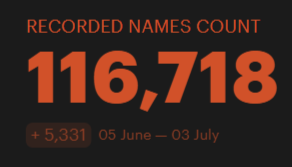
If you highlight only January 1st to present, you get 9,849 confirmed deaths:

You can do this yourself at the official site to confirm.
That means through the first six months of this year, they have registered a mere 9,849 Russian deaths, which amounts to 1,641 per month. Western and Ukrainian publications, on the other hand, claim Russia is suffering that many deaths per day. The discrepancy shows an unprecedented detachment from reality.
We do know MediaZona has a ‘lag’ because it takes time to confirm most recent deaths, and so the number will likely rise, but probably not by an inordinate amount. There is no evidence whatsoever that Russia is taking anywhere near the kinds of losses the West claims. In fact, someone made a good point: since it is Ukraine that purports that 70-90% of their kills on Russian soldiers come by way of drones, they should be able to show all these vast amounts of losses via drone camera recordings; yet there is nothing—and we know the AFU loves nothing more than showing off its ‘successes’.
In an article two months ago, I had highlighted the timeline of the Russian Army’s growth from Ukraine’s own sources. It went as follows:
And what do we have now, at the midpoint of 2025? Straight from Zelensky’s own mouth:

So, to reiterate and simplify:
400k troops in 2023, 500k in 2024, 600k in early 2025, and already 700k in mid-2025.
This is all from Ukrainian sources, the originals of which you can find in my previous article here.
How can Russia possibly be suffering a claimed 100,000 dead in just six months—as per Rubio—when it is literally gaining over 100,000 per year?

In order for Russia to suffer 100k deaths in six months—annualized to 200k per year—and still gain 100k+ men per year, Russian recruitment would have to be staggering, given the contract churn we outlined previously. Hard to imagine people willingly signing up under the dark cloud of such losses, while in Ukraine—suffering “far fewer casualties”—people have to be forcibly kidnapped from the streets and herded into vans like cattle.
Strange how it’s Ukrainian cemeteries that continue to infamously fill up, rather than Russian ones, and how the past year’s ratio of dead body exchanges has jumped to such an astronomical disparity as to be off the charts:
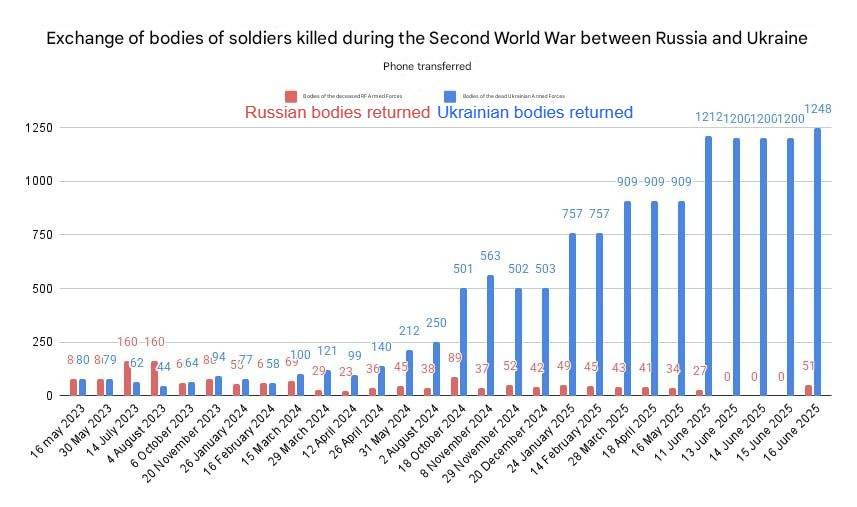
Any honest journalist would pucker at such incongruities in the data—but alas, that species is about as common as a three-legged emu.
As a recent glimpse into Russian losses during active assaults, here is one honest post from Russian military sources about a settlement that was captured. They write that they suffered four “200s” during the operation:

There are many such assaults per day, so you can multiply the four by the daily amount to get a reasonable count—but it certainly isn’t hundreds, much less thousands.
—
Neue Zürcher Zeitung has a new piece which spells out that Ukraine only has two options to prevent collapse:
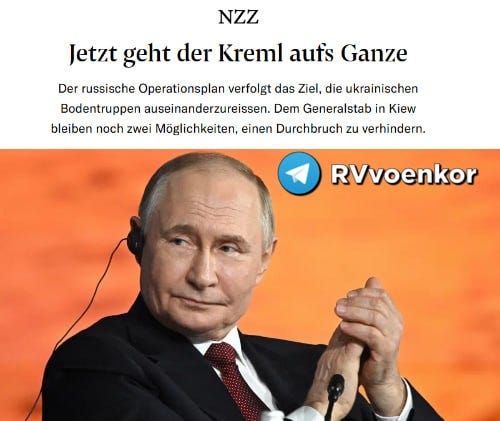
Now the Kremlin is going all out.
The Russian operational plan aims to tear apart the Ukrainian ground forces. The general staff in Kiev still has two options to prevent a breakthrough.
They begin by aptly noting that Putin spelled out the strategy himself at a recent forum:
“They already have too few personnel,” Putin went on to analyze, “and they are withdrawing their forces there, which are already lacking in the decisive theaters of armed conflict.” Putin is making little effort to conceal his operational intentions: the Russian General Staff wants to tear the Ukrainian army apart – and then attempt a breakthrough at a suitable point.
Then they reveal the two options Ukraine faces, which I’ll annotate:
Sirski, on the other hand, still has two basic options for saving Ukraine from a military defeat in the current situation:
1.Delay: The aim is to lose as little ground as possible during the Russian summer offensive and to avoid encirclement of larger troop units. In the fall, the front could then be consolidated and a starting point for negotiations created. At present, Kiev appears to be pursuing this course – in the hope that the USA will resume its military aid.
Here, they admit that Ukraine’s best chance is merely to stall until “negotiations” can be effected; but we know Russia has zero incentive for such a thing, unless you kowtow to the fake figures of Russian losses and believe Russia is “on its last leg”, as per Strelkov and the rest of the doomer clan.
Their second option is to withdraw to the new defensive line reportedly being constructed a few dozen kilometers behind the current LOC:
2. operational withdrawal: The Ukrainian ground forces could gradually withdraw from the front and take up new positions protected by natural and artificial obstacles. The aim is to prevent a capitulation and to maintain the army to protect sovereignty even in the event of an unfavorable outcome to the negotiations. One indication that this option is being examined is the construction of a Ukrainian fortification line 20 kilometers behind the front from the Kharkiv area to Zaporizhia in the southwest of Ukraine.
There are not enough forces for a surprise anywhere along the front, and the pinpricks in the depths of the Russian area will hardly have any effect except in the information area. The Ukrainians lack fighter aircraft such as the F-35 to gain at least partial air superiority. In addition, ammunition for the Himars missile artillery, the Taurus guided missiles, supplies for air defense – the list is well known in Western capitals.
Europe has gone on summer vacation and Trump is at least considering sending defensive weapons to Ukraine again. But the risk of a Russian breakthrough is growing. If a gap opens up somewhere, the occupying forces can suddenly maneuver and use the bridgeheads at Sumi and Kharkiv for large-scale operations. Sirski then gradually ran out of options.
However, the decision to switch from delay to operational withdrawal in good time does not lie with the head of the army, but with President Volodimir Zelensky in Kiev and his dilemma: between military necessity and the political principle of hoping that the Western allies will stand by their big words after all. Meanwhile, the Kremlin is going all out – politically and militarily.
But what would that do? Just like the inherent nonsensical nature of the first option, the second would hardly give Russia pause. We know Ukraine relies on PR to maintain continuity and casualty figures are one facet of this which can be deftly hidden, while territorial changes cannot. This means the organ grinder-in-chief Zelensky would prefer to quietly keep composting thousands of his men while feigning ‘strong resistance’ and pretending that Russia is ‘making no gains’. If a sudden large-scale breakthrough swallowed up a chunk of Ukrainian territory, Western support would likely collapse over night as Ukraine would be deemed a dead case.
—
Lastly, in anticipation of Trump’s supposed “big announcement” on Monday, several MSM publications are reporting that Trump is preparing to launch an unprecedented global oil embargo against Russia:
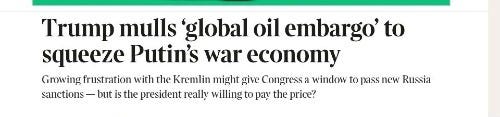
It describes a fancifully unrealistic plan to shackle any country in the world that buys oil or uranium from Russia with a massive 500% tariff. The chances of this passing are laughable, as it would destroy the economies of the US and its allies, rather than harming Russia.
The squabbles over ‘control’ discussed last time rear their head again:
Senators have said they would be willing to grant Trump the power to waive the tariff for up to 180 days, provided there was congressional oversight. The White House is, however, insisting that Congress should have no power to intervene if the president decided to end the sanctions.
Maximilian Hess, a fellow in the Foreign Policy Research Institute, predicted Trump would baulk at the 500 per cent tariff in the bill, which would be equivalent to a global embargo on Russian oil.
Hess elaborates:
“As it’s written, in my view it’s just too strong to ever be used, unless Trump gets out there and says, ‘We need to face the risk that Russia poses to Europe and the globe and we have to accept oil prices of closer to $100 or maybe even higher’,” he said. “Which I just cannot see Trump doing.”
The reason Trump wants such control is because he’s merely using the threat of these laughable ‘sanctions’ to try and frighten Putin into concessions, and wants the ability to immediately pull out, TACO-style, as soon as it backfires. The neocon segment of Congress—Graham, Blumenthal, and co.—want to deviously ‘bake in’ the sanctions by having power over them, so that Trump is forced into a major confrontation with Russia; obviously, the freewheeling deep state moles in Congress cannot allow a US-Russian rapprochement and need to create fissures at all costs.
It is also why they recently ‘leaked’ the audio of his threats to bomb Moscow at an opportune time: they’re doing everything in their power to stir the pot and fan the flames of the narrative of confrontation to browbeat Trump into escalation against Moscow.
The big question is, does Trump have the backbone to stay the course?
—
Lastly:
Ukraine reports Russia has accumulated a record number of missiles—2,000 total:
Even as we speak, another major strike on Ukraine reportedly featuring hundreds of drones and a few dozen missiles is ongoing—all unopposed, as usual:
How are those Patriots coming along?